

Only you, Lord,
are a mighty rock!
Don’t refuse to help me
when I pray.
If you don’t answer me,
I will soon be dead.
Please listen to my prayer
and my cry for help,
as I lift my hands
toward your holy temple.
Don’t drag me away, Lord,
with those cruel people,
who speak kind words,
while planning trouble.
Treat them as they deserve!
Punish them for their sins.
They don’t pay any attention
to your wonderful deeds.
Now you will destroy them
and leave them in ruin.
I praise you, Lord,
for answering my prayers.
You are my strong shield,
and I trust you completely.
You have helped me,
and I will celebrate
and thank you in song.
You give strength
to your people, Lord,
and you save and protect
your chosen ones.
Come save us and bless us.
Be our shepherd and always
carry us in your arms. (Contemporary English Version)
Today’s Psalm, in the Revised Common Lectionary, is alongside the Old Testament story of Joseph and his brothers in the book of Genesis. While out caring for the vast flocks of sheep and goats, Joseph’s brothers hatched a cabal against their younger sibling. They tossed him into an empty cistern (a deep water well) and intended to leave him for dead.

But when a caravan came along, heading to Egypt, the brothers decided on yet another diabolical plan. So, they brought Joseph out of the cistern and sold him into slavery. And, if that weren’t enough, the hateful brothers kept rolling out the devious scheming by making it look like a wild animal killed Joseph, so that they could hide their shameful guilt from Jacob, their father.
So, we are invited to view the psalm from Joseph’s perspective of frustration and agony, crying out to God. Then, praising the Lord for listening and saving his life – even if it meant becoming a servant in a foreign country.
Although becoming a slave was certainly not an ideal situation, Joseph faced a desperate need, even death, and the Lord saved him from it. And Joseph was encouraged and emboldened by the reality that God was with him, no matter where, nor what the situation.
Joseph, along with the original craftsman of the psalm, David, gave praise to God for hearing their prayers. Whereas we may get lost in anger and want retribution, perhaps our orientation is best directed toward offering praise to God for being with us and saving us from certain death.
This raises several questions, at least for me, about being in situations where I experience being heard by God, protected from ultimate harm, yet still left between a-rock-and-hard-place:
- Can I praise God just for being heard and listened to?
- Do I really need to be healed or delivered? Or do I actually need to be delivered from the need for deliverance?
- What if I don’t get everything I pray for? Am I expecting to receive something God never promised?
- Will I offer praise and thanksgiving, even if God is silent?
- Is my joy in a relationship with God either conditional, or unconditional?
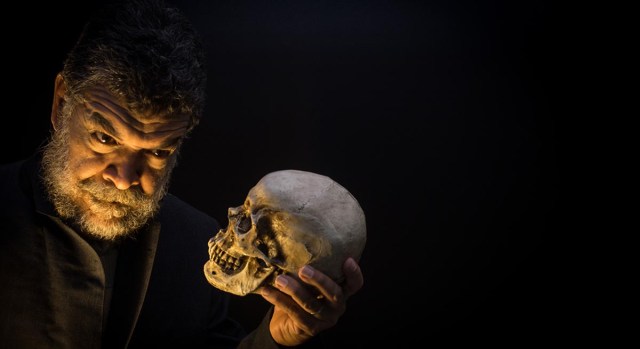
William Shakespeare’s Hamlet (c.1601 C.E.) put the question this way: “To be, or not to be, that is the question.” Hamlet’s soliloquy went on to say:
“Whether ’tis nobler in the mind to suffer
The slings and arrows of outrageous fortune,
Or to take arms against a sea of troubles,
And by opposing end them? To die: to sleep;
No more; and by a sleep to say we end
The heartache and the thousand natural shocks
That flesh is heir to, ’tis a consummation
Devoutly to be wish’d. To die, to sleep;
To sleep: perchance, to dream: ay, there’s the rub;
For in that sleep of death what dreams may come
When we have shuffled off this mortal coil,
Must give us pause: there’s the respect
That makes calamity of so long life;
For who would bear the whips and scorns of time,
The oppressor’s wrong, the proud man’s contumely,
The pangs of despised love, the law’s delay,
The insolence of office and the spurns
That patient merit of the unworthy takes,
When he himself might his quietus make
With a bare bodkin [knitting needle]?”
Like Joseph left for dead in an empty cistern, Hamlet was miserable and burdened with a profound lack of power to change his circumstances. So, he reflected on life and death in a morbid and melancholy way. It’s not that Hamlet had suicidal ideation, as much as he meditated on what life truly is, and tried to find some meaning within it.
Unlike Joseph, Hamlet cannot find the courage to deal with his frustration and feels stymied with fear of the unknown. He became lost in the injustice of it all.
If we are blatantly honest with ourselves, we much too often have a particular outcome in mind that we want or expect God to do.
Our hopes become tethered to God doing something extremely specific so that, if it does not come to pass, or does not come quickly, or doesn’t happen as we want, then discouragement, disillusionment, and even depression may settle down in our souls like a lead weight.
Like Hamlet, we become lost in the shadows of our thinking and ponder some sort of escape.
So, here is another set of questions I am asking myself:
- If my adverse circumstances do not change, can I praise God anyway?
- Can I, like David, take joy in simply being heard?
- Can I find gratitude in all situations?
- Do I only express thanks and praise to God when things are going my way?
- Am I open to whatever God wants to do in my life, even if it is not what I would choose?
- Do I feel that I am above having to put up with the wickedness of this world?
- Am I expecting heaven on earth, or am I willing to suffer as Jesus did?
I honestly believe the answers to those questions will largely determine the trajectory of our spiritual development, our emotional maturity, our mental thoughts, and our overall religious experience.
I praise you, O God, in the good and the bad, the easy and the difficult, the failures and the victories. You are Lord over all things. You are my strength and shield in every circumstance. When I am weak, then I am strong. I can do all things through Christ who strengthens me. Amen.

 Rev. Tim Ehrhardt