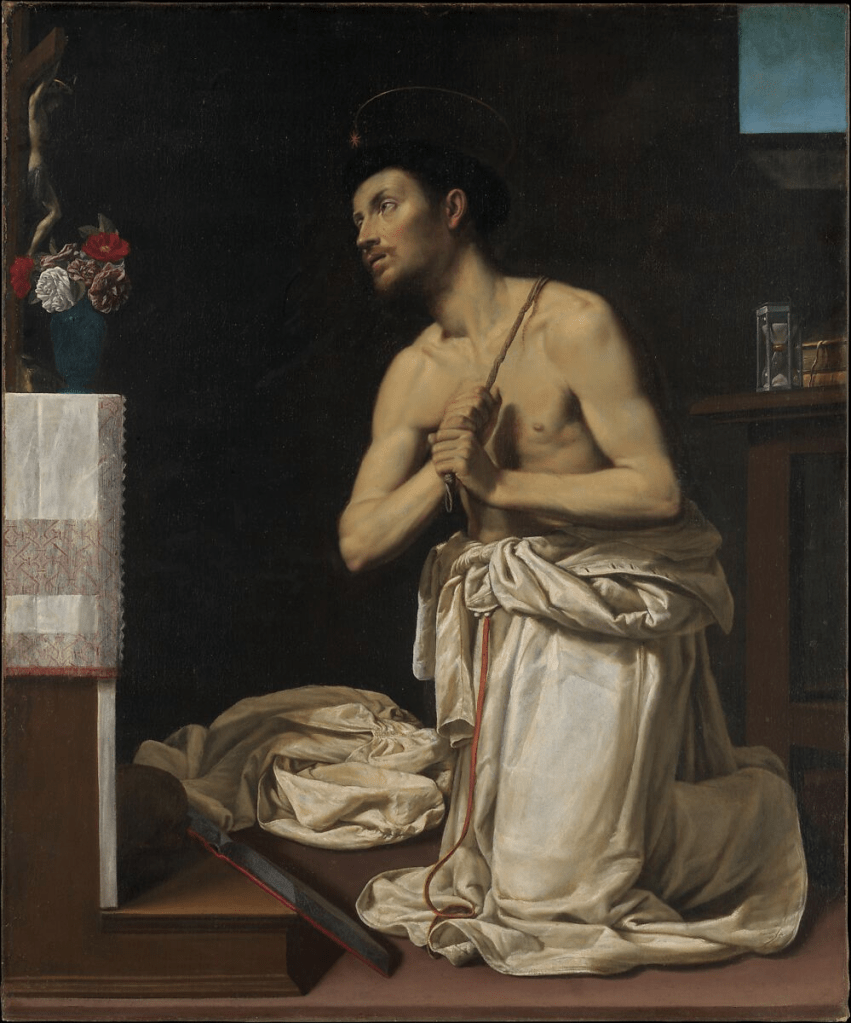
The Penitent Soul Changes the World (Hosea 5:15-6:6)

Saint Dominic in Penitence, by Filippo Tarchiani, c.1607

I will return again to my place
    until they acknowledge their guilt and seek my face.
    In their distress they will beg my favor:

“Come, let us return to the Lord,
    for it is he who has torn, and he will heal us;
    he has struck down, and he will bind us up.
After two days he will revive us;
    on the third day he will raise us up,
    that we may live before him.
Let us know, let us press on to know the Lord;
    his appearing is as sure as the dawn;
he will come to us like the showers,
    like the spring rains that water the earth.”

What shall I do with you, O Ephraim?
    What shall I do with you, O Judah?
Your love is like a morning cloud,
    like the dew that goes away early.
Therefore I have hewn them by the prophets;
    I have killed them by the words of my mouth,
    and my judgment goes forth as the light.
For I desire steadfast love and not sacrifice,
    the knowledge of God rather than burnt offerings. (New Revised Standard Version Update Edition)

We are meant for righteousness, not wickedness. So, whenever we fail to do what is right, we will suffer pain. This is because wicked attitudes, words, and behavior go against how we were designed and created as humans.

There are times when we all transgress what is right by either doing outright wrong, or by failing to do what is good, right, and just when we have the opportunity to do so. Therefore, repentance is vital and necessary. That is, to practice something that seems to be lost in our contemporary language: penitence.

Penitence simply means to have regret over wrongdoing. When we are penitent, we seek to repent (turn from what is wrong and do what is right). God has no interest in those who offer the forms of repentance without any penitence. That’s why God told the ancient Israelites that love and knowledge are what’s important, more than sacrifices and offerings.

What’s more, penitence is necessary for spiritual maturation and growth. The penitent soul finds that one’s faults and wrongs can be transformed into assets – such is the power of God through one’s penitent repentance.

And even more, the individual who experiences penitence and repents of wrongdoing, is forgiven, leading the whole world to be forgiven along with them.

Just one penitent and repentant person will intercede and confess the sins of the world; and that can change everything. So, imagine when a community of forgiven persons are motivated to bring about humanity’s greatness and nobility through penitent prayer.

I want you to think this thought: Any sort of moral misdeed committed by an individual weakens the soul of the entire community, and indeed, all the world.

Every attitude and action has a consequence, whether good or bad. Penitence, repentance, and forgiveness are the mandatory practices to restoring and renewing a life-giving dynamic to everyone.

Thus, penitence brings healing to the world; the individual who repents is forgiven; and the whole world is forgiven with him.

The powers of evil want to keep us ignorant of such things – which is why knowledge of God is so very important. Ignorance inevitably leads to sin and to the construction of a false self, which then encrusts itself upon the soul.

Penitence and repentance remain as lights deep within a person, even if they are buried beneath all sorts of arrogance and bravado of the ego.

Change of our world and transformation of our lives will not come apart from a vigorous and popular education of God and God’s Word. With so much ignorance all around us, it is imperative that individuals and communities become familiar with how spiritual realities work.

Although it appears that sinister darkness is spreading across the world and into the depths of humanity, the hope and promise of light discerns that evil can and will be overcome.

Penitence is the key to the healing presence this world needs.

For those who have experienced the renewal and reformation of a forgiven life, the steadfast love of God’s grace is very much needed for those still stuck in the mud of wickedness.

In truth, the meanness of a person betrays how much anguish of soul they are actually experiencing. Their estrangement of God is such that they are in great spiritual pain.

So, every situation designed by God to evoke penitence and repentance within such a mean person leads not only to a struggle in the soul, but also to outward conflicts with others in the forms of bullying, arrogance, and hardness of heart.

Not only do we suffer because of another’s grotesque sin, so does God. The pain of the wicked person unfortunately works to bring others pain, including God.

The Lord observed the extent of human wickedness on the earth, and he saw that everything they thought or imagined was consistently and totally evil. So the Lord was sorry he had ever made them and put them on the earth. It broke his heart. (Genesis 6:5-6, NLT)

Both humanity and God are in anguish when the dark powers take hold within an individual, and in the community.

We must have the grace to bear with others and hold our ground, giving the Spirit of God time to bring about penitence and repentance. For our part, continual learning of divine things and a commitment to steadfast love becomes the hands and feet of our prayers.

When one suffers, we all suffer, because there is an inextricable connection between all people.

Regret, remorse, and sorrow over wrongdoing are the prerequisites for goodness to become ensconced in the world. Penitence serves both the individual and the community, preventing any poisonous root of bitterness to grow up and corrupt many people.

See to it that no one falls short of the grace of God and that no bitter root grows up to cause trouble and defile many. (Hebrews 12:15, NIV)

God and humanity are meant to be united. And the Lord will create whatever conditions are necessary for divisions to be healed, and for people to love one another and love God will all their hearts, souls, minds, and energy.

Almighty God, my heavenly Father: I have sinned against you, through my own fault, in thought, and word, and deed, and in what I have left undone. For the sake of your Son our Lord Jesus Christ, forgive me all my offenses; and grant that I may serve you in newness of life, to the glory of your Name. Amen.

Waiting Patiently For God (Psalm 40:1-11)

I waited patiently for the Lord;
    he inclined to me and heard my cry.
He drew me up from the desolate pit,
    out of the miry bog,
and set my feet upon a rock,
    making my steps secure.
He put a new song in my mouth,
    a song of praise to our God.
Many will see and fear
    and put their trust in the Lord.

Happy are those who make
    the Lord their trust,
who do not turn to the proud,
    to those who go astray after false gods.
You have multiplied, O Lord my God,
    your wondrous deeds and your thoughts toward us;
    none can compare with you.
Were I to proclaim and tell of them,
    they would be more than can be counted.

Sacrifice and offering you do not desire,
    but you have given me an open ear.
Burnt offering and sin offering
    you have not required.
Then I said, “Here I am;
    in the scroll of the book it is written of me.
I delight to do your will, O my God;
    your law is within my heart.”

I have told the glad news of deliverance
    in the great congregation;
see, I have not restrained my lips,
    as you know, O Lord.
I have not hidden your saving help within my heart;
    I have spoken of your faithfulness and your salvation;
I have not concealed your steadfast love and your faithfulness
    from the great congregation.

Do not, O Lord, withhold
    your mercy from me;
let your steadfast love and your faithfulness
    keep me safe forever. (New Revised Standard Version)

Some of the greatest gifts any of us could ever receive are God’s steadfast love, faithfulness, and mercy. These are no problem for the Lord to bestow, because they are all a part of God’s very character.

Since, according to Holy Scripture, people are created in the image and likeness of God, every single one of us contains a divine reflection of faith, love, and mercy inside our very souls.

So, why aren’t these gifts and character virtues more evident in humanity?

Why does it seem to so many that love, faith, and mercy are in short supply today?

I believe today’s psalm gives us a clue to the answer. Virtuous character only really arises out of us through the practices of patience and gratitude. Another way of looking at this is: Our waiting and our thanksgiving help us become aware and in-touch with love, faith, and mercy.

Waiting Patiently

The Psalter is replete with encouragements to wait. The ability to be patient is connected to our character’s integrity.

May integrity and uprightness preserve me,
    for I wait for you. (Psalm 25:21, NRSV)

Our patience is an expression of our trust and reliance upon God.

Wait for the Lord;
    be strong, and let your heart take courage;
    wait for the Lord! (Psalm 27:14, NRSV)

Throughout the psalms, faithful and patient waiting leads to God’s deliverance.

Wait for the Lord and keep to his way,
    and he will exalt you to inherit the land;
    you will look on the destruction of the wicked. (Psalm 37:34, NRSV)

We can wait because we have the hope that God is good for promises given.

And now, O Lord, what do I wait for?
    My hope is in you. (Psalm 39:7, NRSV)

It would be great if love and mercy were always right there, embedded clearly within every human community, family, group of people, and nation. But, as you well know, virtuous character is not always there for us.

This is why there are times in life in which we must wait for others’ love and faithfulness. We can do that through active patience, that is, by purposely loving others and being committed to them despite their unloving and uncommitted behaviors.

I’m not saying this is easy. In fact, it is downright hard. Yet, our persevering patience, expressed in mercy, will eventually win the day. What’s more, the Lord Jesus made it plain that we are to love others whether they are nice to us, or mean to us. (Matthew 5:43-48)

Giving Praise and Thanks

When God gives us deliverance from whatever or whomever is oppressing us, a new song arises in our hearts. The song declares and testifies to God’s goodness toward us. A song provides witness to our experience of God’s steadfast love, faithfulness, and divine mercy. Through singing, we show others the path toward deliverance.

O sing to the Lord a new song;
    sing to the Lord, all the earth.
Sing to the Lord; bless his name;
    tell of his salvation from day to day.
Declare his glory among the nations,
    his marvelous works among all the peoples. (Psalm 96:1-3, NRSV)

I admit that there are many times I don’t feel like singing. Yet, even using my voice to sing a lament is a way of expressing thanks to God for being present with me in my grief, and for what God will do in my life.

For he will hide me in his shelter
    in the day of trouble;
he will conceal me under the cover of his tent;
    he will set me high on a rock.

Now my head is lifted up
    above my enemies all around me,
and I will offer in his tent
    sacrifices with shouts of joy;
I will sing and make melody to the Lord.

Hear, O Lord, when I cry aloud;
    be gracious to me and answer me! (Psalm 27:5-7, NRSV)

Monetary sacrificial giving and offering is needed, yet this is not so much what God truly desires from us. God delights in our delight to do God’s will. So then, our sacrifice can look more like the exhortation of the Apostle Paul in the New Testament:

Therefore, I urge you, brothers and sisters, in view of God’s mercy, to offer your bodies as a living sacrifice, holy and pleasing to God—this is your true and proper worship. 

Do not conform to the pattern of this world, but be transformed by the renewing of your mind. Then you will be able to test and approve what God’s will is—his good, pleasing and perfect will. (Romans 12:1-2, NIV)

Petitioning God For Mercy

In today’s psalm, the psalmist makes a shift from offering thanks to asking God for mercy. Mercy in the form of God’s steadfast love and faithfulness is what the psalmist needed. And it is likely what you and I need, as well.

Any sort of deliverance we experience in this mortal life seems to have a temporary element to it. There is really no final deliverance until Jesus returns to judge the living and the dead. In the meantime, we need a lot of mercy.

I don’t know if you have ever had that feeling of deliverance from a slimy pit, and having your feet set on firm solid ground. Thankfully, I have.

My own deliverance(s) were never experienced because of any superior character on my part. No, deliverance is realized through asking. And asking requires some humility which admits need, and knows how much we cannot simply save ourselves from trouble.

But we must brace ourselves for the reality that we might do a lot asking over a seemingly long period of time. It’s one thing to ask; it’s another to keep asking day in and day out, week after week, month after month, even year after year, or decade after decade.

Yet this is the nature of patient waiting. There is no deliverance apart from perseverance in prayer. I’m not talking about a vain repetition of trying to get God’s attention – that’s because you and I already have it. I’m talking about the reality that we ourselves are not in control of anything except ourselves. And even our own self-control doesn’t often go so well.

A song of thanksgiving to God always understands that there will be ongoing trouble in this old world; and a continual need for deliverance.

I humbly ask that you join me in getting on your knees every day and asking for deliverance from the injustice and unrighteousness of our current world and national troubles. They are legion.

It isn’t easy watching friends live in fear, and neighbors becoming victims of oppression and abuse. But here we are, all of us in need of seeing God’s kingdom come to earth and God’s will be done on this planet, as it is always done in God’s heaven.

Soli Deo Gloria

May it be so, to the glory of God.

Pray with Persistence (Luke 11:1-13)

He [Jesus] was praying in a certain place, and after he had finished, one of his disciples said to him, “Lord, teach us to pray, as John taught his disciples.” So he said to them, “When you pray, say:

Father, may your name be revered as holy.
    May your kingdom come.
    Give us each day our daily bread.
    And forgive us our sins,
        for we ourselves forgive everyone indebted to us.
    And do not bring us to the time of trial.”

And he said to them, “Suppose one of you has a friend, and you go to him at midnight and say to him, ‘Friend, lend me three loaves of bread, for a friend of mine has arrived, and I have nothing to set before him.’ And he answers from within, ‘Do not bother me; the door has already been locked, and my children are with me in bed; I cannot get up and give you anything.’ I tell you, even though he will not get up and give him anything out of friendship, at least because of his persistence he will get up and give him whatever he needs.

“So I say to you, Ask, and it will be given to you; search, and you will find; knock, and the door will be opened for you. For everyone who asks receives, and everyone who searches finds, and for everyone who knocks, the door will be opened. Is there anyone among you who, if your child asked for a fish, would give a snake instead of a fish? Or if the child asked for an egg, would give a scorpion? If you, then, who are evil, know how to give good gifts to your children, how much more will the heavenly Father give the Holy Spirit to those who ask him!” (New Revised Standard Version)

If we desire to see the power of prayer become a reality in our lives, we will have to avoid drive-by prayers in favor of sustained and focused prayers taught to us from the Lord Jesus.

Prayer empowered Jesus in his earthly ministry. His disciples saw this, and wanted it, too. So, Christ encouraged them in what to pray, and to keep persistently praying, despite the circumstances.

We are instructed by Jesus to approach the heavenly Father just as he himself did – in a straightforward and intimate manner. The content of our prayers ought to encompass the following five petitions:

  • Let God’s name be made holy. In other words, we are to let the Lord’s name be seen by others as holy within us in our daily lives. This is a petition for God to establish divine sovereignty and holiness in the heart of the believer. When this happens, the name of God is exalted and set apart as holy before a watching world.
  • Let God’s kingdom come. This is a prayer that asks for the reign of God to extend over the entire earth in a very practical way – to have God’s rule draw near to everyone and everything, including ourselves.
  • Let us have our daily bread. That is, pray that God will give us everything we need for life and godliness in this present evil age, including physical sustenance, mental acuity, emotional intelligence, and spiritual food. None of us lives by bread alone, but by every word that proceeds from the mouth of God.
  • Let forgiveness come. Sin is a reality. Therefore, every one of us needs forgiveness; and everyone needs to forgive others. Forgiveness is powerful; it releases us to freedom. And thus, we have the power to release others through the act of forgiving the egregious sins of others. The failure to do this is why the kingdom of God is so disestablished in this world.
  • Let us not become victims of the cosmic conflict. There is a continual struggle of unseen powers on this earth that no human is armed to deal with. Apart from God’s intervention, humanity gets caught in the crosshairs of the conflict. We are to pray that this trial does not overcome us.

These prayers are to be consistently and persistently prayed every day. Christ wants us to keep asking, seeking, and knocking.

Jesus, in his teaching ministry on earth, often used the lesser-to-greater argument in getting his point across. And that is precisely what he was doing with his disciples in today’s Gospel lesson by instructing them about the nature and motivation of prayer.

The lesser-to-greater argument implies a comparison of values. It’s grounded on a common sense and logical convention that if this lesser thing is true, then, of course, how much more is this greater thing!

If something less likely to happen is true, then something more likely to happen will probably be true as well. The technical phrase for this is an argument a fortiori – a Latin term meaning, “for a still stronger reason.”

Jesus wanted his followers to understand that prayer has value because God is a loving Father, not a begrudging friend. Whereas the friend in the story was badgered just so the person could get some real necessities, God needs no badgering to generously give good gifts that may or may not be considered as necessities by us.

Jesus desired to highlight that prayer has veracity because of whom those prayers are directed.

In the ancient world, it was common understanding you needed to get the local gods attention if you wanted something. Which is why, for example, in the prophet Elijah’s showdown with the prophets of Baal, that Baal’s worshipers were yelling, gesticulating, and even cutting themselves for hours. They fully expected to put a lot of work into getting Baal’s attention, maybe even needing to convince him of intervening in their ancient version of a wild West shootout.

In contrast to four-hundred prophets of Baal, a single prophet of the Lord utters one simple prayer, then fire comes rushing down from heaven. Much like the person who badgered the friend for bread, the prophets pestered Baal for hours. (1 Kings 18)

In Christ’s story, it all comes down to who really cares. The friend? Not enough to jump out of bed right away and meet a need. Baal? Not so much. God? Now we’re talking.

We typically don’t ask, seek, or knock, if we believe we will not get a response – or if it will take a lot of energy, time, and effort we don’t have. Yet, if we are confident of being heard and our requests taken seriously with care, then we are likely to have a habit of asking, seeking, and knocking.

If a friend begrudgingly gives to you because of persistent knocking, how much more will God graciously, generously, and with gaiety give you goodness when you ask?

Because God is good, God gives. The largess of the Lord is willing and ready to dispense grace from an infinite storehouse of mercy.

This is why Jesus encouraged people to not pray like those who don’t know God, babbling on because they think they’ll be heard because of the sheer volume of words. (Matthew 6:7-8)

Two misconceptions of prayer existed in Christ’s day (and today); they come from non-Christian sources:

  1. There must be a lot of prayer before prayer “works.” Although I believe repetition is important for forming good habits, praying the same prayers over and over again so as to be heard betrays an ignorance of God, not to mention an actual lack of faith. Many ancient religions were based in learning how to manipulate the spiritual forces out there to get what we need. It’s kind of like a divine version of hustling for love in all the wrong places. Christians need to know they don’t need to have thousands of people praying in order to get God’s attention to answer prayer.
  2. I must convince God of the need to answer my prayer. God is not a reluctant listener. The reason the Lord already knows what we need before we ask is because God has been paying close attention to us well before we got around to asking, seeking, and knocking on the divine door. God’s ear is already inclined to hear us – expectantly and anxiously awaiting our petitions. This is a tremendously freeing idea, that I can come to God openly and honestly, without drudgery, and without wondering if I am heard, or not.

May we be encouraged to pray, to truly connect with God, because the Lord is available without appointment, and is waiting for us to ask with bended ear.

Eternal God, by whose power we are created and by whose love we are redeemed: Guide and strengthen us by your Spirit so that we may give ourselves to your service and live today and every day in love to one another and to you, through Jesus Christ our Lord, in the strength of the Holy Spirit. Amen.

I Will Yet Again Praise God (Psalms 42 & 43)

Solitude, by Winslow Homer, 1889

As a deer longs for flowing streams,
    so my soul longs for you, O God.
My soul thirsts for God,
    for the living God.
When shall I come and behold
    the face of God?
My tears have been my food
    day and night,
while people say to me continually,
    “Where is your God?”

These things I remember,
    as I pour out my soul:
how I went with the throng
    and led them in procession to the house of God,
with glad shouts and songs of thanksgiving,
    a multitude keeping festival.
Why are you cast down, O my soul,
    and why are you disquieted within me?
Hope in God, for I shall again praise him,
my help and my God.

My soul is cast down within me;
    therefore I remember you
from the land of Jordan and of Hermon,
    from Mount Mizar.
Deep calls to deep
    at the thunder of your torrents;
all your waves and your billows
    have gone over me.
By day the Lord commands his steadfast love,
    and at night his song is with me,
    a prayer to the God of my life.

I say to God, my rock,
    “Why have you forgotten me?
Why must I walk about mournfully
    because the enemy oppresses me?”
As with a deadly wound in my body,
    my adversaries taunt me,
while they say to me continually,
    “Where is your God?”

Why are you cast down, O my soul,
    and why are you disquieted within me?
Hope in God, for I shall again praise him,
    my help and my God.

Vindicate me, O God, and defend my cause
    against an ungodly people;
from those who are deceitful and unjust,
    deliver me!
For you are the God in whom I take refuge;
    why have you cast me off?
Why must I walk about mournfully
    because of the oppression of the enemy?

O send out your light and your truth;
    let them lead me;
let them bring me to your holy hill
    and to your dwelling.
Then I will go to the altar of God,
    to God my exceeding joy,
and I will praise you with the harp,
    O God, my God.

Why are you cast down, O my soul,
    and why are you disquieted within me?
Hope in God, for I shall again praise him,
    my help and my God. (New Revised Standard Version)

I often get asked why God allows such hard things in our lives. There is likely no complete answer to that question; at least not on this side of heaven. Yet, I believe we can respond to the query in part: Facing hard circumstances, difficulty, and  adversity drives us to seek our help in God.

For those committed to knowing God, the desire for help through hardship becomes a deep longing not just to cope with and transcend troubles, but also to experience God like never before.

Every believer is familiar with becoming forlorn, even with crying themselves to sleep at night because of what is happening in their life. And the experience is further exacerbated by calloused others who mock us for our belief in a divine transcendent being.

Much like Christ on the cross, those who care nothing for us stroll by, see our agony, and respond with a “Humph! Let’s see your ‘God’ save you now!” (Matthew 27:42; Mark 15:31; Luke 23:35)

It’s in such times we remember back, when God felt very near to us, and seemed to answer every prayer. Yet now, the silence of God is palpable. This awkward quietness puts one in a position to hope. And when hope reawakens, a new resolve toward perseverance through the trouble comes.

For in hope we were saved. Now hope that is seen is not hope, for who hopes for what one already sees? But if we hope for what we do not see, we wait for it with patience. (Romans 8:24-25, NRSV)

Somehow, deep in our soul, we know that we will yet praise God again for a great deliverance. We remember that we were helped in the past; and now, in the present, that we will be helped again. Praise arises as an organic response to what we know will happen, even though it hasn’t yet happened.

Fresh prayers come to us, smack in the midst of our adverse situations. We pray, not only for our own help and deliverance, but also for the justice of God to have it’s way in the world.

We think of all the other believers who, like us, are facing hardship for no fault of their own. In a wonderful sense of solidarity in spirit, we lift up our sisters and brothers in the faith before the God for whom we are convinced will help them, as well as us.

All we want to do is somehow maintain our integrity of relationship with God and others, to remain in the cradle of truth – keeping our little light shining in the darkness that surrounds us.

It is not a sin to be troubled and to feel alone in the middle of a stressful and difficult circumstance. What we do with ourselves when we are in such a situation is what makes all the difference.

I suggest we flee to the Book of Psalms. In those times when tears become our food and drink, and we don’t know how to pray, let’s let the psalmist pray for us by adopting his prayers as our very own.

O God, our refuge and hope: When despondency and despair haunt and afflict us, comfort us with the stillness of your divine presence, so that we might confess all you have done, through Christ to whom we belong and in whom we are one. Amen.