


The Lord was deeply concerned
about his land
and had pity on his people.
In answer to their prayers
he said,
“I will give you enough grain,
wine, and olive oil
to satisfy your needs.
No longer will I let you
be insulted by the nations.
An army attacked from the north,
but I will chase it
into a scorching desert.
There it will rot and stink
from the Dead Sea
to the Mediterranean.”
The Lord works wonders
and does great things.
So tell the soil to celebrate
and wild animals
to stop being afraid.
Grasslands are green again;
fruit trees and fig trees
are loaded with fruit.
Grapevines are covered
with grapes.
People of Zion,
celebrate in honor
of the Lord your God!
He is generous and has sent
the autumn and spring rains
in the proper seasons.
Grain will cover
your threshing places;
jars will overflow
with wine and olive oil.
I, the Lord your God,
will make up for the losses
caused by those swarms
and swarms of locusts
I sent to attack you.
My people, you will eat
until you are satisfied.
Then you will praise me
for the wonderful things
I have done.
Never again will you
be put to shame.
Israel, you will know
that I stand at your side.
I am the Lord your God—
there are no other gods.
Never again will you
be put to shame.
Later, I will give my Spirit
to everyone.
Your sons and daughters
will prophesy.
Your old men
will have dreams,
and your young men
will see visions.
In those days I will even give
my Spirit to my servants,
both men and women. (Contemporary English Version)
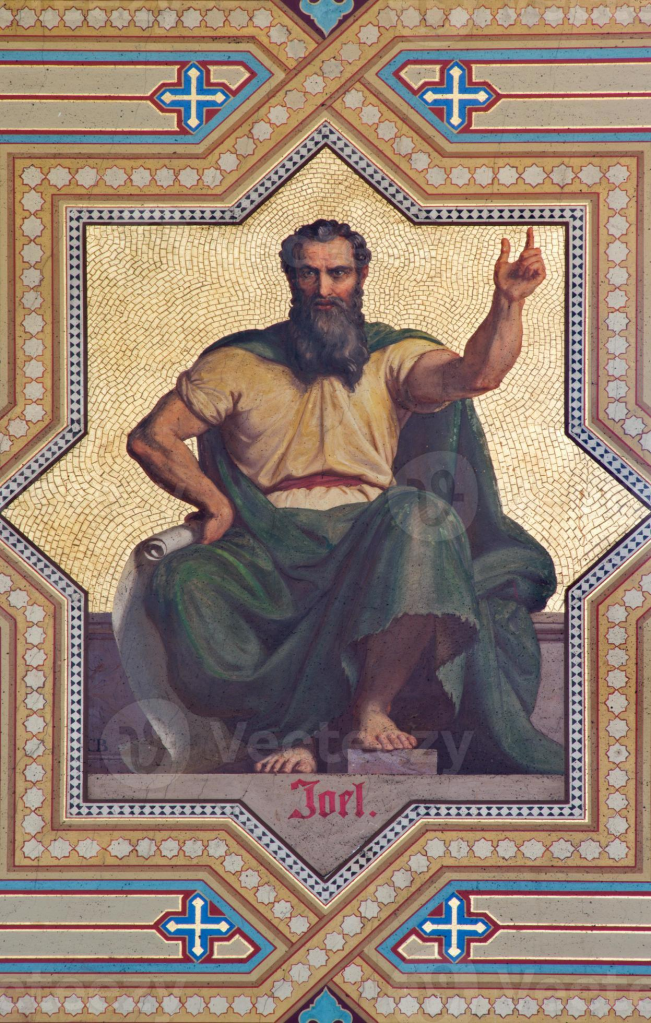
We are in the wake of Pentecost Day. But it ought not to have come as a surprise. There were prophetic rumblings of the Spirit’s future tornadic activity, long before the time of Jesus.
The prophet Joel, along with all the Old Testament prophets, had both a message of grace and of judgment. And so, this prophetic book falls naturally into those two parts.
Within the first part of the prophecy, Joel speaks of a terrible locust plague that came over Israel as a judgment from God. The people had strayed from their spiritual and religious ways of covenant with God. The locusts, destroying every plant in their path, reflected the people’s lack of spiritually thriving and growing in grace. They, too, were vulnerable to destruction. They needed to repent and to return to their God.
Yet, the Lord’s anger lasts only a moment, but God’s mercy and blessing endure forever. So, words of grace were offered to the people. There is a time coming, Joel insisted, when God will pour out the divine Spirit far and wide to bless the people and contend with the nations who oppose the covenant community.
Put another way, the first part of the prophecy describes how God fought against God’s own people, to bring them back to their spiritual senses. And the second part of the prophecy describes how the Lord will fight against the nations who fight against God and God’s people.
The people’s affections and allegiance became attached to other things rather than God. So, the Lord sent an army of locusts to oppose them, to challenge their milquetoast and half-hearted attempts at following divine instructions.
Joel foresaw two things coming as the great Day of the Lord approaches: a great outpouring of the Holy Spirit; and a terrible time of divine judgment.
Let’s take a few things to heart as a response to Joel’s prophecy:
Be aware of God’s purpose in history
From grasshopper swarms to world-wide judgment, to the dissolving of sun and moon—God’s purpose is to reveal divine glory to all the world.
“You will know that I am in the midst of Israel,
and that I am the Lord your God—no other exists;
never again will my people be put to shame.” (Joel 2:27, CEB)
“Father, the hour has come; glorify your Son so that the Son may glorify you.” Jesus (John 17:1, NRSV)
Stay close to the Lord
Don’t wander from God. But, if you do, the Lord will spend all kinds of energy in bringing us back and restoring us.
“But even now,” declares the Lord,
“return to me with all your heart—
with fasting, crying, and mourning.” (Joel 2:12, GW)
And the God of all grace, who called you to his eternal glory in Christ, after you have suffered a little while, will himself restore you and make you strong, firm and steadfast. (1 Peter 5:10, NIV)
Change the inside, not the outside
Repentance and faith are to be a way of life, and not simply a one time event. The way we present ourselves on the outside is a projection of what we want others to see. But God sees the heart, so we must go there and focus on the inner person.
Don’t rip your clothes
to show your sorrow.
Instead, turn back to me
with broken hearts.
I am merciful, kind, and caring.
I don’t easily lose my temper,
and I don’t like to punish. (Joel 2:13, CEV)
Endure what you suffer as being a father’s punishment; your suffering shows that God is treating you as his children. Was there ever a child who was not punished by his father? If you are not punished, as all his children are, it means you are not real children, but bastards. In the case of our human fathers, they punished us and we respected them.
How much more, then, should we submit to our spiritual Father and live! Our human fathers punished us for a short time, as it seemed right to them; but God does it for our own good, so that we may share his holiness. When we are punished, it seems to us at the time something to make us sad, not glad. Later, however, those who have been disciplined by such punishment reap the peaceful reward of a righteous life. (Hebrews 12:7-11, GNT)
Earnestly seek the outpouring of the Holy Spirit
On the Day of Pentecost, the Apostle Peter said that the coming of the Holy Spirit was a fulfillment of Joel’s prophecy (Acts 2:16). That was just the beginning of the blessing. The Holy Spirit is still operative and active in the church and the world. The prophecy is far from complete.
In reply to those who were concerned about others prophesying and thereby possibly challenging authority, Moses said:
“Are you concerned what this might do to me? I wish the Lord would give his Spirit to all his people so everyone could be a prophet.” (Numbers 11:29, CEV)
And those who observed and heard the Spirit being poured out, exclaimed with slack jawed amazement:
“Aren’t these all Galileans? How come we’re hearing them talk in our various mother tongues?
Parthians, Medes, and Elamites;
Visitors from Mesopotamia, Judea, and Cappadocia,
Pontus and Asia, Phrygia and Pamphylia,
Egypt and the parts of Libya belonging to Cyrene;
Immigrants from Rome, both Jews and proselytes;
Even Cretans and Arabs!
“They’re speaking our languages, describing God’s mighty works!” (Acts 2:7-11, MSG)
The age of the Spirit is here. It hasn’t gone away. So, let’s pursue the spiritual life with all the energy given us, to the glory and praise of God. Amen.

 Rev. Tim Ehrhardt