Already Justified and Accepted (Romans 5:1-8)

Crucifixion, by Natalya Rusetska

Therefore, since we are justified by faith, we have peace with God through our Lord Jesus Christ, through whom we have obtained access to this grace in which we stand, and we boast in our hope of sharing the glory of God. And not only that, but we also boast in our afflictions, knowing that affliction produces endurance, and endurance produces character, and character produces hope, and hope does not put us to shame, because God’s love has been poured into our hearts through the Holy Spirit that has been given to us.

For while we were still weak, at the right time Christ died for the ungodly. Indeed, rarely will anyone die for a righteous person—though perhaps for a good person someone might actually dare to die. But God proves his love for us in that while we still were sinners Christ died for us. (New Revised Standard Version Updated Edition)

Perhaps we have so many people filled with shame and regret today over their past poor decisions and the trajectory their lives, because there is such a profound lack of hope in the world.

Becoming confident in both the unseen realities and the stated promises of God can melt away both personal and corporate shame.

Long ago, the Apostle Paul reminded the Roman Church of their true standing before the God of all. Paul knew that if the people were secure in their identity, then resilience would arise; and if resilience rises, then a robust Christian character and identity will take root. Hope then becomes a central part of life.

Notice that the Apostle made it clear what is true of believers: They are justified, possessing the justification of God. In other words, the Christians have no reason to try and justify themselves to others (or to God) because they already have been justified by God.

There is great freedom in feeling no compunction whatsoever to prove oneself. Followers of Jesus Christ need not prove themselves, spending all sorts of social capital attempting to please others, out of some perceived need to demonstrate who they are.

If you want others to know who you are and what kind of God you serve, then know thyself, instead of constantly putting your finger to the wind in order to gauge which way the prevailing winds of society are blowing so that you can follow it.

In truth, all you need is the wind of the Spirit to carry you on into doing God’s will from a merciful, pure, and peaceful heart.

Since we are already justified, we have peace with God through our Lord Jesus Christ. Things are good between us and God. Not only do we have no need to prove ourselves to the world, but we especially have also absolutely no reason to try and prove ourselves to God.

The Lord already knows the score of everyone’s life. It is a silly venture to put on airs before the Sovereign of the universe, as if God must be convinced to love us and have our backs.

The grace of God is abundant and ever-present; grace is continually available. And there are no exceptions to this. One is never too far from God or too estranged from the good in order to receive the mercy of God.

God’s love has been already poured into our hearts. God is with us; divine love is intimately close to us. Rather than wondering or vacillating between whether God loves me or God loves me not, the objective spiritual reality of the moment is that you and I are surrounded by the God who rejoices over us.

The Lord your God is with you.
He is a hero who saves you.
He happily rejoices over you,
renews you with his love,
and celebrates over you with shouts of joy. (Zechariah 3:17, GW)

What’s more, God does not wait for anyone to get their lives straightened out before paying gracious attention to them. No, while we were still stuck in the darkness of our bad and misguided ways, Christ died for us. Jesus Christ died for the ungodly while they were still going on in their own selfish and oppressive way.

That, my friend, is the extent to which God’s love reaches. There is no pit too deep, no meanness too great, nor any unrighteous life too bad that God cannot reach the long divine arm of mercy and love into the muck, and snatch us out of a depressing existence.

And the world is not too filthy rotten that God is unable to cut through the filth. As far as the Lord is concerned, the earth is presently just a compost pile that will eventually become transformed from garbage to fertilizer for new life, in which love can grow, thrive, and flourish across this world.

Unhindered access to God has been granted to us.

Let us then approach God’s throne of grace with confidence, so that we may receive mercy and find grace to help us in our time of need. (Hebrews 4:16, NIV)

We now have the hope and the freedom to be active spiritual farmers who carefully and pastorally care for all creation by spreading the seeds of God’s love to the world.

Everything we have and all that we are, comes from the grace, mercy, and love of God. Therefore, we have no reason to boast in and of ourselves, but to boast extravagantly in what Christ has done for us. He has bought and brought  deliverance from all which hindered us from living a loving and hopeful life.

So then, the path to true self-acceptance comes from knowing that we are already accepted by God.

The very core of our identity is in the Creator, Savior, and Sustainer. Since we possess God’s love and acceptance, there is never a need for subjective feelings of trying to gin-up a sense of self-acceptance. You and I already have it. You are profoundly loved.

This, then, is the basis for peace and rest. Please understand that it is quite possible that later today or tomorrow or next week you will again feel unworthy of God’s love, unaccepted by God and others, and nervous to the point of peace becoming a bygone wish.

None of this, however, erases what is already real and true of you, or changes your identity in any way. You are still in the hollow of God’s hand; still the apple of God’s eye; and still in a place where there is no need to justify yourself. What there is, however, is abundant grace.

No matter how we are doing, feeling, or believing, there is always open access to God because of Jesus Christ.

The ground of our confidence allows us to view tribulations as opportunities for spiritual growth; and patient waiting as the privilege to hope in what is yet to come. I will yet see the glory of God face to face.

God in Christ has done for us what we could not do for ourselves. The Lord has granted us faith, and gifted us with a fresh new allegiance. Through recognition of our helpless state, and our distance from God (including a nasty tendency to ignore God) we discover that the love of God is with us. So, we may rely completely on the divine initiative of the love which never wavers.

In this state, guilt, shame, and regret is left in the dust – replaced by faith in the Son of God who loved me and gave himself for me.

Loving God, open our ears to hear your Word, and draw us closer to You, so that the whole world may be one with you as you are one with us in Jesus Christ our Lord. Amen.


Life In the Spirit (Romans 8:6-11)

Art by Randi Ford

The attitude that comes from selfishness leads to death, but the attitude that comes from the Spirit leads to life and peace. So the attitude that comes from selfishness is hostile to God. It doesn’t submit to God’s Law, because it can’t. People who are self-centered aren’t able to please God.

But you aren’t self-centered. Instead you are in the Spirit, if in fact God’s Spirit lives in you. If anyone doesn’t have the Spirit of Christ, they don’t belong to him. If Christ is in you, the Spirit is your life because of God’s righteousness, but the body is dead because of sin. If the Spirit of the one who raised Jesus from the dead lives in you, the one who raised Christ from the dead will give life to your human bodies also, through his Spirit that lives in you. (Common English Bible)

The chapters of Romans 5-8 are a core biblical text for the Christian life. They get down to the fundamental issue of a Christian’s identity and daily practice.

In the mind of the Apostle Paul, all persons are either in the Spirit of God, or not; selfish or unselfish; thinks of the common good of all, or only thinks of oneself and what is best for the individual me.

For Paul, the tell of one being a Christian is to orient one’s life completely around the person and work of Jesus Christ. If not, then one cannot claim to be a Christian, at all.

Regular Bible-readers will notice that I have used the Common English Version’s rendering of the Greek word σάρξ as “selfishness” instead of the literal and often translated English word “flesh.”

My choice highlights the reality that, although “flesh” may make some reference to the physical body, it has much more to do with a person’s holistic expression of sin by means of the mind, emotions, and soul. In other words, “flesh” can be appropriately translated as “selfishness” since it truly takes the whole person to accommodate sin’s desires.

The selfish nature of human individuals (and communities) can take many forms such as the passionate pursuit of material possessions, winning at all costs, unchecked power, and seeking influential positions.

What’s more, this fleshly selfishness is seen in communal ways through extreme promotion of capitalist ideology; hierarchical forms of power which dominate and oppress others; societal norms which keep people locked into class warfare; and exploitation of the earth’s resources for selfish purposes.

Those who are in these sorts of mindsets and social practices cannot please God, because they fundamentally contradict the overarching ethics of Holy Scripture.

We are not to dwell in the realm of selfishness but are to live in and according to the Spirit of Christ. All of this means that every believer has within them a great potential for both good and evil. Even though we have been freed from the realm of sin, the individual (and the community) must actively use this freedom from Christ for good purposes.

Simply avoiding the bad – although quite necessary – will not do. Only focusing on not getting into trouble may easily leave one complicit to evil by not helping when it was in our power to do so. The Lord Jesus avoided a simple skate through his earthly life. He instead sought:

“to preach good news to the poor,
    to proclaim release to the prisoners
    and recovery of sight to the blind,
    to liberate the oppressed,
    and to proclaim the year of the Lord’s favor.” (Luke 4:18-19, CEB)

These are actions rooted in Old Testament ethical practices. They are socially minded aspirations meant for the common good of all people, and not just some persons.

The Spirit invades our lives in order to unite us to Christ. In him the believer is made righteous, and given new life and hope. Christians now have a real possibility to live according to the words and the ways of Jesus.

We no longer need to “watch out for number one.” The love of God in Christ provides what is necessary to melt the old selfish desires.

We can now remove ourselves from unholy cycles of condemnation toward both others and self.

We can now speak in a manner which encourages and uplifts, rather than use our speech to verbally decapitate another with harsh divisive language.

We can now relate to others with genuine spiritual care, instead of personal disinterest.

And we can take great hope in the fact the work of God in this world is ongoing, because of transformation by divine grace. I need no longer to listen to all the condemning messages emanating from ignorant persons who are quick to make knee jerk judgments on things they know little about.

The Spirit of Christ and the Word of God are more powerful and have greater effectiveness than any other spirit or word that is expressed or spoken. The inner testimony within the individual knows this to be true. The Christian’s identity is firmly in Christ, not in selfishness.

Perhaps it is so hard to live unselfishly because self-surrender to God feels like dying. Often our longings betray the fact that we have forgotten who we are. When that happens, we tend to search for that identity in all the wrong places.

Let’s instead put our effort into the ultimate ethic of love as embodied in the Lord whom we serve – not in idyllic ideas of romance, but in accepting people for who they are, and not what we want them to be.

I’m talking about a love that is present to others and stays with them; sharing my life; putting up with another’s difficulties; seeing things through and plugging away at what I know is right.

Most of the time, living in the Spirit is just a matter of meeting what comes day by day, and persevering with patience through it in the best way I know how.

The love of God in Christ tends not to be the kind that people write stories about, but is simply doing things with a good attitude, a right spirit, and proper motives. If we relate deeply to life and experience both the joy and pain of living on this earth, then I believe we will find that our longings fade into the background.

That’s because I am now living in the realm of the Spirit of love. And when I’m in that zone, there’s no reason to seek anything else, because the Spirit is your life.

God of compassion and consolation, your breath alone brings life to weary souls. Pour out your Spirit upon us, so that we may face despair with the hope of resurrection and faith in Jesus Christ your Son, our Lord, who with you and the Holy Spirit are one God, now and forever. Amen.

It’s All About Grace (Acts 1:1-5)

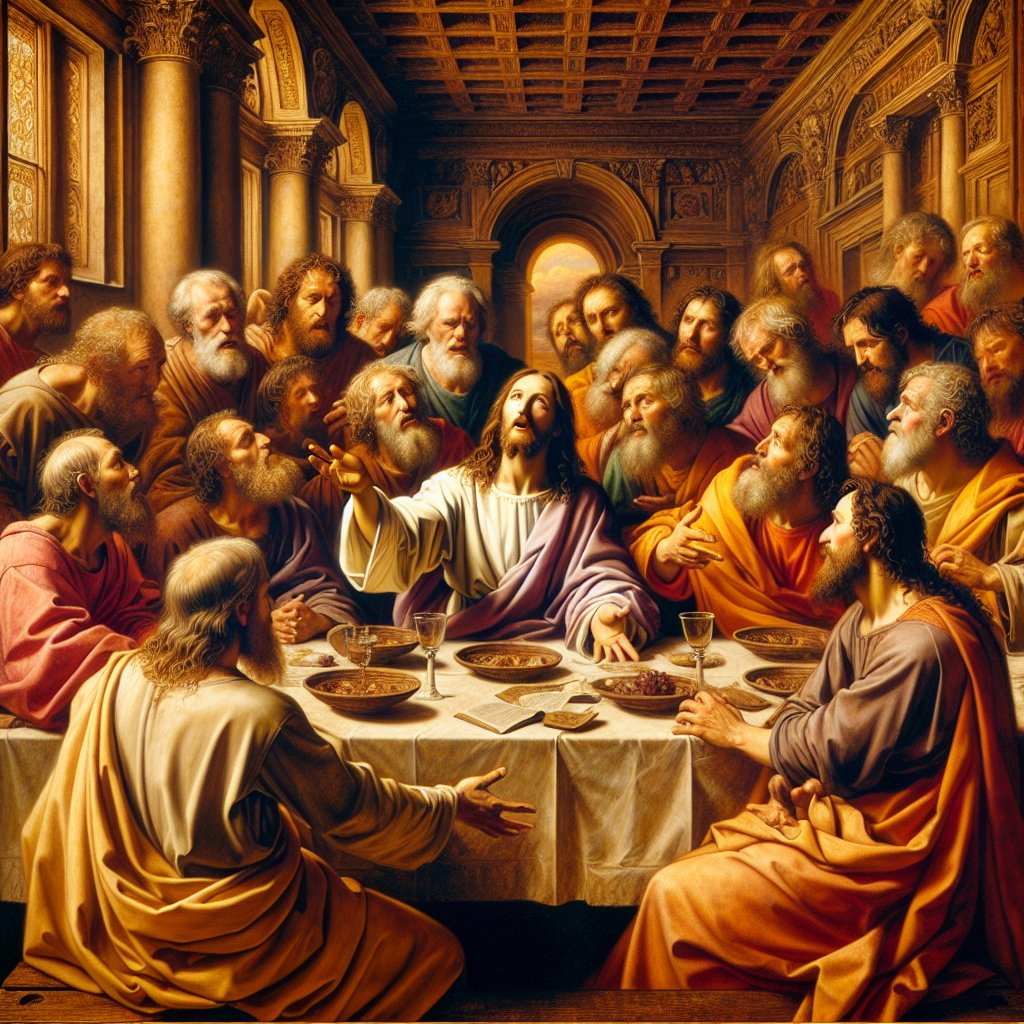
Jesus and the Apostles, by Bible Art

Theophilus, I first wrote to you about all that Jesus did and taught from the very first until he was taken up to heaven. But before he was taken up, he gave orders to the apostles he had chosen with the help of the Holy Spirit.

For 40 days after Jesus had suffered and died, he proved in many ways that he had been raised from death. He appeared to his apostles and spoke to them about God’s kingdom. While he was still with them, he said:

Don’t leave Jerusalem yet. Wait here for the Father to give you the Holy Spirit, just as I told you he has promised to do. John baptized with water, but in a few days you will be baptized with the Holy Spirit. (Contemporary English Version)

One of the unshakable and foundational convictions I have is that the earth revolves on an axis of grace. Apart from grace, we wouldn’t even exist.

If God’s grace in Christ was only an undeserved gift, that would be incredibly wonderful and more than enough for us. Yet, it is even more.

The word “grace” doesn’t need to be in every verse of the Bible for the reality of grace to be embedded within every verse of the Bible.

Grace is the answer to every question that humankind can ask. Grace not only forgives and loves unconditionally, but it also infuses us with freedom and power within our souls.

Grace is the ultimate game-changer. And grace is evident everywhere in Holy Scripture, powering its message and mission. It’s evident in today’s New Testament lesson…

The Grace of God Choosing People

In this biblical passage of Christ’s imminent ascension to heaven, Jesus intentionally made gracious provision so that his apostles could carry on without his bodily presence.

First of all, and priority above the ability to be and to do anything, is the gracious reality that Jesus chose his apostles; they did not choose him. In fact, every disciple of Christ was chosen by God before we made our choice. That, my friend, is grace.

Christ deliberately chose twelve Jewish men to be his intimate followers on this earth during his ministry. No follower and disciple of Christ is ever self-appointed to anything, nor are they really appointed by any committee or by some human means.

What’s more, every church pastor, elder, deacon, and leader of any sort is providentially chosen and appointed by Christ himself well before being chosen by a body of believers in a church, synod, or board.

The Lord’s intentions in choosing people for a specific purpose (and especially for salvation) is first of all a tremendous act of divine grace. This ought to be of great encouragement to us, that Christ who builds the Church, sees us and chooses us.

The Grace of Seeing Jesus

Second, God showed his infinite grace by having Jesus shown to his apostles after his resurrection. The twelve, along with many other disciples, were eyewitnesses to the bodily resurrection of Christ.

After his sufferings, the risen Lord revealed his presence to his apostles. He gave them many convincing and decisive proofs that he was truly alive. And if that wasn’t enough, Jesus kept it up for 40 days until his ascension.

Jesus talked to them about the kingdom of God, about God’s gracious rule and reign upon this earth. He prepared them for the ascension, and helped them make sense of all the nonsensical things happening in their lives. Jesus showed them that he was no ghost, but could be touched, hugged, and enjoy a meal with.

The entire post-resurrection experience was a time of amazing grace in getting to see, feel, and listen to Jesus.

The Grace of Christ’s Commissioning

Third, Jesus not only spoke with his apostles, but he also commissioned them by giving them instructions to proclaim gracious good news of forgiveness and new life with God.

The word “apostle” means to be a herald, an envoy or messenger; being an ambassador sent out with the authority to boldly proclaim good news for the nations. Disciples  are to have a ministry of proclaiming peace and reconciliation between God and humanity, and between one another. Indeed, it is all about grace.

Therefore, if anyone is in Christ, the new creation has come: The old has gone, the new is here! All this is from God, who reconciled us to himself through Christ and gave us the ministry of reconciliation: that God was reconciling the world to himself in Christ, not counting people’s sins against them. And he has committed to us the message of reconciliation. 

We are therefore Christ’s ambassadors, as though God were making his appeal through us. We implore you on Christ’s behalf: Be reconciled to God. God made him who had no sin to be sin for us, so that in him we might become the righteousness of God. (2 Corinthians 5:17-21, NIV)

The Grace of Having the Holy Spirit

Finally and ultimately, Jesus promised his apostles the greatest grace gift of all: the very Holy Spirit of God. The Advocate, the Spirit of Truth, would remind them and teach them of all things concerning God’s gracious and benevolent kingdom. (John 16:12ff)

The Holy Spirit is the battery, the power source, of the Christian life. Apart from the Spirit we can do nothing.

The Need For Grace Today

It is imperative that we continually remember grace, and keep grace in the forefront of our minds and our hearts. It’s especially needed in this day and age.

We live in a time in which ungracious and unjust words and actions are in front of our faces continually. The biblical witness is adamant that life is not about having earthly power and wielding it for our own earthly purposes.

Grace is what gives and sustains life. Grace is the real power operative in the world. And if we fail to realize this, and do not tap into grace, then we are truly doomed and are to be pitied above all persons.

So, let us keep bearing in mind that:

  • God’s grace is why we have Jesus and the Holy Spirit
  • The purpose of Jesus is to alert people the presence and eventual fulfillment of God’s gracious realm and reign
  • The Spirit’s presence among us equips us to be Salt to ICE by melting injustice and a lack of mercy; and Light to those blinded by greed by showing the world how to live a different way.

Lord, we pray that your grace may always precede and follow us, so that we may continually be given to good works; through Jesus Christ our Lord, who lives and reigns with you and the Holy Spirit, one God, now and forever. Amen.

The Fruit of the Spirit

The fruit of the Spirit is love, joy, peace, patience, kindness, goodness, faithfulness, gentleness, and self-control. (Galatians 5:22-23, CEB)

It takes little effort to have a bad attitude; to slip a bit of gossip into the day; or to go along with the crowd in a divisive conversation. However, it takes a good deal of humility, energy, and commitment in order to live into the fruit of the Spirit.

On the one hand, the believer in Jesus Christ has been graciously given such fruit; we possess it by means of the Spirit. On the other hand, it feels as if we still need this fruit to be given to us, because our daily experience of it is such a struggle.

For me, experiencing the fruit of the Spirit is a bit like buying something from Ikea; I have it, but it needs to be put together. And I’m not so good at making sense of the directions and actually getting the thing in working condition.

Yes, there will be some frustration tapping into our spiritual reservoir and accessing the fruit provided for us. Yet, it’s totally worth it. In fact, the nine elements of spiritual fruit mentioned in the New Testament book of Galatians are experiences people really want to have – whether they are Christian, or not.

One of the reasons folks may become overwhelmed with the Spirit’s fruit is that they look at those nine words as nine different “fruits.” However, the grammar of the text is clearly not plural but singular. In other words, the “fruit” of the Spirit is one packaged piece.

It may be tempting to relieve ourselves of any responsibility or accountability with this fruit by saying, “I’m good at being kind and good, but I really have problems with patience and self-control.”

But the text doesn’t allow for such thinking. To not possess any one of the nine words is to not have the entire nine. The Holy Spirit of God is not divided; when the Spirit gives, it’s the whole kit-and-caboodle.

After all, the believer in Jesus seeks to be a person of integrity and wholeness, being aligned fully in all aspects of life around the person and work of Christ. Any fragmentation belies the reality that one, no matter how apparently peaceful or gentle, is attempting to manifest spiritual fruit on one’s own power.

There is a big difference  between trying to control the process of Christian sanctification (becoming holy) and exercising self-control. And there is an even wider chasm between accessing and using the accepted spiritual fruit, and trying to go on a self-improvement project that is disconnected from God’s given grace.

In truth, believers already have everything they need for life and godliness in this present evil age (2 Peter 1:3). The seed has been firmly planted within the soul. We possess the fruit. Yet, that fruit must grow and mature before it is ripe enough to eat. There is still the work of cultivating and nurturing to do, so that we might flower and flourish.

We only need the essential conditions to grow. Any seed – no matter what kind – will grow and produce a harvest if it has the proper amounts of sun, rain, and good soil. Then, we never need to wonder what will happen; the seed will grow.

As spiritual farmers, we need to be daily working in the field our soul, keeping the weeds and the critters out, so that there is no obstacle or impediment to the growth and maturity of our precious fruit.

If we need to build a fence, we build it. If we must buy or borrow a hoe, we do it. Whatever needs to happen to guard what we possess, we are committed to doing it.

None of us ever produces a seed. Not even in this modern age of genetically modified seeds can we do this. The scientist only manipulates what is already there; he cannot create a seed ex nihilo.

So, we have this tremendous spiritual fruit, graciously given to us by means of God’s Spirit. Perhaps the million dollar question is:

How do I access this grace? How can I realize the fruit of love, joy, peace, patience, kindness, goodness, faithfulness, gentleness, and self-control in my life?

We have no further to look than to the very words of the Lord Jesus himself:

Very truly I tell you, unless a kernel of wheat falls to the ground and dies, it remains only a single seed. But if it dies, it produces many seeds. Anyone who loves their life will lose it, while anyone who hates their life in this world will keep it for eternal life. Whoever serves me must follow me; and where I am, my servant also will be. (John 12:24-26, NIV)

We must die to ourselves. There is no other way. Christ demonstrated the way by dying and being placed in the earth. Only then could he rise from death. And only then could his disciples have their faith come to fruition, spreading gospel seed throughout the world.

For one cannot have a resurrection unless there is first a crucifixion. There must be suffering before glory.

That, my friend, is the cost of discipleship. It’s the cost of realizing the spiritual fruit that you and I long for in our lives. This is the struggle we must go through to experience the life that is truly life.

Heavenly Father, in you I live and move and have my being. I humbly pray You so to guide and govern me by your Holy Spirit, that in all cares and occupations of my life I may not forget You, but remember I am ever walking in Your sight, exhibiting Your fruit; through Jesus Christ my Lord. Amen.