Good vs. Evil (2 Thessalonians 2:7-12)

For the mystery of lawlessness is already at work, but only until the one who now restrains it is removed. And then the lawless one will be revealed, whom the Lord Jesus will destroy with the breath of his mouth, annihilating him by the manifestation of his coming. The coming of the lawless one is apparent in the working of Satan, who uses all power, signs, lying wonders, and every kind of wicked deception for those who are perishing because they refused to love the truth and so be saved. For this reason God sends them a powerful delusion, leading them to believe what is false, so that all who have not believed the truth but took pleasure in unrighteousness will be condemned. (New Revised Standard Version)

There are two opposing forces which are operating in this world. One is the power of evil, manifested through lawlessness, selfishness, and wickedness. The other power is good, and it is seen wherever there is a concern for the common good of all people. Labors of love for all humanity and right relations with everyone are a demonstration of the peaceable fruit of righteousness existing in the world.

To put it succinctly, a spirit of merciful grace and a spirit of careless judgment both exist throughout the world.

Hate what is evil; cling to what is good.

The Apostle Paul (Romans 12:9, NIV)

The Apostle Paul wrote his letter to the church in Thessalonica because the believers there were confused. Somebody had told them that the end of the age already happened. Paul sought to set the record straight, that we are still anticipating the return of the Lord and the final judgment of all things.

The great Day of the Lord will not come until the faithless one, the person of lawlessness, the son of destruction, is revealed. Such a person opposes God and has the force of evil behind them. So, who is this person?

The person is not a single individual. Paul was helping the Thessalonian believers understand the actual situation by wrapping the abstract concept of evil into human form, so that they could visualize its reality and sinister nature. In truth, there will be lots of individual humans who manifest themselves through evil intent and actions, until the Lord’s return.

Grace is the operative power which restrains all the evil. A lot of people have questions about God and evil. Why is there so much evil? How come God doesn’t snuff it all out? Is the Lord not able to do anything? What’s going on?

Those are honest questions. And they come from a place of limited human perspective. Let’s turn this on it’s head. It’s not that God is impotent or isn’t doing anything about evil. Think of it this way: When you scoop up a bunch of sand in your hands, there are a lot of sand grains which fall to the ground. If the sand is evil, and the hands are God’s, the reality of the situation is that the Lord has most of the evil kept at bay.

In other words, if God were not involved in this world, at all, we would be living in a real dystopian society – people staying up at night to guard their homes with guns, and anxious folks attacking each other with impunity. As bad as some things are, it could be infinitely worse than it is.

The grace of God is active in restraining evil and providing believers with what they need to not only survive, but also to thrive in this world.

His divine power has given us everything needed for life and godliness, through the knowledge of him who called us by his own glory and excellence. Thus he has given us, through these things, his precious and very great promises, so that through them you may escape from the corruption that is in the world because of lust and may become participants of the divine nature. (2 Peter 1:3-4, NRSV)

A reversal occurs because of God’s grace. The wickedness which exists, especially within the human heart, is dealt with and transformed into a force for good in the world.

Once we, too, were foolish and disobedient. We were misled and became slaves to many lusts and pleasures. Our lives were full of evil and envy, and we hated each other. But—when God our Savior revealed his kindness and love, he saved us, not because of the righteous things we had done, but because of his mercy. (Titus 3:3-5, NLT)

Grace is wonderful for those who believe. However, for those who are faithless, grace is inoperative – simply because the wicked consider virtues like mercy and grace as weak and useless; they have no intention of either giving or receiving such drivel.

From a certain angle, it may seem that God is harsh. The Lord hardens hearts, sends powerful delusions, and entertains mysteries which some people will never discover. Yet, from another point of view, these are all necessary divine tools in dealing with unjust humanity and their systems of oppression.

Justice and righteousness are championed by God, and therefore, injustice and unrighteousness will not be put up with by the Lord. And that is a good thing. Love not only gives, but it also protects and withholds. Evil will be dealt with according to God’s good grace and in God’s good time – and not according to a limited human perspective or any person’s impatience.

The time is short, and the time is near; everything shall not continue, as it presently is, forever. This is why the author of Hebrews exhorted people to pay attention to “Today” with a capital “T.” Today won’t be here tomorrow. Tomorrow is the Day of the Lord. So, while it’s Today, we must be responsive.

My friends, watch out! Don’t let evil thoughts or doubts make any of you turn from the living God. You must encourage one another each day. And you must keep on while there is still a time that can be called “Today.” If you don’t, then sin may fool some of you and make you stubborn. (Hebrews 3:12-13, CEV)

We must encourage each other with continued faith and patience until the end of the age. We can do this. We are all in this life together, so let us keep on holding up one another and carrying each other’s burdens. In so doing, we will not be lawless, but fulfill the Law of Christ. (Galatians 6:2)

Keep on being brave! It will bring you great rewards. Learn to be patient, so you will please God and be given what he has promised. As the Scriptures say,

“God is coming soon!
    It won’t be very long.
The people God accepts
will live because
    of their faith.
But he isn’t pleased
with anyone
    who turns back.”

We are not like those people who turn back and get destroyed. We will keep on having faith until we are saved. (Hebrews 10:35-39, CEV)

May it be so, to the glory of God. Amen.

The Parable of the Weeds (Matthew 13:24-30, 36-43)

Jesus told them another parable: “The kingdom of heaven is like a man who sowed good seed in his field. But while everyone was sleeping, his enemy came and sowed weeds among the wheat, and went away. When the wheat sprouted and formed heads, then the weeds also appeared.

“The owner’s servants came to him and said, ‘Sir, didn’t you sow good seed in your field? Where then did the weeds come from?’

“‘An enemy did this,’ he replied.

“The servants asked him, ‘Do you want us to go and pull them up?’

“‘No,’ he answered, ‘because while you are pulling the weeds, you may uproot the wheat with them. Let both grow together until the harvest. At that time I will tell the harvesters: First collect the weeds and tie them in bundles to be burned; then gather the wheat and bring it into my barn….’”

Then he left the crowd and went into the house. His disciples came to him and said, “Explain to us the parable of the weeds in the field.”

He answered, “The one who sowed the good seed is the Son of Man. The field is the world, and the good seed stands for the people of the kingdom. The weeds are the people of the evil one, and the enemy who sows them is the devil. The harvest is the end of the age, and the harvesters are angels.

“As the weeds are pulled up and burned in the fire, so it will be at the end of the age. The Son of Man will send out his angels, and they will weed out of his kingdom everything that causes sin and all who do evil. They will throw them into the blazing furnace, where there will be weeping and gnashing of teeth. Then the righteous will shine like the sun in the kingdom of their Father. Whoever has ears, let them hear. (New International Version)

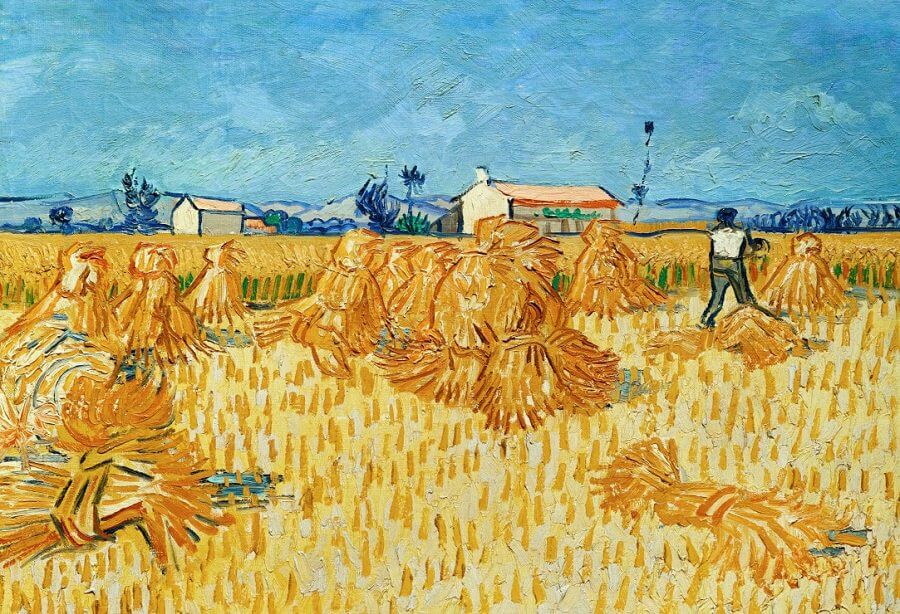
Harvest in Provence, by Vincent Van Gogh, 1888

People of every age struggle with the evil present in this world – and also within the church. For how do we make sense of those who profess Christ but have no fire and passion for their faith? How do we reconcile our own faith with folks in the church who seem to care more about getting their own way than about sacrificing themselves to reach people who do not know Christ. Jesus says, “He who has ears, let him hear.” In other words, listen!

Jesus has informed us that in this present evil age we live in, between his two advents of incarnation and Second Coming, not everything for Christians is going to be rainbows and unicorns.

There are competing pressures on the Church, and sometimes she will fail. The kingdom of God has broken into history and is present, but sin and evil is there, too. So, our focus must be on the hope we have when Christ comes again to judge the living and the dead.

In Christ’s parable of the weeds (or the parable of the wheat and the tares) the enemy of our souls seeks to distract the workers by overwhelming them with evil. If Satan cannot prevent God’s kingdom from being established in the human heart, the devil will try and corrupt the heart by throwing as much evil at it as he can. 

The devil has no problem with people saying they are Christians; the thing Satan has a problem with is people giving themselves unconditionally and unreservedly to God for kingdom business.

“Not everyone who says to me, ‘Lord, Lord,’ will enter the kingdom of heaven, but only the one who does the will of my Father who is in heaven.”

Jesus (Matthew 7:21, NIV)

Where did all these weeds come from?

I’ll frame this question in the modern form that many people have asked me over the years: “If God is a God of love, why is there so much evil in the world?” Or, “If this is Christ’s Church, why is it so messed up?”

Jesus is straightforward in his answer: An enemy did this. In other words, God didn’t plant evil – the source of evil comes from the devil, not God. God’s agenda is for the seed to take root in the human heart and grow into a full-fledged embodiment and commitment to the words and ways of Jesus.

When that growth doesn’t happen, the problem is not because God messed up; it’s because the devil has also done his own work of planting. And the devil wants the opposite of God: to have Christians nit-picking each other like a bunch of crazy chickens, and keeping a demonic pecking order; instead of being the continuing presence of Christ on this earth.

What do we do with all these weeds?

That is, how do we deal with wicked people?  The answer seems obvious: Pull the weeds up and get rid of them. Get rid of wicked people and their wicked behavior. Yet Jesus says in response to this line of reasoning in a clear and unequivocal answer of “No.” But why? Because doing violence to the weeds ends up doing violence to the wheat, as well.

Christ’s answer to the problem of evil is: Let God take care of it. Meanwhile, until that fully happens, we must co-exist with evil, rather than exterminate evil people.

There is always a temptation for believers to force people into the kingdom of God (e.g. the Spanish Inquisition). Yet, at the harvest (the final judgment at the end of the age) evil will be squarely dealt with. Judge Jesus will have the angels separate the wheat from the tares, and the weeds will be burned up.

This teaching from Jesus may open up a whole set of other questions, such as:

  • What am I supposed to do with evil? Just watch it happen? 
  • Am I to let that evil person just be evil? Shouldn’t I give them what they deserve?
  • Shouldn’t I at least tell evil people that they are no good rotten sinners? That they are going to hell because they are wicked?

This doesn’t mean we do nothing. Earlier in Matthew’s Gospel, Jesus has already said: Love your enemies and pray for those who persecute you. (Matthew 5:44)  We are to love and pray people into the kingdom, not force them in.

As for the evil, Jesus will decisively solve the problem of evil, not you, nor me! It isn’t our place to be judge, and if we make it our place, we’ll end up hurting and destroying our brothers and sisters.

Where is evil?

A sobering reality taught by Jesus in this parable is that it’s not a simple matter that we, the wheat are here, and they, the weeds, are over there. It is much more sinister than that; the enemy is within, not out there. 

We have no further to look than in our own hearts and within our own faith communities – which is why we need the lordship of Christ to completely overtake us. Evil is present in the Church, next to the good, seeking to:

  • discourage people in their commitment to Christ
  • offend and hurt others, particularly by overlooking and speaking ill of weaker people
  • step on others in order to get it’s way
  • be a stumbling block to those trying to do God’s will
  • promote ignorance of God’s Word, for no one can live by God’s will if they do not know what it is

The eventual end of sinister people is that, when Christ returns, they will be separated from the righteous and thrown into the fire, just like a harvester would do with a bunch of weeds. As the wicked went about their lives in anger, upsetting others in this life, so they will be tormented in the next.

Conclusion

We may expect God to handle evil in a hurry. But the kingdom of God doesn’t work that way; it’s intended to be planted in the ground, and takes time to grow. While it’s growing, evil is there, like a weed.

Whenever things go sideways because of wickedness, we might expect God to act quickly and drastically to uproot the evil. We may confuse God’s slowness as being uncaring, when in reality it means that God is patient, and desires people to change. And change always begins with you and me.

God Almighty, Creator of heaven and earth, we are a complacent people. While you desire us to be a beacon of light to a world in need, we are preoccupied with all the weeds in the field. We are sorry for the madness unleashed through our own selfish desires. May you plant the seed of love in our hearts for all people, not just our friends. And we shall commit to watering and nurturing that seed with your Word, through Jesus Christ our Lord. Amen.

Don’t Be Stupid (2 Timothy 2:14-26)

Keep reminding God’s people of these things. Warn them before God against quarreling about words; it is of no value, and only ruins those who listen. Do your best to present yourself to God as one approved, a worker who does not need to be ashamed and who correctly handles the word of truth. 

Avoid godless chatter because those who indulge in it will become more and more ungodly. Their teaching will spread like gangrene. Among them are Hymenaeus and Philetus, who have departed from the truth. They say that the resurrection has already taken place, and they destroy the faith of some. Nevertheless, God’s solid foundation stands firm, sealed with this inscription: “The Lord knows those who are his,” and, “Everyone who confesses the name of the Lord must turn away from wickedness.”

In a large house there are articles not only of gold and silver, but also of wood and clay; some are for special purposes and some for common use. Those who cleanse themselves from the latter will be instruments for special purposes, made holy, useful to the Master and prepared to do any good work.

Flee the evil desires of youth and pursue righteousness, faith, love and peace, along with those who call on the Lord out of a pure heart. Don’t have anything to do with foolish and stupid arguments because you know they produce quarrels. And the Lord’s servant must not be quarrelsome but must be kind to everyone, able to teach, not resentful. 

Opponents must be gently instructed, in the hope that God will grant them repentance leading them to a knowledge of the truth, and that they will come to their senses and escape from the trap of the devil, who has taken them captive to do his will. (New International Version)

Stupidity doesn’t have to do with intellect; it is a matter of character. A fool is stupid. A wise person is smart. One can be a “genius” yet still be as dumb as a bowling ball. And someone who never gets a “A” in school just might be the most knowledgeable person in the room.

Whoever loves discipline loves knowledge, but whoever hates correction is stupid.

Proverbs 12:1, NIV

The Apostle Paul understood this – which is why he put the focus on cultivating and communicating character instead of sheer intelligence. Anytime we purposefully neglect and forget this, we land into Paul’s “stupid” category of people.

Much of church ministry needs to be a memory care unit experience. That’s because too much spiritual dementia happens. There must be continual reminders about the importance of Christian character. It seems believers in Jesus too easily forget their identity and what they are supposed to be doing. This is most certainly not a new issue; it is one that has been endemic throughout the ages. It’s a problem as old as sin itself.

In the Gospels, Jesus miraculously fed a great crowd of people not once, but twice. The second time he called his disciples to remember what had happened the first time in order to understand the second. 

In the Epistles, Paul kept on reminding the Jewish believers to remember the ancient covenant; and he called the Gentile believers to keep in mind that they were once estranged from that very same covenant. Both Jews and Gentiles together needed to collectively remember the death of Christ that unites them into a new covenant community. And much like them, we are to remember Jesus Christ, raised from the dead, descended from David. (2 Timothy 2:8)

Whenever we forget who we are, whose we are, and what it is we are really all about, we get downright stupid. We get lost majoring on the minors and wagging our tongues like a bunch of foolish simpletons.

It’s stupid to say bad things
    about your neighbors.
If you are sensible,
    you will keep quiet.
A gossip tells everything,
but a true friend
    will keep a secret. (Proverbs 11:12-13, CEV)

Christians are blood-bought people of God, belonging to Jesus Christ, and given a mission to make disciples and participate with God in the redemption of all creation through remembering the poor, seeking justice, and being peacemakers in the church and the world. 

And what’s more, we are not to put up with letting others stand around and endlessly argue about lesser things, making every doctrine and dogma a battleground – as if the fine China and paper plates were exactly the same.

“Remember the height from which you have fallen!  Repent and do the things you did at first.” (Revelation 2:5, NIV)

There is a difference between the brains of dementia patients and Christian folk – the mind overtaken by dementia will only worsen, yet the church can recover its collective memory by listening again to the ancient Word of God; any and every congregation can be constantly refreshed with the promises and covenant of God. 

We must neither rely on mere pragmatism nor doing things the way we always have done them without any understanding of why we do it. 

Yet, we must understand that even when we point out what to remember and why we are to remember it to others, they aren’t always going to respond like we want them to – which is why instruction needs to be gentle so that another does not stumble on the messenger instead of the message.

A person of great understanding is patient, but a short temper is the height of stupidity. (Proverbs 14:29, GW)

It takes no effort to be stupid; but it takes a great deal of will and energy to keep learning and growing in the Christian life. Too many persons have unwittingly fallen into the trap of the devil, believing themselves to be godly because of their defense of the faith. Sadly, they’ve been defending their own interpretation of faith instead of the actual faith itself.

Please, don’t do that. Don’t be stupid. Better to focus on having a pure heart of your own rather than always pointing out the impurities of others.

Almighty God, to you all hearts are open, all desires known, and from you no secrets are hid. Cleanse the thoughts of our hearts by the inspiration of your Holy Spirit, that we may perfectly love you, and worthily magnify your holy Name, through Jesus Christ our Lord. Amen.

Isaiah 9:18-10:4 – The Reality in Front of Us

Surely wickedness burns like a fire;
    it consumes briers and thorns,
it sets the forest thickets ablaze,
    so that it rolls upward in a column of smoke.
By the wrath of the Lord Almighty
    the land will be scorched
and the people will be fuel for the fire;
    they will not spare one another.
On the right they will devour,
    but still be hungry;
on the left they will eat,
    but not be satisfied.
Each will feed on the flesh of their own offspring:
    Manasseh will feed on Ephraim, and Ephraim on Manasseh;
    together they will turn against Judah.

Yet for all this, his anger is not turned away,
    his hand is still upraised.

Woe to those who make unjust laws,
    to those who issue oppressive decrees,
to deprive the poor of their rights
    and withhold justice from the oppressed of my people,
making widows their prey
    and robbing the fatherless.
What will you do on the day of reckoning,
    when disaster comes from afar?
To whom will you run for help?
    Where will you leave your riches?
Nothing will remain but to cringe among the captives
    or fall among the slain.

Yet for all this, his anger is not turned away,
    his hand is still upraised. (New International Version)

There are times when God has some very hard things to say.

The Lord does get angry. And that’s a good thing.

The Love/Anger Reality of God

God’s anger and wrath are a form of God’s love. A heartless unloving god is fickle and unconcerned for much of the evil which happens in the world. Conversely, a loving God is not okay with wicked persons having their way. A loving God’s anger is kindled against injustice. A loving God doesn’t long put up with people oppressing other people, and taking advantage of them.

So, this is what the Old Testament prophets are all about – communicating and calling people to change their ways because they are harming others. And when the harming and the hurting is done purposefully and callously, then the ire of a holy God is raised. The Lord will not contend with this sort of attitude and action.

The language of judgment, in today’s Old Testament prophetic lesson, is an invitation for us to take a very hard look at the reality which was responsible for such an angry response from God.

The Social/Economic Reality of Both the Prophet’s World and Today’s World

God expects justice, to have people helping one another thrive and flourish in this life, to be concerned for the common good of all persons, not just some. In Isaiah’s day, all that God saw was greed and selfishness, injustice and corruption. And God was not okay with it. The unjust systems and practices were a failure of the people to live up to the Lord’s expectations for righteous living.

Sadly, issues of justice and righteousness are still relevant in our world today. Throughout the earth, this very day, the powerless are being exploited; the rich get wealthier at the cost of the poor; greed, corruption, outsourcing, and unjust legal systems are the norm and not the exception.

Much of the world gloomily faces racism, poverty, gender injustice, violence, famine, health disparities and inequities. And so called “religious” folk are at the forefront of ensuring that these evils continue to persist. So, why would not a holy God become infuriated at such a situation!?

A 12th century German depiction of Isaiah the prophet

The Religious Reality of Isaiah’s Day and Our Day

The religious reality of Isaiah’s day is not so far off from our own today. People were, and are, engaging in forms of spiritual and/or religious activity while being completely devoid of justice. Folks attend religious gatherings and believe in God – and treat others unjustly. They talk of faith in the Lord, while trusting in wealth and assets.

It was, and is, a world where people bow before their own works and ingenuity, focusing their attention on money and power. It’s a world with no room for the God of the Bible and true divine justice.

Far too many “believers” espouse unethical leaders and turn a blind eye to morally bankrupt leadership. Far too many religious folk want what they want, with no regard for the needs of others.

The Divine Reality of God’s Pathos

We as people need to contend with a God who is a profoundly emotional Being.

God is moved and affected by what happens in the world. The Lord’s anger and judgment is aroused because of God’s love and compassion.

God both binds up the injuries of people, as well as inflicts wounds. This ought not be surprising. After all, we readily understand, through our extensive healthcare systems, that medical interventions and surgeries are needed, and that they hurt.

A God of justice is, of course, angered by ethical violations. The Lord is rightly upset that the world often falls so woefully short of instituting a just social, economic, and political order for all citizens to enjoy.

Everyone must deal with the God who is not a brain-on-a-stick but has a deep heart for people everywhere to experience truth, justice, righteousness, salvation, and love.

Conclusion

Yes, there is a coming reality in which a new world will emerge. For the Christian, this occurs when Christ returns to judge the living and the dead. Complete deliverance from sin, death, and hell shall be realized.

But we aren’t there yet. We still need to cope with the world as it is today, and deal with it’s failures, shortcomings, and sins.

There is currently a massive need to be attentive to the needy, to proclaim the gospel to all nations, and to be involved in reforming unjust systems in our cities, communities, and countries. Salvation is meant for the whole person, not just the spiritual part.

Therefore, we have a choice as to how we will approach the world.

Will we withdraw from it? Will we engage it, only to take advantage of others within it? Or will we participate with God in transforming it?

  • Will we hear the cries of the oppressed?
  • Will we live out God’s commitment to the poor, the weak, and the sick?
  • Will we work for economic and social equity?
  • Will we break the bonds of injustice?
  • Will we help people to reach their full potential?
  • Will we preach good news?
  • Will we suffer with those who suffer and show solidarity with the weak?
  • Will we be truly spiritual folk who invest in the concerns of humanity?
  • Will we take up our cross and follow the Lord in being suffering servants for a lost world in need of God and God’s justice?

The reality in front of us is one which demands confrontation, participation, and reformation. Will you do it?

Blessed and holy God and Father of all, it is your will that all people be gathered together as one family in yourself. Fill the hearts of humanity with the fire of your love and with the desire to ensure justice for all. By sharing the good gifts that you give us, may we secure an equality for all our brothers and sisters throughout the world. May there be an end to division, strife and war. May there be a dawning of a just society built on love and peace. We ask this in the name of Jesus, our Lord. Amen.