Psalm 52 – Deliver Us From Evil

The world’s oldest olive tree, 3,000 years, on the island of Crete

Hey, powerful person!
    Why do you brag about evil?
    God’s faithful love lasts all day long.
Your tongue devises destruction:
    it’s like a sharpened razor, causing deception.
You love evil more than good;
    you love lying more than speaking what is right.
You love all destructive words;
    you love the deceiving tongue.

But God will take you down permanently;
    he will snatch you up,
    tear you out of your tent,
    and uproot you from the land of the living!
The righteous will see and be in awe;
    they will laugh at those people:
“Look at them! They didn’t make God their refuge.
    Instead, they trusted in their own great wealth.
        They sought refuge in it—to their own destruction!”

But I am like a green olive tree in God’s house;
    I trust in God’s faithful love forever and always.
I will give thanks to you, God, forever,
    because you have acted.
In the presence of your faithful people,
    I will hope in your name because it’s so good. (Common English Bible)

Ideally, every person on planet earth would be safe to talk to and work with. But we know this is not true. That’s because we have our own experiences of persons in authority who used their power and influence for malevolent purposes – knowing exactly what kind of harm they’re doing.

This is precisely what once happened with David. Before he was king over all Israel and Judah, David was on the run from King Saul.

David had done nothing wrong. In fact, he had done everything right from a good heart. And yet, because of Saul’s jealousy and lust for power, he saw David as a threat and not an asset. So, he hunted him like an animal.

King Saul’s abuse of power was bad enough. But that abuse reached it’s evil height with Doeg the Edomite. (1 Samuel 22:6-23)

Doeg was a nasty guy. He wasn’t just bad; he enjoyed being bad. Saul was so obsessed with getting rid of his perceived rival, that he sought to kill anyone who aided and abetted David. And Doeg had such a lust for murder that he was willing to kill anyone.

And that’s what he did. When Saul found out that the priests in the village of Nob had helped David when he was on the run, the jealous king tried to use his authority to command the army to slaughter them all. However, being reasonable men, they could not do it.

Yet, Doeg stepped in and stepped up to single-handedly wipe out the priests. Sadly, he didn’t stop there…

Doeg the Edomite turned and attacked the priests; on that day he killed eighty-five who wore the linen ephod. Nob, the city of the priests, he put to the sword; men and women, children and infants, oxen, donkeys, and sheep, he put to the sword. (1 Samuel 22:18-19, NRSV)

It was after this horrific event that David crafted the psalm for today.

There is abuse, trauma, and oppression – and then there is the continual harming from another which goes unabated. The abuser, the oppressor, the murderer keeps going, unchecked. And we are powerless to stop it.

There is only One who can right such terrible wrongs.

Today’s psalm speaks of God’s constancy, the continual love which persists all day long. David lifted his grief and anger to the Lord concerning the misuse of power and authority by Saul and Doeg. In light of God’s justice and faithful love, David affirms and believes that the Lord will bring ruin on those who despise divine commands and ethical instruction.

We don’t know always know why evil continues, or how it will end. Those enduring questions out of our own human condition and experience of evil may persist. Yet, the believer knows with certainty, as follower of a righteous, just, and holy God, that the downfall of the wicked will be total, and it will be permanent.

There is a day coming when evil shall be finished forever. And it’s hard not knowing exactly when that’s going to happen.

Perhaps this sort of talk seems like a cop out. It may appear that if God is so loving and powerful that evil ought to be stopped this very second.

Yet, consider this: There is so much evil and injustice in this world that to forcefully and immediately pull up those nasty wicked weeds will end up taking out the good plants next to them. The cure ends up being the harm.

The Lord is presently, patiently, and meticulously moving all things toward an inexorable ending – and it must be done carefully so that the godly are preserved from annihilation.

Fortunately, most people on earth aren’t like Doeg the Edomite or King Saul. Unfortunately, having one of them in your life is likely to happen because of the world’s great evil. One wicked person is bad enough to foment hate, spread lies, create havoc, and outright murder people – both verbally and actually.

The biblical psalms exist to serve us well whenever we experience the wrath of a person like Doeg. The psalms let us know we aren’t alone and help give us a voice. This is highly important, especially when the wicked seek to silence us and squelch our voice.

Trusting in the Lord, day after day… week after week… month after month… year after year… decade after decade… with the same slow and deliberate plod of God, strengthens us like a big old thick olive tree. And the psalms are here to help that happen.

May the Lord Jesus Christ guard and deliver you from the snares of the devil, the assaults of evil spirits, the wrath of the wicked, all base passions, and the fear of the known and unknown. Amen.

Ezekiel 11:1-25 – A New Heart

Then the Spirit lifted me up and brought me to the gate of the house of the Lord that faces east. There at the entrance of the gate were twenty-five men, and I saw among them Jaazaniah son of Azzur and Pelatiah son of Benaiah, leaders of the people. The Lord said to me, “Son of man, these are the men who are plotting evil and giving wicked advice in this city. They say, ‘Haven’t our houses been recently rebuilt? This city is a pot, and we are the meat in it.’ Therefore, prophesy against them; prophesy, son of man.”

Then the Spirit of the Lord came on me, and he told me to say: “This is what the Lord says: That is what you are saying, you leaders in Israel, but I know what is going through your mind. You have killed many people in this city and filled its streets with the dead.

“Therefore, this is what the Sovereign Lord says: The bodies you have thrown there are the meat, and this city is the pot, but I will drive you out of it. You fear the sword, and the sword is what I will bring against you, declares the Sovereign Lord. I will drive you out of the city and deliver you into the hands of foreigners and inflict punishment on you. You will fall by the sword, and I will execute judgment on you at the borders of Israel. Then you will know that I am the Lord. This city will not be a pot for you, nor will you be the meat in it; I will execute judgment on you at the borders of Israel. And you will know that I am the Lord, for you have not followed my decrees or kept my laws but have conformed to the standards of the nations around you.”

Now as I was prophesying, Pelatiah son of Benaiah died. Then I fell face down and cried out in a loud voice, “Alas, Sovereign Lord! Will you completely destroy the remnant of Israel?”

The word of the Lord came to me: “Son of man, the people of Jerusalem have said of your fellow exiles and all the other Israelites, ‘They are far away from the Lord; this land was given to us as our possession.’

“Therefore say: ‘This is what the Sovereign Lord says: Although I sent them far away among the nations and scattered them among the countries, yet for a little while I have been a sanctuary for them in the countries where they have gone.’

“Therefore say: ‘This is what the Sovereign Lord says: I will gather you from the nations and bring you back from the countries where you have been scattered, and I will give you back the land of Israel again.’

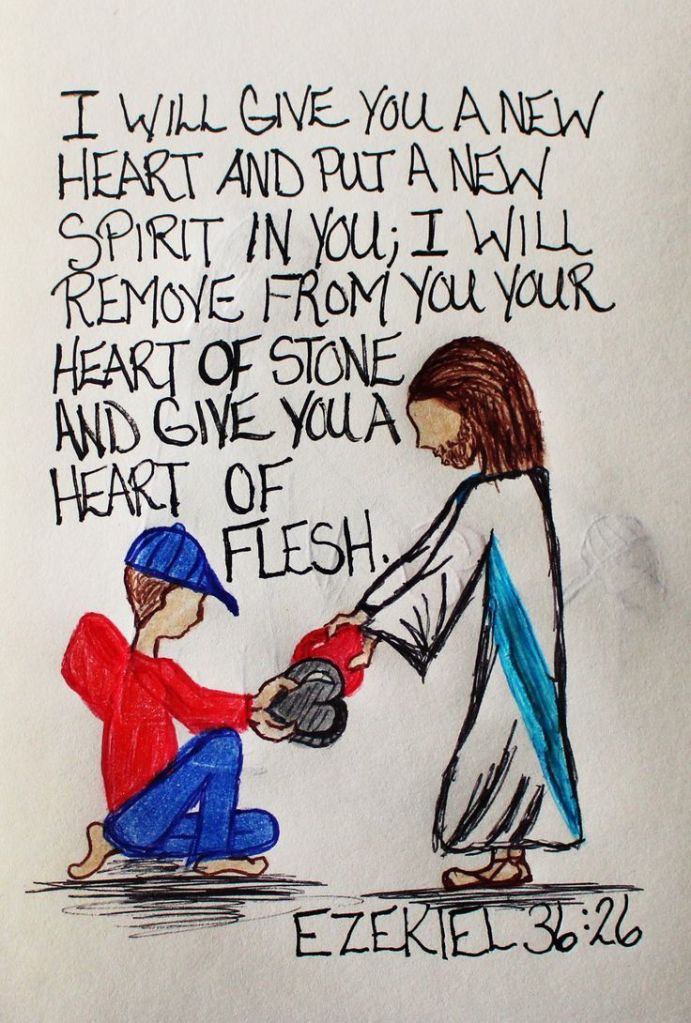
“They will return to it and remove all its vile images and detestable idols. I will give them an undivided heart and put a new spirit in them; I will remove from them their heart of stone and give them a heart of flesh. Then they will follow my decrees and be careful to keep my laws. They will be my people, and I will be their God. But as for those whose hearts are devoted to their vile images and detestable idols, I will bring down on their own heads what they have done, declares the Sovereign Lord.”

Then the cherubim, with the wheels beside them, spread their wings, and the glory of the God of Israel was above them. The glory of the Lord went up from within the city and stopped above the mountain east of it. The Spirit lifted me up and brought me to the exiles in Babylonia in the vision given by the Spirit of God.

Then the vision I had seen went up from me, and I told the exiles everything the Lord had shown me. (New International Version)

God’s heart is a heart of justice. The Lord abhors unrighteousness, injustice, and oppression. Thankfully, God will not sit idle and put up with systemic evil for long.

Ezekiel is one of those Old Testament prophets that thoroughly uncovered the true state things, especially of the human heart. Through a series of visions given to Ezekiel for the Israelite exiles, one of the main messages of the prophet is that God would give them a new heart. 

There is hope for the exile, for the one in captivity because of sin’s destructive, demeaning, and deluding power. Conversely, for those conforming to such ways, for the ones who caused the exile of others, the high Judge of the universe will deal with them according to their errant and rascally ways.

Dark shadows exist within the human heart. Although humanity has a great potential for altruistic good, people also have a large capacity for evil. Arrogant pride, self-centered behavior, and sheer ignorance can take such root within a person’s heart, as well as the heart of an organization or institution, that oppression becomes the norm, with fat cats ruling over an indigent people.

At best, the heart apart from God contains a miniscule vestige of its ancient Creator’s image; at worst, the heart is desperately wicked and on a highway to hell. 

The issue, then, is whether the heart only needs to be modified, or whether there is needed a complete heart transplant. The prophet makes it quite clear which option must be done.

Jesus Christ sacrificed himself on the cross so that we could be transformed into new people. He did not come to tweak a few things in life and improve upon it – he came to bring wholesale change and transform the heart. 

If all we needed was a motivational speaker who would inspire our hearts to live better and reach our personal goals, then we would have not needed an incarnation, a crucifixion, a resurrection and ascension. Jesus is the risen Lord and Savior who replaces our hard stubborn hearts with a soft new heart of flesh. 

We need transformation of life, not life modification.

Awesome God, you have graciously and surgically removed my old heart, which was bound for destruction, and replaced it with a new heart, oriented toward living and loving like the Lord Jesus. May my heart always be inclined to the doing of your will, in the power of your Holy Spirit. Amen.

Deuteronomy 9:1-5 – A Reality Check

Jordan River by Ilan Szekely, 1944

Listen, Israel! Today you will cross the Jordan River to enter and take possession of nations larger and more powerful than you, along with huge cities with fortifications that reach to the sky. These people are large and tall—they are the Anakim. You know and have heard what people say: “Who can stand up to the Anakim?” Know right now that the Lord your God, who is crossing over before you, is an all-consuming fire! He will wipe them out! He will subdue them before you! Then you will take possession of their land, eliminating them quickly, exactly as the Lord told you.

Once the Lord your God has driven them out before you, don’t think to yourself, It’s because I’m righteous that the Lord brought me in to possess this land. It is instead because of these nations’ wickedness that the Lord is removing them before you. You aren’t entering and taking possession of their land because you are righteous or because your heart is especially virtuous; rather, it is because these nations are wicked—that’s why the Lord your God is removing them before you, and because he wishes to establish the promise he made to your ancestors: to Abraham, Isaac, and Jacob. (Common English Bible)

When my kids were small, I dealt with the issue of sharing, as every parent has to do. Once, two of my girls were fighting over a doll. As I entered the room, one of them quickly said, “She has my doll!” So, I sat her down with me and calmly asked, “Whose doll is it?” “It’s mine!” my daughter cried.

I asked again, “Whose doll is it?” Again, the answer came, “It’s my doll!” I asked yet a third time, “Whose doll is it?” Because this was not our first rodeo together about fighting over dolls and toys, my daughter bowed her head, gave a big sigh, and quietly said, “It’s God’s doll.”

“Yes, it’s God’s doll,” I said. “God is just letting you borrow it for a while and expects you to take good care of it and share his stuff with others.”

Kids often need a reality check of where things come from and who really owns it all. Many times, adults need the very same reality check.

We big people grow up and tend to think we are bigger than we really are. Over the years, we gain misguided notions of our possessions and accomplishments. We believe we did it all through our own skills and character.

Maybe you recognize some of these common notions about our life, work, and ministry:

  • “I worked a long time for my money. I’m not giving it to so-and-so.”
  • My church has a lot of people because we preach the Bible, not like other churches.”
  • “The government takes too much of my hard earned money.”
  • “Here, you can have this couch. I was going to throw it away, anyway. My couch is a nice new one.”
  • “I made a lot of sacrifices for my job. I’m not letting anyone steal my position from me.”
  • “I raised my kids and they’re all doing very well in life. They wouldn’t have made it without me.”
  • “Hey, that’s my yard. Your dog can’t be on it.”
  • “This is my time.”
  • “It’s my car. Don’t touch it.”
  • My way or the highway.”

Those are actual statements Christians have said to me over the years. In their extreme individualism, they believed they were the masters of their own goodness and achievements. In other words, they gave themselves more credit than they really deserved.

A person is proud and selfish not for pursuing their own good but for neglecting their neighbor’s.

It’s far too easy to chalk-up our positions, titles, degrees, jobs, and the good things which come with them as of our own doing. We then believe we are the true owners of all our stuff. Some can even take the next step of believing that if others would just do what I do and think the way I think, then all would be well in the world.

That’s pretty much how Lucifer thought about things. And even after getting cast from heaven, he still exists with the delusion that he didn’t deserve it, as if he were above ever getting treated any other way than like God does.

The reality, however, is that everything and everyone belongs to God. The Lord is the rightful ruler of the universe, and we are not. Every good and perfect thing we have in this life is a gift from a gracious heavenly Father.

Stupidity doesn’t come from a lack of brains or smarts; it’s a result of pride taking over one’s thinking.

Indifference doesn’t have its source in a lack of caring; it comes from believing certain people don’t deserve to have my attention, my stuff, or my time.

Arrogance isn’t an inbred personality trait; it’s the logical end of the successful person’s life who is convinced that everyone ought to adopt their particular set of societal mores, cultural values, political views, and personal disciplines.

Conversely, a person in humble circumstances with little to their name is not necessarily lazy or unwilling to work. And when they have giants in their lives, they can trust the God who specializes in taking down the stupid, the indifferent, and the arrogant.

All things are a gift from the Lord, even the difficult people and hard circumstances we face. They are really opportunities for God to show up and give us precisely what we need.

Everything is a trust from God that we are to steward well, whether it is people, things, or money. They are given to us, not because of any superior spirituality on our part or righteous ingenuity, but because God simply gives it. We have what we have because of God, period.

The appropriate way of stewarding our resources, as well as expressing thanks to God, is through sharing our stuff, our money, our time, and our love with others.

Whose life is it?

We do not presume to come to your Table, O merciful Lord, trusting in our own righteousness, but in your abundant and great mercies. We are not worthy so much as to gather up the crumbs under your table; but you are the same Lord whose character is always to have mercy. Grant us, therefore, gracious Lord, so to eat and drink that our sinful bodies may be made clean by his body, and our souls washed through his most precious blood, and that we may evermore dwell in him, and he in us. Amen.

Psalm 1 – Choose Real Happiness

The truly happy person
    doesn’t follow wicked advice,
    doesn’t stand on the road of sinners,
    and doesn’t sit with the disrespectful.
Instead of doing those things,
    these persons love the Lord’s Instruction,
    and they recite God’s Instruction day and night!
They are like a tree replanted by streams of water,
    which bears fruit at just the right time
    and whose leaves don’t fade.
        Whatever they do succeeds
.

That’s not true for the wicked!
    They are like dust that the wind blows away.
And that’s why the wicked will have no standing in the court of justice—
    neither will sinners
    in the assembly of the righteous.
The Lord is intimately acquainted
    with the way of the righteous,
    but the way of the wicked is destroyed. (Common English Bible)

True happiness happens when we conform to disciplines of a good life and eschew practices that go against the grain of goodness. That statement might be a bit difficult to accept. Frankly, it is for me, and I wrote it.

You see, I’m not much of a conformity sort of guy. I like creatively doing my own thing, man. Bucking the system and questioning the rules is just something I do. Conformity tends to have a negative connotation with me – like a group of unthinking lemmings running off a cliff to their death.

Yet, the truth is that, although there is a wide range of creative choices we have for most everything, we as humans best function and discover happiness when we are in sync with our Creator. So, we can choose to ignore our foundational human hard-wiring, or we can live into it as the unique individuals we are.

Those two ways of shaping our lives are the path of the righteous and the path of the wicked. The way of the righteous leads to human flourishing, relational connection, and a vast spiritual life. Alternatively, the way of the wicked leads to human degeneration, disconnection from others, and spiritual death. It is to be out of sync with who we are as people.

Distinguishing between the righteous and the wicked is not always as easy as it looks. Only at the end of the age, when the Day of Judgment comes, will we know for certain the righteous and the wicked.

The magisterial Reformer of the sixteenth-century, Martin Luther, framed the two opposing ways as the theology of the cross and the theology of glory. The cross of Christ is G-d’s attack on human sin. Through being crucified with Christ, we find the way to human flourishing and life. It is the narrow road of grace.

A theology of glory is seeking to be radically independent – to rely primarily, perhaps even exclusively, on our own laurels and personal way of doing things. Although these might appear to be outwardly fine, they feed and water themselves from a wicked stream, devoid of grace.

Whenever we place our complete trust in self and forsake faith in something or someone outside of ourselves, it is a highway to the grave.

It is far too easy to place faith in our good works and to do good so that others will observe our goodness, rather than doing them out of the good soil of being planted in ancient and wise instruction.

Embracing tried and true practices of righteousness; delighting in G-d’s law; meditating on sound instruction; privately pouring over the large body of wisdom we have available to us; and diligently seeking to put it all into action is the way of good people who shall surely realize human happiness. They will yield gracious fruit. They will know blessing.

Joyful are people of integrity,
    who follow the instructions of the Lord.
Joyful are those who obey his laws
    and search for him with all their hearts.

Psalm 119:1-2, NLT

Serving only to be seen; seeking public accolades and personal recognition as a sole motivator; and disrespecting others to prop up individual respect is the way of the wicked. They don’t bother to consult the ancient ways of happiness. Instead, they pridefully believe they know what is best.

“You’re like manicured grave plots, grass clipped and the flowers bright, but six feet down it’s all rotting bones and worm-eaten flesh. People look at you and think you’re saints, but beneath the skin you’re total frauds.” (Matthew 23:27-28, MSG)

Abundance, generosity, gentleness, and grace marks the righteous because G-d is abundantly gracious and generous. Jesus is the gentle shepherd who mercifully and lovingly leads anxious sheep to the quiet pastures of settled happiness. Indeed, the Lord watches over the way of the righteous.

Only looking out for number one, stinginess, withholding good, hoarding, and angry criticism identifies the wicked. They have judgment in their future because they add no value to the great needs of humanity. Unhappiness is their lot.

We have choices. We can choose conformity to established patterns of godly instruction and happiness – or we can choose to rely solely on our own ingenuity and/or brawn to eke out a morsel of satisfaction.

Choose wisely, my friends.

O Holy Wisdom, direct us on your path. Make us worthy of your teachings and open our hearts to accept your embrace, that we may serve you in peace and grace. Amen.