Joshua 4:14-24 – The Importance of Visual Reminders

That day the Lord brought honor to Joshua before all Israel. They respected him all his life, just as they had respected Moses.

The Lord told Joshua, “Instruct the priests carrying the ark of the covenantal laws to come up from the Jordan.” So, Joshua instructed the priests, “Come up from the Jordan!” The priests carrying the ark of the covenant of the Lord came up from the middle of the Jordan, and as soon as they set foot on dry land, the water of the Jordan flowed again and returned to flood stage.

The people went up from the Jordan on the tenth day of the first month and camped in Gilgal on the eastern border of Jericho. Now Joshua set up in Gilgal the twelve stones they had taken from the Jordan. He told the Israelites, “When your children someday ask their fathers, ‘What do these stones represent?’explain to your children, ‘Israel crossed the Jordan River on dry ground.’ For the Lord your God dried up the water of the Jordan before you while you crossed over. It was just like when the Lord your God dried up the Red Sea before us while we crossed it.He has done this so all the nations of the earth might recognize the Lord’s power and so you might always obey the Lord your God.” (New English Translation)

On my hospital office desk, where I can see it every day, is a scapular. “Scapular” is the Latin word for “shoulders.” A scapular typically consists of two small pieces of cloth, a few inches in size, which has a religious image on one, and a message on the other. There are two bands of cloth connecting the message or image.

The wearer places one square on the chest, rests the bands on each shoulder and lets the second square drop down the back. Worn by some Catholic faithful, the scapular serves to remind the believer of their commitment to live a Christian life.

The particular scapular I have in my possession was given to me by a patient when I was first starting out as a hospital chaplain. I was called to the room of a dying patient. He was afraid of death. So, we conversed together for an hour about his life, his fears, and his devotion to faith. At the end of the conversation, the patient took off the scapular he was wearing, which states, “Whosoever dies wearing this Scapular shall not suffer eternal fire.”
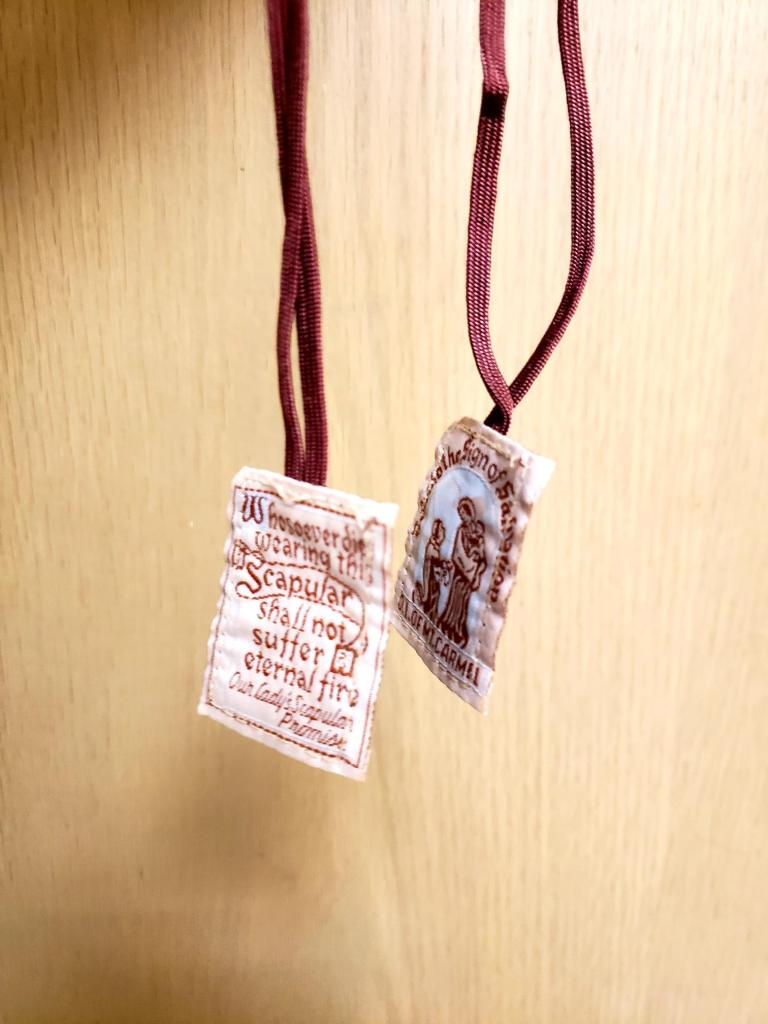
Regardless of what you think about scapulars and the particular message on this one, most important to me is what the patient said next with tears in his eyes: “I’ve worn this scapular every day for the past forty years. Here, I want you to have it. I don’t need it anymore. I am no longer afraid of death.”

The patient died. But he died at peace with God and without fear. I keep his scapular on my desk as a constant reminder of why I am a hospital chaplain, and how important the work I do is. Anytime I get discouraged or have a hard day, when I return to my office, the scapular reminds and reorients me that the spiritual care of patients is a privileged and sacred responsibility.

The ancient Israelites were finally ready to enter the Promised Land. The twelve tribes miraculously crossed the Jordan River on dry ground. God had stopped the water from flowing. After everyone crossed over, the river went back to flowing again.

Joshua, their leader, instructed people from each tribe to take a large stone from the river and place them in a heap for two didactic reasons:

1) To educate future generations inside Israel that God kept the promise to bring them into a land of abundance; and

2) To educate those outside Israel that God is mighty.

It’s important that we all have a continual awareness of why we are here on this earth and what our purpose is. Our history is significant and needs to be remembered.

Yet, there are many families and faith communities in which the children know little about how God worked in their parents’ lives, not to mention the many previous generations. Having tangible reminders of God’s past actions helps everyone remember. 

Just as people ask me about why I have a scapular on my desk, so having reminders of God’s grace in prominent visible places serves to aid all ages of folks to ask why those mementos are there.

It is good to have visual reminders of faith and the faithful people who influenced us around our homes, places of work, and communities so that others may discover and know the redemptive acts of God, that the Lord keeps promises.

Almighty God, we praise and magnify your holy Name for all your servants who have finished their course in faith and patience. May we remember them and their service well. We humbly pray that, at the day of resurrection, we and all who are members of the mystical body of your Son may be set on his right hand, and hear his most joyful voice: “Come, you who are blessed by my Father, inherit the kingdom prepared for you from the foundation of the world.” Grant this, O merciful Father, for the sake of Jesus Christ, our only Mediator and Advocate. Amen

Psalm 32 – Don’t Waste Away

Blessed is the one
    whose transgressions are forgiven,
    whose sins are covered.
Blessed is the one
    whose sin the Lord does not count against them
    and in whose spirit is no deceit.

When I kept silent,
    my bones wasted away
    through my groaning all day long.
For day and night
    your hand was heavy on me;
my strength was sapped
    as in the heat of summer.

Then I acknowledged my sin to you
    and did not cover up my iniquity.
I said, “I will confess
    my transgressions to the Lord.”
And you forgave
    the guilt of my sin.

Therefore, let all the faithful pray to you
    while you may be found;
surely the rising of the mighty waters
    will not reach them.
You are my hiding place;
    you will protect me from trouble
    and surround me with songs of deliverance.

I will instruct you and teach you in the way you should go;
    I will counsel you with my loving eye on you.
Do not be like the horse or the mule,
    which have no understanding
but must be controlled by bit and bridle
    or they will not come to you.
Many are the woes of the wicked,
    but the Lord’s unfailing love
    surrounds the one who trusts in him.

Rejoice in the Lord and be glad, you righteous;
    sing, all you who are upright in heart! (New International Version)

Depression is downright awful. It is the leading cause of disability in the Unites States among people ages 15-45. More sobering is the fact that two-thirds of all persons with depression have not yet sought help.

The psalmist was once one of those persons. When he kept silent, it was as if his bones went limp and wasted away inside him. The emotional pain of such an experience transcends our language.

David, the psalmist, had every reason to feel deeply about the circumstances of his life. He had been both the victim and even the perpetrator in all kinds of very troubling situations. Yet, as the king of Israel and Judah, he kept the stiff-upper-lip of stubbornly holding everything inside. 

The very word “depression” literally means to depress or stuff the emotions down inside and keep them tightly held within, not allowing them to see the light of day. Deep inside, those feelings don’t just go away. Instead, they sit, not going anywhere, and eventually rot the soul.

“It’s so difficult to describe depression to someone who’s never been there, because it’s not sadness. I know sadness. Sadness is to cry and to feel. But it’s that cold absence of feeling — that really hollowed-out feeling.”

J. K. Rowling

There was a time in my past in which I was so good at stuffing my feelings that one night when my neighbor had a blow-out of a party at two o’clock in the morning, I actually felt no anger. Just so you know: That’s not healthy. I had an anger problem. Not the kind where you explode, but just the opposite – the kind where you stuff every unwanted feeling in the book.

Recovery, for me, meant first recognizing that I was depressed and had a lot to be angry about. Next, I began to let myself feel the past situations of my life. And I need to tell you that what was inside me wasn’t at all pretty. 

Like a wound that needs peroxide, dealing with depression hurt like hell. But I couldn’t heal without it. I couldn’t go around it or avoid it; I had to go through it. 

Finally, I learned to not only identify my feelings, but take charge of them. I discovered I could choose to say how I feel without apology, and I could say it all in a way that helped others, as well as myself. Like David of old, I had to get what was inside on the outside.

The Christian season of Lent is an appropriate time to do this sort of internal work. This is no time to sit on neglected feelings or stuff emotions. It may seem as if opening up will cause internal shame, outward regret, or judgment from others.

But that would be a lie.

Shame cannot survive the light of day; regret typically happens when we fail to do something; and millions of others are struggling with the very same sort of things you are.

What’s more, God is patiently awaiting for us to break our silence and tell what’s troubling us. With the Lord, there is bountiful grace, unconditional forgiveness, and emotional healing.

I don’t believe depression is a sin which needs to be confessed but rather a terrible condition of the spirit that must be named and dealt with. So, if you are experiencing:

  • Feelings of sadness or a depressed mood that lingers for weeks, even months
  • A loss of interest or pleasure in activities once enjoyed
  • Changes in appetite — weight loss or gain unrelated to dieting
  • Trouble sleeping or sleeping too much
  • A loss of energy or increased fatigue
  • An increase in useless activity (e.g., hand-wringing or pacing) or slowed movements and speech
  • Feelings of worthlessness, shame, or guilt
  • Difficulty thinking, concentrating, or making decisions
  • Thoughts of death or suicide

Then, it is high time to get help. A place to start can be with the Substance Abuse and Mental Health Services Administration’s National hotline at 1-800-662-HELP (4357) or online at findtreatment.samhsa.gov

It is also wise to speak with a trusted family member or friend about the need for help and support, as well as a safe faith leader, pastor, or chaplain. There is no reason for anyone to have to live with crushing emotional and/or spiritual pain day after day.

Gracious God, your stamp of approval is on the penitent – those who are brutally honest with the inner self and receive your mercy. I will not keep silent. I will declare to you the current state of my life and not run away from the ugliness within. Through the gracious Name of Jesus, I pray with thanksgiving. Amen.

Isaiah 5:1-7 – A Parable of the Vineyard

Let me sing for my loved one
    a love song for his vineyard.
My loved one had a vineyard on a fertile hillside.
He dug it,
    cleared away its stones,
    planted it with excellent vines,
    built a tower inside it,
    and dug out a wine vat in it.
He expected it to grow good grapes—
    but it grew rotten grapes.
So now, you who live in Jerusalem, you people of Judah,
    judge between me and my vineyard:
What more was there to do for my vineyard
    that I haven’t done for it?
When I expected it to grow good grapes,
    why did it grow rotten grapes?
Now let me tell you what I’m doing to my vineyard.
I’m removing its hedge,
    so it will be destroyed.
I’m breaking down its walls,
    so it will be trampled.
I’ll turn it into a ruin;
    it won’t be pruned or hoed,
    and thorns and thistles will grow up.
I will command the clouds not to
The vineyard of the Lord of heavenly forces is the house of Israel,
    and the people of Judah are the plantings in which God delighted.
God expected justice, but there was bloodshed;
    righteousness, but there was a cry of distress! (Common English Bible)

God is the owner of the vineyard. Israel and Judah are the beloved. The Lord graciously chose them, gave them divine promises, and set his steadfast love upon them. God sang over them with affection and took care of them.

The Lord God put time, effort, and love into the relationship. God anticipated good things, looked forward to a bright future, and expected a flowering of justice and righteousness from the people.

It didn’t happen. The relationship went sour. Nothing but rotten grapes.

God builds. God gives. God sustains…. God destructs. God takes away. God ends it.

The Lord didn’t put all that work into the people to have them perpetuate injustice toward the poor and disadvantaged. God didn’t choose Israel so that they would then neglect God’s law by mistreating others and ignoring the right.

The bloodshed of the people was that they squeezed and bled the poor to death. Their cries and anguished responses were ignored. There was no mercy. So, God was not about to idly stand by and let such rotten grapes abuse and ruin the good, the just, and the right.

The relationship between and God and God’s people was an ancient love song that went off key and struck a minor chord. The Lord has extreme love and patience… until he doesn’t. There’s no way the just and right God is going to put up with abusive, ignorant, and bad folks forever.

Defend the rights of the poor and the orphans; be fair to the needy and the helpless.

Psalm 82:3, GNT

Jesus had this allegorical image of Isaiah in mind when he spoke in parables about the impossibility of good fruit coming from bad vines and trees, and the necessity of removing dead branches. (Luke 6:43-45; John 15:1-17)

If the grapes are bad, the vine is bad. If the words are hateful, sarcastic, passive-aggressive, manipulative, conniving, racist, hurtful, mean, foolish, and either subtly or overtly abusive, then the person has a dark heart and is need of redemption, not excuses.

Learn to do good.
    Seek justice.
Help the oppressed.
    Defend the cause of orphans.
    Fight for the rights of widows.

Isaiah 1:17, NLT

Every tree that does not bear good fruit will be cut down and thrown into the fire. The wicked heart will not be able to speak ill of others and act hatefully with impunity forever. They will be called to account for their abusive words and actions, whether overtly violent, or subtly undermining.

The righteous heart, however, shall experience divine pleasure and reward, as if the careful construction of helpful and building up words with loving deeds wins first-prize at the great heavenly fair for their plump juicy grapes.

The good person loves and does not hate. They are so far from harming anyone that they even pray and wish well for their enemies. They pray for blessings on those who curse them. There is an honest striving to speak good words to everyone, regardless of who they are.

The upright heart thinks the best of everyone and holds nothing over someone else’s head. Such a good heart condemns no one, leaving all judgment to God alone. It is patient with the most exasperating of people, praying they might come to their senses and become spiritually healthy.

The righteous are able to use their speech to admonish their neighbor with care and affection. They freely forgive, happily give, liberally encourage, and use their tongue to speak words of life. Indeed, their speech is wise, humble, full of grace, and above all, loving.

The just and right person uses their hands and feet to build good things for others, especially the most vulnerable and needy among us. They willingly meet needs without bitterness or with a begrudging heart.

If there is a problem with words, it will not do to simply change the speech. That’s because it is a heart issue. And the heart must be willing to change and be transformed by sheer mercy.

If there is an issue with actions, it will not do to merely enforce a change in behavior. That’s because it’s a heart problem. And the heart desperately needs to acknowledge sin and repent from evil.

Fortunately, God is the expert on renovating dilapidated hearts and performing effective heart transplants.

Oftentimes something needs to be destroyed for a building to be erected. There always needs to be a death before there can be a resurrection. New life cannot occur without forsaking an old life.

In this Christian season of Lent, believers in Jesus are mindful that our life of faith, hope, and love comes from a death. So, we journey with Jesus along the road of suffering, up Calvary, and are crucified with him so that we might rise with him.

This is the way.

It is the way of repentance, of genuine change, of new habits, of Christianity. So now, let’s go to him outside the camp, bearing his shame. We don’t have a permanent city here, but rather we are looking for the city that is still to come. (Hebrews 13:13-14)

May justice, righteousness, and peace be yours in abundance through him who gave himself for us and for our salvation.

Revelation 2:8-11 – Spiritual Endurance

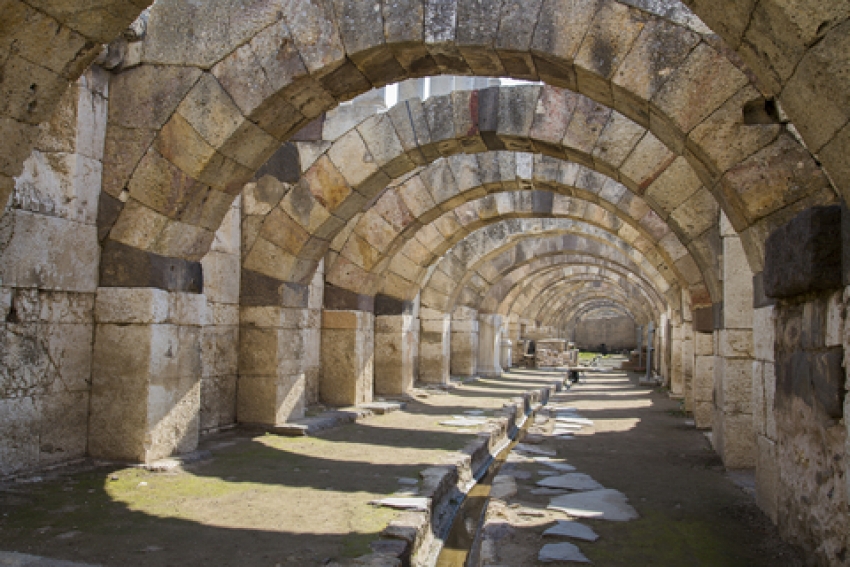
The remains of ancient Smyrna in Izmir, Turkey

This is what you must write to the angel of the church in Smyrna:

I am the first and the last. I died, but now I am alive! Listen to what I say.

I know how much you suffer and how poor you are, but you are rich. I also know the cruel things being said about you by people who claim to be Jews. But they are not really Jews. They are a group that belongs to Satan.

Don’t worry about what you will suffer. The devil will throw some of you into jail, and you will be tested and made to suffer for ten days. But if you are faithful until you die, I will reward you with a glorious life.

If you have ears, listen to what the Spirit says to the churches. Whoever wins the victory will not be hurt by the second death. (Contemporary English Version)

Jesus not only speaks in the four Gospels of the New Testament; Christ also speaks in the final biblical book of Revelation to seven different churches.

In today’s New Testament lesson, Jesus addresses the church at Smyrna – a large and beautiful port city in the ancient world, on the eastern coast of the Aegean Sea (present day Turkey). 

Jesus was letting the believers in Smyrna know they were about to experience severe persecution. However, they need not be fearful and can remain faithful because their Lord knows all about suffering. 

The church’s perseverance under such trouble would result in the crown of life, given to them by Jesus himself. Words coming directly from their Lord and Savior must surely have been an encouragement to the believers as they underwent extreme difficulty.

The congregation at Smyrna was facing imprisonment and, for some, even death for their faith. The heart of the message by Jesus is to remain faithful. 

The seven churches of Revelation which Jesus addressed

There will always be those who are faint of heart with weak faith, giving up when the going gets tough. Yet, persecution and hardship have a way of purging the soul, as well as the church, of its dross. Suffering is inevitable; how we handle adversity when it comes is completely under our own control.

Few of us will likely never face a hardship that could result in martyrdom. Knowing there are brothers and sisters in the faith throughout the world who do face daily hardship for devotion and beliefs puts our own troubles in a different light.

The daily irritations and trials that God puts in our way to refine us and shape our faith certainly seem small compared to imprisonment and martyrdom. Yet, no matter who we are and where we are located on this earth – whether facing uncommon hardship or banal difficulty – the afflictions of both body and soul come to us as opportunities to lean into faith and love Jesus to the end.

Jesus is not looking for perfect people – just faithful followers willing to endure suffering with the truth that our Lord stands with us. 

Whatever our current circumstances may be, Jesus offers us his perspective on it. He knows precisely what is going on and understands the spiritual resources you and I possess for each adverse situation we encounter.

In fact, few of us really discern the largess of internal resources within us because of Christ’s redemptive work and the Spirit’s abiding presence – not to mention the very personhood God graciously gave us in the womb before we were even born.

Even though it seems, at times, we lack the strength, wisdom, and courage for what is ahead – Jesus has supreme confidence in us to maintain faith and endure through our afflictions.

Life is not a sprint; life is a marathon. And to finish the race we need to be in good spiritual health. The perseverance of the saints will happen as we run – step by step, stride by stride – with boldness, despite fear of the unknown future around the bend.

Spiritual endurance requires becoming comfortable with risk, vulnerability, accountability, and the steadfast love which is both received and given.

Perhaps, most of all, it requires keeping our heads up and running toward the promise of reward at the finish. The crown of life is an image of both congratulation and celebration of a race well-run and the enjoyment of unending fellowship with our Lord for whom we have endured so much.

After all is said and done, and the end of the age has occurred, we will be able to look back in hindsight and see that it was really Jesus who all along was fortifying us to keep standing and keep going. Christ is so vested in us that he continually ensures our ultimate victory through a constant presence of help and encouragement. The heritage of both the Reformation and Holy Scripture testify to this truth:

“All our progress and perseverance are from God.”

John Calvin (1509-1564)

“I’m sure about this: the one who started a good work in you will stay with you to complete the job by the day of Christ Jesus.” (Philippians 1:6, CEB)

May the grace of Jesus sustain you; the love of God surround you; and the encouragement of the Spirit surprise you, today and every day. Amen.

Grant, O God, That we may never lose the way through our self-will, and so end up in the far countries of the soul; that we may never abandon the struggle, but that we may endure to the end, and so be saved; that we may never drop out of the race, but that we may ever press forward to the goal of our high calling; that we may never choose the cheap and passing things, and let go the precious things that last forever; that we may never take the easy way, and so leave the right way; that we may never forget that sweat is the price of all things, and that without the cross, there cannot be the crown.

So keep us and strengthen us by your grace that no disobedience and no weakness and no failure may stop us from entering into the blessedness which awaits those who are faithful in all the changes and chances of life down even to the gates of death; through Jesus Christ our Lord. Amen

—William Barclay, Prayers for the Christian Year