Everyone Can Juggle

“Say, what?” you may protest. “I can’t juggle. I can’t learn that. I’m not coordinated, not rhythmic, not graceful, not _____.” (fill in the blank with your own negative)

I’m not buying it. I insist everyone can juggle, without exception. Yes, even the elderly, the young, those with severely arthritic hands and no hands, at all, can juggle. This is no mind game. It’s not playing with words.

Everyone can juggle because there is a juggler inside of every person.

God is Creator. People are creatures, created in the image and likeness of God. God is a juggler. And so are you and me.

It comes down to what kind of story we are telling ourselves.

For example, if there is a narrative rolling around in your head that you are stupid, even though you may be very intelligent, you will live up to the story of being unintelligent. The life you live will be as an incompetent nincompoop.

So, what is the story you are telling yourself about yourself?

Juggling takes practice. I can teach anyone to juggle in three minutes, or less. After that, it’s all about doing it – lots and lots of repetition and practice. It takes time, patience, and tenacity – the very qualities required to do just about anything.

Which you have done multiple times in your life, already. Sometimes we all need to remember when we did something well, when we committed to the time and effort of accomplishing an important task or project.

There is nothing glamorous about learning to juggle, and certainly not about becoming proficient at it. It is tedious, pedantic, and at times, frustrating work. It takes an overarching, “Why?”

If I want to juggle because it looks cool, and I’d like to impress friends, then I likely will not stick with it. If I believe it can be done in a relatively short amount of time, then I’ll probably become discouraged and drop out.

Yet, if I discover I really like to juggle, and I want to do it, that in the doing of this new thing I am finding out some things about myself I didn’t know before – or even that when I juggle, even imperfectly, I learn something about God – well, then, this is a “why” which has sustaining power.

Yes, indeed, everyone can juggle. There is a juggler inside each and every one of us. The real issue is whether we actually believe that is true, and whether we really have a solid internal reason for doing so.

So, let’s come back to that weird part about what I said above – that even people without an ability to lift their arms (or with no arms, at all) can juggle. It has to do with our definition of juggling. Here is the straight up dictionary definition of the words, “juggle,” “juggling,” and “juggler:”

To keep (several objects, as balls, plates, tenpins, or knives, etc.) in continuous motion in the air simultaneously by tossing and catching.

To perform feats of manual or bodily dexterity, as tossing up and keeping in continuous motion a number of balls, plates, knives, etc.

A person who performs juggling feats, as with balls or knives, etc.

One little word makes the difference here: etcetera. (etc.)

I’m actually not going to answer my own question or make explicit my point. I’ll let you fill it in yourself because I am confident you can do so. You are creative.

You’ll figure it out.

What we all really need is just enough direction to get our creative abilities going, without so much instruction that it becomes controlling (like a boss looking over your shoulder and just barking orders when you screw up).

Developing a skill or a craft is different than becoming a professional or doing a job. The real work is both internal and most often out of the limelight. It’s a commitment to a process, more than it is a means to an end goal. A process cannot be rushed; there must not be shortcuts. And, unless we learn to enjoy the process, we end up doing shoddy work.

The construction of a person’s soul is a lifelong project.

It requires becoming aware of one’s deep inward spirituality. Solitude, silence, and stillness are imperative to forming the soul.

I am a Christian. As such, I want to know Christ better. For that to happen, I need to pay attention to and care for my soul.

Throughout the history of Christianity, much attention has been given to the care of souls. Early church fathers (and mothers) such as Gregory the Great (540-604, C.E.) took great pains to describe ministerial work as offering moral and spiritual guidance to both the churched and unchurched, both Christian and non-Christian.

In 1656, Puritan preacher Richard Baxter wrote a book, The Reformed Pastor, which set the standard of pastoral care for generations. Baxter elaborated on seven functions of crafting souls (stated in my own words):

  1. Helping others connect with their spiritual selves;
  2. Giving sage spiritual direction;
  3. Building up people with careful and encouraging words;
  4. Attending to church, family, and group dynamics;
  5. Providing special focus to the needy, the sick, and the dying;
  6. Holding people accountable for their words and actions;
  7. Setting proper spiritual boundaries to keep harmful words and actions at bay within the community.

There is nothing sexy about any of these functions. It is humble nitty-gritty work which typically goes unnoticed by many because it is a slow process over time.

As a Christian who is concerned for the construction of souls, I take my cues from the Christian Bible. There are many references to “one another” in the New Testament which highlight the spiritual dynamics and proper environment needed for souls to thrive. Just a few of the most mentioned are: 

  • Encouragement
  • Mutual edification
  • Love
  • Forgiveness
  • Hospitality

Within the New Testament Gospels of Jesus, Christ modeled a life of spiritual practice which include healing, teaching, guiding, and mending damaged and broken souls. These were all a part of his mission to bring God’s benevolent kingdom to earth.

Like a proper garden, we need to continually tend to our soul, which requires the consistent spiritual farming of daily Scripture reading and prayer, practicing Sabbath rests, silence and solitude, fasting, and giving.

Our souls need careful shepherding. We are to be vigilant toward attending to our spiritual selves, as well as the souls of others – not because we must, but because we are willing.

You can do this. After all, you are a juggler!

Leviticus 23:1-8 – There’s More to Life Than Work

The Lord said to Moses: Speak to the Israelites and say to them: These are my appointed times, the Lord’s appointed times, which you will declare to be holy occasions: Work can be done for six days, but the seventh day is a Sabbath of special rest, a holy occasion. You must not do any work on it; wherever you live, it is a Sabbath to the Lord. These are the Lord’s appointed times, holy occasions, which you will celebrate at their appointed times:

The Lord’s Passover is on the fourteenth day of the first month at twilight. The Lord’s Festival of Unleavened Bread is on the fifteenth day of the same month. You must eat unleavened bread for seven days. On the first day you will hold a holy occasion and must not do any job-related work. You will offer food gifts to the Lord for seven days. The seventh day will be a holy occasion; you must not do any job-related work. (Common English Bible)

When I was kid, watching the cartoon The Jetsons was a Saturday morning ritual. The futuristic family featured George the husband and father, an employee of Spacely Sprockets. 

In one episode, George comes home and is met by his dog, Astro, and wife, Jane, looking tired and haggard from a day’s work. George’s comment when he entered on the treadmill through the door was, “Jane, these 3-hour work-days are killing me!”

Indeed, the technological progress of post-World War II America had led to the common belief among many that with so many advancements, workdays would become smaller, with leisure time growing. In the 1960’s, it seemed a foregone conclusion that technology would provide the masses with unprecedented amounts of discretionary time for whatever they would want to do.

Sixty years removed from The Jetsons, and we now know what Americans and people across the world would do with time-saving devices: We simply work a lot more. 

Just the opposite has occurred from having loads of leisure time. People discovered that greater efficiency with technology has brought an equal competition for business and making more money. Time saved has translated into accomplishing more work, and not in taking vacations or indulging in new hobbies and ventures.

The fourth command of God’s Ten Commandments is needed today more than ever. It is high time that we come back to this basic instruction of the Lord and engraft its wise counsel into our lives. 

The point of God’s command for a Sabbath-rest is neither to squash commerce, nor to be a curmudgeon about fencing one day a week of doing nothing. Instead, the Sabbath command is designed to be a life-giving day where we discover that: There is more to life than work.

The word “Sabbath” literally means “to rest.” God built into creation a rhythm of rest and work. God rested, not because of being tired but so that there was enjoyment of the earth and everything in it. 

Everything in life is done in rhythm. We walk in rhythm, talk in rhythm, and our hearts beat in a rhythm. The earth cycles in rhythmic seasons of the year, and the animal kingdom mates and lives in annual rhythms. All creation is rhythmic.

Whenever we keep going and do not live according to the rhythm laid out for all of God’s creatures, we break. Therefore: Rest from work is needed.

Even machinery needs a break. I find it more than ironic that we treat our cars and vehicles with the regular maintenance and care that we don’t even extend to ourselves. We care for our cars because we don’t want to experience a breakdown on the highway. Yet, much more important is the care of our souls and our bodies. 

Without regular intervals of work and rest, in a consistent rhythmic pattern, we breakdown, burnout, and, like little children who have missed a nap, we have epic meltdowns of anger, frustration, and passive-aggressive behavior because we simply ignored God’s fourth command.

“Each person deserves a day away in which no problems are confronted, no solutions searched for. Each of us needs to withdraw from the cares which will not withdraw from us.”

Maya Angelou

Legalistic observances of the Sabbath miss the point through a continual, “Don’t do this, don’t do that, can’t do anything fun on Sunday,” as if God were some divine curmudgeon who frowns with a deeply furrowed brow at anything happy on the Sabbath. (Mark 2:23-3:6) 

To rest means to have a change of pace from the regular weekday activity of work. To rest and enjoy the difference of a Sabbath’s day is avoided by so many people because it brings this question to the forefront of our minds: Who am I if I’m not working?

Our identities can be so tied to our jobs that we compulsively check our multiple e-mail accounts on a day off; tie ourselves to our smart phones and iPhones on vacation; and allow work to bleed into our time away from the job. 

God has wisely placed loving boundaries around us. But like Adam and Eve, who were not content with enjoying the entire garden, we obsessively pluck the forbidden fruit from the one tree that is off limits.

Work brings money, influence, power, relationships, industry, and a host of good things. The problem is not work; the problem is that we humans can create an idol of it.

Whenever work and all that comes with it, consumes our attention, we are on a one-way road to nowhere. I have heard many deathbed confessions. I’ve yet to hear anyone wish they had worked more.

No, the confessions typically involve something out of rhythm and out of whack – that they let their jobs and their ambitions surrounding work call the shots in life, without stopping to enjoy the vast creation, the gifts of God, and the emotional wealth that can come from relationships.

“If we only stop when we are finished with all our work, we will never stop, because our work is never completely done… Sabbath… liberates us from the need to be finished.”

Wayne Muller

Because we aren’t sure who we are if we’re not working, we just keep working. If we feel bad, we work harder.  If things are tough at home, we just put more hours in at work. If we need more money, we pick up a part-time job. 

When work becomes the catch-all answer to our many problems, it has become our god and we will worship at the altar of money and activity… until we can learn to stop and rest. 

One day out of seven. Just one-seventh of your life is needed to allow a divine rhythm into your existence. 

The temptation, however, is to take a day off from work so that you can do other work at home. So, the challenge, for many people, is to allow the one day of the weekend to be the time you get stuff done, and another day to truly rest.

This is not easy. For me, it is terribly hard. I can easily slide into working seven days a week for weeks, even months, at a time. Few people bat an eye at my constant working, except my wife and a few friends. In fact, many people seem impressed when I work all the time. But what gets lost in all this is God’s grace to us through rest.

God wants enjoyment, not avoidance – for us to be still and know God. The Lord longs for us to connect with the Divine. This means we must plan and prepare for it. Maybe we need to put God on our calendars, to make an appointment with God like we would anyone else. That will often involve being out in God’s big creation.

Whenever we get down to practicing the Sabbath, we find that the world didn’t stop. Then, when we return to work, we discover that the earth is still spinning on its axis. 

Life doesn’t cease when we submit to a Sabbath rest; it’s just that we cease from participating in it for a short time. Our delusions of grandeur dissipate and disappear when we finally come around to consistently obeying a good old Sabbath rest.

Work is noble. But there is nothing noble about working without rest. 

We are still human beings when we aren’t making money, and still valuable when we don’t have jobs. Folks in healthcare facilities aren’t any less important because they no longer hold a job. Work doesn’t define us – God’s image within us does. 

It’s unlikely that we’ll ever see a George Jetson 3-hour workday, and that’s probably a good thing. Work’s inherent goodness can only be truly appreciated when we plan and prepare to live and enjoy a Sabbath’s day rest. 

Because I belong to you, God, and not to myself,
I will rest from worrying about the future
and rest in your never-ending divine presence;
I will rest from frustration at things not working out as I want them to;
I will rest from fear
and rest in my experience of courage when days are hard.
I will rest from complaining
and rest in the beauty and pleasure all around me.
For the Lord’s yoke is easy and his burden is light,
and I will find rest for my soul. Amen.

Isaiah 43:8-15 – The Supremacy of God Matters

Bring out the people who have eyes but are blind,
    who have ears but are deaf.
Gather the nations together!
    Assemble the peoples of the world!
Which of their idols has ever foretold such things?
    Which can predict what will happen tomorrow?
Where are the witnesses of such predictions?
    Who can verify that they spoke the truth?

“But you are my witnesses, O Israel!” says the Lord.
    “You are my servant.
You have been chosen to know me, believe in me,
    and understand that I alone am God.
There is no other God—
    there never has been, and there never will be.
I, yes I, am the Lord,
    and there is no other Savior.
First I predicted your rescue,
    then I saved you and proclaimed it to the world.
No foreign god has ever done this.
    You are witnesses that I am the only God,”
    says the Lord.
“From eternity to eternity I am God.
    No one can snatch anyone out of my hand.
    No one can undo what I have done.”

This is what the Lord says—your Redeemer, the Holy One of Israel:

“For your sakes I will send an army against Babylon,
    forcing the Babylonians to flee in those ships they are so proud of.
I am the Lord, your Holy One,
    Israel’s Creator and King. (New Living Translation)

I am an ordained Minister in a smallish denomination, the Reformed Church in America. This particular Christian tradition has its roots in the magisterial reformer, John Calvin (1509-1564). Calvin placed a strong emphasis on the sovereignty of God. In other words, all things hinge on God as the supreme Being of the universe. As Creator of all things, God’s actions and inactions are in no way dependent upon us creatures.

I believe in God’s unconditional election of persons to salvation and new life. Maybe that means nothing to you, and to others it means everything. For many folks, it’s just some churchy mumbo-jumbo which is rather irrelevant to the real stuff of the Christian life. 

I do not agree. It seems to me to be quite important. The heart of Reformation faith is a focus on God’s sovereignty, majesty, power, and grace. It is God who justifies, and not any human. That means there are no conditions to which God is beholden to act. That is, God works in the world according to divine free will and is not reliant upon anyone or anything to accomplish good purposes and fulfill good promises.

“We should therefore learn that the only good we have is what the Lord has given us gratuitously; that the only good we do is what He does in us; that it is not that we do nothing ourselves, but that we act only when we have been acted upon, in other words under the direction and influence of the Holy Spirit.”

John Calvin

Today’s Old Testament lesson is a soaring view of God’s grace and powerful control. Throughout all eternity God is God. There is none who can thwart the Lord’s plans. God acts freely and mercifully and nothing can cancel out those actions. Nothing can separate us from the love of God. We might jump from finger to finger in our puny attempts at autonomy, but we are not getting out of God’s hand! 

For me, this is a balm and a comfort to my soul. Not everything is up to me, as if my action or inaction has cosmic repercussions. As a guy who easily tends toward carrying the world on his shoulders, it is good for me to know that the earth spinning on it’s axis isn’t my job.

It seems to me, the assurance of God’s sovereignty in the world really ought to be a comfort to every believer. God’s decrees will be fulfilled, and there is not one thing any wicked person can do to subvert divine initiatives.

Furthermore, there is absolutely no way we can screw-up God’s purposes. We simply do not have such power. Our great task as believers is to rest secure in God’s will and to therefore place our trust in the One who knows exactly what he is doing in the world.

So, take a few minutes, draw in a few deep breaths, and think on the wonderful truth that God is sovereign. To help you, here is the great opening to the Reformed confession, The Heidelberg Catechism, giving us a glimpse into the majesty of God:

Q: What is your only comfort in life and in death?

A: That I am not my own,

but belong with body and soul,

both in life and in death,

to my faithful Savior Jesus Christ.

He has fully paid for all my sins

with his precious blood,

and has set me free

from all the power of the devil.

He also preserves me in such a way

that without the will of my heavenly Father

not a hair can fall from my head;

indeed, all things must work together

for my salvation.

Therefore, by his Holy Spirit

he also assures me

of eternal life

and makes me wholeheartedly willing and ready

from now on to live for him. Amen.

Psalm 126 – Planting in Tears and Harvesting with Joy

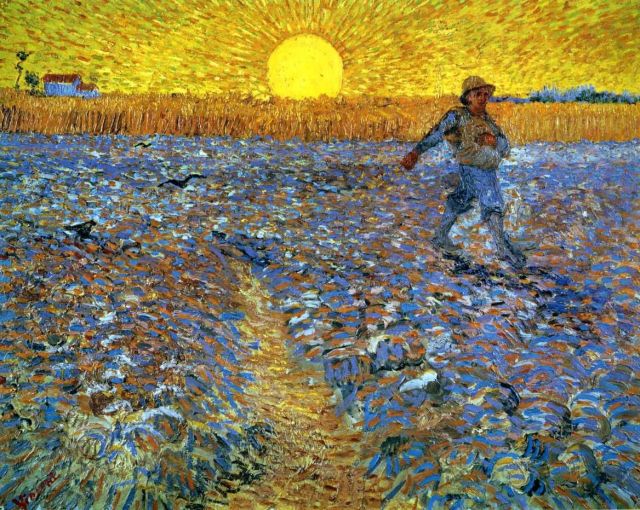
The Sower, by Vincent Van Gogh, 1881

When the Lord brought back his exiles to Jerusalem,
    it was like a dream!
We were filled with laughter,
    and we sang for joy.
And the other nations said,
    “What amazing things the Lord has done for them.”
Yes, the Lord has done amazing things for us!
    What joy!

Restore our fortunes, Lord,
    as streams renew the desert.
Those who plant in tears
    will harvest with shouts of joy.
They weep as they go to plant their seed,
    but they sing as they return with the harvest. (New Living Translation)

Many people are familiar with the phrase, “You reap what you sow.” Although the saying is typically referred to in the context of avoiding poor decisions (Galatians 6:7) the principle is woven throughout Holy Scripture in other scenarios, as well, as it is in today’s psalm.  

Sowing and reaping are, of course, agricultural terms. Farmers and gardeners tend to the soil through tilling, planting, cultivating, weeding, and eventually harvesting. The images of farming and the growth of plants serve as fitting metaphors for the spiritual life. Growth does not occur quickly. Instead, constant and vigilant attention to one’s spirit eventually brings a harvest of good works and godly attitudes. 

Jesus said, “My food is to do what the one who sent me wants me to do. My food is to finish the work that he gave me to do.” (John 4:34, ERV)

In a culture which values immediacy and having things now, the slow growth of the spiritual life can be a difficult principle to grasp. We may think that whenever we sin – with no immediate lightning to zap us – that therefore what we did must not have been so bad. 

Eventually, however, our implanted seeds will sprout and become visible to all. Conversely, we might believe whenever we dedicate ourselves to altruistic service, and then see no immediate results, that we must be doing something wrong. So, we may easily become discouraged and give up.

Sow for yourselves righteousness; reap steadfast love. Break up your fallow ground; for it is time to seek the Lord, that he may come and rain righteousness upon you. (Hosea 10:12, NRSV)

The psalmist reminds us of the need for patience. Just as it takes continual watering to reap a harvest in the field, so the Christian’s life of weeping and tears, of tilling deeply into the things of God, is the necessary work to eventually spot a sprout, see growth, and finally bear fruit. 

The tedious cultivating and weeding of our souls is the task before us. If we are patient and consistent, we will realize a harvest of righteousness. 

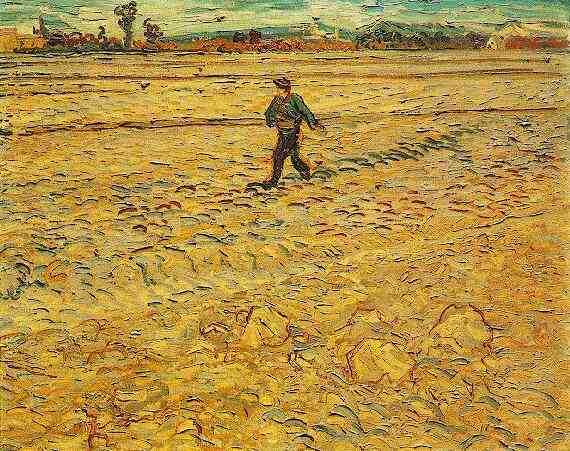
The Sower, by Vincent Van Gogh, 1888

Jesus taught his Beatitudes to help us understand that righteousness, peace, and joy come through connecting with our poverty of spirit; mourning over personal and corporate sin; embracing humility and meekness; hungering and thirsting after righteousness.

Only through the blood, sweat, and tears of spiritual agony will we come through to the deep happiness of seeing the Lord accomplish great things in our lives. In other words, joy is neither cheap nor easy. It is the fruit of many tears.

Spiritual farming involves sound practices of sowing and reaping. There is suffering before glory, tears before joy, lament before healing.

Just as a farmer cannot take short-cuts in the planting and cultivating process if he wants to have a bounteous and delicious harvest, so there is no getting around the painful work of grieving our changes and losses.

Avoiding the hard work of spiritual farming leads to a bogus harvest where we bite into a fresh ear of sweet corn only to discover a mouthful of worms.

Remember this: The person who plants a little will have a small harvest, but the person who plants a lot will have a big harvest.

2 Corinthians 9:6, NCV

The bulk of our lives are played out in the liminal space between sowing and reaping. The farmer plants and waits, attentive to the land and the weather until the time of harvest. We, too, exist in a time of patience. So, we pray, recalling past harvests and anticipate that with God’s good help, we will enjoy abundance.

This in-between time is often characterized by tears.

As she stood behind him at his feet weeping, she began to wet his feet with her tears. Then she wiped them with her hair, kissed them and poured perfume on them. (Luke 7:38, NIV)

I grew up on an Iowa farm. I only saw my father cry twice in my life. The first time, I was just a boy, two days after my eighth birthday – a devastating hailstorm destroyed the crops that had been planted just six weeks before. Despite farm equipment and technological savvy, the farmer is still at the mercy of the weather.

And we will always be at the mercy of God. Because God is good, just, and fair, the Lord does great and benevolent things. To be blessed, we need to embrace the dog days of summer in all its banality and its tears until we reach the time of reaping. There is joy, and it is coming, if we do the work of spiritual farming and wait patiently.

Likely, none of us awake in the morning, sit up on the edge of the bed, and say to ourselves, “Well, let’s see, I think I’ll cry and be sorrowful today.” We might do that with joy, but not with sadness. It can be easier to gravitate toward the fulfillment of dreams, laughter, and happiness than tears and weeping.

Yet, if we want to experience authentic joy, the path to it is through crying because it is our tears which find a better way.

“Normality is a paved road: It’s comfortable to walk, but no flowers grow on it.”

Vincent Van Gogh

Whether it comes from a certain denominational tradition, ethnic background, or family of origin dynamics, there are many Christians who love to emphasize Jesus as Victor and camp in resurrection power – while eschewing Christ as the man of sorrows, acquainted with grief and sadness.

By viewing only one dimension of Christ’s redemptive work, pastoral care often falls far short of true help. Trying to engineer cheerfulness and create solutions to a person’s genuine grief is, at best, not helpful, and at worst, damaging to their soul. It only leads to cheap inauthentic joy.

Sincerely singing spontaneous songs of joy, with a sense of abundant satisfaction, comes through suffering and sorrow. There must be a crucifixion before there is a resurrection. In the agrarian culture of ancient Israel, the metaphor of sowing a reaping connected well to the importance of planting tears and allowing them to flower later into an abundant harvest of joy.

Perhaps in contemporary American culture, a more apt metaphor would be financial investing and cashing out. The investment we put into attending to our grief with expressions of lament through tears, will eventually get a return, and we shall be able to cash out with a rich bounty of joy.

Easter is coming. Resurrection and new life will occur. The journey of Lent, with seeds repentance carefully planted, watered with tears, shall bring an abundant harvest of joy.

Gratias Deo. Thanks be to God.