
Ezekiel 11:1-25 – A New Heart

Then the Spirit lifted me up and brought me to the gate of the house of the Lord that faces east. There at the entrance of the gate were twenty-five men, and I saw among them Jaazaniah son of Azzur and Pelatiah son of Benaiah, leaders of the people. The Lord said to me, “Son of man, these are the men who are plotting evil and giving wicked advice in this city. They say, ‘Haven’t our houses been recently rebuilt? This city is a pot, and we are the meat in it.’ Therefore, prophesy against them; prophesy, son of man.”

Then the Spirit of the Lord came on me, and he told me to say: “This is what the Lord says: That is what you are saying, you leaders in Israel, but I know what is going through your mind. You have killed many people in this city and filled its streets with the dead.

“Therefore, this is what the Sovereign Lord says: The bodies you have thrown there are the meat, and this city is the pot, but I will drive you out of it. You fear the sword, and the sword is what I will bring against you, declares the Sovereign Lord. I will drive you out of the city and deliver you into the hands of foreigners and inflict punishment on you. You will fall by the sword, and I will execute judgment on you at the borders of Israel. Then you will know that I am the Lord. This city will not be a pot for you, nor will you be the meat in it; I will execute judgment on you at the borders of Israel. And you will know that I am the Lord, for you have not followed my decrees or kept my laws but have conformed to the standards of the nations around you.”

Now as I was prophesying, Pelatiah son of Benaiah died. Then I fell face down and cried out in a loud voice, “Alas, Sovereign Lord! Will you completely destroy the remnant of Israel?”

The word of the Lord came to me: “Son of man, the people of Jerusalem have said of your fellow exiles and all the other Israelites, ‘They are far away from the Lord; this land was given to us as our possession.’

“Therefore say: ‘This is what the Sovereign Lord says: Although I sent them far away among the nations and scattered them among the countries, yet for a little while I have been a sanctuary for them in the countries where they have gone.’

“Therefore say: ‘This is what the Sovereign Lord says: I will gather you from the nations and bring you back from the countries where you have been scattered, and I will give you back the land of Israel again.’

“They will return to it and remove all its vile images and detestable idols. I will give them an undivided heart and put a new spirit in them; I will remove from them their heart of stone and give them a heart of flesh. Then they will follow my decrees and be careful to keep my laws. They will be my people, and I will be their God. But as for those whose hearts are devoted to their vile images and detestable idols, I will bring down on their own heads what they have done, declares the Sovereign Lord.”

Then the cherubim, with the wheels beside them, spread their wings, and the glory of the God of Israel was above them. The glory of the Lord went up from within the city and stopped above the mountain east of it. The Spirit lifted me up and brought me to the exiles in Babylonia in the vision given by the Spirit of God.

Then the vision I had seen went up from me, and I told the exiles everything the Lord had shown me. (New International Version)
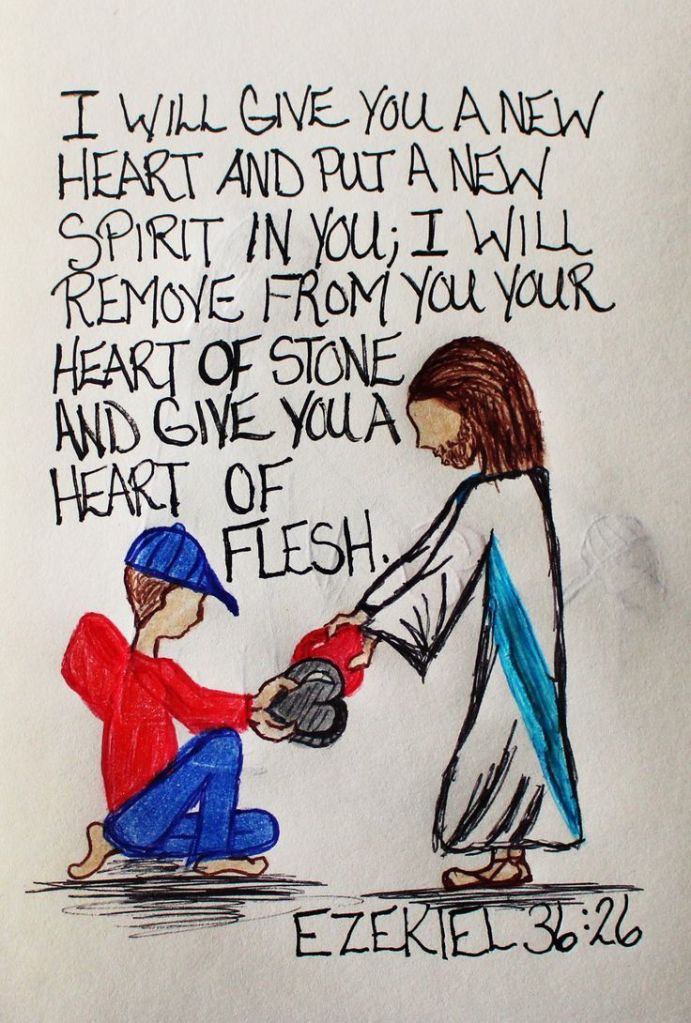
God’s heart is a heart of justice. The Lord abhors unrighteousness, injustice, and oppression. Thankfully, God will not sit idle and put up with systemic evil for long.

Ezekiel is one of those Old Testament prophets that thoroughly uncovered the true state things, especially of the human heart. Through a series of visions given to Ezekiel for the Israelite exiles, one of the main messages of the prophet is that God would give them a new heart. 

There is hope for the exile, for the one in captivity because of sin’s destructive, demeaning, and deluding power. Conversely, for those conforming to such ways, for the ones who caused the exile of others, the high Judge of the universe will deal with them according to their errant and rascally ways.

Dark shadows exist within the human heart. Although humanity has a great potential for altruistic good, people also have a large capacity for evil. Arrogant pride, self-centered behavior, and sheer ignorance can take such root within a person’s heart, as well as the heart of an organization or institution, that oppression becomes the norm, with fat cats ruling over an indigent people.

At best, the heart apart from God contains a miniscule vestige of its ancient Creator’s image; at worst, the heart is desperately wicked and on a highway to hell. 

The issue, then, is whether the heart only needs to be modified, or whether there is needed a complete heart transplant. The prophet makes it quite clear which option must be done.

Jesus Christ sacrificed himself on the cross so that we could be transformed into new people. He did not come to tweak a few things in life and improve upon it – he came to bring wholesale change and transform the heart. 

If all we needed was a motivational speaker who would inspire our hearts to live better and reach our personal goals, then we would have not needed an incarnation, a crucifixion, a resurrection and ascension. Jesus is the risen Lord and Savior who replaces our hard stubborn hearts with a soft new heart of flesh. 

We need transformation of life, not life modification.

Awesome God, you have graciously and surgically removed my old heart, which was bound for destruction, and replaced it with a new heart, oriented toward living and loving like the Lord Jesus. May my heart always be inclined to the doing of your will, in the power of your Holy Spirit. Amen.

Breakfast In the Liminal Space

Welcome, friends! John 21:1-19 is a story of Jesus and the disciples in the six weeks between Christ’s resurrection and ascension. It’s an awkward time for the disciples, as they try and come to grips with a new reality in which all the old rules have changed. Click the videos below and let’s help each other move into a new reality….

Pastor Tim Ehrhardt, John 21:1-19

Before us it is blessed, behind us it is blessed,
below us it is blessed, above us it is blessed,
around us it is blessed as we set out with Christ.
Our speech is blessed as we set out for God.
With beauty before us, with beauty behind us,
with beauty below us, with beauty above us,
with beauty around us, we set out for a holy place indeed. Amen. –A traditional Navajo blessing

Luke 14:12-14 – Abundance and Inclusion For All

The Great Banquet by Hyatt Moore

Then Jesus said to his host, “When you give a luncheon or dinner, do not invite your friends, your brothers or sisters, your relatives, or your rich neighbors; if you do, they may invite you back and so you will be repaid. But when you give a banquet, invite the poor, the crippled, the lame, the blind, and you will be blessed. Although they cannot repay you, you will be repaid at the resurrection of the righteous.” (New International Version)

A lot of people live by the old adage, “You scratch my back and I’ll scratch yours.” It’s a phrase referring to reciprocity. In other words, if you give me something I want, I will then respond by giving you something you want.

That old adage works fine, that is, unless you have no ability to give or give back to another. If we only operate by the principle of reciprocity, a large chunk of people automatically get left out. And this situation is untenable and unacceptable to Jesus.

Christ observed that the religious insiders of his day were keeping entire groups of people on the outside through their practice of scratching one another’s backs.

We need to get ahold of the reality that God loves us, as well as everyone else – even the people we may not give the time of day to. God so loved the world that he sent his Son. Jesus has come to feed us. 

The kingdom of God is about food. The food given by Jesus is to feed the hungry by staging a banquet. It is a feast of God’s abundance. Yet, many seem to hoard the resources they have, only thinking about their friends, family, and people just like them. They act as if there is no need to invite outsiders, consumed as they are with their own daily lives.

We have an incredible abundant feast contained in Scripture – in fact, Jesus said that his food and drink was to do the Father’s will, that Scripture was his bread. (Matthew 4:4; John 4:34) 

It’s much too easy to take our blessings of food for granted. After all, when we are well-fed, it’s easy to assume that everyone else is, too. Feeling healthy, it’s easy to forget that others are hurting. Making money, it’s easy to think there are not many poor people around. Living in a community with plenty of churches and more bibles than people, it’s natural to assume that everyone knows the gospel of Jesus – but they don’t!

Then, whenever we get around to acknowledging there are people who need Jesus, we keep devising ways to reach them without having to change or accommodate our own lives to do it.

Christ’s call to faithful discipleship requires people to change from having a narrow focus on our small circle of friends, to including those who have no means to pay us back.

The gospel of Jesus Christ is open to outcasts and failures, to problem people and to unimpressive persons. People with needs and flaws are especially dear to Jesus. It’s the people who outwardly have it all together who are being replaced wholesale with those who admit their need. 

We must not be picky about who we invite to participate in the largess of abundance we possess. We are to avoid the spiritual snobbery of looking down our noses at the needy and less fortunate, who have nothing to offer us in return.

St. John Chrysostom (348-407, C.E.) was a Bishop of Constantinople and arguably one of the greatest preachers in the history of Christianity. John always thought of both the recipient and the giver in his sermons, insisting that both need God’s mercy.

With a concern for the giver’s soul, John insisted that givers provide for all – even the lazy, the fool, and the sinner. By opening our hearts in almsgiving, we open ourselves to Christ, who is present in the least of those among us. Refusing mercy to people deemed as unworthy, givers then actually shut themselves off from the very mercy God desires for them.

There is no reward from God when there is only reward from others.

“If we are going to examine lives, we will never have mercy upon any human being; rather, hindered by this inopportune meddlesomeness, we will remain fruitless and destitute of all help ourselves.”

St. John Chrysostom, On Repentance and Almsgiving

It’s not only the poor who suffer when the rich fail to give. In judging whether or not a particular person is worthy of love and aid, the wealthy person rejects the spiritual fruit that he would have received by giving with humility.

Giving to the poor, simply to relieve our own conscience, is not real charity; it doesn’t consider the other. We attend fully to the other by observing their spiritual and holistic needs for community, purpose, respect, and dignity. Dispassionate giving from a distance, without relationship, refuses to acknowledge the whole person. It exploits the poor for the mental comfort of the rich.

We need to be involved in people’s lives, and that takes a lot of blood, sweat, and tears. There are too many lost people who need Jesus, and too many Christians who are the walking wounded and need the healing touch of Jesus, for us to pay scant attention to the call of Jesus to invite the needy into our lives. 

Seeing people come into God’s great banquet, and into a joyous and vital relationship with Christ, probably takes about ten times more work than what you are thinking it does right now. Yet, this is the pathway of true blessing – to having God’s stamp of approval on our lives.

Merciful God, thank you for the abundance of life, relationships, health, comfort, and wealth you have provided to so many. Thank you that, even in times of need, despair, and brokenness, you are there. Please, put your arms around children and families in  poverty and disability so that they feel your comfort and hope. Meet their needs both physically and spiritually. And guide me so I can be your hands and feet pursuing justice for the poor and upholding the cause of the needy, in the way of Jesus Christ our Lord. Amen.

Psalm 122 – A Spiritual Journey

I was glad when they said to me,
“Let’s go to the house of the Lord.”
Our feet are standing inside your gates, Jerusalem.
Jerusalem is built to be a city
where the people are united.
All of the Lord’s tribes go to that city
because it is a law in Israel
to give thanks to the name of the Lord.
The court of justice sits there.
It consists of princes who are
David’s descendants.

Pray for the peace of Jerusalem:
“May those who love you prosper.
May there be peace inside your walls
and prosperity in your palaces.”
For the sake of my relatives and friends, let me say,
“May it go well for you!”
For the sake of the house of the Lord our God,
I will seek what is good for you. (God’s Word Translation)

The spiritual life is a pilgrimage—a journey of constant growth, sacrifice, and faith in what we cannot see. As both pilgrims and disciples, we continually move and learn.

The biblical psalms of ascent (Psalms 120-134) were sung by worshipers as they made the journey to Jerusalem for the annual feasts, and up the temple mount to unite together in worship.

Many pilgrims spent hours and/or days walking to the holy city. In the great anticipation of collective worship, the people quoted and sang the several psalms of ascent together. They enjoyed the journey.

I once spent some time reading the journals of several medieval Christian pilgrims who went to various holy sites in Europe, and some who even made the trek all the way to Jerusalem – on foot. Early in their journals, they mostly wrote about the anticipation of reaching their destination. These pilgrims went into great detail about the hospitality they encountered, and friends made along the way.

I was struck, however, with the profound lack of space and detail devoted to visiting the actual holy site – especially when they returned home and reflected on their experiences. The vast majority of pilgrims had the journey itself as their most memorable time.

Of course, we all can worship individually and personally anywhere and anyplace. Yet, if we want to have worship experiences which truly shape our spiritual lives, then we will need to have plenty of corporate encounters with fellow pilgrims on the same path as us.

Within today’s psalm, we are told that part of Israel’s decree in approaching the Lord is to give thanks. The Jewish pilgrims were to have an attitude of gratitude when they came to Jerusalem and the house of God. Each pilgrimage to Jerusalem was to have a marked expression of thanksgiving to God for giving them a place to worship and a land to dwell within.

I cannot help but wonder if attending church services would be much more appreciated and impactful if we took the mental and emotional posture of gratitude when approaching worship. 

Within some church buildings and sacred spaces there is a flight of stairs that one must ascend to reach the sanctuary. Slowly going up the stairs, we can give thanks for one thing in each step. Even if you attend a church with a zero entry, you can still give thanks to God while walking from the parking lot to the building. 

The point is that the worship of God needs some thought and intent behind it. Simply showing up and flopping down in a seat – almost daring the worship leaders and/or pastor to bless them – is far from the imagination the psalmist had for approaching a sovereign God.

Pilgrimage is about more than a long walk. It’s about the soul in community with others and God.

One way of being a pilgrim close to home is through walking a Labyrinth – an ancient practice of the Church meant for spiritual centering, contemplation, and prayer.

Entering the serpentine path of a Labyrinth, one walks slowly while quieting the mind and focusing on a spiritual question or prayer. A Labyrinth is not a maze. It has only one winding path to the center and back out. 

The wisdom of the Labyrinth is that it reflects the way life actually is – that our lives are not about the destination but about the long circuitous journey. The Christian life is consistently described in the New Testament as a road or a way. We walk with Jesus.

Labyrinths can be found within some church buildings, on church grounds, in hospitals, or park spaces. There are also “finger” Labyrinths. Rather than physically walking, the pilgrim can slowly trace the path on a paper or small Labyrinth object with a finger. 

You might also get creative and make your own homemade Labyrinth within a space of your home or out in the yard. labyrinthsociety.org has free printable Labyrinths, as well as a virtual Labyrinth walk.

The Labyrinth is not meant to be a race to the center; it only “works” if we move at a pace which enables us to meditatively pray, paying attention to what God is doing within us. Generally, there are four stages to the walk:

  • Releasing on the way toward the center – letting go of all that weighs us down in the Christian life.  “Let’s throw off any extra baggage, get rid of the sin that trips us up, and fix our eyes on Jesus, faith’s pioneer and perfecter.” (Hebrews 12:1-2, CEB)
  • Receiving in the center – accepting the love God has for you. Jesus said, “Ask and you will receive, so that your joy may be complete.” (John 16:24, NRSV)
  • Returning through following the path back out – integrating what you have received for the life of the world. “I will give them a heart to know me, God. They will be my people and I will be their God, for they will have returned to me with all their hearts.” (Jeremiah 24:7, MSG)
  • Responding to the love of God through gratitude – thus finding joy, even in the most troubling of circumstances. “O give thanks to the Lord, for he is good; his steadfast love endures forever!” (Psalm 118:1, NRSV)

The penitent heart will resonate deeply with the psalms as worship liturgy. This is because liturgical practices impress the spirit and bring spiritual freedom.

Walking together in a common spiritual journey is like going through a gate into a new reality and rejoicing with all the other redeemed pilgrims who are walking the road to Jerusalem.

Lord Jesus Christ, you call me to follow you, and I choose to walk with you. Open the eyes of my heart to see my life in a new way. With each step I take, help me to be open to change. As I walk this pilgrimage, give me the grace to journey deliberately and patiently. Amen.