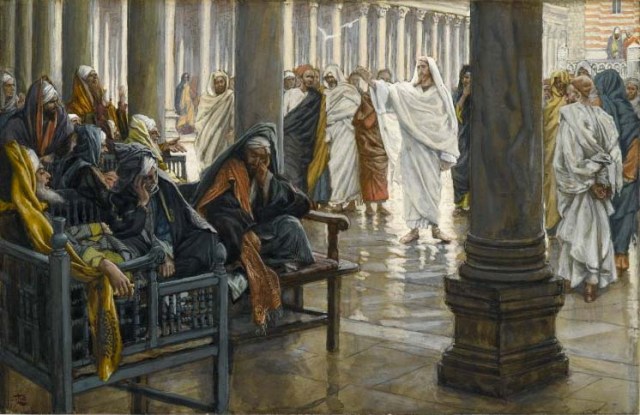
All Who Come and Touch are Made Well (Matthew 14:34-36)

They crossed the lake and came to land at Gennesaret, where the people recognized Jesus. So they sent for the sick people in all the surrounding country and brought them to Jesus. They begged him to let the sick at least touch the edge of his cloak; and all who touched it were made well. (Good News Translation)

Jesus showed up. That’s all it took. The very presence of Christ emboldened people to act. And these were not just the religious folk. They were on the other side of the lake – which for us means the other side of the tracks. In other words, the people of Gennesaret were poor and needy with lots of sick persons, as well as spiritually pagan.

This wasn’t a place that pious people visited. It was far from being a destination vacation spot. But it was just the sort of place that Jesus would visit. It was for people like those at Gennesaret that Christ came.

Jesus Recognized

In the previous story of the disciples on the lake during a storm, Jesus walked out on the water to them. When they saw him, they didn’t recognize him. But here, in today’s story, a bunch of people who weren’t following Jesus around, knew who he was straightaway.

One of the great ironies of the New Testament Gospels is that Jesus often got a cool reception of unbelief amongst the religious insiders in his own homeland, while tending to receive faith from spiritual outsiders in heathen places. Christ initiated a seismic shift and a great transfer of replacing the insiders with the outsiders. This sort of activity was so spiritually scandalous and cataclysmic that it eventually got Jesus killed.

“Many who are first will be last, and many who are last will be first.”

Jesus (Matthew 19:30, NIV)

People Respond

The people of Gennesaret demonstrated their faith by acting on the sight of Jesus amongst them. They sent others out into the surrounding countryside to let them know that Jesus was here. That was all it took for the rural folk to not only come but to bring all their sick friends and family with them. Belief abounded, that this man, Jesus, could do the impossible work of curing and healing.

And this is precisely the sort of mentality and heart attitude Jesus was looking for. In telling his parable of the soils, Christ wanted the response of the fourth soil: To not only hear and acknowledge, but to also take the words and ways of God into one’s life in such a way that growth and development happens, fruit matures, and a harvest of righteousness, justice, and peace occurs.

“The seed falling on good soil refers to someone who hears the word and understands it. This is the one who produces a crop, yielding a hundred, sixty or thirty times what was sown.” (Matthew 13:23, NIV)

Jesus Makes All the People Well

The most “touching” thing to me in this short account of Christ encountering the people of Gennesaret is that every single person who came to Jesus was made well, without exception.

Such was the faith of the people, that they neither needed nor expected Jesus to come and lay his hands on them or to even say anything. They simply believed that if they could but touch the fringe of his cloak, healing and wellness would happen.

And the people weren’t just seeking their own betterment, but were concerned for everyone they knew who needed help. Whether there was superstition mingled with the faith is really of no concern; just a smidgeon of faith in Jesus is potent and powerful enough to effect a complete makeover of a person.

Moreover, there wasn’t simply individual and isolated instances of wholeness and healing; there was a mass level miracle, a giant group touch of healing and health.

Jesus welcomed them all, and allowed all the people to touch. Most of us don’t want a bunch of strangers touching us or our clothes, at all. That’s too weird and creepy, and likely makes us uncomfortable. What’s more, no respectable person would ever think of touching a rabbi – especially women. That sort of thing was religiously and culturally unacceptable.

Another irony we see is that the crossing of purity boundaries and laws which made people ritually impure is turned on it’s head. Instead, this kind of activity of people touching Christ made the impure folks pure. As something of a rule-breaker at heart, I find this reality refreshing. We need a lot more of it.

Jesus and People Today

Today’s Gospel lesson might seem a nice story that happened a very long time ago. We may also believe it doesn’t have much to do with me today. After all, Jesus isn’t bodily roaming the countryside today. We don’t see mass healings of people. In some places, we rarely see any healing at all from a direct result of faith. So, why even talk about this? Why bring it up? Do you just want to get my hopes up, only to dash them? Isn’t all this stuff pie-in-the-sky thinking, anyway?

Those are legitimate questions and concerns. And we ought not to disparage or make light of anyone asking them. All of us have likely encountered reaching out in faith without any healing or change of circumstance. Rather than going to one of two extremes, by either berating ourselves for a supposed failure of faith, or of discounting God altogether as a figment of the unenlightened mind, we can take a different approach.

The very nature of faith is contact, connection, and care. Faith is up close, relational, and involves touch. Faith is free, yet it is not cheap. Faith always involves a cost: vulnerability and intimacy. If we ever look for faith from afar and have no intention of getting up close and personal – so close as to touch the hem of a garment – then that which we seek will forever be elusive to us.

I’m not talking about a process or a plan that you can predictably access to get the result you want. Rather, I’m referring to real human contact and relationship that can only happen with being open about needs and wants, and is willing to expose one’s inner person to the outside world. I’m talking about putting away the false front we put up for others to see, and let the true self come out. Yes, it’s risky. Yes, it most likely will hurt. And yes, it will lead to healing.

When a person goes to a doctor for a pain they cannot get rid of, and get a diagnosis of needing surgery to deal with the hurt, we willingly allow the surgeon to create more pain for us by cutting into our body. We allow it because we understand that more pain leads to less pain.

And the same is true for our soul. Our broken hearts, our damaged emotions, our racing thoughts, and our hurting spirits need to experience the invisible scalpel of God. Divine intervention is often unpleasant – at least at first – but then later results in wellness for all who invite it’s touch.

May you come with vulnerable faith, confident hope, and active love, to the One who can help you realize your most intimate longings. Amen.

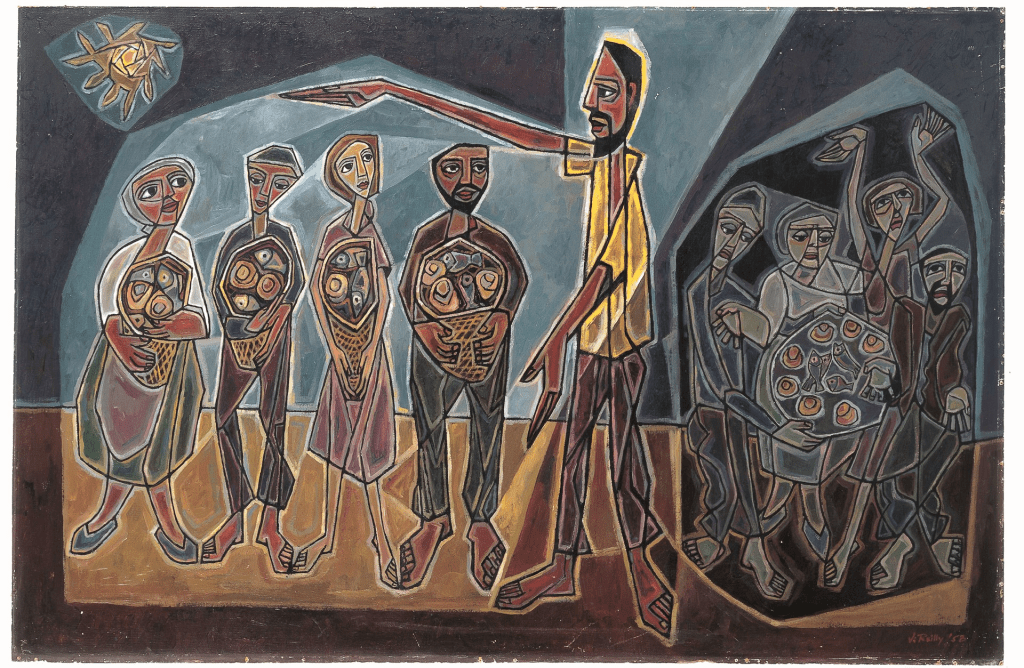
Jesus Feeds the Five Thousand (Matthew 14:13-21)

The Feeding of the Five Thousand, by John Reilly (1928-2010)

When Jesus heard what had happened, he withdrew by boat privately to a solitary place. Hearing of this, the crowds followed him on foot from the towns. When Jesus landed and saw a large crowd, he had compassion on them and healed their sick.

As evening approached, the disciples came to him and said, “This is a remote place, and it’s already getting late. Send the crowds away, so they can go to the villages and buy themselves some food.”

Jesus replied, “They do not need to go away. You give them something to eat.”

“We have here only five loaves of bread and two fish,” they answered.

“Bring them here to me,” he said. And he directed the people to sit down on the grass. Taking the five loaves and the two fish and looking up to heaven, he gave thanks and broke the loaves. Then he gave them to the disciples, and the disciples gave them to the people. They all ate and were satisfied, and the disciples picked up twelve basketfuls of broken pieces that were left over. The number of those who ate was about five thousand men, besides women and children. (New International Version)

Miracles still happen

I know of a woman who once brought a pan of lasagna to a community meal at her church, thinking that only 25-30 people would be fed. However, 70 people showed up. Her immediate thought was to go buy more, but she didn’t have the time.

So, here is what the dear woman did: She looked up to heaven, gave thanks, and started dishing out the lasagna – until every last person was fed. She confided in me that “every time I put my spatula down there was food to put on it!”

The story of Jesus feeding thousands of people is not just a nice account that happened a long time ago; Jesus is still in the miracle business. Christ can take our meager resources and turn them into something with a large impact on a lot of people. 

For this to happen, all we need to do is follow our Lord’s simple instructions: “You give them something to eat,” and, “Bring them here to me.” Jesus, using a simple act of obedience by the disciples, did one of the most famous miracles in history.

The message of the story is simple, but profound: Jesus can multiply whatever little we have, to accomplish his kingdom work, through us. Jesus could do miracles without us, but he wants us to participate in the work. We only need to bring our few loaves and fish to him.

The compassion of Jesus is the motivation for miracles

Jesus withdrew to a solitary place. But the crowd did not leave him alone. Rather than be annoyed by the situation, Jesus looked at the large group of people and his heart went out to them. So, he went about the work of healing the sick. Please know that God does not begrudgingly deal with you, as if you were an interruption to his day; he has compassion.

The desire of Jesus is for us to participate in the miracles

After a full day of healing, Christ’s disciples came to him as if he was unaware of the people’s need for food. They gave a very rational and realistic answer to the problem of hunger: Dismiss them so they can go out to eat. But Jesus said, “They don’t need to go away; you give them something to eat.” 

I detect maybe a hint of sarcasm in the tone of the disciples reply: “We have only five loaves of bread and two fish.” But their math was way off because they did not count Jesus.  “Bring them here to me,” Christ replied. If we have ears to hear, Jesus is still saying this today: bring them here to me. Through simple prayer and active obedience, we give Jesus what we have, no matter how little or insignificant it seems to us.

Much of what we do in the American church is a reasonable and rational ministry; it has little to do with the impossibility of faith and seeing God work in ways that are incomprehensible to our modern sensibilities.

A Chinese pastor once visited the United States. After seeing our vast resources of money, buildings, and ministries. He said, “This is amazing! It’s incredible what you American Christians can do without God!” 

In reality, we need God – who is in the business of taking our simple obedience and humble participation, and doing the miraculous. And it has always been this way. For example….

Elisha Multiplies the Widow’s Oil, from  L’histoire dv Vieux et dv Nouveau Testament, 1670

The wife of a man from the company of the prophets cried out to Elisha, “Your servant my husband is dead, and you know that he revered the Lord. But now his creditor is coming to take my two boys as his slaves.”

Elisha replied to her, “How can I help you? Tell me, what do you have in your house?”

“Your servant has nothing there at all,” she said, “except a small jar of olive oil.”

Elisha said, “Go around and ask all your neighbors for empty jars. Don’t ask for just a few. Then go inside and shut the door behind you and your sons. Pour oil into all the jars, and as each is filled, put it to one side.”

She left him and shut the door behind her and her sons. They brought the jars to her and she kept pouring. When all the jars were full, she said to her son, “Bring me another one.”

But he replied, “There is not a jar left.” Then the oil stopped flowing.

She went and told the man of God, and he said, “Go, sell the oil and pay your debts. You and your sons can live on what is left.” (2 Kings 4:1-7, NIV)

You want me to do what?

What if we were to operate as if God were truly in the business of doing miracles?  Would it impact the way we pray, and the way we act?  What if we understood just enough of Jesus and what he can and wants to do that we would be bold to say: “This might sound crazy, but what if we….”

  • found out everyone who needs food in this community, go love on them, and feed them…
  • used our property to create a community garden and seek to help people grow their own food…
  • came up with a God-sized plan to reach our community…
  • prayed to see a hundred people come to Christ through this church… 

Most of our plans don’t require us to do anything impossible, so we simply settle for the possible.

We too often do nothing out of a sense that God either cannot or does not want to use me or what I have. But it just won’t do to stand afar off and expect God to work without us giving what we have – whether that something is time, money, conversation, food, hospitality, or whatever. 

Our limitations mean nothing to Jesus, so he doesn’t hear us when we say:

  • my home is too small, and it’s not clean enough
  • I don’t have enough money,
  • I’m not smart enough
  • my schedule won’t allow it
  • I don’t have enough resources

You don’t need much – only the willingness to be part of the miracle Jesus is doing.

Conclusion

You want me to do what? Feed thousands? Lead someone to Jesus? Pray in front of others? Work for justice?

Sometimes, the greatest miracle is for people to be open, real, and transparent enough to believe that Christ can do a miracle through confessing my sin, participating in a ministry, or having a spiritual conversation with an unbeliever. 

The question is never, “Can God use me?” It is, “What miracle does God want to do through me and through this church?”

It is no accident that when Jesus distributed the bread that it sounds a lot like communion. The Lord’s Supper may seem irrelevant, as if it is merely remembering Jesus. However, God’s design is much bigger: The Lord wants to do a miracle. 

God wants the practice of our communion together to bring healing and wholeness that the world cannot give. It might be unrealistic to expect that Jesus can use a Table to feed and reach thousands, but we don’t serve a God who is limited to work through rational means.

Blessed are you, O Lord God, King of the Universe, for you give us food to sustain our lives and make our hearts glad. We thank you for your countless blessings, especially for the gift of your Son, for the Church, for our faith, and now for this meal we are about to participate in, through Christ our Lord. Amen.

Luke 10:13-16 – Confronting Hard Hearts

“Woe unto You” by French painter James Tissot (1836-1902)

“Woe to you, Chorazin! Woe to you, Bethsaida! For if the miracles that were performed in you had been performed in Tyre and Sidon, they would have repented long ago, sitting in sackcloth and ashes. But it will be more bearable for Tyre and Sidon at the judgment than for you. And you, Capernaum, will you be lifted to the heavens? No, you will go down to Hades.

“Whoever listens to you listens to me; whoever rejects you rejects me; but whoever rejects me rejects him who sent me.” (New International Version)

Hardness of heart is the greatest malady and the most serious condition which could ever afflict a spiritual person.

A soft heart needs only gentle words and humble responses in order to continue learning and growing in life. Not so with the hard heart. It needs a mighty chisel from God to scrape the encrusted barnacles off the heart so that it might receive goodness.

This is why today’s Gospel lesson recounts some rather harsh words from Jesus. Christ had some hard things to say in order to get at the hardness of heart he was experiencing from the people. His scathing words were specifically leveled at the towns in which he had performed miraculous healings. Their inability to accept what was happening in front of their very faces testified to how hard their hearts truly were.

The miracles of Jesus, in addition to being gracious restorations of individual lives, were also meant to demonstrate that the kingdom of God has broken into history in the person of Jesus Christ. The crowd refused to acknowledge this reality. So, Jesus began leveling a rebuke to the towns who observed his ministry firsthand, and yet did nothing in response to those good works.

A hard heart observing Christ’s ministry will likely be unresponsive to Jesus. A soft heart will likely reply with humility by forsaking everything to follow him. For Jesus, the height of hubris was to simply ignore his righteous works of merciful teaching and benevolent healing.

Christ’s denunciation of the particular towns came not because he was experiencing opposition or persecution; rather, he was denouncing them for their bonehead lack of response and refusal to change their lives to conform to what they were seeing and experiencing from God.

The crowd heard Christ’s teaching and saw his miracles, and it had no effect on them. So, Jesus gave them a big “C’mon, man!”

Judgment becomes the lot of someone who is unaffected and unresponsive to the vast sea of human need around them, viewing Jesus as just another voice, and living a life of mediocrity in the face of opportunity.

The Holy Spirit has been provided, who is the power source of the Christian life. We possess all the resources of grace necessary to step into this world and make a difference, yet so many do nothing but occupy a place in the pew [or couch] because they are too afraid to sacrifice their time in meaningful ministry.

There are neighbors, relatives, and co-workers who are lost and lonely, in need of the kind of grace Jesus gives, yet too many of us are oblivious to them and instead are constantly worried about things that, in the end, don’t really matter at all.

We have opportunities to grow in the grace and knowledge of Jesus Christ through a vast array of available ministries, yet many do not take the chance to change and be spiritually stretched. For these situations and more, the words of Jesus are there in front of our faces, and yet some, out of hardness of heart, will have the audacity to read them and remain unchanged, unchallenged, and unresponsive.

If our highest values in life are sameness, stability, and security, we may very well, at the least, miss Jesus altogether, and, at worst, find ourselves under his condemnation. These verses are for those whom Jesus has become all too familiar, as if he is just another piece of furniture in the living room – the coffee table with a dusty Bible resting on it.

There are times when nice gets us nowhere and we must have hard conversations because of hard hearts.

Yes, conversations, and not verbal rockets launched from one group to another. Jesus did not denounce from a distance; he did it up close and personal. Furthermore, he was specific and not generic about why he was speaking in the way he did.

So, may you be able to pray this prayer of repentance today with heartfelt conviction:

Almighty God, Father of our Lord Jesus Christ, Sovereign Lord of the universe, Creator of humanity, we, your unfaithful children, are sorry for our sins and the lives that we have lived apart from your grace. We sincerely believe and confess in our hearts that only through the precious blood of our Lord Jesus Christ on the cross, can we obtain your forgiveness.

We repent that: in thought, word, and deed, we have committed serious offences against you and our neighbors. Through spiritual laziness and prideful lust for power, we have provoked hatred, division, despair, and hurt within our communities.

Through our greed, deceit, and indifference, we have inflicted serious damage, unnecessary conflict, and aggravated destruction to those different than us.

Through our selfishness, insensitivity, and bias (both conscious and unconscious) we have encouraged and emboldened those who inflict hurt, pain, and sorrow on those who are already oppressed and poor.

In the name of religion, doctrine, and even of Christ himself, we have wounded fellow believers and those who genuinely pursue a faith different than ours.

In stubbornness, pride, and arrogance, we have caused division and strife within your church and among your people.

Mercifully send your Holy Spirit, the Spirit of order and comfort, to cleanse us from all unrighteousness; to restore in us true faith in Christ which brings truth, peace and harmony; and, to help us walk together
with our brothers and sisters in the peace of our Lord Jesus Christ, to the glory of your name. Amen.

Acts 5:12-16 – Healing For All

The apostles performed many signs and wonders among the people. And all the believers used to meet together in Solomon’s Colonnade. No one else dared join them, even though they were highly regarded by the people. Nevertheless, more and more men and women believed in the Lord and were added to their number. 

As a result, people brought the sick into the streets and laid them on beds and mats so that at least Peter’s shadow might fall on some of them as he passed by. Crowds gathered also from the towns around Jerusalem, bringing their sick and those tormented by impure spirits, and all of them were healed. (New International Version)

Healing is a universal longing.

To long for healing, of course, presupposes that something or someone is broken.

Those with bodily ills and infirmities; the ones carrying diseased and disordered minds; those with deep emotional wounds; and tortured souls with broken hearts and damaged spirits are all intimately familiar with pain – not to mention their friends and loved ones who observe their suffering day after day.

How will the healing ever come? When will it ever be realized? Dare I hope for a miracle?

There is a reason the ancient apostles were able to be agents of healing. There was something happening privately which worked itself out in miraculous public healing. Within the believing community, earnest prayers were being offered:

Stretch out your hand to heal and perform signs and wonders through the name of your holy servant Jesus. (Acts 4:30, NIV)

Just as all were healed when brought to Jesus, so the same happened with his followers.

The natural world, along with the most modern medical practices and interventions, has its limitations. Yet, the supernatural realm is unlimited in its power and scope to bring thorough and complete healing.

Prayer discerns and understands that humanity is limited in its abilities to transform and heal. There is no magical incantation to access such power. There isn’t any specific formula to achieve results. There is only the simple prayers and faithful ministry of believing persons who know that healing can come in many forms and in various ways.

In many cases, I have witnessed my hospital patients improve without any specific medical interventions – decades of intestinal issues gone; heart and brain function restored (which, biologically, doesn’t return when lost); and even the paralyzed walking again.

A miracle isn’t finding an open spot in a busy parking lot. Miracles don’t occur by sending in $19.95 to a “faith healer” who will pray and rid you of your gout.

Bona fide miracles have no natural, medical, or biological explanation. They aren’t tied to money. They only have divine explanations.

Prayers offered daily, and for years, are still effective prayers. That’s because the miraculous occurs irrespective of time.

There shall be healing. It just might not be today. We may have to wait.

Whenever God heals, there is complete healing. The physical trauma of an accident or disease isn’t confined to the body. It also traumatizes the person mentally, emotionally, and even spiritually. This is why faithful believers who come out of a major surgery may feel estranged from God. It’s not that God is absent, or that the individual did something wrong. The spirit just needs to heal along with the body.

The Lord wants to heal the whole person. Whenever a person has been emotionally abused, that abuse is experienced throughout the entirety of personhood. It is common for such persons to have a bevy of physical health issues in their lives. As the individual is healed from their damaged emotions, the body follows.

In this era of religious, church, and clergy abuse, the broken spirits left in its wake need healing. Victims may find themselves with chronic depression, anxiety, or other mental and emotional disorders. The spiritual healing which the Lord carefully provides will also effect the mind and the feelings.

The deepest need of healing is holistic – to impact the breadth and depth of a person’s life. The myriad diseases, disorders, and depressions of humanity are devastating enough, in and of themselves. Yet, they also create social separation, economic challenges, emotional distress, spiritual wondering, relational disconnection, terrible grief, and grinding loneliness.

God seeks to restore a life, and not just a malady.

Restoration to a family, a community, a workplace, a position of respect and responsibility, and to God is the Lord’s goal for all humanity.

The Lord your God will restore your fortunes and have compassion on you and gather you again from all the nations where he scattered you. Even if you have been banished to the most distant land under the heavens, from there the Lord your God will gather you and bring you back. (Deuteronomy 30:3-4, NIV)

Your righteousness, God, reaches to the heavens,
    you who have done great things.
    Who is like you, God?
Though you have made me see troubles,
    many and bitter,
    you will restore my life again;
from the depths of the earth
    you will again bring me up.
You will increase my honor
    and comfort me once more. (Psalm 71:19-21, NIV)

After you have suffered for a little while, the God of all grace, who has called you to his eternal glory in Christ, will himself restore, support, strengthen, and establish you. To him be the power forever and ever. Amen. (1 Peter 5:10-11, NRSV)

Our simple prayers focused on the restorative healing of a person, are what God has chosen to use to mend the broken. Prayer is not a last resort; it is always the believer’s first order of business.

O God, you made us in your own image and redeemed us through Jesus your Son: Look with compassion on the whole human family; take away the arrogance and hatred which infect our hearts; break down the walls that separate us; unite us in bonds of love; and work through our struggle and confusion to accomplish your purposes on earth; that, in your good time, all nations and races may serve you in harmony around your heavenly throne; through Jesus Christ our Lord. Amen.