Luke 9:10-17 – Jesus Feeds Five-Thousand

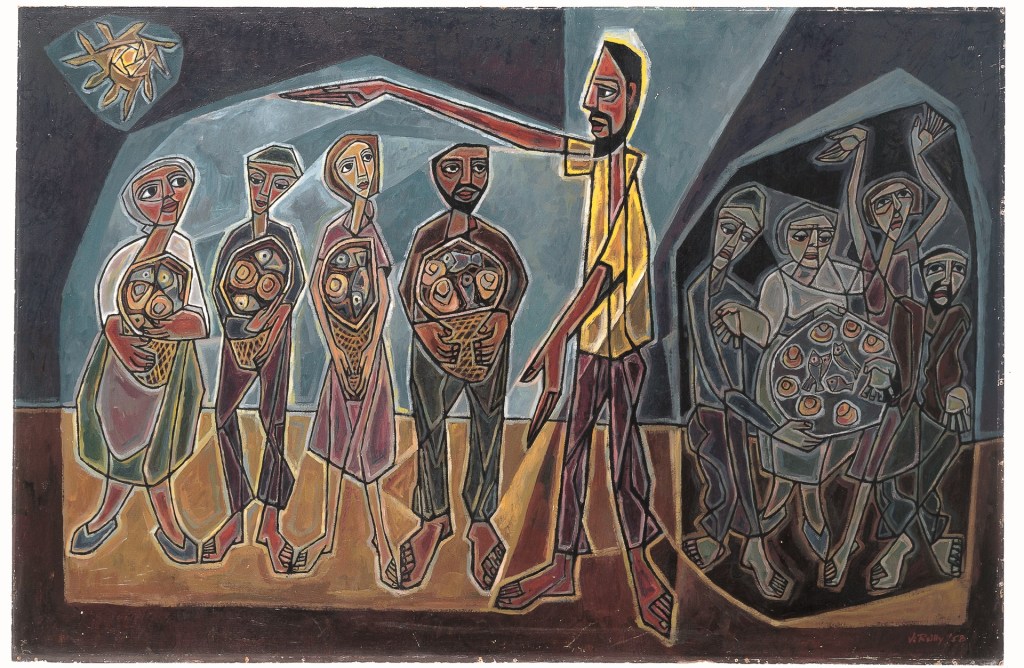
The Feeding of the Five Thousand by John Reilly, 1958

When the apostles returned, they reported to Jesus what they had done. Then he took them with him, and they withdrew by themselves to a town called Bethsaida, but the crowds learned about it and followed him. He welcomed them and spoke to them about the kingdom of God and healed those who needed healing.

Late in the afternoon the Twelve came to him and said, “Send the crowd away so they can go to the surrounding villages and countryside and find food and lodging, because we are in a remote place here.”

He replied, “You give them something to eat.”

They answered, “We have only five loaves of bread and two fish—unless we go and buy food for all this crowd.” (About five thousand men were there.)

But he said to his disciples, “Have them sit down in groups of about fifty each.” The disciples did so, and everyone sat down. Taking the five loaves and the two fish and looking up to heaven, he gave thanks and broke them. Then he gave them to the disciples to distribute to the people. They all ate and were satisfied, and the disciples picked up twelve basketfuls of broken pieces that were left over. (New International Version)

Jesus feeding five thousand people is not just an incredible story that happened a long time ago. Today, Jesus is still in the miracle business because he is still in the kingdom business. Christ still takes our meager resources and turns them into something that has a large impact on a lot of people. 

For that to happen, all we need do, is follow the Lord’s simple instructions: “You give them something to eat,” and, “Bring them [five loaves and two fish] here to me.” Jesus, using a simple act of obedience by his disciples, did one of the most famous miracles in history.

Jesus can multiply whatever little we possess to accomplish his kingdom work through us. 

It is true that Jesus most certainly can do miracles without us. And yet, Christ chooses to use us simple folk to participate in his work. God uses our simple prayers for the miracle of a transformed life. The Lord uses our imperfect speech to bring new life to others. Jesus takes our miniscule bank account to bring a river of financial resources to many through a small act of giving. 

Faith is our true work – to believe God can do the extraordinary through our ordinary loaf of bread and piece of fish.

The Compassion of Jesus Motivates Him To Do Miracles

Jesus withdrew to a solitary place. The crowd, however, did not leave him alone. But rather than being annoyed by the situation because this interruption was not on his divine day planner, Jesus looked at the large group of people and had compassion on them. 

Christ’s heart went out to thousands of people, so he set about the work of healing the sick. Please know that God does not begrudgingly deal with you, as if you were an interruption to his day; the Lord has compassion for you.

The Desire of Jesus is For Us to Participate in the Miracles He Does

After a full day of healing, Christ’s disciples came to him as if he was unaware of the people’s need for food.  They had a very rational and realistic answer to the problem of hunger in front of them; dismiss the crowd so they can go out to eat. 

Jesus calmly responded, “They don’t need to go away; you give them something to eat.” 

I detect perhaps a hint of sarcasm and a slight eye roll in the reply of the disciples, “We have only five loaves of bread and two fish.” But their math was way off because they did not count Jesus. 

The Five Thousand by Eularia Clarke, 1962

Jesus simply said, “Bring them here to me.” My friends, if we have ears to hear, Jesus is still saying this today to us – bring them here to me. Through simple prayer and active obedience, we must give Jesus what we have, no matter how little or insignificant.

Most of what happens in Western Christianity, much like the ancient disciples, is a reasonable doing of rational ministry. Many ministries have little to nothing to do with the impossibility of faith and seeing God work in ways that are incomprehensible to our modern sensibilities.

The earthly miracles of Christ were not an isolated instance. God has always been taking the impossible and making it possible.

Now there was a woman who had been married to a member of a group of prophets. She appealed to Elisha, saying, “My husband, your servant, is dead. You know how he feared the Lord. But now someone he owed money to has come to take my two children away as slaves.”

Elisha said to her, “What can I do for you? Tell me what you still have left in the house.”

She said, “Your servant has nothing at all in the house except a small jar of oil.”

He said, “Go out and borrow containers from all your neighbors. Get as many empty containers as possible. Then go in and close the door behind you and your sons. Pour oil into all those containers. Set each one aside when it’s full.”

She left Elisha and closed the door behind her and her sons. They brought her containers as she kept on pouring. When she had filled the containers, she said to her son, “Bring me another container.”

He said to her, “There aren’t any more.” Then the oil stopped flowing, and she reported this to the man of God.

He said, “Go! Sell the oil and pay your debts. You and your sons can live on what remains.” (2 Kings 4:1-7, CEB)

What if we were to live as if God was interested in doing the miraculous? Would it change the way we pray, and the way we act? 

What if we understood just enough of Jesus, of what he can and wants to do, that we are bold to say:

  • “This might sound crazy, but what if we found out the names of everyone in our community who needs food and go love on them and feed them?” (instead of only the rational means of a food pantry)
  • “This might sound crazy, but what if we used our property to create a community garden and help people grow their own food?” (instead of only the rational means of government aid) 
  • “This might sound crazy, but what if we prayed for one-hundred people, by name, to be healed?” (instead of only the rational means of relying on the pastor to pray)

Most of our plans are humanly possible and doable. Maybe we ought, instead, to seek the impossible.

We may often do nothing out of a sense that God either cannot or does not want to use me or what I have. However, it just won’t do to stand afar off and expect God to work without us giving what we have, whether that something is time, money, conversation, food, hospitality, or whatever. 

Our excuses won’t do for Jesus – my home is too small, I don’t have enough money, I am not smart enough, my schedule won’t allow it, I don’t have enough resources…. In God’s economy you don’t need much, at all. Just a mustard seed worth of faith will do. Jesus wants us to be a part of the miracles he is doing.

Conclusion

I can visualize the disciples befuddled by Christ’s words. I can imagine hearing their excuses. “You want me to do what?  Feed thousands?  Lead someone to Jesus?  Pray in front of others?….” 

The miracle for many a believer is to be open, real, and transparent enough to believe that Christ can do the impossible through confessing sin, participating in ministry, having a spiritual conversation with an unbeliever, or just naming out loud what one actually thinks and feels.  

The question is never, “Can God use me?” The real question is, “What miracle does God want to do through me, and through us as a community of faith?”

It is no accident that when Jesus distributed the bread, it sounds a lot like communion. The Lord’s Supper may seem to be irrelevant – only something we do to remember Jesus, or a mere ritual. But God’s design is much bigger. The Lord wants to do a miracle. 

God wants our observance of Christian communion to bring a healing which the world cannot give. It appears irrational that Jesus can use a small Table to feed and reach thousands. Yet, we don’t serve a God who is limited to work through rational means. 

O God, our heavenly Father, you have blessed us and given us dominion over all the earth. Increase our faith and our reverence for the mystery of life. Give us new insight into your purposes for the human race, and new wisdom and determination in making provision for its future, no matter whether it makes sense, or not, in accordance with your goodwill, through Jesus Christ our Lord. Amen.

Matthew 17:14-21 – Use Your Faith

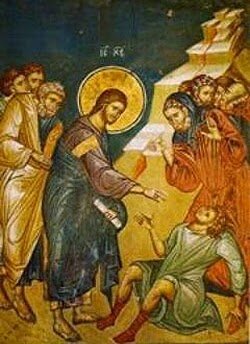
At the foot of the mountain, a large crowd was waiting for them. A man came and knelt before Jesus and said, “Lord, have mercy on my son. He has seizures and suffers terribly. He often falls into the fire or into the water. So, I brought him to your disciples, but they couldn’t heal him.”

Jesus said, “You faithless and corrupt people! How long must I be with you? How long must I put up with you? Bring the boy here to me.” Then Jesus rebuked the demon in the boy, and it left him. From that moment the boy was well.

Afterward the disciples asked Jesus privately, “Why couldn’t we cast out that demon?”

“You don’t have enough faith,” Jesus told them. “I tell you the truth, if you had faith even as small as a mustard seed, you could say to this mountain, ‘Move from here to there,’ and it would move. Nothing would be impossible.” (New Living Translation)

As we reflect on today’s Gospel lesson, let’s keep in mind that any time we see Jesus exorcising demons, we need to resist the idea that anyone having similar symptoms today is demonic in origin. Any chronic health condition a person experiences, without seeing any healing take place, does not necessarily mean the condition is due to the person’s lack of faith.

Conversely, it is also possible to relegate such healing accounts to a different time and place. My own view of Scripture, along with personal experience, informs me that demonization is real. We may underestimate how influential and widespread demonization occurs in this modern time and place.

The nature of faith is not located in its amount or intensity but in its object. All of life requires some faith. Even sitting in a chair. When I sit, the amount or intensity of my faith isn’t the issue – the object, the chair, is the issue. If a leg on the chair breaks and I flop to the floor, its not reasonable for me to conclude that it happened because of my lack of faith.

The disciples’ inability to heal the boy.

I’m not sure what is more difficult: to be the person suffering, or to observe a loved one suffering. The father is desperate and hurting, watching his son suffer with seizures. The man is utterly discouraged because Christ’s disciples were not able to help.

So, the desperate father approached Jesus and knelt, begging him to have mercy and help his son.

Our Lord’s response, I admit, is not likely what my response would be. I would be more like, “I’m so sorry this is happening to you. This is terrible. Let’s take care of this.” Jesus did honor the father’s request and healed the boy, but not before he had some words.

Jesus was exasperated, and he let everyone know about it. Why was he so disappointed?

Because his disciples knew better. The disciples were not ignorant or unable. They had what they needed to deal with the boy and his father. Jesus already equipped them to do this kind of ministry: 

Jesus called his twelve disciples together and gave them authority to cast out evil spirits and to heal every kind of disease and illness… “Heal the sick, raise the dead, cure those with leprosy, and cast out demons. Give as freely as you have received!” (Matthew 10:1, 8, NLT)

The reason for the disciples’ inability to heal was their lack of faith.

Jesus was perturbed with his disciples because they were not utilizing faith.

Jesus is bothered when believers don’t believe.

Up until this encounter, the disciples were healing people and doing the work Jesus gave them to do. Yet now they cannot. What changed? They relied on their own power, abilities, and experience, instead of relying on the power of God to heal. 

The Gospel of Mark includes Jesus saying that this kind of demon can only be dislodged through prayer (Mark 9:14-29). In short, the disciples didn’t pray. They didn’t tap into God’s power. They didn’t use the authority Jesus gave them. Rather, the disciples rested on their own laurels.

Their lack of prayer translated into a lack of power. 

If we are unable to do the work God has called us to do, it isn’t because we lack the authority or ability. It is a lack of faith.

Effective ministry happens because of faith.

The power of faith is in the person to whom it is directed. If we trust solely in ourselves, we will fail. However, if we trust in Jesus, then even the tiniest of faith will be able to do the impossible.

The power is not in particular words, or in a certain formula – the power is in faith rightly directed toward Jesus. Most demonic manifestations are much more subtle – such as thoughts of how I am not enough, how I have no right to try and help another, and how unable I am to do the will of God.

Conclusion

Here is a simple observation of Christ’s words: We are not told that if we have faith as big as a mountain that we can move one. Instead, Jesus tells us that if we have any faith at all, even as small as a tiny seed, directed toward God and not ourselves, the sky is the limit – we will have all the ability we need to do the will of God.

So, what is that impossible thing that could be done in your life with properly directed faith? 

What miracle, healing, or resistance to a bad spirit needs to take place around us? 

Discouragement is the most common tool of the devil in keeping us from realizing genuine manifestations of faith. Jesus has already accomplished victory over sin, death, and Satan. We must, then, claim all the will of God for today.

Resist the devil and he will flee from you (James 4:7). Step out in faith and do the will of God. The first step is always one of prayer….

High and Holy One, because your mercy is everlasting and your truth endures from generation to generation, show mercy to the sick and infirmed of either body or soul. Grant them deliverance from mental, emotional, spiritual, and physical illness. Blessed Lord, keep them under your care, for only in you can we live in safety and wellbeing. Visit them with your saving health. Do not let their hope be taken away, through Jesus Christ, our Lord. Amen.

Mark 8:14-21 – Adventures in Missing the Point

The disciples had forgotten to bring bread, except for one loaf they had with them in the boat.“Be careful,” Jesus warned them. “Watch out for the yeast of the Pharisees and that of Herod.”

They discussed this with one another and said, “It is because we have no bread.”

Aware of their discussion, Jesus asked them: “Why are you talking about having no bread? Do you still not see or understand? Are your hearts hardened? Do you have eyes but fail to see, and ears but fail to hear? And don’t you remember? When I broke the five loaves for the five thousand, how many basketfuls of pieces did you pick up?”

“Twelve,” they replied.

“And when I broke the seven loaves for the four thousand, how many basketfuls of pieces did you pick up?”

They answered, “Seven.”

He said to them, “Do you still not understand?” (New International Version)

In today’s Gospel lesson, Jesus uses yeast as a metaphor for corrupting influences. It only takes a little bit of yeast to work through the whole batch of dough. Christ, upholding the teachings of Old Testament law, didn’t just want people to avoid eating actual unleavened bread. He desired his disciples to be unleavened themselves, a holy people, free of all crookedness and malevolent motives.

Christ’s disciples, bless their pea-pickin’ literal interpreting hearts, were too dense to pick up on the metaphor. They began anxiously chattering about how Jesus might be disappointed with them in having no actual bread to eat. Although they had just witnessed an amazing miracle of literally feeding thousands of people, the disciples did not discern what that miracle meant beyond just filling bodily stomachs.

Had Christ’s disciples been able to see beyond the literal to the metaphorical, they would have likely understood several lessons Rabbi Jesus was teaching them:

  • The provision of bread pointed to who Jesus truly is: Living Bread from heaven. Just like the miraculous provision of manna in the desert to the ancient Israelites, so God was graciously meeting the total needs of people through Jesus. Conversely, the yeast of corruption saps the life out of people.
  • The presence of bread doesn’t necessarily mean it’s all good. There’s leavened bread and unleavened bread. That is, there is the healthy bread of God’s Word to eat, and there are other words to eat which is unhealthy bread. A life set apart for goodness and mercy in the world brings life to others. A person with mixed motives and personal agendas of power and privilege brings no nourishment to others – only inedible bread.
  • The puny amount of bread became a huge feast. A little bit of Jesus is enough to feed thousands and satisfy empty stomachs. A little bit of false teaching and hypocrisy is enough to corrupt thousands of people and make them sick.
  • The prosperity of bread multiplied by Jesus was so much that there were leftovers. In the kingdom of God, there is abundance. The disciples served the bread to the throng of people, and they received bread for themselves with twelve basketfuls of bread pieces – enough bread to feed their families, as well. The leavened bread of corruption doesn’t satisfy; it only decreases health.

But the disciples didn’t get it. So, Jesus chided them for their profound lack of spiritual awareness. By this time, the disciples had been following Jesus for a while – watching him do miraculous works of healing and meeting people’s needs, as well as being on the inside track of receiving his gracious teaching. If anyone ought to get what’s going on, it was them.

If we continually possess only a one-dimensional interpretation of Holy Scripture, a literal one, we are most certainly going to miss most of what’s really happening with Jesus. Rigid and narrow hermeneutical approaches aren’t just inadequate; they’re a corrupting influence. It is an adventure in missing the point because there is only a dim awareness of self, others, God, and God’s Word. It doesn’t nourish anybody. In fact, it makes people sick.

That sad situation makes such people, along with disciples at the time, no better than those on the outside of God’s kingdom.

“You will listen and listen,
    but never understand.
You will look and look,
    but never see.” (Isaiah 6:9, CEV)

Spiritual blindness and deafness are the symptoms of an unexamined and unaware life. And the lack of awareness is a malady from the bread of corruption.

Jesus Christ has a mission, along with the authority to make it happen. He was hoping for a more adequate understanding of this from his disciples, instead of getting the obtuse deer-in-the-headlights response.

Although, in some ways, today’s Gospel story is downer, it is also hopeful. The disciples ultimately do not remain stuck. They illustrate for us the nature of faith. Faith is not a one and done event of praying a sinner’s prayer or accepting Jesus. Rather, faith is an unfolding drama of redemption.

We grow in and into faith. Faith is much more a gradual awareness of God’s character and working in the world, with maybe a few dramatic epiphanies along the way. It is piecemeal, rather than wholesale. It’s more like taking small bites of delicious bread and savoring it with friends, instead of ravenously devouring an entire loaf alone.

“I am the living bread which came down from heaven. If anyone eats of this bread, he will live forever; and the bread that I shall give is My flesh, which I shall give for the life of the world.” (John 6:51, NKJV)

Lord Jesus, as you came to serve us living bread, fill us with the compassion and insight to respond to human need by loving service. Let the fire of your goodness and justice burn into us and through us, that we may seek to transform the unjust structures of society. As you come into our lives to redeem all that is good, guide to renew and sustain the life of your creation. Let your glory fill our lives. Let your glory fill this world. Amen.

Mark 6:35-44 – You Want Us To Do What?

Late in the afternoon his disciples came to him and said, “This is a remote place, and it’s already getting late. Send the crowds away so they can go to the nearby farms and villages and buy something to eat.”

But Jesus said, “You feed them.”

“With what?” they asked. “We’d have to work for months to earn enough money to buy food for all these people!”

“How much bread do you have?” he asked. “Go and find out.”

They came back and reported, “We have five loaves of bread and two fish.”

Then Jesus told the disciples to have the people sit down in groups on the green grass. So, they sat down in groups of fifty or a hundred.

Jesus took the five loaves and two fish, looked up toward heaven, and blessed them. Then, breaking the loaves into pieces, he kept giving the bread to the disciples so they could distribute it to the people. He also divided the fish for everyone to share. They all ate as much as they wanted, and afterward, the disciples picked up twelve baskets of leftover bread and fish. A total of 5,000 men and their families were fed. (New Living Translation)

I once knew a dear church lady who made a pan of lasagna for a local soup kitchen. When she showed up, it turned out, other church ladies didn’t. Hers was to be one pan amongst many. Instead, it was the only one. When a long line formed of hungry impoverished people, she felt both compassion and heartsick. Her immediate thought was to go and buy several pans of lasagna. But she knew it would take too long, and she wasn’t even sure she could find enough to feed everyone.

So, rather than turning the people away, the dear woman looked up to heaven, uttered a prayer of thanksgiving to God for what little she had, and began serving. She said, “I just kept sticking my spatula into the pan, and lasagna kept coming out. By the time the last person in line came, I served the last of it. I can’t explain it. It just happened.”

No one left hungry.

Today’s Gospel lesson of Jesus feeding the five thousand men and their families is not just a nice account of something that happened a long time ago. Jesus is still doing miracles. The Lord is still expanding his benevolent reach all across God’s big world.

Jesus takes our meager resources and turns them into something with a large impact on a lot of people. For this to happen, all we need to do is follow our Lord’s simple instructions: “You feed them.” 

“But Jesus! I don’t have much money. I’m not a good organizer. I can’t do what you’re asking!”

“I don’t…” “I’m not…” “I can’t…” Jesus hears it every day.

Jesus really doesn’t want to hear about our “buts.” Maybe we ought to take the word “but” out of our language altogether. That’s because it’s not about us, at all.

Jesus can multiply whatever little we have to accomplish his benevolent work through us. 

Jesus could clearly do miracles without us having any involvement. Yet, he deliberately chooses to use us and our drop-in-the-bucket resources to participate in his work. Jesus wants to use our minds, our mouths, and the very marrow of our being to effect a miracle.

Our work is to bring Jesus our five small loaves and two fish. He’ll do the rest.

It is the compassion of Jesus which motivates him to miracles.

The crowd did not leave him alone. Rather than being annoyed by the situation because it was not on his agenda to deal with any people, Jesus looked at the large group of people and had compassion on them.  His heart went out to them.

God does not begrudgingly deal with us, as if we are an interruption to his day.

All these hungry people. What to do about it? “You feed them,” Jesus says. I perhaps detect a hint of sarcasm in the tone of the disciples reply: “We have only five loaves of bread and two fish.”  Their math was way off because they did not count Jesus. 

Through simple prayer and active obedience, we must give Jesus what we have, no matter how little or insignificant.

In this contemporary era, much of what we do is concerned to be reasonable and rational with a strong scientific or proven base for engaging ministry. Although I don’t have much of a stomach for believers who incessantly want a miracle for everything and see devils under every rock, I equally have no stomach for doing ministry as if it were an Enlightenment project, completely drained of all faith and the possibility of seeing God work in ways that are incomprehensible to our modern sensibilities.

Indeed, looking out at all the vast Western resources have accomplished with money and buildings and programs, it makes me want to explain, “This is amazing! It is incredible what we know-how American Christians can do without God!” 

I am curious what Christ’s Church would look like if we were to have an underlying presupposition and assumption that God is still in the business of doing miracles? I wonder: Would it impact the way we pray, and the way we act? 

What if we altogether forsook shame and had the boldness to say, “This might sound crazy, but what if we…”

  • “Found everyone in our city who needs food and go love on them and feed them” (instead of just going the rational route of only supplying the food pantry).
  • “Used our property to create a community garden and seek to help people grow their own food.” (instead of just giving out some food cards).
  • “Built a smart robot to plant the fields of disabled farmers and gave them the rights to the tech we developed.” (am I getting too crazy yet!?). 

In the kingdom of God, there are no boundaries – only unlimited opportunities to give our small ideas, little bits of strength, and puny resources to Jesus so that he can take it and feed the world.

Jesus is perfectly able to do his work without us and without what we have. However, he wants to use us and our meager resources to accomplish the miraculous meeting of needs far beyond what we could ever imagine. 

We too often do nothing. That’s because we mistakenly believe God either cannot or does not want to use me or what I have.

It just won’t do to stand afar off and expect God to work without us giving what we have, whether that something is time, money, conversation, food, hospitality, or whatever. Our excuses won’t do for Jesus – my home is too small, it is not clean enough, I don’t have enough money, I am not smart enough, my schedule won’t allow it, I don’t have enough resources…. All you need is something, no matter how seemingly insignificant it is.

You want me to do what? Feed thousands? The real pre-miracle work for many people is to be open, real, and transparent enough to believe Christ can do a miracle through confessing sin, participating in a ministry, having a spiritual conversation with somebody different than me, or just saying what I actually think and feel.  

The question is never, “Can God use me?” The real question is, “What miracle does Jesus want to do through me and through his Church?”

It was no accident when Jesus distributed the bread that it sounds a lot like communion.

The Lord’s Supper may seem to be irrelevant to some – as if it is only a way to remember Jesus, a mere regular ritual. Yet, God’s design is much bigger. Jesus wants to do a miracle through the distribution and ingestion of the common elements of bread and wine – a miracle of healing, a miracle of bringing true satisfaction the world can never give. 

It isn’t realistic to expect that Jesus can use the Table to feed and reach thousands. However, we don’t serve a God who is limited to work through rational means by only using our five senses. 

We serve a God who does unexpected miracles within the life of the community.

Lord, I believe. Help me in my unbelief! I open my mind and heart believing in your infinite power and possibility. I believe in your constant expression of perfect good in and through me. I know that with you all things are possible. All that I am, all I was, and all I hope to be I give to you. I am yours. Amen.

*Above painting: Feeding of the 5,000 by Laura James

**Above: Ethiopian Orthodox Church depiction of Christ feeding the 5,000