

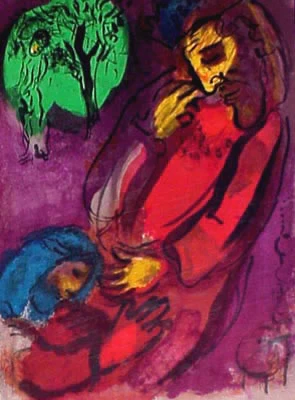
In all Israel there was not a man so highly praised for his handsome appearance as Absalom. From the top of his head to the sole of his foot there was no blemish in him. Whenever he cut the hair of his head—he used to cut his hair once a year because it became too heavy for him—he would weigh it, and its weight was two hundred shekels by the royal standard.
Three sons and a daughter were born to Absalom. His daughter’s name was Tamar, and she became a beautiful woman.
Absalom lived two years in Jerusalem without seeing the king’s face. Then Absalom sent for Joab in order to send him to the king, but Joab refused to come to him. So he sent a second time, but he refused to come. Then he said to his servants, “Look, Joab’s field is next to mine, and he has barley there. Go and set it on fire.” So Absalom’s servants set the field on fire.
Then Joab did go to Absalom’s house, and he said to him, “Why have your servants set my field on fire?”
Absalom said to Joab, “Look, I sent word to you and said, ‘Come here so I can send you to the king to ask, “Why have I come from Geshur? It would be better for me if I were still there!”’ Now then, I want to see the king’s face, and if I am guilty of anything, let him put me to death.”
So Joab went to the king and told him this. Then the king summoned Absalom, and he came in and bowed down with his face to the ground before the king. And the king kissed Absalom. (New International Version)
Parents are people, and so, they don’t always make sense. David was both a king and a parent. And those two roles often got mixed and complicated for him.
David’s son Abasalom had killed another son, Amnon, who had sexually assaulted a daughter, Tamar, Abasalom’s sister. Yes, it sounds a lot like a Bible soap opera.
Joab, David’s military general (and cousin) convinces the king to bring Absalom back to Jerusalem, having fled Jerusalem after killing Amnon. And David did so. Yet, he gave an order that Absalom was not to come into his presence, even though David longed for his son.
It was a case of the nonsensical – the parental approach of yearning for an adult child, while at the same time, shunning and shaming them. Indeed, these were incongruent actions on the part of David.
When Tamar was assaulted, David found out and was very angry; yet he neither dealt with Tamar by giving her support and compassion, nor dealt with Amnon in meting out justice.
As for Absalom, David’s feelings for him did not translate into action. It appears the story wants us to see the wide gap between King David’s emotions and actions.
Perhaps the emphasis on Absalom’s sheer beauty is designed to emphasize the incongruence of David – this handsome man is put at arm’s length by his father. Furthermore, this behavior would eventually put David’s royal position in jeopardy.
When guilt and shame are not confronted, it leads to a downward spiral into continued levels of degradation.
The assault of Tamar led to the murder of Amnon, which led to the inactions of David. Everyone ended up responding to someone else’s guilt by adding their own guilt to it. In this scenario, everyone loses something, and there is a lot of unnecessary grief.
Abasalom returned to his hometown of Jerusalem. But everything had changed. He was simply existing. Honestly, Absalom needed something, anything, instead of living day after day in a house without any love or acceptance. Absalom was in that awkward place of wanting either mercy or judgment, acceptance or punishment, because to live in limbo was shrinking him to nothing.
For those who know the story of David and Absalom, you understand where all of this family dysfunction is leading; and it will not end well.
It could be that Jesus had this story in the back of his head when he told the parable of the prodigal son (Luke 15). Perhaps Christ wanted us to see what could happen when a father chooses to respond with actions of grace, acceptance, and undeserved kindness. Even though the son had done something awful and was full of guilt, when he finally made his way home, the father ran to him, embraced him, and accepted him with a blowout party.
We can only wonder what would have happened had David stepped into the situations of his children’s lives when they were going awry. Methinks that had David done so, with his characteristic wisdom and mercy, there would have been a very different outcome in his family.
One way of viewing this story is that the incongruence of King David toward Absalom, with his combination of longing and rejection, was a stubborn passive-aggressive refusal to give his son the grace and love which God had given to him. In light of the story’s eventual end, this view makes a lot of sense.
Yet, this doesn’t have to be the same for you or me in our family relationships today. We can choose to love, instead of inflexibly holding on to a denial of love. One can do all the mental gymnastics of justifying that denial by believing you’re teaching the kid a lesson, or giving them what they deserve, but it’s really, at it’s core, choosing not to love with the love provided by God.

Absalom eventually entered David’s throne room and received a kiss. But it was simply too little, too late. And that’s why, at some point after this, Absalom decided to replace his emotionally and actively distant father as king.
If guilt, shame, evil, and sin go unchecked for too long, it makes for a terrible mess of people’s lives; and usually results in either verbal violence, physical violence, or both.
But it doesn’t have to be that way….
For being quick to see the sins of others, and slow to repent of our own, forgive us, Lord.
For clinging to remembered hurts, and brushing off gestures of kindness, forgive us, Lord.
For the divisions among us that damage our mission to the world, forgive us, Lord.
For the work we have not done because we refused to do it together, forgive us, Lord.
For these and all our sins, O God, we weep in sorrow and ask for your forgiveness, through Jesus Christ our Lord. Amen.

 Rev. Tim Ehrhardt