Oppressors Are On Notice (Nahum 1:1-13)

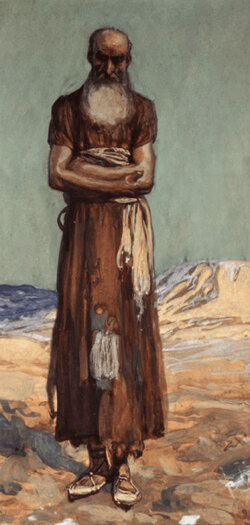
Nahum, by James Tissot, 1888

A prophecy concerning Nineveh. The book of the vision of Nahum the Elkoshite.

The Lord is a jealous and avenging God;
    the Lord takes vengeance and is filled with wrath.
The Lord takes vengeance on his foes
    and vents his wrath against his enemies.
The Lord is slow to anger but great in power;
    the Lord will not leave the guilty unpunished.
His way is in the whirlwind and the storm,
    and clouds are the dust of his feet.
He rebukes the sea and dries it up;
    he makes all the rivers run dry.
Bashan and Carmel wither
    and the blossoms of Lebanon fade.
The mountains quake before him
    and the hills melt away.
The earth trembles at his presence,
    the world and all who live in it.
Who can withstand his indignation?
    Who can endure his fierce anger?
His wrath is poured out like fire;
    the rocks are shattered before him.

The Lord is good,
    a refuge in times of trouble.
He cares for those who trust in him,
    but with an overwhelming flood
he will make an end of Nineveh;
    he will pursue his foes into the realm of darkness.

Whatever they plot against the Lord
    he will bring to an end;
    trouble will not come a second time.
They will be entangled among thorns
    and drunk from their wine;
    they will be consumed like dry stubble.
From you, Nineveh, has one come forth
    who plots evil against the Lord
    and devises wicked plans.

This is what the Lord says:

“Although they have allies and are numerous,
    they will be destroyed and pass away.
Although I have afflicted you, Judah,
    I will afflict you no more.
Now I will break their yoke from your neck
    and tear your shackles away.” (New International Version)

I’m willing to wager you’ve never heard a sermon on the Old Testament book of Nahum. It’s unfortunate that many Bible-readers have never read the prophecy of Nahum, let alone know that this book even exists in Holy Scripture.

Each individual book of the Bible has its own particular message that is wise for us to understand. Although Nahum’s prophecy is against the long-dead empire of Assyria, it still contains a timeless message for us.

Nineveh

The capital city of Assyria, Nineveh, was a large and influential city in the centuries of 600-900 B.C.E. The Assyrians were a cruel people even by ancient standards. Their army was feared, and rightly so. Army officers were experts at torture, having turned it into an art form with all kinds of different ways of killing and maiming captured people from their conquests.

The prophet Nahum focused on the sure destruction of Nineveh, and the overwhelming judgment and justice of God. And at the same time, Nahum was also attuned to the great and many sins of Israel – their predilection for idolatry and immorality, as well as their purposeful ignoring of social responsibilities.

No matter who we are, or where we are from, the Lord God, the Almighty, shows no favoritism in condemning the guilty, and upholding the innocent. Unlike us, who have a nasty tendency toward practicing cronyism, bigotry, and ethnocentrism, Yahweh extends grace, judgment, and fairness in an even-handed way.

We humans also have a bent toward emphasizing one trait of God over another. There are those who talk only of love when it comes to the Lord; and others who always speak of God’s wrath and judgment.

Yet, in truth, God is the sovereign Lord of both wrath and love, judgment and grace. And, if we are able to hear it, God’s wrath is an expression of God’s love – not willing for oppression and violence to run amok among the powerless.

What’s more, God’s love has a penetrating way of arousing the conscience and bringing deep conviction of guilt for things we have done, and have left undone. So, when we talk of God, let us keep in mind that God is the Lord of both wrath and love, judgment and grace.

Nahum described Yahweh as a powerful God who is the avenging Lord against violence, cruelty, and injustice. If this God can make mountains move, oceans froth, and the earth heave, then no one, including the mighty Assyrian warriors, can stand against Yahweh’s indignation.

It is also true that with the Lord God there is abundant goodness which provides protection for those who seek refuge in Yahweh. Throughout Holy Scripture, including the prophecy of Nahum, divine vengeance and wrath is continually set in the context of divine mercy and grace.

Because God is holy and just, sovereign and powerful, God is Judge of the nations. Mercy only really has meaning when wrath is necessary. If everything were always unicorns and bunny rabbits, there would never be a need for mercy. But we live in a terribly broken world in which oppression and cruelty too often make sinister inroads into our lives.

Although the Lord is slow to anger and God’s fuse is long, divine patience has its limits. Yahweh does not let calloused hearts and selfish minds go on with impunity. Eventually, there will be hell to pay.

God saw all the foolish destruction and misery that Assyria brought to others. And so, Nineveh would see their own terrible destruction. This is why we now talk of Assyria as a long-past ancient empire; they no longer exist in any way, shape, or form. The Lord wiped the Assyrians off of the map.

As for Judah, there would be comfort. Even though it was true that God used the Assyrians to extend judgment upon Israel, there was also merciful relief and gracious rest from Assyria for the people.

With God, relief, rest, and recovery are sure and certain. Violence and oppression shall not last. Mercy always ends up winning the day.

This is most assuredly good news for us who seek the just, the right, and the good in this fallen world. The foolish decisions of contemporary politicians shall not win the day. God will have the final word on all things.

In a time when it seems the other shoe keeps dropping, we can be a hopeful people, because there is a transcendent God in heaven who sees it all, and will have mercy upon the innocent, while judging the guilty.

Therefore, those who engage in grift, corruption, violence, and cruelty, with no concern for the weak and needy, will eventually find themselves on the side of God’s vengeful wrath.

Whereas, those who are powerless against an evil misuse of authority, eventually they will know what it is to experience hope and deliverance from that evil. They shall know safety and perfect peace.

The overarching message of Nahum is that God is sovereign over all the world and all of history. The Lord will judge and love according to God’s own sense of divine wrath and divine grace.

Since God is the ultimate champion of the frustrated and the helpless, God will by no means acquit the guilty. The universe is God’s dominion, and in this dominion, violence, corruption, and oppression will face an awesome judgment which eradicates evil.

No nation, no person, and no government can withstand the God who is over all. Every corrupt person, especially politicians who have their eye only on themselves, should be on notice.

O God, by whom the meek are guided in decision-making, and light rises up in darkness for the godly: Grant us, in all our doubts and uncertainties, the grace to ask what you would have us to do, so that the Spirit of wisdom may save us from all false choices, and that in your light we may see light, and in your straight path may not stumble; through Jesus Christ our Lord. Amen.


Christ’s Parable of the Weeds (Matthew 13:24-30, 36-43)

Wheat Fields with Stacks, by Vincent Van Gogh, 1888

Here is another story Jesus told: “The Kingdom of Heaven is like a farmer who planted good seed in his field. But that night as the workers slept, his enemy came and planted weeds among the wheat, then slipped away. When the crop began to grow and produce grain, the weeds also grew.

“The farmer’s workers went to him and said, ‘Sir, the field where you planted that good seed is full of weeds! Where did they come from?’

“‘An enemy has done this!’ the farmer exclaimed.

“‘Should we pull out the weeds?’ they asked.

“‘No,’ he replied, ‘you’ll uproot the wheat if you do. Let both grow together until the harvest. Then I will tell the harvesters to sort out the weeds, tie them into bundles, and burn them, and to put the wheat in the barn….’”

Then, leaving the crowds outside, Jesus went into the house. His disciples said, “Please explain to us the story of the weeds in the field.”

Jesus replied, “The Son of Man is the farmer who plants the good seed. The field is the world, and the good seed represents the people of the Kingdom. The weeds are the people who belong to the evil one. The enemy who planted the weeds among the wheat is the devil. The harvest is the end of the world, and the harvesters are the angels.

“Just as the weeds are sorted out and burned in the fire, so it will be at the end of the world. The Son of Man will send his angels, and they will remove from his Kingdom everything that causes sin and all who do evil. And the angels will throw them into the fiery furnace, where there will be weeping and gnashing of teeth. Then the righteous will shine like the sun in their Father’s Kingdom. Anyone with ears to hear should listen and understand! (New Living Translation)

As you have likely noticed, not everyone in this world is supportive of you and what you’re doing.

The good work we do – no matter how competently and expertly done – will be undermined by others. There will be people with selfish and sinister agendas who put roadblocks in our way to frustrate our ongoing work. They don’t like what we are doing and what we’re trying to accomplish.

Unfortunately, that’s just the way it is. So then, one of the big questions for all of us is this: How do we live with others trying to subvert the good work we are doing for the Kingdom of Heaven?

One of the most popular responses is to strike the enemy on their cheek just as hard or harder in the way they slapped you. It is responding to evil in kind.

But if we will ponder for a moment, we shall realize that is makes no sense to repay evil with evil. Why? Because then the Kingdom of Hell has just snagged this one with doing evil in order to defend good work – which ends-up ruining the whole enterprise.

No, instead let’s heed the words of Christ to turn the other cheek and not retaliate; and live the words of the Apostle Paul who reminded us to overcome evil by doing good. (Matthew 5:38-42; Romans 12:14-21)

Yes, all judgment belongs to the Lord, and not us. In today’s Gospel lesson the reasoning Jesus provides for non-retaliation and non-violence is both reasonable and practical.

Field with Stacks of Wheat, by Vincent Van Gogh, 1890

Christ told his disciples that the enemy’s efforts at thwarting our good works are sinister enough to bring about a situation where evil is so close to the good that to eradicate the evil is to therefore also do away with the good.

If you have weeds in your field or your garden, you know that some of those nasty weeds cannot be pulled out of the ground without yanking-up the good plant along with it. Instead, you’ll have to wait until you can harvest the plant, and then you can safely get rid of the offending weed.

Let’s think, then, about our own situations right now in this world. For myself, it seems that every single day I am upset and angered over decisions made by those in political power, because they almost always involve oppressing and/or harming powerless people.

Yet, to immediately stop the offending persons and organizations would involve some wicked methods. Instead, if I want to maintain doing good, I will have my time to unseat them through the vote, or writing my Senators, or directly contacting the offices of the institutions, etc.

Some of our responses may seem tepid in comparison to the evil being perpetrated, yet we can be sure that there is a time coming in which the reality of divine judgment will handle the wicked once and for all. At the proper time, heaven’s angels will do their own good work of removing evil and eradicating it forever.

We need to put our efforts into doing the very best at living in harmony with one another, promoting peace, and being peacemakers – using our greatest and most effective tools of humility, gentleness, grace, and love. These are the proper fertilizers which will keep the plants of righteousness and justice growing and thriving, even though they are surrounded by a bunch of close weeds.

As maddening as it is to see those weeds grow up alongside the plants, nowhere in Holy Scripture are we called or encouraged to become judge, jury, and executioner to the wicked.

Furthermore, Christians are nowhere called to force onto others Jesus as King through a theocratic nation, using authoritarian means. We are called, rather, to put our faith where our fear is and exercise a faith that does good work through love. (Galatians 5:6)

Equipped by the Spirit, we urge oppressors, tyrants, and egotists to turn from their selfishness and amend their evil ways. And we are not called to force the Kingdom of Heaven on others by trying to ensconce a form of Christian nationalism. For Americans, many of our ancestors came to the New World in order to flee their home Christian nationalist countries who persecuted them and did evil to them.

“To identify any particular form of government with Christianity is a dangerous error, for it confounds the permanent with the transitory, the absolute with the contingent.” T.S. Eliot

It takes very little prodding for Christians with political power to move into glorifying violence and ignoring biblical injunctions to love enemies, seek peace, and grant grace.

God puts a high premium of looking after the poor and needy, and rescuing them from oppression and violence. The last thing we ought to be doing is becoming the violent oppressors ourselves!

Giving ourselves as ambassadors of reconciliation, speaking truth to power, and doing the work of peacemaking is a narrow and hard road to hoe. The easy way is typically the road of destruction. (Matthew 7:13-14)

As citizens of the Kingdom of Heaven, we are to labor toward the things Jesus himself did: Challenge the arrogant religious types; offer mercy to the lowly and forgotten ones; warn of judgment; encourage faith; forgive generously; and speak words of truth in all places, including the halls of political power.

It is perfectly legitimate to disagree with others, but only if we ourselves are willing to defend their equally legitimate right to be disagreeable.

So, instead of always trying to snuff-out and vanquish our opponents with overt tools of evil, let us do the good work of winning their respect, living in peace with them, and affirming our shared humanity together.

We all have the right to be different; we don’t have the right to do evil and reprise evil with evil. The organizations, institutions, faith communities, corporations, and governments of this world are only as good as the people guarding that goodness through their good work, utilizing good means toward good ends.

Anyone with ears ought to listen and understand.

God of steadfast love and grace: Teach us your way and your truth. Root us in you alone, and help us to grow in grace and love, so that we may fulfill our role and our work in the reign of Jesus Christ our Lord. Amen.

The Parable of the Tenants (Mark 12:1-12)

Parable of the Vineyard Workers, from Unknown Artist in the Middle Ages

Then he began to speak to them in parables. “A man planted a vineyard, put a fence around it, dug a pit for the winepress, and built a watchtower; then he leased it to tenants and went away. 

When the season came, he sent a slave to the tenants to collect from them his share of the produce of the vineyard. But they seized him and beat him and sent him away empty-handed. 

And again he sent another slave to them; this one they beat over the head and insulted. Then he sent another, and that one they killed. And so it was with many others; some they beat, and others they killed. 

He had still one other, a beloved son. Finally he sent him to them, saying, ‘They will respect my son.’ But those tenants said to one another, ‘This is the heir; come, let us kill him, and the inheritance will be ours.’ So they seized him, killed him, and threw him out of the vineyard. 

What then will the owner of the vineyard do? He will come and destroy the tenants and give the vineyard to others. Have you not read this scripture:

‘The stone that the builders rejected
    has become the cornerstone;
this was the Lord’s doing,
    and it is amazing in our eyes’?”

When they realized that he had told this parable against them, they wanted to arrest him, but they feared the crowd. So they left him and went away. (New Revised Standard Version)

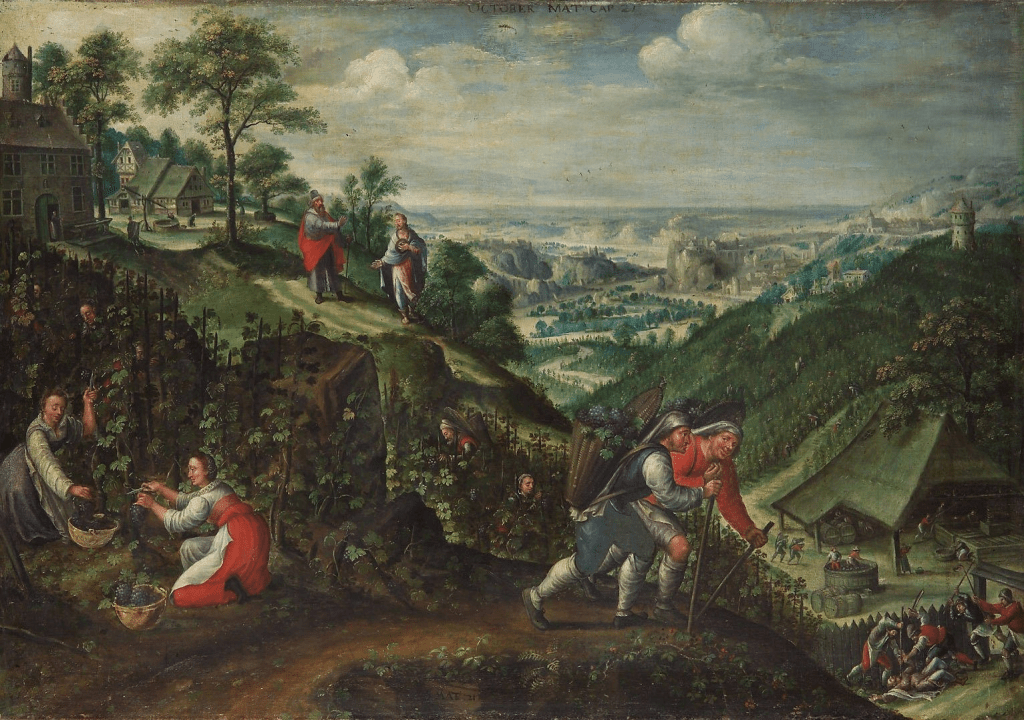
Parable of the Wicked Tenants, by Maarten Van Valckenborg (1535-1612)

Jesus was at the temple in Jerusalem. While there, the religious leaders confronted him over his supposed ministerial authority. Jesus, rather than become defensive, took the initiative by telling a parable.

The parable’s imagery comes directly from the second chapter of the prophet Isaiah in the Old Testament. It, too, was a parable concerning a vineyard. Isaiah leveled an accusation against the entire nation of Israel.

Jesus picked up the same imagery and directed his accusation against the people in front of him, the Jewish religious leaders. The connection between the parable of Isaiah and the parable of Jesus would not have been lost on those leaders.

In many ways, I can relate to the parable’s setting in the land. I grew up on a farm, and appreciate the deep connection of working the land and caring for it. I know something of owning land and having renters work it, since that it was my family did in my parent’s later years.

Anytime there is a relationship between owners, and renters or tenants or servants, it is an unequal relation. And whichever situation you relate to will affect your perspective of the parable.

If you understand what it means to be a landowner, with all of the rights and responsibilities of that ownership, and with the people who work that land, then you likely resonate with the landowner in Christ’s parable. You also will likely detest what the tenants in the parable do.

Perhaps you relate more to being a renter or a tenant. Having an understanding of what it means to rent from another, you may likely see the how the tenants in the parable think, and why they do what they do.

Having personal experiences on both sides of the owner/renter situation – for both good and bad – I can easily see how the violence in the parable could happen. I have my own stories of justice and injustice when it comes to each, the owners and the renters/tenants.

Much like today, ancient power dynamics were a fundamental part of life for many people. And those relations were, and are, fraught with all sorts of inequality.

Christ’s parable is a rather violent story. It’s not really bedtime reading. Notice that the owner has slaves, whom he sends to collect what is due him. Several of them are beaten and/or killed.

There is no backstory to the tenants situation. Yet, at the time of Christ’s ministry, there were many lower class folk who lost their land to unscrupulous owners, in a system of inequity. It’s possible that some of the men Jesus was talking to owned some land. And the religious leaders in the Gospels are rarely presented in a positive light.

Even today, there are violent struggles regarding land, especially in the Middle East. And the power dynamics and inequities are rife with injustice which is claiming to be justice. There are no easy answers to quelling the constant violence.

Feelings of hatred, anger, and fear are common. The desire to kill too often overcomes the desire for life. A group of people are outraged for being the brunt of murder, killing, and evil. Another group already feels neglected and have been the victims of unjust usury and death. They feel justified in their violence toward those they view as perpetrators.

Imagine how people on this earth, such as Palestinians, Israelis, Native Americans, and Ukrainians – just to name a few – feel about land. Land involves life, because the land has water, the potential for farming, trees, and a place to live. Thus, whoever controls land, in many ways, controls life. Agribusiness owns large chunks of land in the United States – and not the smaller family farms. Ah, but that is a topic for another time….

In Christ’s parable, everybody suffered in some way. Servants died. The landowner’s son died. The tenants were destroyed. Life was permanently altered for all involved.

Is that how any of us really want to live?

If we take a theological perspective, God owns everything. But we think we own the land and its resources. We believe we have the right to do whatever we want with it. And that is where the problem arises.

Until we truly hold to the notion that we humans are a society of equals, and that we are all subject to a God who owns everything, then we will continue to experience the effects of injustice, war, and death.

Can we, at least, change our minds? Yes, we can. And Christians are called to do just that:

Do not be conformed to this age, but be transformed by the renewing of the mind, so that you may discern what is the will of God—what is good and acceptable and perfect.

For by the grace given to me I say to everyone among you not to think of yourself more highly than you ought to think but to think with sober judgment, each according to the measure of faith that God has assigned. (Romans 12:2-3, NRSV)

The religious leaders of Christ’s day needed to change their minds about Jesus. Yet, no matter what they did, he would still become the cornerstone, if they rejected him as just one of the stones in the edifice of God’s kingdom.

Today, the parable is still meant to speak to people, to you and me. We have the chance to embrace the Prince of Peace, and walk in the way of peace, not violence. We still yet have the opportunity to be peacemakers, and live in a way that promotes human flourishing, and not human carnage.

If, like the parable of the prophet Isaiah, Christ’s parable is meant to speak to everyone, then it is most necessary that we heed the words of Jesus.

Almighty God our heavenly Father, guide the nations of the world into the way of justice and truth, and establish among them peace, which is the fruit of righteousness, so that they may become the kingdom of our Lord and Savior Jesus Christ. Amen.

A Sad Family Situation (2 Samuel 14:25-33)

David and Absalom, by Marc Chagall, 1956

In all Israel there was not a man so highly praised for his handsome appearance as Absalom. From the top of his head to the sole of his foot there was no blemish in him. Whenever he cut the hair of his head—he used to cut his hair once a year because it became too heavy for him—he would weigh it, and its weight was two hundred shekels by the royal standard.

Three sons and a daughter were born to Absalom. His daughter’s name was Tamar, and she became a beautiful woman.

Absalom lived two years in Jerusalem without seeing the king’s face. Then Absalom sent for Joab in order to send him to the king, but Joab refused to come to him. So he sent a second time, but he refused to come. Then he said to his servants, “Look, Joab’s field is next to mine, and he has barley there. Go and set it on fire.” So Absalom’s servants set the field on fire.

Then Joab did go to Absalom’s house, and he said to him, “Why have your servants set my field on fire?”

Absalom said to Joab, “Look, I sent word to you and said, ‘Come here so I can send you to the king to ask, “Why have I come from Geshur? It would be better for me if I were still there!”’ Now then, I want to see the king’s face, and if I am guilty of anything, let him put me to death.”

So Joab went to the king and told him this. Then the king summoned Absalom, and he came in and bowed down with his face to the ground before the king. And the king kissed Absalom. (New International Version)

Parents are people, and so, they don’t always make sense. David was both a king and a parent. And those two roles often got mixed and complicated for him.

David’s son Abasalom had killed another son, Amnon, who had sexually assaulted a daughter, Tamar, Abasalom’s sister. Yes, it sounds a lot like a Bible soap opera.

Joab, David’s military general (and cousin) convinces the king to bring Absalom back to Jerusalem, having fled Jerusalem after killing Amnon. And David did so. Yet, he gave an order that Absalom was not to come into his presence, even though David longed for his son.

It was a case of the nonsensical – the parental approach of yearning for an adult child, while at the same time, shunning and shaming them. Indeed, these were incongruent actions on the part of David.

When Tamar was assaulted, David found out and was very angry; yet he neither dealt with Tamar by giving her support and compassion, nor dealt with Amnon in meting out justice.

As for Absalom, David’s feelings for him did not translate into action. It appears the story wants us to see the wide gap between King David’s emotions and actions.

Perhaps the emphasis on Absalom’s sheer beauty is designed to emphasize the incongruence of David – this handsome man is put at arm’s length by his father. Furthermore, this behavior would eventually put David’s royal position in jeopardy.

When guilt and shame are not confronted, it leads to a downward spiral into continued levels of degradation.

The assault of Tamar led to the murder of Amnon, which led to the inactions of David. Everyone ended up responding to someone else’s guilt by adding their own guilt to it. In this scenario, everyone loses something, and there is a lot of unnecessary grief.

Abasalom returned to his hometown of Jerusalem. But everything had changed. He was simply existing. Honestly, Absalom needed something, anything, instead of living day after day in a house without any love or acceptance. Absalom was in that awkward place of wanting either mercy or judgment, acceptance or punishment, because to live in limbo was shrinking him to nothing.

For those who know the story of David and Absalom, you understand where all of this family dysfunction is leading; and it will not end well.

It could be that Jesus had this story in the back of his head when he told the parable of the prodigal son (Luke 15). Perhaps Christ wanted us to see what could happen when a father chooses to respond with actions of grace, acceptance, and undeserved kindness. Even though the son had done something awful and was full of guilt, when he finally made his way home, the father ran to him, embraced him, and accepted him with a blowout party.

We can only wonder what would have happened had David stepped into the situations of his children’s lives when they were going awry. Methinks that had David done so, with his characteristic wisdom and mercy, there would have been a very different outcome in his family.

One way of viewing this story is that the incongruence of King David toward Absalom, with his combination of longing and rejection, was a stubborn passive-aggressive refusal to give his son the grace and love which God had given to him. In light of the story’s eventual end, this view makes a lot of sense.

Yet, this doesn’t have to be the same for you or me in our family relationships today. We can choose to love, instead of inflexibly holding on to a denial of love. One can do all the mental gymnastics of justifying that denial by believing you’re teaching the kid a lesson, or giving them what they deserve, but it’s really, at it’s core, choosing not to love with the love provided by God.

Réconciliation d’Absalom et de David, by Gabriel de Saint-Aubin, 1752

Absalom eventually entered David’s throne room and received a kiss. But it was simply too little, too late. And that’s why, at some point after this, Absalom decided to replace his emotionally and actively distant father as king.

If guilt, shame, evil, and sin go unchecked for too long, it makes for a terrible mess of people’s lives; and usually results in either verbal violence, physical violence, or both.

But it doesn’t have to be that way….

For being quick to see the sins of others, and slow to repent of our own, forgive us, Lord.

For clinging to remembered hurts, and brushing off gestures of kindness, forgive us, Lord.

For the divisions among us that damage our mission to the world, forgive us, Lord.

For the work we have not done because we refused to do it together, forgive us, Lord.

For these and all our sins, O God, we weep in sorrow and ask for your forgiveness, through Jesus Christ our Lord. Amen.