

Ascribe to the Lord, O heavenly beings,
ascribe to the Lord glory and strength.
Ascribe to the Lord the glory of his name;
worship the Lord in holy splendor.
The voice of the Lord is over the waters;
the God of glory thunders,
the Lord, over mighty waters.
The voice of the Lord is powerful;
the voice of the Lord is full of majesty.
The voice of the Lord breaks the cedars;
the Lord breaks the cedars of Lebanon.
He makes Lebanon skip like a calf
and Sirion like a young wild ox.
The voice of the Lord flashes forth flames of fire.
The voice of the Lord shakes the wilderness;
the Lord shakes the wilderness of Kadesh.
The voice of the Lord causes the oaks to whirl
and strips the forest bare,
and in his temple all say, “Glory!”
The Lord sits enthroned over the flood;
the Lord sits enthroned as king forever.
May the Lord give strength to his people!
May the Lord bless his people with peace! (New Revised Standard Version)
I grew up in rural middle America, on the land, and working the land. All of that outdoor work of the farmer makes one very attuned to the weather. In fact, my dad could often predict a coming thunderstorm with an almost precise accuracy.
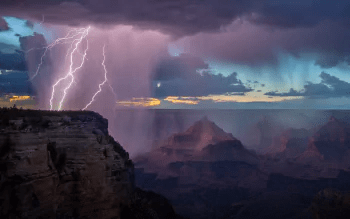
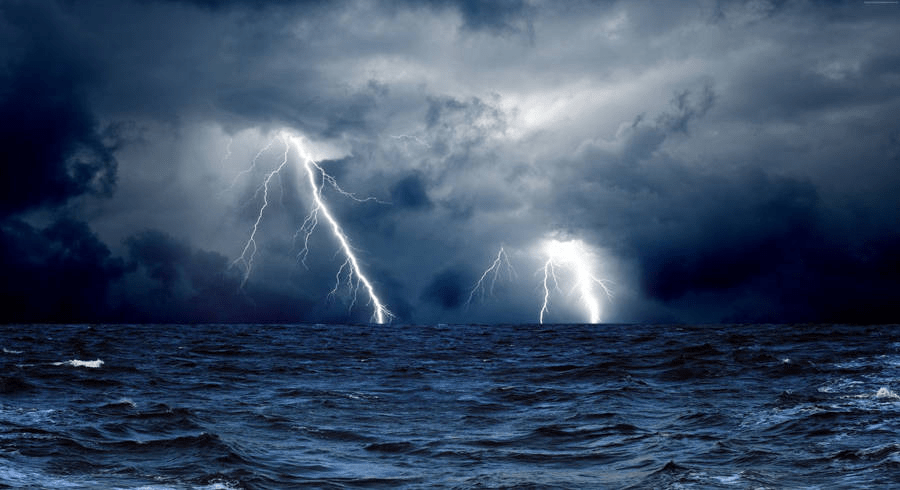
There is something of a weather report from the psalmist in today’s lesson. He describes a powerful storm forming and moving its way inland from over the sea. It does its damage as a result of high winds, incredible lightning, and of course, the loud rumble of thunder. It is this thunderous display of strength that is the voice of the Lord.
Seven times in Psalm 29 the psalmist repeats the phrase, “the voice of the Lord.” There’s a lot more going on than a meteorological thunderstorm; behind the storm is theological Being who controls all things. The Lord God almighty is not your run-of-the-mill ordinary local deity.
Israel did not have multiple gods of thunder, lightning, clouds, and rain; they worshiped Yahweh, one God, who was Lord of the entire storm, as well as the whole world. The point of the psalmist is that no one, no other god, can compete with this awesome God of Israel.
Yet, despite the theological reality of Israel and their God, there was an entire panoply of gods that the Canaanites worshiped in ancient Palestine. The Canaanite god Baal is mentioned many times in the Old Testament. Baal was the lord of the storm, the god who hung out in the clouds and brought needed rain for the crops to grow.
What’s more, ancient Israel was continually tempted toward the worship of Baal. There were even those who gave the ancient god credit for the harvest of crops. But the psalmist will have none of that business. The real lord of the storm, the actual power behind everything in the universe, is Yahweh.
This is why there is the invitation to praise the Lord. And it isn’t just people who are invited; the heavenly beings are called upon to praise. It’s likely that the psalmist is putting those pagan gods in their place by encouraging them to recognize who is really in charge and in control of all things.
Whatever is going on with the psalmist’s intention, there is clearly a universal and cosmic call to acknowledge the majesty and sovereignty of Yahweh and offer appropriate praise for the One who is over everything.
The description of the powerful thunderstorm is presented as evidence of Yahweh’s power, glory, and sovereignty. It’s as if the entire earth is a temple, with every creature on earth called upon to offer up their praise and honor. Beings in both heaven and earth join together in a great universal choir of praise to the God who makes all things possible.

Even when the rains turn into a flood and brings chaos, God is over those chaotic waters, as well. It is the Lord who brings order from chaos, and who tames the mighty waters. In the New Testament, Jesus demonstrated this godly power in front of the fearful disciples:
A great windstorm arose, and the waves beat into the boat, so that the boat was already being swamped. But he was in the stern, asleep on the cushion, and they woke him up and said to him, “Teacher, do you not care that we are perishing?” And waking up, he rebuked the wind and said to the sea, “Be silent! Be still!” Then the wind ceased, and there was a dead calm. He said to them, “Why are you afraid? Have you still no faith?” And they were filled with great fear and said to one another, “Who then is this, that even the wind and the sea obey him?” (Mark 4:37-41, NRSV)
God, as absolute Sovereign, is able to provide peace and well-being from fearful hearts and anxious minds. And this is something to celebrate, to offer gratitude to God for such absolute authority.
People today may not be tempted to worship Baal; but in the middle of our fear and anxiety of life’s many storms, we might search for help and deliverance from the stock market, technology companies, a capitalist economy, social networking, or our own hard work and ingenuity.
Those things may easily become the gods we worship – offering our time, commitment, money, and emotional energy to them – and leaving God in the dugout of our lives to be available, just in case, as a pinch-hitter. But this approach never accounts for the inevitable game being rained out – perhaps permanently.
Just as the wise person saves their money for the inevitable rainy day, so the spiritual person who is aware of God’s authority and power will wisely invest their time and energies into discovering this God. They will engage in spiritual practices designed for relatable connection.
The believer realizes that, although today might be bright and sunny, there will be a damaging thunderstorm in the future for which preparations must be made now.
The voice of the Lord can be a reassuring presence and a healing balm; or it can be a fearful and devastating experience. How you see it and prepare for it makes a big difference.
Glorious God, I worship and praise you in response to your voice. I join with all the voices of the earth, together with all the voices of the heavens, to praise your glorious name; and to bow down in awe before your mighty power. Amen.

 Rev. Tim Ehrhardt