
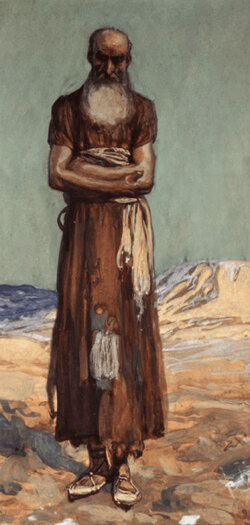
Oppressors Are On Notice (Nahum 1:1-13)

Nahum, by James Tissot, 1888

A prophecy concerning Nineveh. The book of the vision of Nahum the Elkoshite.

The Lord is a jealous and avenging God;
    the Lord takes vengeance and is filled with wrath.
The Lord takes vengeance on his foes
    and vents his wrath against his enemies.
The Lord is slow to anger but great in power;
    the Lord will not leave the guilty unpunished.
His way is in the whirlwind and the storm,
    and clouds are the dust of his feet.
He rebukes the sea and dries it up;
    he makes all the rivers run dry.
Bashan and Carmel wither
    and the blossoms of Lebanon fade.
The mountains quake before him
    and the hills melt away.
The earth trembles at his presence,
    the world and all who live in it.
Who can withstand his indignation?
    Who can endure his fierce anger?
His wrath is poured out like fire;
    the rocks are shattered before him.

The Lord is good,
    a refuge in times of trouble.
He cares for those who trust in him,
    but with an overwhelming flood
he will make an end of Nineveh;
    he will pursue his foes into the realm of darkness.

Whatever they plot against the Lord
    he will bring to an end;
    trouble will not come a second time.
They will be entangled among thorns
    and drunk from their wine;
    they will be consumed like dry stubble.
From you, Nineveh, has one come forth
    who plots evil against the Lord
    and devises wicked plans.

This is what the Lord says:

“Although they have allies and are numerous,
    they will be destroyed and pass away.
Although I have afflicted you, Judah,
    I will afflict you no more.
Now I will break their yoke from your neck
    and tear your shackles away.” (New International Version)

I’m willing to wager you’ve never heard a sermon on the Old Testament book of Nahum. It’s unfortunate that many Bible-readers have never read the prophecy of Nahum, let alone know that this book even exists in Holy Scripture.

Each individual book of the Bible has its own particular message that is wise for us to understand. Although Nahum’s prophecy is against the long-dead empire of Assyria, it still contains a timeless message for us.

Nineveh

The capital city of Assyria, Nineveh, was a large and influential city in the centuries of 600-900 B.C.E. The Assyrians were a cruel people even by ancient standards. Their army was feared, and rightly so. Army officers were experts at torture, having turned it into an art form with all kinds of different ways of killing and maiming captured people from their conquests.

The prophet Nahum focused on the sure destruction of Nineveh, and the overwhelming judgment and justice of God. And at the same time, Nahum was also attuned to the great and many sins of Israel – their predilection for idolatry and immorality, as well as their purposeful ignoring of social responsibilities.

No matter who we are, or where we are from, the Lord God, the Almighty, shows no favoritism in condemning the guilty, and upholding the innocent. Unlike us, who have a nasty tendency toward practicing cronyism, bigotry, and ethnocentrism, Yahweh extends grace, judgment, and fairness in an even-handed way.

We humans also have a bent toward emphasizing one trait of God over another. There are those who talk only of love when it comes to the Lord; and others who always speak of God’s wrath and judgment.

Yet, in truth, God is the sovereign Lord of both wrath and love, judgment and grace. And, if we are able to hear it, God’s wrath is an expression of God’s love – not willing for oppression and violence to run amok among the powerless.

What’s more, God’s love has a penetrating way of arousing the conscience and bringing deep conviction of guilt for things we have done, and have left undone. So, when we talk of God, let us keep in mind that God is the Lord of both wrath and love, judgment and grace.

Nahum described Yahweh as a powerful God who is the avenging Lord against violence, cruelty, and injustice. If this God can make mountains move, oceans froth, and the earth heave, then no one, including the mighty Assyrian warriors, can stand against Yahweh’s indignation.

It is also true that with the Lord God there is abundant goodness which provides protection for those who seek refuge in Yahweh. Throughout Holy Scripture, including the prophecy of Nahum, divine vengeance and wrath is continually set in the context of divine mercy and grace.

Because God is holy and just, sovereign and powerful, God is Judge of the nations. Mercy only really has meaning when wrath is necessary. If everything were always unicorns and bunny rabbits, there would never be a need for mercy. But we live in a terribly broken world in which oppression and cruelty too often make sinister inroads into our lives.

Although the Lord is slow to anger and God’s fuse is long, divine patience has its limits. Yahweh does not let calloused hearts and selfish minds go on with impunity. Eventually, there will be hell to pay.

God saw all the foolish destruction and misery that Assyria brought to others. And so, Nineveh would see their own terrible destruction. This is why we now talk of Assyria as a long-past ancient empire; they no longer exist in any way, shape, or form. The Lord wiped the Assyrians off of the map.

As for Judah, there would be comfort. Even though it was true that God used the Assyrians to extend judgment upon Israel, there was also merciful relief and gracious rest from Assyria for the people.

With God, relief, rest, and recovery are sure and certain. Violence and oppression shall not last. Mercy always ends up winning the day.

This is most assuredly good news for us who seek the just, the right, and the good in this fallen world. The foolish decisions of contemporary politicians shall not win the day. God will have the final word on all things.

In a time when it seems the other shoe keeps dropping, we can be a hopeful people, because there is a transcendent God in heaven who sees it all, and will have mercy upon the innocent, while judging the guilty.

Therefore, those who engage in grift, corruption, violence, and cruelty, with no concern for the weak and needy, will eventually find themselves on the side of God’s vengeful wrath.

Whereas, those who are powerless against an evil misuse of authority, eventually they will know what it is to experience hope and deliverance from that evil. They shall know safety and perfect peace.

The overarching message of Nahum is that God is sovereign over all the world and all of history. The Lord will judge and love according to God’s own sense of divine wrath and divine grace.

Since God is the ultimate champion of the frustrated and the helpless, God will by no means acquit the guilty. The universe is God’s dominion, and in this dominion, violence, corruption, and oppression will face an awesome judgment which eradicates evil.

No nation, no person, and no government can withstand the God who is over all. Every corrupt person, especially politicians who have their eye only on themselves, should be on notice.

O God, by whom the meek are guided in decision-making, and light rises up in darkness for the godly: Grant us, in all our doubts and uncertainties, the grace to ask what you would have us to do, so that the Spirit of wisdom may save us from all false choices, and that in your light we may see light, and in your straight path may not stumble; through Jesus Christ our Lord. Amen.

Truth Stumbles In the Public Square

In these past few months, as an American citizen, I have often wondered what God thinks about the current political situation and climate of the United States.

I must say that with a serious reading of the biblical prophets, it’s rather easy to imagine what the Divine stance likely is:

Justice is far from us,
    and deliverance does not reach us;
we wait for light, but there is only darkness;
    and for brightness, but we walk in gloom.
We grope like the blind along a wall,
    groping like those who have no eyes;
we stumble at noon as in the twilight,
    among the vigorous as though we were dead.
We all growl like bears;
    like doves we moan mournfully.
We wait for justice, but there is none;
    for salvation, but it is far from us.
For our transgressions before you are many,
    and our sins testify against us.
Our transgressions indeed are with us,
    and we know our iniquities:
transgressing and denying the Lord
    and turning away from following our God,
talking oppression and revolt,
    conceiving lying words and uttering them from the heart.
Justice is turned back,
    and deliverance stands at a distance,
for truth stumbles in the public square,
    and uprightness cannot enter.
Truth is lacking,
    and whoever turns from evil is despoiled.

The Lord saw it, and it displeased him
    that there was no justice. (Isaiah 59:9-15, NRSV)

These days, many of my prayers echo the complaint of the ancient prophet Isaiah. I too, have an expectation that God will grant justice and righteousness; and that the Lord will take pity upon us for our ignorance of what is just, right, and good.

And like the prophet Isaiah, I grieve a situation of profuse lying, political malpractice, and socio-economic illiteracy. Many, if not most, Americans and the world community alike, lacks things it needs to live a viable and joyous life. So, I mourn, like a bear growling for a long-awaited meal.

It seems to me that we are failing one another. Our collective vice, and lack of virtue, have led us on a path of injustice. We are a flawed people; we need Divine help.

Perhaps you believe I am being something of a curmudgeon, being too negative – that I’m seeing the glass darkly as only half empty. But no, I’m actually seeing the glass as completely empty, for we are a bereft people.

But just maybe this emptiness can be filled with justice and righteousness, and not shallowness and lack of education, nor gaslighting and manipulative selfishness. Just maybe we can filled to the full in truth.

Our public life together depends upon ethics of accountability.

This insipid business of people stating that they are “being transparent” is nothing but a red flag letting us know that they are doing just the opposite.

We need a new community – a fresh vision of what life can be together. And we are getting anything but that. Instead, in the U.S., we get entrenched yelping from both Republicans and Democrats. And in the face of injustice, we receive an eerie silence from those who ought to know better.

This is not simply a struggle for a political party and its policies. What is happening now transcends each party’s vision of how to live together as a people.

Historically, the Democratic party has generally believed that government ought to raise money through a fair system of taxation. The funds then are to be used to provide basic services that serve the common good of all persons, i.e. ensuring a living wage, protection through laws, maintenance of infrastructure, equal access to healthcare and education, etc.

The Republican party has approached a more individualistic vision of government, believing that each person should manage their own money to make the best use of a market economy. Then, they can create economic growth without reliance upon government regulation of business. Private philanthropy and non-profit organizations are relied upon to provide social services. Private companies are called upon to handle infrastructure needs.

In essence, at the core, Democrats have a vision of community and caring for one another, whereas Republicans have a vision of each person living prosperously under their own fig tree without the interference of others.

This is why things like tax increases and tax cuts become such visceral issues, because they get at the practical outworkings of each party’s vision of how to live together.

But the stakes are even higher than an American two-party system. There is presently leadership in the United States that is openly antagonistic, belligerent, bullying, rude, and frankly, unbiblical and unvirtuous. There is nothing that comes out of the current president’s mouth that reflects the words of Jesus; and there is nothing he does which is consistent with the ways of Jesus.

Many, if not most, “Christian” Republicans are woefully out of touch with their own Bibles; and, at the very least, are complicit in retraumatizing the already traumatized people in the nation (and the world) through supporting unjust leadership.

In the time of the prophet Isaiah, not only was there injustice (common citizens not receiving what they need to build a good life and flourish) but there was no one willing and available, no one engaged and at work to turn around an unjust system so that the government would respect basic human rights for the poor and the needy, the least and the lost in society.

So, the prophet was on the scene to announce that Yahweh, the God of Judah, has noticed. Yahweh has seen that the leadership would not accept responsibility for implementing the Law of God (namely, a set of just, right, and good laws which were to frame all of Jewish society).

Nobody cared. No one bothered to help those without a voice and without hope. And Yahweh knew it. Therefore, a sorry state existed which eventually turned into the people losing their land through an active judgment of God.

Truth matters. And when it is suppressed in the public square, God’s eyebrow is raised.

Lips that speak lies, tongues that mutter wickedness, attitudes which are dishonest, hands that work only for self, and feet which run to violence are all anti-truth practices. (Isaiah 59:3-4)

There is no way on this earth and in this life to get along without government. And because of that, government’s legitimate duty to its people is to provide necessary order, safety, peace, and ensure justice – which means making sure that all citizens have what they need to grow, thrive, and prosper.

Both survival and prosperity must have the glue of truth holding society together – which means that a nation’s government needs to have the basic fundamentals of justice in mind and at heart.

A telltale sign that leaders do not have the best interests of their own people is how they speak to and treat others outside their own nation, people in differing circumstances in different places.

“They did not want to consider their duty. They have distorted their intelligence so as to not understand what ought to be done… They have distanced themselves so far from the truth that they openly combat those who turn away from perversity and choose the good.”

Theodoret (393-457 C.E.)

I cannot think of a better way to describe our current failure of leadership in this world.

Lord, have mercy upon us.

Instead of selfishness we need self-discipline. Rather than a personal concern for earthly wealth and profit, we need to seek first the kingdom of God and God’s righteousness.

Instead of simply loving those who love us, we can  love our enemies and seek to do good. We can actively walk alongside beleaguered people who have had quite enough of belligerent bullying and bogus bellicosity in their lives.

To God belongs the ability to save, deliver, redeem, and judge. To you and I belongs the responsibility for treating our fellow humanity with justice, equity, goodness, and humility with a gentle spirit, holding one another accountable for our attitudes and actions. In short, it means living the truth.

That includes every politician and political party.

“Truth is difficult to reach and endure, but it is always the doorway to new freedom and life.”

John O’Donohue

If you yet are looking for some sort of positive outlook, some kind of hope, it is this: Our present suffering of spirit can serve to burn away any illusions (and delusions) that a politician or political process will save us.

Any disillusionment we may have becomes an opportunity to discover both old and new ways living the truth. It often takes suffering to teach us what is truly most important to us.

Our current malaise, national anxiety, and world troubles can become the means of future possibility, if we will let it. Worrisome circumstances can open to us the light of undiscovered truth about ourselves and our world.

We may stumble, yet there is always the chance to catch ourselves and not fall. So, what does God think of this present national and world situation? The prophet Isaiah insisted:

Let the wicked forsake their way
    and the unrighteous their thoughts;
let them return to the Lord, that he may have mercy on them,
    and to our God, for he will abundantly pardon.
For my thoughts are not your thoughts,
    nor are your ways my ways, says the Lord.
For as the heavens are higher than the earth,
    so are my ways higher than your ways
    and my thoughts than your thoughts. (Isaiah 55:7-9, NRSV)

No matter what happens on this earth, Isaiah’s perspective insists upon the truth and reality of God’s ultimate authority. We shall not always understand divine authority, yet at its core, is full of justice and righteousness. And nothing can stop from it breaking out into the public square.

May it be so, to the glory of God.

God (Psalm 147:12-20)

Extol the Lord, O Jerusalem!
    Praise your God, O Zion!
For he strengthens the bars of your gates;
    he blesses your children within you.
He grants peace within your borders;
    he fills you with the finest of wheat.
He sends out his command to the earth;
    his word runs swiftly.
He gives snow like wool;
    he scatters frost like ashes.
He hurls down hail like crumbs—
    who can stand before his cold?
He sends out his word and melts them;
    he makes his wind blow, and the waters flow.
He declares his word to Jacob,
    his statutes and ordinances to Israel.
He has not dealt thus with any other nation;
    they do not know his ordinances.
Praise the Lord! (New Revised Standard Version)

The psalmist portrays a God who is clearly in control of all things. This is the Lord God almighty, who is the Creator, and is sovereign over the entire world.

God has no need for bluster, or to leverage knowledge in order to get things done. With only a word, the weather changes completely, and people are invited to participate in the divine will for this earth.

There is no creature, and no human on this earth, who has such power and authority, sovereignty and control, over everything and everyone as God.

Because of God’s great power, the Lord is able to extend gracious and providential care for those who put their hope in God’s steadfast love. Such grace and love of divine blessing is the means for Israel’s praise of Yahweh in the psalm.

The grandest blessing of them all is the gift of the “word.” God’s word of command is what sets in motion all of the natural processes of this earth. It is the divine word that gives and sustains life on this planet.

The same divine word which has been gifted in order for the waters to abundantly flow and the wind to continually blow, is the word given to Israel in the laws and commands for the people.

This gift of word is a wonderful privilege, given to the nation of Israel in the Old Testament. It is what makes them a peculiar people, recipients of the divine will. It is a word of guidance for the covenant people of God.

And that divine word is the primary reason for the human word to respond in praise by extoling the awesome might and mercy of God.

Please understand that today’s psalm is profoundly theological. In other words, it is all about God. We humans and the creation are mentioned and talked about within the psalm, yet all of it is in the context of God’s activity in the world, of God’s actions in history.

The things which God does among us and in this world is a theological reflection, in and of itself. Let me say it another way: God does what God is.

God didn’t simply do some wondrous act in the past. The Lord didn’t merely console and heal someone at some time. Rather, God is constantly binding up the brokenhearted; continually casting down the wicked; and consistently demonstrating steadfast love through right, good, and just actions, all the time.

There is a never a time when God is not God, being holy, loving, and good; and therefore, God’s eternal actions are a non-stop working of justice and righteousness in this old fallen world.

Evil, of course, is continually at work, as well. But we are not talking about opposing powers which are equal to each other. Justice and love will eventually swallow up wickedness and evil.

This is the hope that undergirds the psalmist, and it is the reason that the faithful keep persevering and offering their praise, adoration, and thanksgiving to the God who never slumbers nor sleeps, but is always watching over the righteous.

God’s wisdom and power is matchless. It is impossible for any one of us, or even all of us collectively, to count and number all the stars in the universe. But God can. And God even has them all named, because they all belong to God.

Neither you nor I could ever number the raindrops that fall on our roof in just a few minutes. Yet, God can. And the Lord can count the grains of sand on a beach and the hairs on every head (or in some cases, every hair on a guy’s back).

We humans number in the billions on this earth. Yet, God knows us all by name. And God’s perfection is near and intimate, not distant and remote.

I don’t know about you, my friend, but my encounters with God are nothing like a virtual Zoom meeting. My interactions with the God of the universe are close, intimate, and caring, just as a mother with her newborn baby.

Therefore, matters of renewal, restoration, and even resurrection are not problems for the God of the psalmist. Widows are comforted and rejoice. The poor are lifted up, and not ruined by their poverty.

The confused, the disordered and disoriented, the discouraged and discombobulated, are all held in the hands of the God who knows their confusion and will take care of them.

I might not understand; and, in fact, the older I become, I’ve discovered that the less I actually know. But I believe. I trust God. I do this, daily, because the Lord has demonstrated to me over and over again that God is trustworthy and has the ability to bend everything in this world for redemptive purposes.

That is the sort of God I serve – that the psalmist serves. And this faith, hope, and love is what I want for you, as well, my friend.

Life is too short and precious to squander it, and to flounder in disbelief. So, just listen; and take as much time as you need to hear the word, and experience the presence of life that is around you, and right in front of your face.

Dearest and most gracious Lord:

I thank you for the gift of life, the rising sun, and the promise of the seasons.

I give you thanks for my family and friends and the gifts they share; for my home and all its comforts within; for the abundance you give me and my willingness to share it with others.

I offer my gratitude to you for granting me wisdom, and the ability to listen; for acceptance of the challenges that I face every day; for strength and courage to act for justice and peace.

Most of all, I thank you for the knowledge that, without you, I have nothing; and with you, I possess all things, and have everything I need. Amen.

‘Tis the Season For Praise (Psalm 148)

By Stushie Art

Praise the Lord!
Praise the Lord from the heavens;
    praise him in the heights!
Praise him, all his angels;
    praise him, all his host!

Praise him, sun and moon;
    praise him, all you shining stars!
Praise him, you highest heavens
    and you waters above the heavens!

Let them praise the name of the Lord,
    for he commanded and they were created.
He established them forever and ever;
    he fixed their bounds, which cannot be passed.

Praise the Lord from the earth,
    you sea monsters and all deeps,
fire and hail, snow and frost,
    stormy wind fulfilling his command!

Mountains and all hills,
    fruit trees and all cedars!
Wild animals and all cattle,
    creeping things and flying birds!

Kings of the earth and all peoples,
    princes and all rulers of the earth!
Young men and women alike,
    old and young together!

Let them praise the name of the Lord,
    for his name alone is exalted;
    his glory is above earth and heaven.
He has raised up a horn for his people,
    praise for all his faithful,
    for the people of Israel who are close to him.
Praise the Lord! (New Revised Standard Version)

By Bible Art

God is sovereign – which means that the Lord has complete power, dominion, and authority over everything that exists. God has supremacy because the Lord is the Creator God, the One who brought all things into existence.

Ideally, God and all creation exist harmoniously together. People coexist with God and recognize the Lord’s sovereignty through offering praise, adoration, and thanksgiving to the Lord.

That is what today’s psalm calls us to do, especially in this season of Christmastide. Christians are to offer their praise to God, despite whatever circumstances may be happening in their lives, and around them.

The psalmist was not telling people to simply forget their sorrows. He was exhorting everyone, including all creation, to praise the Lord in the middle of their distress.

When Christ was born, circumstances were not good for the Jews in Judea. Roman occupation had a firm authoritative hold upon them. Throughout their history, Jews have been often marginalized and oppressed. They know what suffering is.

Even though Christianity is a sizable world religion, Christians in many parts of the world today experience ostracization and discrimination. Christians everywhere are not immune to world events with situations like dictators, disasters, and diseases.

Yet, there is always an opportunity for praise to God. And the psalmist summons the faithful to do so. Praise and adoration of God shape us and form us spiritually, so that, even if we do not feel like doing it, the very act of offering the praise trains our spirits to bend in a good direction.

We could simply give-in to the status quo of things through constant complaining; or keep offering our woes. But that doesn’t negate the importance of praise.

Today we have the opportunity (and responsibility) to praise God for the incarnation of Christ. To remember that God loved us enough to become one of us. To adore the Christ child, and choose to give thanks, even though there might be oppression all around us.

We can celebrate, along with all creation, the nature of God and the Lord’s good purposes for humanity and all the earth. Adverse situations may stop us from many things we want to do, yet no circumstance can ever prevent us from praising God for divine attributes and divine sovereignty.

All of creation praises God by being exactly what God created it to be. A tree doesn’t try and be a star in the sky. It simply takes root and grows, branching out and becoming a haven for many creatures. Squirrels do what squirrels do, just like flowers, rocks, wind and weather do what they do.

It’s us people who tend to go rogue and try to be something or someone we’re not.

We can best praise God by living as God created us to live. We were designed to live in a divine/human cooperation of caring for all creation. We best exist alongside God by being good stewards of all that God has given to us – including the earth, our families and neighborhoods, and especially ourselves.

Praise is the job description of everything which exists. We will do that well as we honor our mandate to care, and not to harm; to serve others, and not be self-serving.

All things are connected on this planet. The ecosystems of the earth, and the economies of people, are all meant to live in harmony with each other, so that all of creation is blessed.

You and I have a sacred trust of relating well with each other, and everything around us.

The human condition is one of ongoing ups and downs. We experience a full range of tragedy, division, and hardship; along with joy, wonder, and happiness. In all things, no matter what, we are called to praise the Lord.

Each of us needs to find that place and that way of orienting and reorienting ourselves to what is important and why we are here.

For me, that happens whenever I hug my dear wife. Sometimes, I even go out in my backyard and hug my oak tree. The very act of hugging helps ground me to what is here and real, what is important and necessary.

If we can but touch one another, not just literally, but with well-placed words and helpful actions, then we can recall why harmony with all things is so important.

I’m in no way saying this is easy. It isn’t. There are many days when either the world seems as if it is a big collective ball of grumpy; or you yourself can hardly do the barest of responsibilities.

Yet, we can still find a way to praise, to be grateful, to offer what little care there may be to give.

Because it’s not so much about the amount of what we do, but rather how we are able to do it. A smidge of something done with love is infinitely better than lots of accomplishment without any care behind it.

The holidays are some of the hardest days for some folks. Christmas and the New Year are associated with grief for various reasons. It can bring isolation, not connection. The last thing such a person may want to do is praise the Lord, especially with a community of folks. And yet, that may just be the best activity.

There is no one-dimensional way of praising God; our offerings to the Lord can be multi-faceted. It can be achieved according to what we have to offer, and why we are offering it. It will not look the same for everyone.

Whatever you really need to do for an offering of praise this year, then do it. It’s okay if it’s a bit avant-garde, or off the beaten path. You are, after all, talking to a guy who hugs trees, for God’s sake.

Maybe this is the time to re-establish an old tradition that has fallen by the wayside. It could be the right opportunity to pick up that old musical instrument or to stretch your voice in singing again.

The exhortation we have from the psalmist is to praise. How you go about it, is up to you, my friend.

May almighty God, who sent his Son to take our nature upon him, encourage you in this holy season, scatter the darkness of sin, and brighten your heart with the light of his holiness. And may the blessing of God – Father, Son, and Spirit – be upon you and remain with you forever. Amen.