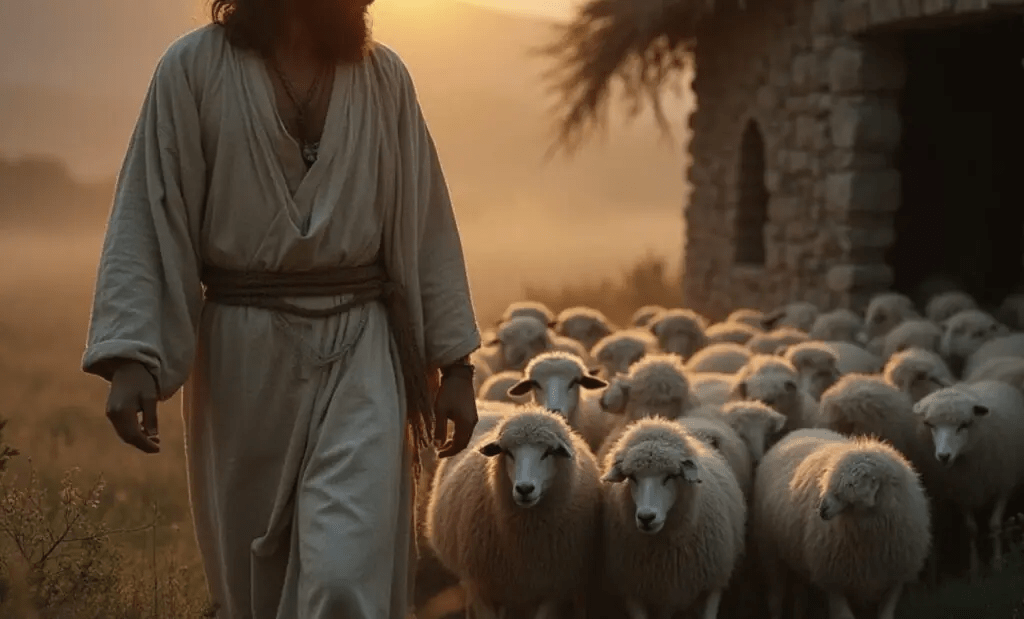
The Singular Voice of Jesus (John 10:1-10)

“Very truly, I tell you, anyone who does not enter the sheepfold by the gate but climbs in by another way is a thief and a bandit. The one who enters by the gate is the shepherd of the sheep. The gatekeeper opens the gate for him, and the sheep hear his voice. He calls his own sheep by name and leads them out. When he has brought out all his own, he goes ahead of them, and the sheep follow him because they know his voice. They will not follow a stranger, but they will run from him because they do not know the voice of strangers.” Jesus used this figure of speech with them, but they did not understand what he was saying to them.

So again Jesus said to them, “Very truly, I tell you, I am the gate for the sheep. All who came before me are thieves and bandits, but the sheep did not listen to them. I am the gate. Whoever enters by me will be saved and will come in and go out and find pasture. The thief comes only to steal and kill and destroy. I came that they may have life and have it abundantly. (New Revised Standard Version Updated Edition)

“A bee does not waste its energy trying to convince a fly that honey is better than s**t.” ancient Japanese saying

The voice of Jesus goes out into the world and calls persons by name. He spends no time twisting arms or putting the squeeze on people to get them into his sheep pen. Christ simply opens the gate, letting in people who come in response to his voice.

Jesus trusts that those who will come, will come. There’s no anxious hand-wringing on his part concerning whether anyone is going to show up, or not.

We certainly live in an anxious age – tending toward worrying incessantly about things out of our control. Many people spend an inordinate amount of time trying to influence things which belong to the realm of Jesus and the Spirit.

In addition, there is an over-abundance of putting unnecessary pressure upon ourselves to ensure we live some sort of perfect life. There is a hyper-developed sense of responsibility by some to never ever make any mistakes in this life.

I am speaking as much or more to myself. I have a nasty tendency of trying to be Atlas, picking up the world and carrying it on my shoulders. It’s all done in the erroneous notion that everything is up to me, that the earth spins on the Pastor Tim axis. After all, what will happen if I’m not there? I can’t be sidelined; people need me! O, what hubris there is in such notions.

In the Gospel text for today, Jesus makes no mention of our anxieties about entrance into the divine sheepfold. That’s because he has no expectations that we are to do his work. It isn’t our voices that are raised here; it is the voice of Jesus. We can trust that his voice and naming of persons is sufficient.

The responsibility and onus of salvation has always been on the side of God, not us. We redeem no one, including ourselves.

Sheep don’t shepherd the flock; the shepherd handles the flock of sheep. Another’s deliverance from sin, death, and hell comes neither from our hand nor our well-articulated words. No, it is the voice of Jesus that makes the difference. Hearing him is what creates response.

The voice of Christ is so powerful and effective that it doesn’t need to be heard audibly by the physical ear; it can more easily be heard with our spiritual ears and discerned by the soul.

Wisdom cries out in the street;
    in the squares she raises her voice.
At the busiest corner she cries out;
    at the entrance of the city gates she speaks:
“How long, O simple ones, will you love being simple?
How long will scoffers delight in their scoffing
    and fools hate knowledge?
Give heed to my reproof;
I will pour out my thoughts to you;
    I will make my words known to you. (Proverbs 1:20-23, NRSVUE)

It is our responsibility to listen and respond for ourselves, and not for anyone else. The gate will open for us.

We are to equally refuse listening to other competing voices of Trumpian-type charlatans. Such persons make grandiose promises which they never intend on keeping.

Those other voices only use the sheep by fleecing them of what little they have. However, if we enter the divine sheep pen, we need no longer be subject to the alternative voices which are full of foolish contradictory words that do nothing to help.

As the very gate by which the sheep enter, Jesus provides verdant green pastures; protects from bandits and predators; and gives life to the full. Christ calls folks together, guards, and sustains his flock. The shepherd can be trusted to take care of his own.

Open to me the gates of righteousness,
    that I may enter through them
    and give thanks to the Lord.

This is the gate of the Lord;
    the righteous shall enter through it.

I thank you that you have answered me
    and have become my salvation. (Psalm 118:19-21, NRSVUE)

Because Jesus gives abundant life, he can be contrasted with outlaws who come to create chaos among the sheep and ultimately destroy them.

Thieves do not come for the benefit of others; only themselves. They’re continually watching for how they can take advantage of situations, gaslight unsuspecting victims, and then dispense with them after having fleeced them of their resources, and even their very lives.

Whatever does not lead to life, leads to death and destruction. The hallmark of a contemporary charlatan-leader is that he creates division, disharmony, and disunity, rather than fostering loving connections and life-giving relationships.

If abundance is in the hands of a few, and not the many, then you can be sure that the outlaw is in charge of the flock. To have people languish, while others ignore them or even demonize them, is to have a charlatan thief calling the shots and trying to suffocate the voice of Jesus.

But the voice of Jesus will not be silenced. Christ’s voice will be heard. And it is being heard. Many are listening to the life that he offers. Jesus has the singular voice of deliverance.

Yet, many in this old world still seek political saviors. Only too late do these people realize that the would-be-savior makes a mockery of all that is good, just, and true.

In this current climate of Trumpism and a world which is attempting to resurrect authoritarianism in the name of Christianity, utopian dreams from twisted politicians will turn (and are turning) into nightmares.

Only Jesus is the gate; no one else can make the claim to providing an abundant life.

These current times are yet another temptation toward sinking into a debilitating anxiety. However, if we come back to listening to the singular voice of Jesus, then we can allow faith, hope, and love to take their rightful place in our lives. We can say along with the psalmist:

Even though I walk through the darkest valley,
    I fear no evil,
for you are with me;
    your rod and your staff,
    they comfort me.

You prepare a table before me
    in the presence of my enemies;
you anoint my head with oil;
    my cup overflows.
Surely goodness and mercy shall follow me
    all the days of my life,
and I shall dwell in the house of the Lord
    my whole life long. (Psalm 23:4-6, NRSVUE)

Holy Shepherd, you know your sheep by name and lead us to safety through the valleys of death. Guide us by your voice, so that we may walk in certainty and security to the joyous feast prepared in your house, where we celebrate with you forever. Amen.


The Thundering Voice of the Lord (Psalm 29)

Ascribe to the Lord, O heavenly beings,
    ascribe to the Lord glory and strength.
Ascribe to the Lord the glory of his name;
    worship the Lord in holy splendor.

The voice of the Lord is over the waters;
    the God of glory thunders,
    the Lord, over mighty waters.
The voice of the Lord is powerful;
    the voice of the Lord is full of majesty.

The voice of the Lord breaks the cedars;
    the Lord breaks the cedars of Lebanon.
He makes Lebanon skip like a calf
    and Sirion like a young wild ox.

The voice of the Lord flashes forth flames of fire.
The voice of the Lord shakes the wilderness;
    the Lord shakes the wilderness of Kadesh.

The voice of the Lord causes the oaks to whirl
    and strips the forest bare,
    and in his temple all say, “Glory!”

The Lord sits enthroned over the flood;
    the Lord sits enthroned as king forever.
May the Lord give strength to his people!
    May the Lord bless his people with peace! (New Revised Standard Version)

I grew up in rural middle America, on the land, and working the land. All of that outdoor work of the farmer makes one very attuned to the weather. In fact, my dad could often predict a coming thunderstorm with an almost precise accuracy.

There is something of a weather report from the psalmist in today’s lesson. He describes a powerful storm forming and moving its way inland from over the sea. It does its damage as a result of high winds, incredible lightning, and of course, the loud rumble of thunder. It is this thunderous display of strength that is the voice of the Lord.

Seven times in Psalm 29 the psalmist repeats the phrase, “the voice of the Lord.” There’s a lot more going on than a meteorological thunderstorm; behind the storm is theological Being who controls all things. The Lord God almighty is not your run-of-the-mill ordinary local deity.

Israel did not have multiple gods of thunder, lightning, clouds, and rain; they worshiped Yahweh, one God, who was Lord of the entire storm, as well as the whole world. The point of the psalmist is that no one, no other god, can compete with this awesome God of Israel.

Yet, despite the theological reality of Israel and their God, there was an entire panoply of gods that the Canaanites worshiped in ancient Palestine. The Canaanite god Baal is mentioned many times in the Old Testament. Baal was the lord of the storm, the god who hung out in the clouds and brought needed rain for the crops to grow.

What’s more, ancient Israel was continually tempted toward the worship of Baal. There were even those who gave the ancient god credit for the harvest of crops. But the psalmist will have none of that business. The real lord of the storm, the actual power behind everything in the universe, is Yahweh.

This is why there is the invitation to praise the Lord. And it isn’t just people who are invited; the heavenly beings are called upon to praise. It’s likely that the psalmist is putting those pagan gods in their place by encouraging them to recognize who is really in charge and in control of all things.

Whatever is going on with the psalmist’s intention, there is clearly a universal and cosmic call to acknowledge the majesty and sovereignty of Yahweh and offer appropriate praise for the One who is over everything.

The description of the powerful thunderstorm is presented as evidence of Yahweh’s power, glory, and sovereignty. It’s as if the entire earth is a temple, with every creature on earth called upon to offer up their praise and honor. Beings in both heaven and earth join together in a great universal choir of praise to the God who makes all things possible.

Even when the rains turn into a flood and brings chaos, God is over those chaotic waters, as well. It is the Lord who brings order from chaos, and who tames the mighty waters. In the New Testament, Jesus demonstrated this godly power in front of the fearful disciples:

A great windstorm arose, and the waves beat into the boat, so that the boat was already being swamped. But he was in the stern, asleep on the cushion, and they woke him up and said to him, “Teacher, do you not care that we are perishing?” And waking up, he rebuked the wind and said to the sea, “Be silent! Be still!” Then the wind ceased, and there was a dead calm. He said to them, “Why are you afraid? Have you still no faith?” And they were filled with great fear and said to one another, “Who then is this, that even the wind and the sea obey him?” (Mark 4:37-41, NRSV)

God, as absolute Sovereign, is able to provide peace and well-being from fearful hearts and anxious minds. And this is something to celebrate, to offer gratitude to God for such absolute authority.

People today may not be tempted to worship Baal; but in the middle of our fear and anxiety of life’s many storms, we might search for help and deliverance from the stock market, technology companies, a capitalist economy, social networking, or our own hard work and ingenuity.

Those things may easily become the gods we worship – offering our time, commitment, money, and emotional energy to them – and leaving God in the dugout of our lives to be available, just in case, as a pinch-hitter. But this approach never accounts for the inevitable game being rained out – perhaps permanently.

Just as the wise person saves their money for the inevitable rainy day, so the spiritual person who is aware of God’s authority and power will wisely invest their time and energies into discovering this God. They will engage in spiritual practices designed for relatable connection.

The believer realizes that, although today might be bright and sunny, there will be a damaging thunderstorm in the future for which preparations must be made now.

The voice of the Lord can be a reassuring presence and a healing balm; or it can be a fearful and devastating experience. How you see it and prepare for it makes a big difference.

Glorious God, I worship and praise you in response to your voice. I join with all the voices of the earth, together with all the voices of the heavens, to praise your glorious name; and to bow down in awe before your mighty power. Amen.

Psalm 29 – The Power of Language

Praise the Lord, you heavenly beings;
    praise his glory and power.
Praise the Lord’s glorious name;
    bow down before the Holy One when he appears.

The voice of the Lord is heard on the seas;
    the glorious God thunders,
    and his voice echoes over the ocean.
The voice of the Lord is heard
    in all its might and majesty.

The voice of the Lord breaks the cedars,
    even the cedars of Lebanon.
He makes the mountains of Lebanon jump like calves
    and makes Mount Hermon leap like a young bull.

The voice of the Lord makes the lightning flash.
His voice makes the desert shake;
    he shakes the desert of Kadesh.
The Lord’s voice shakes the oaks
    and strips the leaves from the trees
    while everyone in his Temple shouts, “Glory to God!”

The Lord rules over the deep waters;
    he rules as king forever.
The Lord gives strength to his people
    and blesses them with peace. (Good News Translation)

“Language is the blood of the soul into which thoughts run and out of which they grow.”

Oliver Wendell Holmes

I have always felt comforted during thunderstorms. Having grown up in the Midwest of America, strong thunderstorms are a given every summer. When my daughters were small children and frightened by the loud clap of thunder, I routinely said to them, “That’s just God letting us know he is powerful and watching over us.”

God spoke and stirred up a storm… So, they cried out to the Lord in their distress, and God brought them out safe from their desperate circumstances. God quieted the storm to a whisper; the sea’s waves were hushed. (Psalm 107:25, 29-30, CEB)

Yet, there is even more going on in today’s psalm than a reminder of God’s glory and power throughout creation. God’s very voice is the source of all the power.

In the beginning, God created the heavens and the earth – with words. The Lord Almighty spoke the entire world into existence. God’s words are generative, that is, the speech of God creates and gives life. When God’s voice goes forth, things happen.

God said, “Let the waters under the sky come together into one place so that the dry land can appear.” And that’s what happened. (Genesis 1:9, CEB)

God generously gives through speech.

Yes, the mechanism of God’s provision for us is language. The Lord creates, gives, sustains, and blesses us creatures through language. Out of all creation, humans are the only creatures formed in the image and likeness of God with the power of connection through speech.

God said, “Now we will make humans, and they will be like us. (Genesis 1:26, CEV)

Not only are we as people capable of speech, but we also have the ability and the capacity to form our own generative words. We have the God-given means to give life with how we use our power of language.

“Life and death lie in the power of language”

Helen Keller

I believe we all intuitively know this is true. As we reminisce the history of our lives, we can observe events where another’s words impacted us so significantly that it was as if they gave us the gift of life. We never forgot those words.

Unfortunately, we also have had times when another’s words cut us emotionally and it felt as if a part of us died. We remember those as well, and they hold us back in our own life-giving speech to ourselves and others.

“The godless destroy their neighbors by their words, but the righteous are saved by their knowledge.” (Proverbs 11:9, CEB)

We must listen to the voice of the Lord. God’s speech neither disappoints nor destroys. God’s Word is eternal life. The better we listen to God, the better we can have the generative power of words to provide life for others.

It only takes a cursory look at Holy Scripture to realize that words are powerful and are to be used with great care. We are all to continually develop the craft of wordsmithing so that we might ascribe to the Lord the glory due his name, as well as bless the world.

“As a tree gives fruit, healing words give life, but dishonest words crush the spirit.” (Proverbs 15:4, NCV)

The language we use—spoken and written words, sign language, facial expressions, bodily gestures, singing—helps us understand ourselves and lets us create relationships with others. Our words give us the power to describe our past, define our present, and dream of our future. 

“Words from wise people are like water bubbling up from a deep well—the well of wisdom.” (Proverbs 18:4, ERV)

We adults may balk at the notion that words are anything more than a creative expression. Yet, as I believe is typical with most things, children are closer to the kingdom of God than us bigger folk. Kids effortlessly make connections between words and reality – whereas older people barely have an idea this even occurs.

My grandson once remarked, when I was talking to him about being cautious at the playground, “How am I supposed to meet new people if I can’t talk to strangers?”

“When I asked my son (5 years old) how his day was, he said it was awesome. I asked him what made it so awesome – his response was ‘because I wanted it to be.’” – Tanya Niedzwiecki (Huffington Post, November 2015)

The voice of the Lord exhibits a mighty God who has the power to create and recreate with but a word.

As people in God’s likeness, our words are powerful tools to be used with wisdom and care. Our speech allows us to praise God and encourage one another. Even more, the use of language enables us to speak into existence new realities for ourselves and others.

May our words bring forth hope and blessing to a world in need of healing.

Mighty God, the Lord who is King and all powerful, I am overwhelmed before such awesome majesty, and my response to your voice is reverent worship through Jesus Christ, your Son, my Lord, who lives and reigns with you and the Holy Spirit, one God, now and forever. Amen.

The Voice of the Lord and the Power of Words

The Power of Words by Tiffany Hagen, 2015

I have always felt comforted during thunderstorms. Having grown up in Iowa, strong thunderstorms are a given every summer. When my daughters were small children and frightened by the loud clap of thunder, I would say to them, “That’s just God letting us know he is powerful and watching over us.”

God spoke and stirred up a storm… So, they cried out to the Lord in their distress, and God brought them out safe from their desperate circumstances. God quieted the storm to a whisper; the sea’s waves were hushed. (Psalm 107:25, 29-30, CEB)

God’s very voice is the source of all power. In the beginning God created the heavens and the earth – with words. The Lord Almighty spoke the entire world into existence. God’s words are generative, that is, the speech of God creates and gives life. When God’s voice goes forth, things happen:

God said, “Let there be light,” and there was light… (Genesis 1:3, NIV)

God said, “Let there be a vault between the waters to separate water from water….” And it was so. (Genesis 1:6-7, NIV)

God said, “Let the waters under the sky come together into one place so that the dry land can appear.” And that is what happened. (Genesis 1:9, CEB)

God said, “Let the earth produce plants—some to make grain for seeds and others to make fruits with seeds in them. Every seed will produce more of its own kind of plant.” And it happened. (Genesis 1:11, NCV)

God said, “Let lights appear in the sky to separate the day from the night. Let them be signs to mark the seasons, days, and years. Let these lights in the sky shine down on the earth.” And that is what happened. (Genesis 1:14-15, NLT)

God said, “Let the land produce living creatures according to their kinds: the livestock, the creatures that move along the ground, and the wild animals, each according to its kind.” And it was so. (Genesis 1:24, NIV)

God creates and gives through speech. Yes, the mechanism of God’s provision for us is words. This means language is vitally important. The Lord creates, gives, sustains, and blesses creation through language – with humans as the only creatures formed in the image and likeness of God.

God said, “Now we will make humans, and they will be like us. (Genesis 1:26, CEV)

People, then, are capable of speech. Even more, with our ability of language, we also have the capacity to form generative words. We have the God-given means to give life with our speech.

“Life and death lie in the power of language.”

helen keller

I believe we all intuitively know this is true. As we reminisce the history of our lives, we can observe events where another’s words impacted us so significantly that it was as if they gave us the gift of life. We never forget those words. We also have had times when another’s words cut us emotionally and it felt as if a part of us died. We tend to remember those as well, and they hold us back in our own life-giving speech to ourselves and others.

“The godless destroy their neighbors by their words, but the righteous are saved by their knowledge.” (Proverbs 11:9, CEB)

We must listen to the voice of the Lord. God’s speech does not disappoint or destroy. God’s Word is eternal life. The better we listen to God, the better we can have the generative power of words to provide life for others. It only takes a cursory look at Holy Scripture to realize that words are powerful and are to be used with great care. We are all to continually develop the craft of wordsmithing so that we might ascribe to the Lord the glory due his name as well as bless the world.

“As a tree gives fruit, healing words give life, but dishonest words crush the spirit.” (Proverbs 15:4, NCV)

The language we use—spoken and written words, sign language, facial expressions, bodily gestures, singing—helps us understand ourselves and lets us create relationships with others. Our words give us the power to describe our past, define our present, and dream of our future. 

“Words from wise people are like water bubbling up from a deep well—the well of wisdom.” (Proverbs 18:4, ERV)

“Words are singularly the most powerful force available to humanity. We can choose to use this force constructively with words of encouragement, or destructively using words of despair. Words have energy and power with the ability to help, to heal, to hinder, to hurt, to harm, to humiliate and to humble.”

Yehuda Berg

We need to speak mindfully, paying careful attention to give people words of encouragement and compassion. We must discipline ourselves to use our words in a way that conveys respect, gentleness, and humility.

We adults may balk at the notion that words are anything more than a creative expression. Yet, as I believe is typical with most things, children are closer to the kingdom of God. They effortlessly make connections between words and reality whereas us older folks barely have an idea this even occurs. My grandson once remarked when I was talking to him about being cautious at the playground, “How am I supposed to meet new people if I can’t talk to strangers?”

“When I asked my son (5 years old) how his day was, he said it was awesome. I asked him what made it so awesome – his response was ‘because I wanted it to be.’”

Tanya Niedzwiecki (Huffington Post, November 2015)

The voice of the Lord exhibits a mighty God who has the power to create, recreate, and renew with but a word. As people in God’s likeness, our words are powerful tools to be used with wisdom and care. Our speech allows us to praise God and encourage one another. Even more, the use of language enables us to speak into existence new realities for ourselves and others. May those words bring forth hope and blessing to a world in need of healing.