Learn to Live Well (Micah 7:18-20)

The Prophet Micah exhorting the Israelites to repent by Gustave Doré (1832-1883)

Who is a God like you, pardoning iniquity
    and passing over the transgression
    of the remnant of his possession?
He does not retain his anger forever
    because he delights in showing steadfast love.
He will again have compassion upon us;
    he will tread our iniquities under foot.
You will cast all our sins
    into the depths of the sea.
You will show faithfulness to Jacob
    and steadfast love to Abraham,
as you have sworn to our ancestors
    from the days of old. (New Revised Standard Version)

In a world obsessed with constant and rapid change, it is refreshing to know that there is a God whose essential character, attributes, and way of being in the world never changes.

The Lord is a God who is faithful, always keeping divine promises to people. God is pleased to show steadfast love and kindness through extending forgiveness. And because the Lord values pardoning human transgressions, God always looks sin square in the eye – not ever sugarcoating iniquities – and puts it down like a rabid animal.

In the prophet Micah’s day, the social and communal sins of the people were legion, leading to a great deal of injustice. Wealthy landowners creatively and unjustly seized property in order to feed their continual greed for more; false prophets went about preaching a positive future of peace, even though the poor became poorer through no fault of their own; and the nation’s leaders abused their power by fleecing the people of what little they had to begin with.

In short, dishonest business practices, dressed up by leadership as the path to prosperity, stirred up the just and right indignation of God. An assurance of pardon comes, yet only after there is confession of sin.

In this present contemporary era, we have our own legion of social sins which must be identified, confronted, confessed, expiated, and replaced with virtues that foster life and happiness.

Today’s way of doing business – whether in the corporate world and even in many faith communities – is to embrace an unholy ethic of more, faster, and better.

“Wait,” you may push back, “that doesn’t sound to me like anything bad.” And I would respond by saying that this is evidence of how far into our sin we have become, that we cannot distinguish our unjust practices from legitimate just practices.

Behind many contemporary business “ethics” are compulsions to beat the competition at all cost, obsessions with more money, and a lust for power and control. These are not practices helping people to live well.

More

In ancient Egypt, Pharaoh’s massive industrial complex was built on more – more pyramids and buildings, more wealth, more power and influence. Behind the “more” is usually old-fashioned greed. We want more market share, more numbers, more options and opportunities, more control.

Yet, what if the people doing the “more” are already tired, weary, and have given what they can? Like the Israelite slaves in Egypt, making more bricks translated to more wealth. And if it takes a literal whip to make them do more, then so be it.

Many modern workers put up with the “more” mantra only because they need their jobs and fear losing them if they don’t keep a ridiculously high level of production. And if anybody complains about it, they immediately get labeled (by the people in power) as not being grateful.

Faster

I once worked a job where a manager would occasionally and literally stand over my shoulder and time me with a stopwatch… sheesh… and I worked another job in which there was a quota for every day; we had to keep pace because production was king.

You don’t need to be in a factory for the clock to be the taskmaster. I don’t know of anyone who is hounded by a boss about time to experience contentment, peace, and rest. Speeding up to meet a quota or deadline only promises to create the necessity for more change, done faster.

None of this makes for a good life; and I would argue that it doesn’t make for good business either. It only produces empty and vacuous people who sacrifice themselves on the altar of work.

We are finite creatures with finite time and resources. We are not inanimate machines without a soul.

Better

One of the manifestations of valuing speed and productivity is also expecting fewer mistakes – because imperfection slows the wheels of progress. This is where people begin to be treated like machines instead of humans. And they become expendable; if they don’t do better, they get replaced with someone else.

Furthermore, this push to do better is often why workers are told to keep their problems at home and not bring them to the job. This has had a terrible impact on individuals, their families, and their relationships.

Forced compartmentalization has the effect of breaking down integrity and creating disparities. People’s very normal struggles cannot be shared with anyone but a professional counselor, therapist, or pastor. Their feelings and emotions become privatized.

Giving someone a list of resources might make management feel better, but it does little to actually help a grieving person who is right under their nose. Depression sets in because the person’s experience and emotions have been implicitly invalidated, leaving them with a sense that they’re meaningless and are a burden on others.

More, faster, and better – continually pumped into society’s bloodstream – is only making the world anxious, depressed, and with no energy to keep being yourself, that is, if you even know who you are anymore after such a pace of work.

What If?

Instead of more, faster, better, what if we…

  1. Embrace an unforced rhythm of life which recognizes the values of slowness, simplicity, and satisfaction?

2. Ask people to be themselves, to live life at a pace that’s doable and enjoyable?

3. Expect workers and people everywhere are to rest and adopt Christ’s easy yoke?

4. Take up the mantle as God’s people to be a counter-cultural movement of relationships which emphasize grace, love, mercy, patience, peace, joy, and spiritual support?

5. Put our energies into the careful construction of souls, instead of draining the spirits of people through unrealistic expectations?

6. Sought to live a simple life, without the need for more?

7. Learn to be satisfied with what we already have?

8. Rid ourselves of financial language to communicate with one another? (e.g. “invest in eternity,” “be an asset, not a liability,” “pay your debt to society,” etc.)

For the Christian, transformation isn’t dependent upon praying more, reading more, giving more, or serving more. Spiritual growth isn’t realized overnight; it takes time, in fact, a lifetime. And change isn’t about trying to be better, since our identity is already firmly in Christ.

My friends, you and I are enough. Transformation of life is the result of becoming open and receiving the grace of God in Christ. If we want forgiveness, we must face the sin of our world in all of its deceit, degradation, and damage.

Let’s not find ourselves on the other end of God’s ire because of unsound practices which dehumanize others. But let us accept and adopt rhythms of life that are consistent with being human and caring for others. That’s what the prophet Micah was looking for.

May it be so, to the glory of God.

A Changed Life (Galatians 1:11-24)

A mosaic of the Apostle Paul in St Isaac’s Cathedral, St. Petersburg, Russia

I want you to know, brothers and sisters, that the gospel I preached is not of human origin. I did not receive it from any man, nor was I taught it; rather, I received it by revelation from Jesus Christ.

For you have heard of my previous way of life in Judaism, how intensely I persecuted the church of God and tried to destroy it. I was advancing in Judaism beyond many of my own age among my people and was extremely zealous for the traditions of my fathers. But when God, who set me apart from my mother’s womb and called me by his grace, was pleased to reveal his Son in me so that I might preach him among the Gentiles, my immediate response was not to consult any human being. I did not go up to Jerusalem to see those who were apostles before I was, but I went into Arabia. Later I returned to Damascus.

Then after three years, I went up to Jerusalem to get acquainted with Cephas and stayed with him fifteen days. I saw none of the other apostles—only James, the Lord’s brother. I assure you before God that what I am writing you is no lie.

Then I went to Syria and Cilicia. I was personally unknown to the churches of Judea that are in Christ. They only heard the report: “The man who formerly persecuted us is now preaching the faith he once tried to destroy.” And they praised God because of me. (New International Version)

I didn’t ask God for this

Saul wasn’t looking to change anything – except maybe to keep those confounded Christians, the group known as “The Way,” out of his beloved religion. He didn’t wake up one morning, sit on the edge of his bed and say, “Well, now, gee-whillikers, I think I’ll become the Apostle Paul, follow Jesus, and rankle a bunch of my fellow Jews with establishing churches all over the place.”

The only well-thought out plan Saul had was to ensure that Christians stayed away by any means possible. He had quite the turn around by actually joining the Christian movement. (Acts 9:1-19)

From the very get-go of his conversion, the new Paul faced skepticism, doubts, and opposition from both church and synagogue. Christians knew how Saul breathed all kinds of threats against them; so, understandably, they were reticent to receive him, perhaps wondering if it were some sort of ruse to topple the church. If it were not for the insight and encouragement of Barnabas, Paul may not have ever entered the ranks of the church. (Acts 9:26-27)

Paul’s fellow devout Jews were so upset with him for becoming a turncoat that they sought to kill him – which became a theme of Paul’s life – getting rocks thrown at him, whipped, beaten, and left for dead more than once. (Acts 9:23-24; 2 Corinthians 11:24-29)

Although Paul never asked for a dramatic conversion to Christianity, a missionary life, and continual suffering at the hands of others, he nevertheless embraced it with all the gusto of faith God gave him.

So, the gospel that the Apostle Paul proclaimed wasn’t something he sought; it was given to him. God graciously revealed the good news to Paul. For three years, he received it. Considering Paul’s background and former life, we can see why it might not be a good idea for him to hang out in Jerusalem and learn about Jesus.

Arabia is a desert. That is precisely where Paul needed to be in his early life as a Christian. Eventually, the churches and believers came around to seeing the authenticity of Paul’s faith and embraced him as a disciple. Paul is considered an Apostle because he had direct contact with Jesus himself in the Arabian desert.

God called me through the grace of Jesus

That phrase is Paul’s spiritual autobiography in a nutshell. It represents his dramatic transformation — from persecutor to preacher — and gives evidence of the hand of God at work in his life.

The fundamental conviction of being called by God, anchors Paul’s faith story. He tells that story in order to remind the Galatian Church of their own experience of being called by God’s grace.

Paul wrote his letter to the Church to help keep them on the track of grace; they were saved by grace, so therefore, they needed to also be sanctified by grace (and not law). He feared they were being led astray by believers who twisted the gospel for their own ends in order to avoid suffering. (Galatians 6:12)

The question Paul tackled head on was: Do the Gentiles have to become Jewish in order to be Christians? “Absolutely not!” Paul insisted. Neither circumcision nor uncircumcision counts for anything; the only thing that counts is faith working through love. (Galatians 5:6)

I connected with God, and you can, too

Paul was arguably the most influential Christian who ever lived. He shared his faith story in order to encourage the Galatians to examine their own experiences for signs of God’s call.

How has God called you?

It matters little whether it’s a dramatic call, like Paul’s, or whether it seems mundane, as if you don’t remember a time that you didn’t believe. And everything in between.

The important point is that we all need moments, events, and experiences of life transformation; and God’s grace must be the defining center of our personal and collective narratives.

Grace makes all the difference and is what leads to a changed life.

Once you were separated from God. The evil things you did showed your hostile attitude. But now Christ has brought you back to God by dying in his physical body. He did this so that you could come into God’s presence without sin, fault, or blame. (Colossians 1:21-22, GW)

Almighty God, transform us – not for our benefit, but for the benefit of the world. Do your work in changing us to be the new creation you have called us to be in Jesus Christ.  

Holy Spirit of God, do your sanctifying work in the church and help us to be the Body of Christ – engaged in mission, testifying to our faith, and bearing witness to the presence of our Savior, Jesus Christ. 

Lord Jesus, enable us to surrender the church back to you. It is yours, not ours. Help us lay aside our personal agendas and preferences so we can be fully committed to your calling for us. 

Blessed Holy Trinity – Father, Son, and Spirit – the God whom we serve: Do your work in our world and give to us a vision of transformed lives, renewed neighborhoods, and restored communities – bringing blessings and redemption for the glory of God. Amen.

Pride Comes Before the Fall (Luke 22:31-33, 54-62)

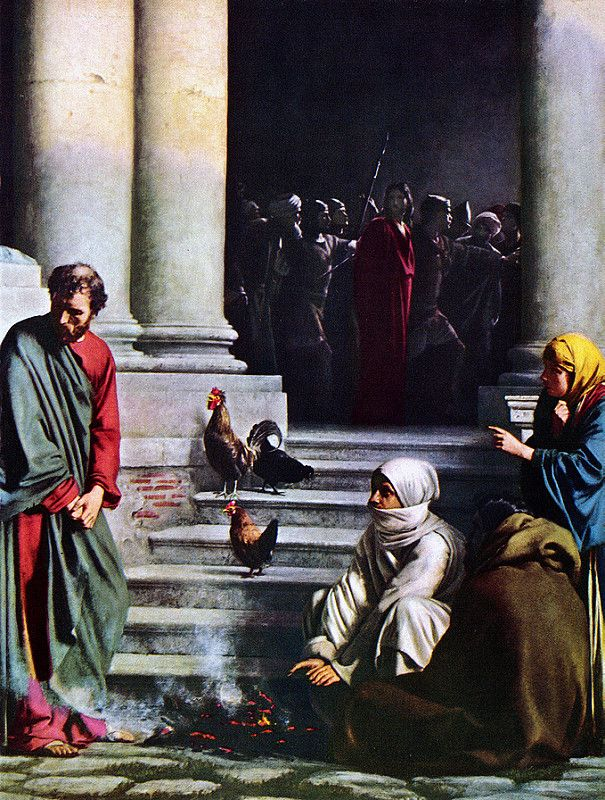
The Denial of Peter by Carl Bloch (1834-1890)

“Simon, Simon, Satan has asked to sift all of you as wheat. But I have prayed for you, Simon, that your faith may not fail. And when you have turned back, strengthen your brothers.”

But he replied, “Lord, I am ready to go with you to prison and to death….”

Then seizing Jesus, they led him away and took him into the house of the high priest. Peter followed at a distance. And when some there had kindled a fire in the middle of the courtyard and had sat down together, Peter sat down with them. A servant girl saw him seated there in the firelight. She looked closely at him and said, “This man was with him.”

But he denied it. “Woman, I don’t know him,” he said.

A little later someone else saw him and said, “You also are one of them.”

“Man, I am not!” Peter replied.

About an hour later another asserted, “Certainly this fellow was with him, for he is a Galilean.”

Peter replied, “Man, I don’t know what you’re talking about!” Just as he was speaking, the rooster crowed. The Lord turned and looked straight at Peter. Then Peter remembered the word the Lord had spoken to him: “Before the rooster crows today, you will disown me three times.”And he went outside and wept bitterly. (New International Version)

A Lesson In Trust

One day I watched a lifeguard handle a group of kids for their first time in the pool. She went to each one and told them to put their ears in the water and their belly buttons in the air while she was holding them up. “When I count to three, you won’t feel my hands underneath you, but they’re there,” she said. 

Most of the kids frantically jerked their knees toward their chins and flailed their arms.

Even though nearly all people float when they assume a posture of rest, many believe they’ll sink, and don’t keep their posture for long. 

The disciples had a hard time trusting Jesus. They couldn’t seem to rest and relax because Jesus said and did things that they were not expecting him to say and do. 

Jesus preached the necessity of humility and loving one’s enemies; and he focused on ministry to the least persons around them. The disciples had not yet really bought into Christ’s kingdom agenda because they kept pulling their knees up by thinking Jesus was going to lead a rebellion against the Romans and put Israel back on the map – believing it would be just like the old days of Jewish domination of the land.

But Jesus is all about a different agenda: transformation of the inner person that leads to greater submission to God’s will so that the least persons among us will be reached.

Bad News Before Good News

Many already believe they know what God wants and how to follow Jesus, and so, aren’t much open to the Spirit. They acknowledge they’re sinners, yet don’t believe their sin is as bad as others. “O, sure, we sin, but not like murderers and child molesters. Our sins are ‘respectable’– a little resentment, a little prejudice, and a little gossip is even necessary to make sure people submit to the unwritten rules.”

We must first hear the bad news before we can hear the good news. Once we hear the bad news and accept it, we must receive God’s remedy for it. In order to do this, let’s compare and contrast two disciples: Peter and Judas.

Peter’s Denial, 17th Century Ethiopian

Peter and Judas

Peter and Judas shared a similar vision about seeing Israel restored to its previous glorious prominence. Judas was a Zealot, ready to take military action, if necessary; and Peter had no problem taking up the sword when it seemed the time was ripe for a political rebellion and takeover.

Even though Peter insisted he would never turn on Jesus, Jesus knew better. And, sure enough, Peter did a full-fledged moral belly flop in the pool of denial by disowning Jesus three times.

Judas actually caught on, quicker than Peter, that Jesus wasn’t going to lead a military coup. Judas had enough of wasting time on poor marginalized people; they weren’t going to make good soldiers. After Judas clearly saw that Jesus had no intention of forcing an earthly political kingdom, he actively sought an opportunity to betray him.

Neither Judas or Peter, nor any of the disciples wanted to take a step into the world of suffering as the means of reaching others and embracing the kingdom of God. They wanted glory not suffering. But Jesus chose the cup of suffering.

Both Judas and Peter realized after denying Jesus that they had made a terrible mistake. But that is where the similarities end. 

Judas realized what he had done, and so, went out and died by suicide. Rather than throw himself upon the mercy of God, Judas tried to atone for his own sin. He tried to fix something that could not be undone. It was a refusal of grace.

Peter responded by weeping bitterly, consistent with someone experiencing repentance. He realized he was poor in spirit and mourned over his sin. Peter later becomes a genuinely meek person with God’s righteousness taking root within him as he, in the book of Acts, demonstrated mercy and became a preacher of truth and grace.

The Need for Transformation

There cannot be systemic and structural renewal without personal transformation. And there cannot be personal transformation without a brutally honest assessment of myself. “I will never fall,” comes from a heart of pride that believes “I’m not so bad.”

Our sins and failures stem ultimately from a lack of trust. We keep pulling our knees up because we are too anxious to let the agenda of Jesus control our lives. 

Proud people don’t pray much because they are self-sufficient. But humble people pray a lot because they don’t want to fall into temptation. They pray because they discern they’re prone to being like a cockeye little dog who thinks he is a big dog. 

Even Jesus felt the need to watch and pray so that he could face his hour of pain and suffering on behalf of all mankind.

Following Either Close or From a Distance

Jesus was arrested and Peter followed him at a distance. If we are brutally honest with ourselves, this too, describes much of our own following of Jesus. We want to see how everything will shake-out before we commit. 

Christ is asking us to trust him, to make and keep promises before we even know what it all means. We need to acknowledge and admit that we have commitment-it is; we have made a mess of our lives by our stubbornness and holding on to our own ideas for how we think things ought to go.

If you find yourself in a mess, whether it is of your own making or of somebody else, the only thing that can handle it is a close following of grace. We are to approach God with brutal honesty, humility, and a willingness to rest and relax when he is telling you to. 

The Lord will give you his righteousness; you need not try to obtain it on your own. So, let the knees go down and stick the belly button out – rest in Jesus.

Psalm 50:1-8, 22-23 – The Beauty in Brokenness

The Almighty God, the Lord, speaks;
    he calls to the whole earth from east to west.
God shines from Zion,
    the city perfect in its beauty.

Our God is coming, but not in silence;
    a raging fire is in front of him,
    a furious storm around him.
He calls heaven and earth as witnesses
    to see him judge his people.
He says, “Gather my faithful people to me,
    those who made a covenant with me by offering a sacrifice.”
The heavens proclaim that God is righteous,
    that he himself is judge.

“Listen, my people, and I will speak;
    I will testify against you, Israel.
    I am God, your God.
I do not reprimand you because of your sacrifices
    and the burnt offerings you always bring me….

“Listen to this, you that ignore me,
    or I will destroy you,
    and there will be no one to save you.
Giving thanks is the sacrifice that honors me,
    and I will surely save all who obey me.” (Good News Translation)

In the beginning, all of creation was a vessel filled with divine light. Then, it broke, and the shards of holiness were strewn across the earth. Those broken pieces are all around us. Sometimes, maybe oftentimes, we don’t see them because of our own darkness.

Ever since, the Lord has been on a mission, bending down, carefully looking for the broken shards, finding them, and picking them up. From east to west, God has been gathering together everyone on earth – the broken yet divinely lighted humans.

A major theme throughout the entirety of Holy Scripture is that God is reaching all kinds of people all over the world. Indeed, the Bible is a long unfolding drama of redemption in which the Lord does whatever it takes to restore a fundamentally broken world.

“Kintsugi” (literally, in English, “golden joinery”) is a centuries-old Japanese art form of repairing broken pottery with gold. Instead of rejoining broken ceramic pieces with a clear camouflaged adhesive, the kintsugi technique uses a special lacquer dusted with powdered gold. After restoration, beautiful seams of gold glint in the obvious cracks of the ceramic vessel. This also means that every restored ceramic piece has a unique appearance; no two of them are the same.

The Lord is presently in the divine workshop, putting broken shards of humanity together. And God isn’t trying to hide or disguise the cracks and flaws; it’s just the opposite: God celebrates the artifact by emphasizing it’s fractures and breaks. As it turns out, the restoration which the Lord employs brings the vessel to even greater beauty than it originally enjoyed. It’s the transformation of a new existence from the old.

The deepest yearning in every human soul is to become whole again, to return to their spiritual source, to experience belonging and union with the Beloved.

Amidst the human pain all around us, and within us, we can observe the sacred light, and turn in the direction of beauty. We can hear the call of God to respond with gratitude and thanksgiving, instead of relying upon some physical or monetary sacrifice to suffice our spiritual obligations.

We are here to participate with God in redeeming that which is broken. The sacrificial activity that honors the Lord, and gathers the strewn shards, is a grateful heart with lips that speak thankfulness. Humanity can only see the power of God to save and restore, whenever us jars of clay practice gratitude and obedience to the Lord.

The world’s observation of a perfect vessel is not what draws anyone to faith. Rather, it is seeing an imperfect vessel, put together with a divine glue of gold, the cracks visible and showing for all to notice. Perfectionism is repellent to most folk; it smacks of others attempting to appear something they are not; it’s disingenuous and insincere.

Imperfection, however, speaks of being genuine and real; it brings solidarity with others; it relates and seeks to connect. Observing broken pieces put back together through God’s kintsugi communicates that suffering can be changed into beauty.

Today’s psalm is a reminder for us to stay optimistic when things fall apart and to celebrate the flaws and missteps of life. It teaches us that, when God breaks and destroys, this is not necessarily a mark of judgment. It lets us know that we can be calm when all falls apart. It reminds us that the fragility of humanity is not ugly but beautiful. It reminds us that amidst so much complexity, there is simple beauty all around us, if we will but seek and see.

In a world that has a hard time accepting all the breaks, scars, and imperfections of life, there is a God who is undisturbed by it all. The Lord gently, patiently, and skillfully puts us back together again so that a beautiful transformation of heart and life results.

The Lord said to me, “My grace is sufficient for you, for my power is made perfect in weakness.” Therefore, I will boast all the more gladly about my weaknesses, so that Christ’s power may rest on me. That is why, for Christ’s sake, I delight in weaknesses, in insults, in hardships, in persecutions, in difficulties. For when I am weak, then I am strong. (2 Corinthians 12:9-10, NIV)

Grant us, O God, not to be anxious about earthly things but to love things heavenly and, even now, while we are placed among things that are passing away, to hold fast to those that shall endure; through Christ our Lord, Amen.