Acts 2:22-36 – From Flake to Fearless

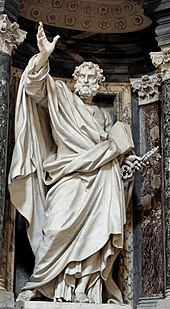
Statue of St. Peter in Rome

“Fellow Israelites, listen to this: Jesus of Nazareth was a man accredited by God to you by miracles, wonders and signs, which God did among you through him, as you yourselves know. This man was handed over to you by God’s deliberate plan and foreknowledge; and you, with the help of wicked men, put him to death by nailing him to the cross.But God raised him from the dead, freeing him from the agony of death, because it was impossible for death to keep its hold on him.David said about him:

“‘I saw the Lord always before me.
    Because he is at my right hand,
    I will not be shaken.
Therefore my heart is glad and my tongue rejoices;
    my body also will rest in hope,
because you will not abandon me to the realm of the dead,
    you will not let your holy one see decay.
You have made known to me the paths of life;
    you will fill me with joy in your presence.’

“Fellow Israelites, I can tell you confidently that the patriarch David died and was buried, and his tomb is here to this day. But he was a prophet and knew that God had promised him on oath that he would place one of his descendants on his throne. Seeing what was to come, he spoke of the resurrection of the Messiah, that he was not abandoned to the realm of the dead, nor did his body see decay. God has raised this Jesus to life, and we are all witnesses of it. Exalted to the right hand of God, he has received from the Father the promised Holy Spirit and has poured out what you now see and hear. For David did not ascend to heaven, and yet he said,

“‘The Lord said to my Lord:
    “Sit at my right hand
until I make your enemies
    a footstool for your feet.”’

“Therefore, let all Israel be assured of this: God has made this Jesus, whom you crucified, both Lord and Messiah.” (New International Version)

Throughout my ministerial life, there have been individuals who have come to me a bit discouraged because they have not experienced a changed life. After trying, time and again, to be different, they say to me, “Nobody ever really changes. We’re basically the same people throughout our whole lives.”

I couldn’t disagree more.

In the New Testament Gospels, the Apostle Peter was a flake. He sometimes was discerning and got it, and sometimes didn’t. 

Peter could understand Jesus was Messiah, but then turn around and refuse that Christ had to die on a cross. He would get bold and walk on water, but then also end up afraid, needing help from drowning. Peter stood tall for Jesus, ready to take on the world, and then turn around and deny the Lord three successive times.

However, when we come to biblical book of Acts, Peter is a completely changed man. Peter gets it. He is brave and fearless. He boldly confesses Christ. And all the while he does not falter, flinch, or back down. 

So, what in heaven’s name, happened and made the difference for Peter between the Gospels and Acts? 

The Holy Spirit, that’s what, or rather, who.

God’s Spirit comes upon Peter, and he is never the same again. He is a changed man. Peter goes from flake, to fearless.

Everything falls into place for Peter, who preaches with such boldness and effectiveness that thousands turn from their previous ways of thinking and living and turn to Jesus as the hope of the world. They changed, too.

Peter was all-in with a simple and straightforward message of good news, that God raised Jesus from death. He went on to insist, without wavering and with firm conviction, that this was so, because it was not possible for the Son of God to be held by anything, even death. The proof being the resurrection.

If it was impossible for death to keep a grip on Jesus, then there is absolutely nothing that can deter Jesus or hold him back from accomplishing what he wants to accomplish. 

Flaky believers are not going to frustrate Jesus or upset his plans; he’ll just send the Holy Spirit. 

We may too often imprison ourselves in self-made spiritual jail cells. Like the pre-Pentecostal Peter, we flake and flip-flop in the Christian life. Once-in-a-while we are spot-on, but cannot really explain why, like a golfer who hits an amazing shot but can’t reproduce it no matter how hard he tries. 

The truth is that Jesus has conquered sin, death, and hell. By faith, we have forgiveness of sins in him, and have the way opened to a new life in the Spirit. It isn’t a secret; it’s a new reality.

At the front end of the Christian season of Ordinary Time, we are reminded that God’s Holy Spirit is with us. We remember what good old Peter said so long ago, which is still relevant for us today:

We have everything we need to live a life that pleases God. It was all given to us by God’s own power, when we learned he had invited us to share in his wonderful goodness. God made great and marvelous promises, so his nature would become part of us. Then we could escape our evil desires and the corrupt influences of this world. (2 Peter 1:3-4, CEV)

The message Peter proclaimed was powerful, not only because it was inherently potent, but also that the gospel dwelled mightily in Peter and inhabited a central place within him.

We, too, have that same opportunity and privilege.

Loving Lord Jesus, I confess my faults, shortcomings, sins, and rebellious acts, and ask you to forgive me. I embrace you as my Savior and Lord. Thank you for your atoning death on the cross in obedience to your Father’s will to put away my sins. Be in charge of every part of my life. Indwell and empower me with your Holy Spirit, so that I may live as your faithful follower, now and forever. Amen.

Psalm 30 – Mourning Has Turned to Joy

I will exalt you, Lord, for you rescued me.
    You refused to let my enemies triumph over me.
O Lord my God, I cried to you for help,
    and you restored my health.
You brought me up from the grave, O Lord.
    You kept me from falling into the pit of death.

Sing to the Lord, all you godly ones!
    Praise his holy name.
For his anger lasts only a moment,
    but his favor lasts a lifetime!
Weeping may last through the night,
    but joy comes with the morning.

When I was prosperous, I said,
    “Nothing can stop me now!”
Your favor, O Lord, made me as secure as a mountain.
    Then you turned away from me, and I was shattered.

I cried out to you, O Lord.
    I begged the Lord for mercy, saying,
“What will you gain if I die,
    if I sink into the grave?
Can my dust praise you?
    Can it tell of your faithfulness?
Hear me, Lord, and have mercy on me.
    Help me, O Lord.”

You have turned my mourning into joyful dancing.
    You have taken away my clothes of mourning and clothed me with joy,
that I might sing praises to you and not be silent.
    O Lord my God, I will give you thanks forever! (New Living Translation)

Life is not only full of the tears which give way to joy; a great deal of life is learning to move through our grief and transform the pain into something beautiful.

Hard circumstances make us either better or bitter.

The psalmist, King David, had his share of adversity, difficulty, and distress. The youngest of seven sons, David was something like the runt of the litter. He was given the grunt work that nobody else wanted to do, since he was the lowest person in the household.

So, off to the fields he went, shepherding the sheep, dealing with hot days and cold nights, fighting off predators, and keeping the sheep healthy and safe. Yet out there where no one was looking, God was watching. And the Lord was developing within David the very qualities needed to one day rule over all Israel and Judah.

Even in-between becoming a member of the king’s court and becoming king himself, David’s life was mostly characterized by misunderstanding and being victimized. In other words, David had intimate first-hand experience of terrible sorrow, buckets of tears, and stress-filled anxiety. Through it all, he did not become bitter. Instead, David learned to transform his mourning to joy.

Many persons, having experienced the sort of things David of old did, come through their difficulties and adversity with a hard heart. They end up hurting people, just like they were hurt. Their verbal and physical acts of violence betray their inability to turn pain into something useful.

So, what makes the difference between those who experience the same sorts of painful events, yet go in the different directions of caring or harming?

I believe the twentieth-century Trappist monk, Thomas Merton, understood the true source of violence and non-violence…

“There is a pervasive form of contemporary violence to which the idealist most easily succumbs: activism and overwork. The rush and pressure of modern life are a form, perhaps the most common form, of its innate violence. To allow oneself to be carried away by a multitude of conflicting concerns, to surrender to too many demands, to commit oneself to too many projects, to want to help everyone in everything, is to succumb to violence. The frenzy of our activism neutralizes our work for peace. It destroys our own inner capacity for peace. It destroys the fruitfulness of our own work, because it kills the root of inner wisdom which makes work fruitful.”

Thomas Merton, Conjectures of a Guilty Bystander

Merton rightly discerned that the false self (the self we project to others and try to maintain as real) is in fact the source of violence – specifically, the false self’s need to gratify impulses for power and control, affection and esteem, security and safety, at all costs.

However, we do not find ourselves in those ways. The cultivation of solitude, silence, and contemplation are non-violent practices which organically produce non-violent ways of being in the world. Those were the very practices which characterized David’s early life as a shepherd.

It’s what we do when no one is watching, and nobody is around, that makes the difference. Our way of being in the world is determined by the way we are with ourselves when we are alone.

How you are, matters.

“If we do not transform our pain, we will most assuredly transmit it.”

Richard Rohr

We need to be present to our pain, to pay attention to it. Our hurts don’t simply vanish if we ignore them, try to go around them, or seek quick fixes to them. The pain is still there, and over time, becomes gangrene of the soul.

Instead, we must dare to go to the unexplored territory of the inner person, to confront and contend with our inner turmoil and be open to hearing from it.

“The endurance of darkness is the preparation for great light.”

St. John of the Cross

Today, like every day, we have the opportunity and even responsibility to bring our whole selves, pain included, to the relationships we have, the work we do, and everywhere we go. The world not only needs our skills and abilities; it needs us.

The path to joy isn’t through perfect circumstances and having all our wants satisfied; joy comes after a season of darkness with all it’s sobbing, tears, and wondering. As we become more comfortable with the shadowy places of our lives, the more open we become to transforming our pain to a beauty which blesses the world.

O God, you are my God, and I will praise you, whether at night’s inky blackness, or in the day’s bright sunshine of happiness. As I endure each difficult situation, help me to see it’s transformative power and it’s potential to make me a better and more godly person, through Jesus Christ my Lord, in the enablement of the Holy Spirit. Amen.

Romans 7:14-25 – Our Existential Angst

We know that the law is spiritual; but I am unspiritual, sold as a slave to sin. I do not understand what I do. For what I want to do I do not do, but what I hate I do. And if I do what I do not want to do, I agree that the law is good. As it is, it is no longer I myself who do it, but it is sin living in me. For I know that good itself does not dwell in me, that is, in my sinful nature. For I have the desire to do what is good, but I cannot carry it out. For I do not do the good I want to do, but the evil I do not want to do—this I keep on doing. Now if I do what I do not want to do, it is no longer I who do it, but it is sin living in me that does it.
 
So, I find this law at work: Although I want to do good, evil is right there with me. For in my inner being I delight in God’s law; but I see another law at work in me, waging war against the law of my mind and making me a prisoner of the law of sin at work within me. What a wretched man I am! Who will rescue me from this body that is subject to death? Thanks be to God, who delivers me through Jesus Christ our Lord!
 
So then, I myself in my mind am a slave to God’s law, but in my sinful nature a slave to the law of sin. (New International Version)
 
We can relate to the Apostle Paul. We, along with him, have many times said to ourselves, “I don’t understand why I act the way I do. I don’t do what I know is right. I do the things I hate.” 
 
Paul’s existential angst is a timeless description of our common human condition. There are times we seem completely unable to follow our conscience and do what’s right. It can be maddening, even to the point of experiencing a continual low-level discouragement and/or depression which underlies almost everything we do.
 
The prescription for dealing with this mental, emotional, and spiritual malady does not include the law. That’s right. Putting our willpower and effort into obeying commands gets us nowhere. Even if we obey laws and rules and commands for a time, our efforts eventually break down. We fail to do what we want and do just the opposite.
 
The law isn’t bad. It just doesn’t have the capacity to transform us. The law’s purpose is to show us how bad off we really are in this world, to give us an awareness of our true condition so that we will seek help. 
 
We humans are a bundle of contradictions, doing good, then bad, and flip-flopping back and forth – all with great frustration.
 
In our abject misery, what then, shall we do? Who will help us? Is there anyone to save us from our plight?
 
Sheer willpower and obedience will not help us; it won’t work. It will only give us a false hope. Any success in using such willpower only deludes one into believing they have the answer… until they yet fall again into the abyss of their own inner darkness.
 
The good news is that there is a Savior, a Redeemer, a Rescuer who has the will and the power to deliver us from our predicament.
 
The grace of God in Christ is the operative power that changes lives, not the law. Freedom from the tyranny of our “should’s” and our misplaced desires comes from Christ’s forgiveness through the cross. 
 
Like a lover enamored with his beloved, our desires become oriented toward Jesus for his indescribable gift to us. That is the strength of grace. Transformation is relational; it is found in a person, not a program. And the only person and relationship which has the ability to change us is, I believe with all my heart and mind, the Lord Jesus Christ.
 
Why? Because I myself have been transformed and changed by such a relationship with Christ. I, along with the hymn writer John Newton, can say, “I once was lost but now am found, was blind but now I see.”
 
“Self-help” for all the good it really can do, is in many ways an oxymoron. There is no Bible verse which states that God helps those who help themselves.
 
Yes, we have an incredible capacity for good and vast internal resources within us which we lack awareness of for which we can tap into. Yet, when it comes to an outright metamorphosis, we need a new heart – and we can no more simply decide to change our lives any more than we can perform heart transplant surgery on ourselves.
 
People need the Lord.
 
Whenever the foundation of a house is about to crumble, it won’t do to rearrange the living room furniture and do a bit of spruce up painting. And we deceive ourselves if we believe that all our efforts at landscaping the property and having a great curb appeal will do the trick.
 
If the foundation crumbles, the house implodes, and nothing else will matter.
 
Jesus is our cornerstone. Without him, we are at risk, about to fall and without hope. With him, true restoration and renewal happens. And then, when the house is repaired and in order, we set about the task of being good stewards and maintaining and caring for the wonderful changes which were made.
 
If we want freedom from self-loathing and to experience peace and contentment, calmness and confidence, satisfaction and settled peace, then we will grow ever closer to the Savior who exudes all those qualities, and more.
 
For the Lord not only saves and delivers; he also sanctifies and encourages. And the existential angst becomes forgotten.
 
Saving God, I thank you for delivering me from sin, death, and hell through your Son, the Lord Jesus. May your Holy Spirit apply the work of grace to my life every day so that I can realize practical freedom from all that is damaging and destructive in my soul. Amen.

Ezekiel 11:1-25 – A New Heart

Then the Spirit lifted me up and brought me to the gate of the house of the Lord that faces east. There at the entrance of the gate were twenty-five men, and I saw among them Jaazaniah son of Azzur and Pelatiah son of Benaiah, leaders of the people. The Lord said to me, “Son of man, these are the men who are plotting evil and giving wicked advice in this city. They say, ‘Haven’t our houses been recently rebuilt? This city is a pot, and we are the meat in it.’ Therefore, prophesy against them; prophesy, son of man.”

Then the Spirit of the Lord came on me, and he told me to say: “This is what the Lord says: That is what you are saying, you leaders in Israel, but I know what is going through your mind. You have killed many people in this city and filled its streets with the dead.

“Therefore, this is what the Sovereign Lord says: The bodies you have thrown there are the meat, and this city is the pot, but I will drive you out of it. You fear the sword, and the sword is what I will bring against you, declares the Sovereign Lord. I will drive you out of the city and deliver you into the hands of foreigners and inflict punishment on you. You will fall by the sword, and I will execute judgment on you at the borders of Israel. Then you will know that I am the Lord. This city will not be a pot for you, nor will you be the meat in it; I will execute judgment on you at the borders of Israel. And you will know that I am the Lord, for you have not followed my decrees or kept my laws but have conformed to the standards of the nations around you.”

Now as I was prophesying, Pelatiah son of Benaiah died. Then I fell face down and cried out in a loud voice, “Alas, Sovereign Lord! Will you completely destroy the remnant of Israel?”

The word of the Lord came to me: “Son of man, the people of Jerusalem have said of your fellow exiles and all the other Israelites, ‘They are far away from the Lord; this land was given to us as our possession.’

“Therefore say: ‘This is what the Sovereign Lord says: Although I sent them far away among the nations and scattered them among the countries, yet for a little while I have been a sanctuary for them in the countries where they have gone.’

“Therefore say: ‘This is what the Sovereign Lord says: I will gather you from the nations and bring you back from the countries where you have been scattered, and I will give you back the land of Israel again.’

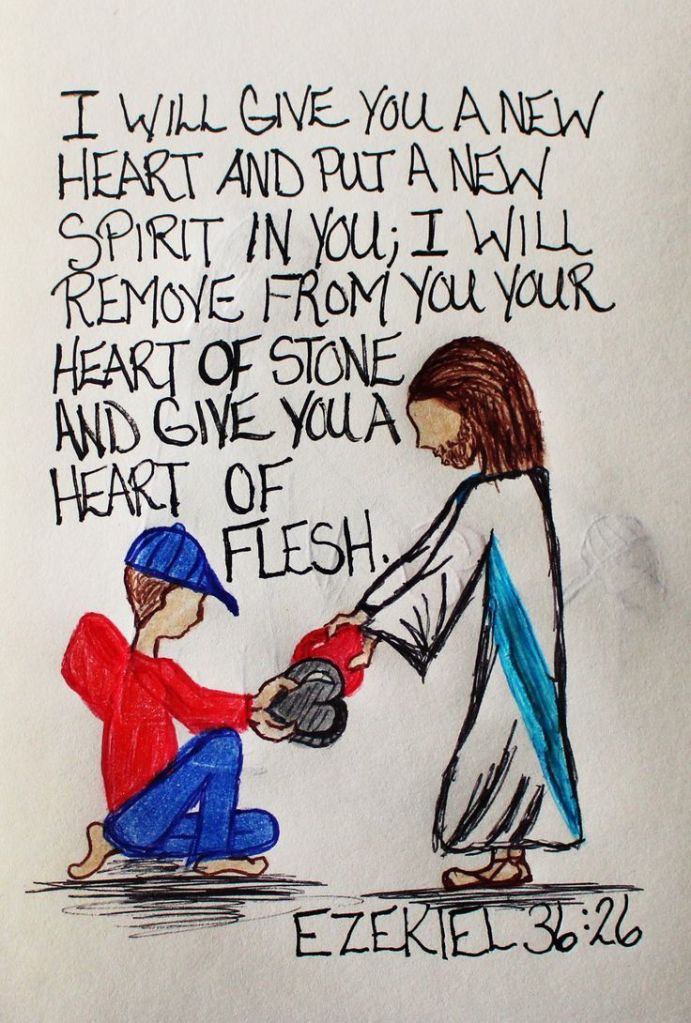
“They will return to it and remove all its vile images and detestable idols. I will give them an undivided heart and put a new spirit in them; I will remove from them their heart of stone and give them a heart of flesh. Then they will follow my decrees and be careful to keep my laws. They will be my people, and I will be their God. But as for those whose hearts are devoted to their vile images and detestable idols, I will bring down on their own heads what they have done, declares the Sovereign Lord.”

Then the cherubim, with the wheels beside them, spread their wings, and the glory of the God of Israel was above them. The glory of the Lord went up from within the city and stopped above the mountain east of it. The Spirit lifted me up and brought me to the exiles in Babylonia in the vision given by the Spirit of God.

Then the vision I had seen went up from me, and I told the exiles everything the Lord had shown me. (New International Version)

God’s heart is a heart of justice. The Lord abhors unrighteousness, injustice, and oppression. Thankfully, God will not sit idle and put up with systemic evil for long.

Ezekiel is one of those Old Testament prophets that thoroughly uncovered the true state things, especially of the human heart. Through a series of visions given to Ezekiel for the Israelite exiles, one of the main messages of the prophet is that God would give them a new heart. 

There is hope for the exile, for the one in captivity because of sin’s destructive, demeaning, and deluding power. Conversely, for those conforming to such ways, for the ones who caused the exile of others, the high Judge of the universe will deal with them according to their errant and rascally ways.

Dark shadows exist within the human heart. Although humanity has a great potential for altruistic good, people also have a large capacity for evil. Arrogant pride, self-centered behavior, and sheer ignorance can take such root within a person’s heart, as well as the heart of an organization or institution, that oppression becomes the norm, with fat cats ruling over an indigent people.

At best, the heart apart from God contains a miniscule vestige of its ancient Creator’s image; at worst, the heart is desperately wicked and on a highway to hell. 

The issue, then, is whether the heart only needs to be modified, or whether there is needed a complete heart transplant. The prophet makes it quite clear which option must be done.

Jesus Christ sacrificed himself on the cross so that we could be transformed into new people. He did not come to tweak a few things in life and improve upon it – he came to bring wholesale change and transform the heart. 

If all we needed was a motivational speaker who would inspire our hearts to live better and reach our personal goals, then we would have not needed an incarnation, a crucifixion, a resurrection and ascension. Jesus is the risen Lord and Savior who replaces our hard stubborn hearts with a soft new heart of flesh. 

We need transformation of life, not life modification.

Awesome God, you have graciously and surgically removed my old heart, which was bound for destruction, and replaced it with a new heart, oriented toward living and loving like the Lord Jesus. May my heart always be inclined to the doing of your will, in the power of your Holy Spirit. Amen.