People Are a Bundle of Contradictions (Romans 7:7-20)

“Contradictions” by Michael Lang, 2015

But I can hear you say, “If the law code was as bad as all that, it’s no better than sin itself.” That’s certainly not true. The law code had a perfectly legitimate function. Without its clear guidelines for right and wrong, moral behavior would be mostly guesswork. Apart from the succinct, surgical command, “You shall not covet,” I could have dressed covetousness up to look like a virtue and ruined my life with it.

Don’t you remember how it was? I do, perfectly well. The law code started out as an excellent piece of work. What happened, though, was that sin found a way to pervert the command into a temptation, making a piece of “forbidden fruit” out of it. The law code, instead of being used to guide me, was used to seduce me. Without all the paraphernalia of the law code, sin looked pretty dull and lifeless, and I went along without paying much attention to it. But once sin got its hands on the law code and decked itself out in all that finery, I was fooled, and fell for it. The very command that was supposed to guide me into life was cleverly used to trip me up, throwing me headlong. So sin was plenty alive, and I was stone dead. But the law code itself is God’s good and common sense, each command sane and holy counsel.

I can already hear your next question: “Does that mean I can’t even trust what is good [that is, the law]? Is good just as dangerous as evil?” No again! Sin simply did what sin is so famous for doing: using the good as a cover to tempt me to do what would finally destroy me. By hiding within God’s good commandment, sin did far more mischief than it could ever have accomplished on its own.

I can anticipate the response that is coming: “I know that all God’s commands are spiritual, but I’m not. Isn’t this also your experience?” Yes. I’m full of myself—after all, I’ve spent a long time in sin’s prison. What I don’t understand about myself is that I decide one way, but then I act another, doing things I absolutely despise. So if I can’t be trusted to figure out what is best for myself and then do it, it becomes obvious that God’s command is necessary.

But I need something more! For if I know the law but still can’t keep it, and if the power of sin within me keeps sabotaging my best intentions, I obviously need help! I realize that I don’t have what it takes. I can will it, but I can’t do it. I decide to do good, but I don’t really do it; I decide not to do bad, but then I do it anyway. My decisions, such as they are, don’t result in actions. Something has gone wrong deep within me and gets the better of me every time. (The Message)

“Contradictions in human character are one of its most consistent notes.”

Muriel Sparks, “Loitering with Intent”

The Apostle Paul’s vulnerable expression of his dilemma resonates deeply with many people. There are times when we say things to ourselves such as:

“I told myself I wasn’t going to be like my mother, and here I am responding just like she would.”

“I know better than to drive by the liquor store on my way home and pick up a pint of vodka, yet, I still did it.”

“I don’t want to die, but my thoughts keep racing about a plan for suicide.”

There are many situations in which we are both frustrated and befuddled by doing the things we do not want to do, and not doing the things we want to do.

Yes, indeed, Paul’s existential angst is a timeless description of our common human condition. We all can relate to the seeming inability to do what is right in so many situations. It can drive us nuts, even to a constant and never-ending low-level discouragement that underlies almost everything we do.

Paul’s prescription for dealing with this does not rely on law. He understood that putting our willpower and effort into obeying commands gets us nowhere, because we will eventually fail. Neither our brains nor our spirits work that way. Our willpower was never designed to be the driver of what we do and do not do. If anything, willpower, and the lack thereof, demonstrates just how much we are climbing the ladder on the wrong wall.

People are a bundle of contradictions, doing good, then bad, and flip-flopping back and forth with great frustration.

God’s law was not crafted to transform us from the inside-out. The law has three solid purposes, none of which are meant to bring deep personal transformation:

  1. Attention to the law works to restrain sin in the world
  2. Use of the law provides us with a helpful guide for grateful living in response to divine grace
  3. Reflection on the laws show us how bad off we really are in this world, and how much we are in need of forgiveness

We need a change of habits, and this is different than adopting a list of laws.

Habits are developed from our desires, our affections. In other words, we do what we love – more specifically, our ultimate love(s) drive us to do what we want. To put it in a more straightforward way:

We sin because we like it. And the path to overcoming any besetting sin is to have an ultimate love surpass the lesser sin which we like.

For example, I have developed daily habits or rituals of faith which enable me to commune with God. I love God with all my heart, soul, mind, and strength, and this ultimate love enables me to push out all competing gods who want my devotion. I also love my wife with all my heart. We work on developing habits of a marital relationship which reinforce our love for each other. Love is what drives me to do right and good by her.

So, what do we do when we mess up? For the Christian, no matter what the question is, the answer is always grace.

God’s grace in the finished work of Jesus Christ applied to us by the Holy Spirit is the operative power that changes lives. The law has no power to do that kind of work. Freedom from the tyranny of our misplaced desires and disordered loves comes from Christ’s forgiveness through the cross. Like a lover enamored with his beloved, our desires become oriented toward Jesus for his indescribable gift to us. That is the strength of grace.

Saving God, I thank you for delivering me from sin, death, and hell through your Son, the Lord Jesus. May your Holy Spirit apply the work of grace to my life every day so that I can realize spiritual healing and practical freedom from all that is damaging and destructive in my soul. Amen.

Free to Live a New Life (Romans 7:1-6)

You shouldn’t have any trouble understanding this, friends, for you know all the ins and outs of the law—how it works and how its power touches only the living. For instance, a wife is legally tied to her husband while he lives, but if he dies, she’s free. If she lives with another man while her husband is living, she’s obviously an adulteress. But if he dies, she is quite free to marry another man in good conscience, with no one’s disapproval.

So, my friends, this is something like what has taken place with you. When Christ died he took that entire rule-dominated way of life down with him and left it in the tomb, leaving you free to “marry” a resurrection life and bear “offspring” of faith for God. For as long as we lived that old way of life, doing whatever we felt we could get away with, sin was calling most of the shots as the old law code hemmed us in. And this made us all the more rebellious. In the end, all we had to show for it was miscarriages and stillbirths. But now that we’re no longer shackled to that domineering mate of sin, and out from under all those oppressive regulations and fine print, we’re free to live a new life in the freedom of God. (The Message)

The goal of salvation is to be delivered from oppressive bondage so that we are free to live a true and beautiful life – a holy life, set apart for good.

Romans chapters 6-8 are the Apostle Paul’s pointed discussion of how we become holy in a real and practical way. The theological word we typically use for this is “sanctification,” which means “to become holy,” and “set apart” for God. To be delivered from sin, death, and hell through the person and work of Jesus Christ is not the end of the story; it is just the beginning.

Becoming holy and good in our everyday lives boils down to this: identity and belonging.

One of the healthiest ways of looking at the entirety of the Bible’s message is that we belong to God. Our identities are thoroughly wrapped around Jesus. The process of realizing this, and coming to grips with it, is how we grow as people in holiness and righteousness.

Because of Christ’s finished work on the cross, we have been delivered from the realm of sin. Our change in status from condemned to accepted provides us the awareness to make daily affirmations of faith and live a new life.

Yet, the sinful nature (flesh) or the old person is still there. Although it is now toothless, our past can, and may often, exert a powerful influence on us. Even though there is a medium-rare T-bone steak on the table for us to enjoy, there are times we go back to the old bologna sandwich with stale white bread.

We no longer need to fall short of our true humanity. That’s because we belong to God. We are adopted into God’s family, having been orphaned by sin’s cruel influence.

However, just because we have been saved from the power of sin, sin itself is not extinct. We still must deal with it. We are alive to God and need to take up this great spiritual reality and live into it, for the force of sin still exerts a powerful influence in the world.

We deal with sin’s continued presence (the world, the flesh, and the devil) through embracing God’s grace versus trying to overcome it with the law.

Paul used an illustration from marriage to expand our understanding of grafting grace into our daily lives. By law, a married woman is bound to her husband (keeping in mind this sense of belonging was the predominant view of marriage in the Apostle’s day). But if the husband dies, the wife is released from the legal marriage. If she were to give herself to another man while her husband is still alive and they are married, then she becomes an adulteress. However, if she is a widow, then marries again, she is not an adulteress.

Paul applies this understanding to our relationship with the law. Death has separated us from the law. We died with Christ. Therefore, we have been set free from the law and have become alive to grace. As believers in Jesus, God’s grace and love changed our lives:

  • We now “belong to another, to him who was raised from the dead.” (Romans 7:4)
  • “When Christ’s body hung upon the cross, when God spared not his own Son but gave him up for us all.” (Romans 8:32)
  • “Christ took on himself for us all the curse of the law which inflicted all of us.” (Galatians 3:13)
  • We died to the law. God’s grace has made the death of Jesus the death of all from the realm of sin. (2 Corinthians 5:14)

As a married man, let me use Paul’s illustration to get down to the gist of his teaching. Yes, I am legally married and belong to my wife. I made vows to my wife on our wedding day which bind me legally to do what I said I would do. Yet, if I fulfill those vows in a strictly legalistic manner, I can vouch for my wife that this would not qualify as an acceptable situation for her. You see, my wife (and, me, too!) are freely bound to one another in love and grace. I care for my wife because I love her deeply, and not because it is my legal duty to do so.

The Christian life was neither designed nor meant to serve as a bare legal contract or covenant between us and God. God forbid such a thought! Jesus died to clear us from all the legality stuff so that we could freely love and serve God with joyful abundance and gratitude.

I am follower of Jesus because I love him deeply. What impels and motivates me is God’s grace. The law is there and has its place. However, it is not the law that causes me to be a Christian; it is the love of Christ which saved me from myself and compels me to live like Jesus.

May the God of peace make you pure, belonging only to him. May your whole self—spirit, soul, and body—be kept safe and blameless when our Lord Jesus Christ comes. The one who chose you will do that for you. You can trust him. Amen.

Luke 13:10-17 – Healing on the Sabbath

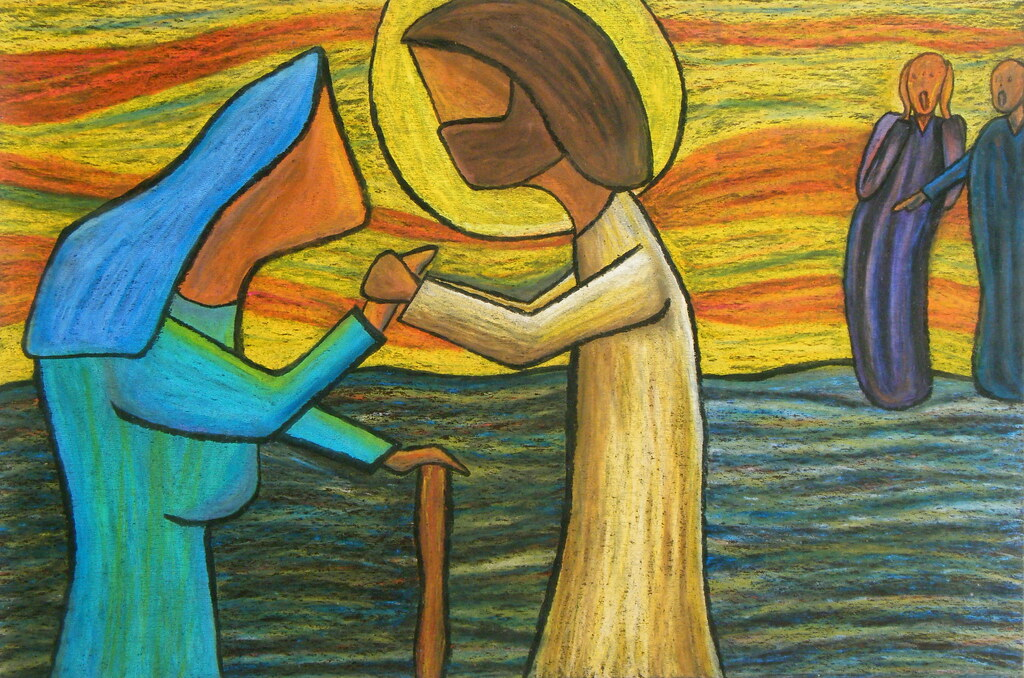
Jesus Healing the Bent-Over Woman by Glenda Skinner-Noble

On a Sabbath Jesus was teaching in one of the synagogues, and a woman was there who had been crippled by a spirit for eighteen years. She was bent over and could not straighten up at all. When Jesus saw her, he called her forward and said to her, “Woman, you are set free from your infirmity.” Then he put his hands on her, and immediately she straightened up and praised God.

Indignant because Jesus had healed on the Sabbath, the synagogue leader said to the people, “There are six days for work. So come and be healed on those days, not on the Sabbath.”

The Lord answered him, “You hypocrites! Doesn’t each of you on the Sabbath untie your ox or donkey from the stall and lead it out to give it water? Then should not this woman, a daughter of Abraham, whom Satan has kept bound for eighteen long years, be set free on the Sabbath day from what bound her?”

When he said this, all his opponents were humiliated, but the people were delighted with all the wonderful things he was doing. (New International Version)

The way in which we interpret events says a lot about who we are and what we need. The story sounds different, depending upon which person(s) are viewing it….

The Crippled Woman

She had gotten used to looking at people out of the corner of her eye, by looking up and sideways.

After eighteen years, she could hardly remember any other way of seeing the world. On this particular Sabbath, there was a special excitement at the synagogue, where she regularly went to worship. A Galilean preacher and prophet, Jesus of Nazareth, had arrived in town and would be teaching there.

She and the others in town had heard reports about Jesus–how he talked about God’s reign arriving soon and how he healed sick people. She was not sure how many of the rumors to believe, but she was trying not to get her hopes up. Her life already had too many disappointments to count.

When she entered the synagogue, the place was abuzz. As Jesus began to teach, however, the room was hushed. Moments later, his words turned from teaching to invitation. He had caught her eye–no mean feat, given that he had to lean over and incline his head to do so. “Come here,” he said to her. She slowly made her way to the front of the assembly.

Jesus and the Bent-Over Woman by Marg Mowczko

What happened next amazed the whole congregation. “Woman, you are set free from your ailment.” When this man, Jesus, spoke those words and put his hands on her broken, bent body, she felt power surge through her. Without hesitation, she straightened her once crooked back. She stood tall and praised her God . . .

The Synagogue Leader

He has come to the synagogue every Saturday. Each Sabbath day the synagogue leader stands and faithfully reads the Torah. On this particular Sabbath, a Galilean preacher is coming. Some say his is a prophet, even Messiah. The leader has seen his share of would-be messiahs come and go, claiming to speak for God. He doubts anything will come of this. Just another man.

But what is this? A synagogue full of people! And just as the leader thought this may just be good for the people, getting them to pay attention to the law and the prophets, this preacher calls a woman forward, and of all things, heals her!? This is not good. This is not how things are to be done!

In the Torah, the seventh day was set aside by God for Israel’s rest. Work is prohibited. Non-life-threatening illnesses and conditions can be treated on the other six days. The synagogue leader is not opposed to healing. In fact, he welcomes it. But at an appropriate time, on the right day. He says to himself, “This all must be done decently and in order. Who does Jesus think he is? We cannot have such insubordination amongst the people, and in the synagogue, of all places!”

And so, the synagogue leader is beside himself with both anger and fear that the Law will not be properly upheld, and that God will be displeased and take away their place of worship.

Coptic Church depiction of Jesus healing the crippled woman, 12th century

Jesus

Jesus comes, looking forward to being with the people in the synagogue on the Sabbath. He understands that since the Sabbath law commemorates and celebrates Israel’s liberation, it ought to be a day for enacting — not inhibiting — the present-day liberation of Israelites. Yes, it is a good day for a healing. Every day is a good day for healing.

As Jesus enters the synagogue, it is full of people, charged with the atmosphere of anticipation. During the service, Jesus sees a woman. Although he rightly discerns that the synagogue leader and some of the congregants will not be happy about this, he calls her forward, intent on freeing her from her satanic bondage. And also knowing that placing his hands upon this woman will appear scandalous, he does it anyway.

Sure enough, the synagogue leader is livid. The leader feels the need to correct Jesus. Yet, Jesus unmoved by this, calmly retorts, without budging an inch, that given the custom of providing water for thirsty livestock on the Sabbath, it is surely appropriate to heal a long-suffering Israelite on the Sabbath.

In none of this does Jesus abolish the Sabbath commandment. Rather he follows it faithfully. Jesus enters an ongoing Jewish debate about how to interpret the Sabbath law, locating himself at the less stringent end of the opinion spectrum.

Jesus is determined to uphold the spirit of the Law, to practice compassion, to do what leads to human betterment. He is doing God’s will. He is allowing the Sabbath to serve this old woman, rather than letting the woman serve the Sabbath as a bent over crippled person.

The People

They come, as they do each Sabbath, to gather and listen to Torah read, to pray to God, and to strengthen one another in their common faith. Yes, the synagogue leader can be a bit tedious. The synagogue service can be a bit boring. But he is a good man doing good work.

Today, however, is different. Jesus, the one they have heard so much about, is there. And what a synagogue service it is! Jesus teaches us, and with authority! But, to our astonishment, he calls one of our women forward. And he touches her! Then heals her! This is the woman who has been tortured with such crippling pain and bent over all the time!

Oh, my, the synagogue leader is upset! We are so full of joy for our healed sister, yet also confused. This is a good thing that Jesus did – God’s kingdom breaking into this world. Yet, here is the synagogue leader and Jesus debating Torah. Does freedom from Satan only come on six days, not seven? Surely, God is especially honored on such a holy day as the Sabbath to do such important work. But work, it is. And Jesus did it. Is this really a good thing, or not?

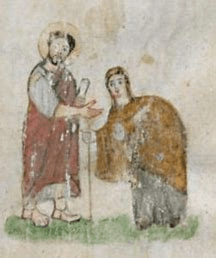
Syrian Church depiction of Jesus and the crippled woman, 6th century

Conclusion

This is a story about the role and function of our religious traditions, our claims about what could and should be practiced, when and where it ought to take place, and who is allowed within the walls of our faith communities. Special religious practices may become hindrances to including folks. We must be diligent to recognize what theological ideas we hold dear that disallow full participation from others.

Jesus was no Sabbath breaker. He operated well within Jewish tradition of the day. At the same time Christ is also not one to allow the tradition to exclude people from access to the community and the potential for their healing. Even though the synagogue leader and some others disagreed, many in the crowd agreed.

Today’s story is about the community and addresses questions such as, “What kind of community do we want to be?” “Do our religious traditions help us to become that kind of community or do they hinder it?” “If we want to be a healing community, how can we make that happen?”

O God the Father, whose will for us and for all your people is health and salvation, O God the Son, who came that we might have life and have it in abundance, O God the Holy Spirit, whose indwelling makes our bodies the temples of your presence, have mercy on us.

O Triune God, we pray you to hear us, and that you will grant your grace to all who stand in need of healing of both of body and spirit, and lead them to look with confidence in you;

That you will grant patience and perseverance to all who are disabled by injury or illness, and increase their courage;

That you will grant peace to all who are troubled by confusion or pain, and set their minds at rest;

That you will grant relief from suffering to all sick children, and give them a sure sense of your tender love and care;

That you will grant rest to all whose increasing years bring weariness, distress, or loneliness, and give them the abiding comfort of your presence;

That you will grant confidence to all about to undergo surgery or difficult procedures, and keep them free from fear;

That you will grant purpose to the church as it seeks to carry on Christ’s ministry of healing to suffering humanity, and keep it always true to the gospel of Christ;

That you will grant skill and compassion to doctors, nurses, technicians, aides, and all who are called to  practice medical arts, and make strong their dedication to help others;

That you will grant to all people the peace of quiet sleep and the joy of resting in your everlasting arms, that we may rejoice in your care while we are on earth, and in the world to come, have eternal life.

O God, who in Jesus Christ called us out of darkness into your marvelous light; enable us always to declare your wonderful deeds, thank you for your steadfast love, and praise your with heart, soul, mind, and strength, now and forever. Amen.

Luke 6:1-5 – Lord of the Sabbath

One Sabbath Jesus was going through the grainfields, and his disciples began to pick some heads of grain, rub them in their hands and eat the kernels. Some of the Pharisees asked, “Why are you doing what is unlawful on the Sabbath?”

Jesus answered them, “Have you never read what David did when he and his companions were hungry? He entered the house of God, and taking the consecrated bread, he ate what is lawful only for priests to eat. And he also gave some to his companions.” Then Jesus said to them, “The Son of Man is Lord of the Sabbath.” (New International Version)

We Christians tend to be rather hard on the Pharisees. Yet, most of them, much like us, were just trying to uphold their understanding of God’s commands. They wanted to do God’s will. And so did Jesus.

The problem in the New Testament Gospels is that Jesus and some of the Pharisees (not all of them, e.g., Nicodemus) were at loggerheads about how to view and interpret the Law. Jesus wanted them to see the purpose of the law, the heart and spirit of the law, and who was the lord of the law. For Jesus, many of the Pharisees were spiritually blind. They either would not or could not discern who Jesus was and what he was all about.

So, when we refer to spiritual blindness, let’s have a bit of humility about it. Although for the Apostle Paul, a dramatic event happened in which the scales of blindness (both physically and spiritually) fell from his eyes, most folks have a gradual ability to see, an awakening which requires a process of time and growing awareness. This was true of Christ’s original disciples. They believed, yet their faith was an extended process over three years. It wasn’t until after Christ’s resurrection and Pentecost that their faith became complete.

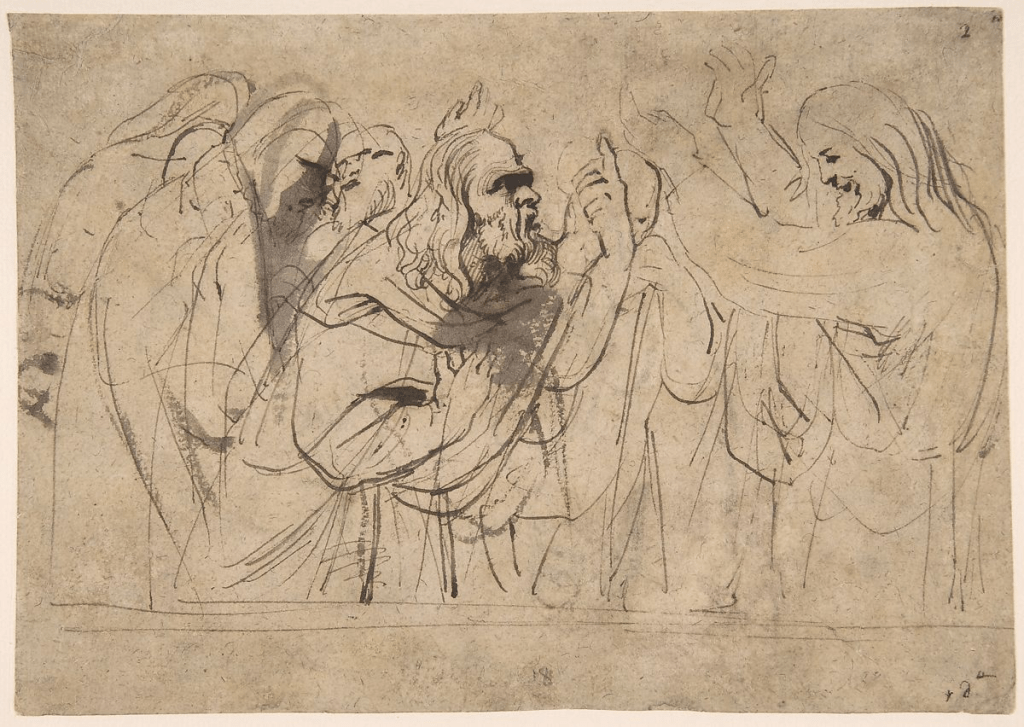
Christ and the Pharisees by Belgian artist Anthony van Dyck (1599-1641)

Jesus didn’t like it that those who should know better, those persons for whom the light of God’s truth ought to be clear and present, were in darkness. When leaders are blind, then we have the blind leading the blind, and nobody finds the door of God’s kingdom.

Many of the Pharisees in the New Testament, most of the heretics in the early church, and some of the spiritual phonies of today are actually not charlatans, that is, they are not deliberately trying to deceive or lead others astray; they are not trying to keep people out of God’s kingdom – they think they are doing the right thing when they are actually leading others astray. 

One of the eye-opening realities I discovered, when I first began studying church history, is that the early heresies condemned at the church councils were doctrines promoted and put forth by men who were not evil bad people – they were just sincerely misguided. They thought they were helping the church better understand the nature of God and Christ, when in fact they were promoting unhealthy doctrine – unintentionally closing the door of God’s kingdom to some people. 

And later when I worked on my master’s thesis in nineteenth century American religious history, I read hundreds of sermons from southern preachers before the American Civil War. I learned that they had a biblical defense for the institution of black chattel slavery. Many of them were pastors of large churches and led many people to Christ, that is, white people. They were slamming the door of God’s kingdom in the faces of African-Americans, and teaching others to do the same.

We can unwittingly slam the door of God’s kingdom in the faces of people when we say God’s grace is for all and then turn around and avoid particular people; or whenever we have explicit written statements or rules that exclude people from serving or being served; or when we bind people to human traditions and practices instead of Holy Scripture. 

The seven deadly words of the Church, believing it is doing the Lord’s will, is, “We’ve-never-done-it-that-way-before… We cannot have somebody out in the field picking heads of grain and rubbing them in their hands. That’s reaping; it’s work; and you can’t do that on the Sabbath.”

Never mind that there are people trying to eat or attempting to enter the kingdom of God. So, we lose sight that the Law was meant to benefit people, to help them thrive and flourish, to lead them into the grace and knowledge of God. The Law gets turned on its head by becoming a heavy burden to carry instead of an easy yolk which brings freedom.

No matter the issue, the last word to everything is grace, God’s grace in Jesus Christ.  

Just as the priest in David’s day was gracious in giving him and his men the consecrated bread meant only for the priests, so Jesus was gracious in giving himself, the Bread of Life, for the benefit of the whole world.

For the Christian, the Law points to Christ, who is the Law’s fulfillment. Now, we carry one another’s burdens, and in doing so, we fulfill the Law of Christ.

O God the Holy Spirit, Sanctifier of the faithful: Make us holy through your abiding divine presence. Enlighten the minds of your people more and more with the light of the everlasting Gospel. Bring erring souls to the knowledge of our Savior Jesus Christ; and those who are walking in the way of life, keep them steadfast in faith to the end.

Give patience to the sick and afflicted and renew them in body and soul. Guard those who are strong and prosperous from forgetting you. Increase in us your many gifts of grace and make us all fruitful in good works. This we ask, O blessed Spirit, whom with the Father and the Son we worship and glorify, one God, world without end. Amen.