A Call to Truth and Justice (Exodus 23:1-9)

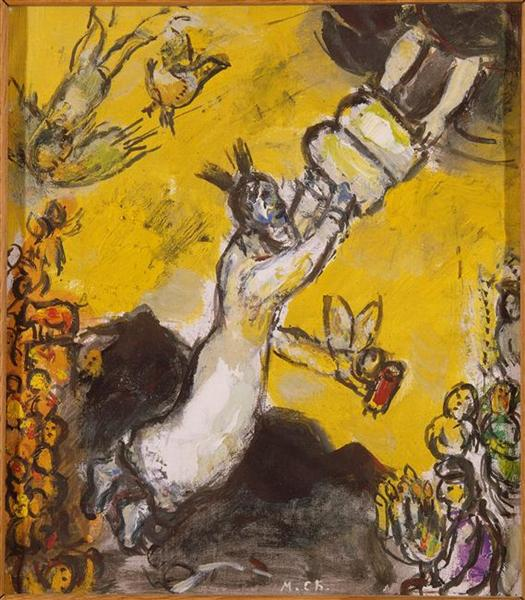
Moses Receives the Law, by Marc Chagall, 1963

“You must not pass along false rumors. You must not cooperate with evil people by lying on the witness stand.

“You must not follow the crowd in doing wrong. When you are called to testify in a dispute, do not be swayed by the crowd to twist justice. And do not slant your testimony in favor of a person just because that person is poor.

“If you come upon your enemy’s ox or donkey that has strayed away, take it back to its owner. If you see that the donkey of someone who hates you has collapsed under its load, do not walk by. Instead, stop and help.

“In a lawsuit, you must not deny justice to the poor.

“Be sure never to charge anyone falsely with evil. Never sentence an innocent or blameless person to death, for I never declare a guilty person to be innocent.

“Take no bribes, for a bribe makes you ignore something that you clearly see. A bribe makes even a righteous person twist the truth.

“You must not oppress foreigners. You know what it’s like to be a foreigner, for you yourselves were once foreigners in the land of Egypt. (New Living Translation)

On Mount Sinai, God gave Moses the Ten Commandments. These laws are basic ethical commands given to the people in their relationship to God and to one another. Following those Ten Words, the next several chapters of Exodus provide detailed instructions and commands for the Israelites in their own social, economic, and cultural context.

Today’s Old Testament lesson is part of this sequence of specific laws for the Israelites. These laws all have to do with being honest in legal matters. There is to be no perversion of justice through perjury, favoritism, bending to dishonest pressure, bribery, and false charges. What’s more, there must be no overlooking of the poor and powerless; and no disregard for the immigrant and foreigner.

All the sequences of commands – covering Exodus chapters 20-25 – are connected back to the basic Ten Commandments. The laws about justice and injustice are the fleshing-out of the ninth command to not testify falsely against your neighbor.

In other words, we are not to lie in public, especially when a person’s life or livelihood is at stake. We are to practice right relations with others; and do justice for all persons without prejudice or favoritism. We do this because God shows no favoritism and judges rightly with proper justice.

He will not judge by what he sees with his eyes,
    or decide by what he hears with his ears;
but with righteousness he will judge the needy,
    with justice he will give decisions for the poor of the earth. (Isaiah 11:3-4, NIV)

The Lord is a just God – it is inherent to the divine character. Therefore, our actions, as people created in the image of God, are to always be just, right, and truthful. There is a special place in God’s heart for the poor and powerless, and so, we ought also to consider their needs and treat them well and with respect – because true religion gives to those who we know cannot pay us back.

This, then, also is why immigrants and foreigners are mentioned. They need proper justice, and not negligence on our part to provide them with what they need. Throughout Holy Scripture we are admonished to not oppress the stranger from another place.

For through him [Christ] we both have access to the Father by one Spirit. Consequently, you are no longer foreigners and strangers, but fellow citizens with God’s people and also members of his household, built on the foundation of the apostles and prophets, with Christ Jesus himself as the chief cornerstone. (Ephesians 2:18-20, NIV)

The Lord watches over the foreigner
    and sustains the fatherless and the widow,
    but he frustrates the ways of the wicked. (Psalm 146:9, NIV)

Jesus picked up on the basic commands of God in his Sermon on the Mount – which, in many ways, is a restatement of the Ten Commandments by getting to the heart of them. Concerning the matter of giving false pledges, he said:

“Again you have heard that it was said to those who lived long ago: Don’t make a false solemn pledge, but you should follow through on what you have pledged to the Lord… Let your yes mean yes, and your no mean no. Anything more than this comes from the evil one. (Matthew 5:33, 37, CEB)

In court, we offer an oath, swearing that we will tell the truth and only the truth – and no lying. This is the only way that injustice can be avoided and justice can be established.

“I swear on a stack of Bibles I won’t…” “I will, if I get around to it….” These are a few of the caveats we give when making a promise or oath. Oaths communicate our truthful intentions of being above board with a high level of integrity.

It’s not okay when we bear false testimony concerning an event or incident that has taken place. There is no excuse for saying something is truthful when you know it isn’t quite true or all true. That makes us liars.

The Lord detests lying lips, but he delights in people who are trustworthy. (Proverbs 12:22, NIV)

Jesus wants us to clarify our values of right and wrong; make wise decisions; identify what we know is truth and error; and follow through on speaking the truth in love.

Any human society cannot stand unless it is committed to justice for all. People everywhere have a universal need for communities and nations which pursue truth, justice, benevolence, and integrity for everyone within their sphere of influence and responsibility.

Almighty God, who created us in your own image: Grant us grace to fearlessly contend against evil; and to make no peace with oppression, so that we may reverently use our freedom. Help us to employ that freedom in the maintenance of justice in our communities and among the nations, to the glory of your holy Name; through Jesus Christ our Lord, who lives and reigns with you and the Holy Spirit, one God, now and forever. Amen.

The Ten Commandments (Exodus 20:1-21)

The Ten Commandments by He Qi

Then God gave the people all these instructions:

“I am the Lord your God, who rescued you from the land of Egypt, the place of your slavery.

“You must not have any other god but me.

“You must not make for yourself an idol of any kind or an image of anything in the heavens or on the earth or in the sea. You must not bow down to them or worship them, for I, the Lord your God, am a jealous God who will not tolerate your affection for any other gods. I lay the sins of the parents upon their children; the entire family is affected—even children in the third and fourth generations of those who reject me. But I lavish unfailing love for a thousand generations on those who love me and obey my commands.

“You must not misuse the name of the Lord your God. The Lord will not let you go unpunished if you misuse his name.

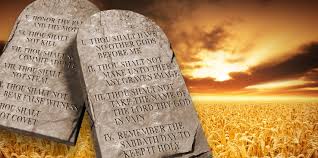
“Remember to observe the Sabbath day by keeping it holy. You have six days each week for your ordinary work, but the seventh day is a Sabbath day of rest dedicated to the Lord your God. On that day no one in your household may do any work. This includes you, your sons and daughters, your male and female servants, your livestock, and any foreigners living among you. For in six days the Lord made the heavens, the earth, the sea, and everything in them; but on the seventh day he rested. That is why the Lord blessed the Sabbath day and set it apart as holy.

“Honor your father and mother. Then you will live a long, full life in the land the Lord your God is giving you.

“You must not murder.

“You must not commit adultery.

“You must not steal.

“You must not testify falsely against your neighbor.

“You must not covet your neighbor’s house. You must not covet your neighbor’s wife, male or female servant, ox or donkey, or anything else that belongs to your neighbor.”

When the people heard the thunder and the loud blast of the ram’s horn, and when they saw the flashes of lightning and the smoke billowing from the mountain, they stood at a distance, trembling with fear.

And they said to Moses, “You speak to us, and we will listen. But don’t let God speak directly to us, or we will die!”

“Don’t be afraid,” Moses answered them, “for God has come in this way to test you, and so that your fear of him will keep you from sinning!”

As the people stood in the distance, Moses approached the dark cloud where God was. (New Living Translation)

Since relationships are important and necessary, we need a way to be in community together so that everyone can get along and thrive as human beings. It’s very helpful to have a few simple rules to live by in order for all persons to relate to each other (and God) with integrity, care, and justice.

Whenever I take my wife’s pooch to the dog park, he knows he’ll need to stick some basic rules. Although he doesn’t need the leash and is free to roam, he understands not to bark at people, or approach them and other dogs without my permission. Those expectations are for both his well-being, and others.

We are free to live our lives as creatures in God’s image. The Lord has just a few basic rules for us to live by to honor both divinity and humanity, as well as to protect others and ourselves. Most folks know them as “The Ten Commandments.”

Statue of Moses and The Ten Commandments, Lodz, Poland

The Ten Commandments (The Decalogue or The Ten Words) were given to the ancient Israelites nearly 3,500 years ago. These words have stood the test of time and continue to be understood as a universal standard of morality and relational interactions.

There are hundreds of commands in Holy Scripture – approximately 613 in the Old Testament, and 437 in the New Testament – a whopping 1,050 total commands throughout the entirety of the Bible. So, what, then, makes these Ten so special?  Why do we stick to the ten basic instructions?

The reason The Ten Commandments have endured is that they are foundational commands. Following the Ten Words in the Old Testament are a string of specific commands from God to Moses and then to the people (Exodus 21-23 and Deuteronomy 6-26). Those commands are all a fleshing-out of how to live the basic Decalogue in the Israelites’ context of entering and being in the Promised Land.

In fact, every single command of Holy Scripture can be ethically and morally tied back to The Ten Commandments in some way. Whereas many Old Testament laws were given to the Israelites in their ancient Middle Eastern socio-economic culture, The Decalogue was designed to be universal and flexible for every culture and society everywhere, for any time, and every generation.

Therefore, we need to distinguish between The Law (capital “L”) and the law (little “l”). God’s fundamental and foundational ethical Law has always existed and continues to exist – and it is encapsulated in ten short and simple commands which everyone everywhere can obey, whether they are at their jobs, at home, church, or out having fun.

In fact, these ten basic commands are so important that Jesus restated them for us in his Sermon on the Mount (Matthew 5-7). Christ got down to the heart of the commands and let everyone know what it truly means to hold, keep, and obey The Ten Words. For example, Jesus said concerning the seventh command:

“You have heard that it was said to our people long ago, ‘You must not murder anyone. Anyone who murders another will be judged.’ But I tell you, if you are angry with a brother or sister, you will be judged. If you say bad things to a brother or sister, you will be judged by the council. And if you call someone a fool, you will be in danger of the fire of hell.” (Matthew 5:21-22, NCV)

It had become easy over the centuries for people to think everything was jim-dandy if they didn’t physically kill anyone. Yet, Jesus knew that well before any person is murdered by another, anger has been nursed through bitter grudges toward another. 

The Ten Words are the very heart of God’s desire for all humanity, and this is precisely why it’s important to know and obey them in their full intent. They contain how to relate to God (Commands 1-4); and, how to relate to one another (Commands 5-10).  Jesus would later say, in response to what is the greatest command of all:

“Love the Lord your God with all your heart, all your soul, and all your mind. This is the first and most important command. And the second command is like the first: ‘Love your neighbor as you love yourself.  All the law and the writings of the prophets depend on these two commands.” (Matthew 22:36-40, NCV)

The Heidelberg Catechism, a Reformed Confession crafted by Protestants in the sixteenth, addresses a significant issue in question-and-answer 115:

Q: Since no one in this life can obey the Ten Commandments perfectly, why does God want them preached so pointedly? 
A: First, so that the longer we live the more we may come to know our sinfulness and the more eagerly look to Christ for forgiveness of sins and righteousness. Second, so that we may never stop striving, and never stop praying to God for the grace of the Holy Spirit, to be renewed more and more after God’s image, until after this life we reach our goal: perfection.

When all is said and done, grace will have the last word. None of us will ever perfectly live-out and embody The Ten Words all the time. Yet, the grace of God in Jesus Christ does for us what we cannot do for ourselves: deliver us from the realm of sin, death, and hell.

Embrace The Ten Commandments. Know the Decalogue. Memorize the Ten Words. Understand how to relate well with God and others. Seek to practice these ten basic rule for living so that you can enjoy all the freedom of God’s big world.

Leviticus 25:1-19 – Your Well-Being Is a Priority to God

And the Lord spoke to Moses on Mount Sinai, saying, “Speak to the children of Israel, and say to them: ‘When you come into the land which I give you, then the land shall keep a sabbath to the Lord. Six years you shall sow your field, and six years you shall prune your vineyard, and gather its fruit; but in the seventh year there shall be a sabbath of solemn rest for the land, a sabbath to the Lord. You shall neither sow your field nor prune your vineyard. What grows of its own accord of your harvest you shall not reap, nor gather the grapes of your untended vine, for it is a year of rest for the land. And the sabbath produce of the land shall be food for you: for you, your male and female servants, your hired man, and the stranger who dwells with you, for your livestock and the beasts that are in your land—all its produce shall be for food.

‘And you shall count seven sabbaths of years for yourself, seven times seven years; and the time of the seven sabbaths of years shall be to you forty-nine years. Then you shall cause the trumpet of the Jubilee to sound on the tenth day of the seventh month; on the Day of Atonement, you shall make the trumpet to sound throughout all your land. And you shall consecrate the fiftieth year and proclaim liberty throughout all the land to all its inhabitants. It shall be a Jubilee for you; and each of you shall return to his possession, and each of you shall return to his family. That fiftieth year shall be a Jubilee to you; in it you shall neither sow nor reap what grows of its own accord, nor gather the grapes of your untended vine. For it is the Jubilee; it shall be holy to you; you shall eat its produce from the field.

‘In this Year of Jubilee, each of you shall return to his possession. And if you sell anything to your neighbor or buy from your neighbor’s hand, you shall not oppress one another. According to the number of years after the Jubilee you shall buy from your neighbor, and according to the number of years of crops he shall sell to you. According to the multitude of years you shall increase its price, and according to the fewer number of years you shall diminish its price; for he sells to you according to the number of the years of the crops. Therefore, you shall not oppress one another, but you shall fear your God; for I am the Lord your God.

‘So, you shall observe My statutes, keep My judgments, and perform them; and you will dwell in the land in safety. Then the land will yield its fruit, and you will eat your fill, and dwell there in safety. (New King James Version)

Our continual well-being and rest are not optional; it is absolutely essential.

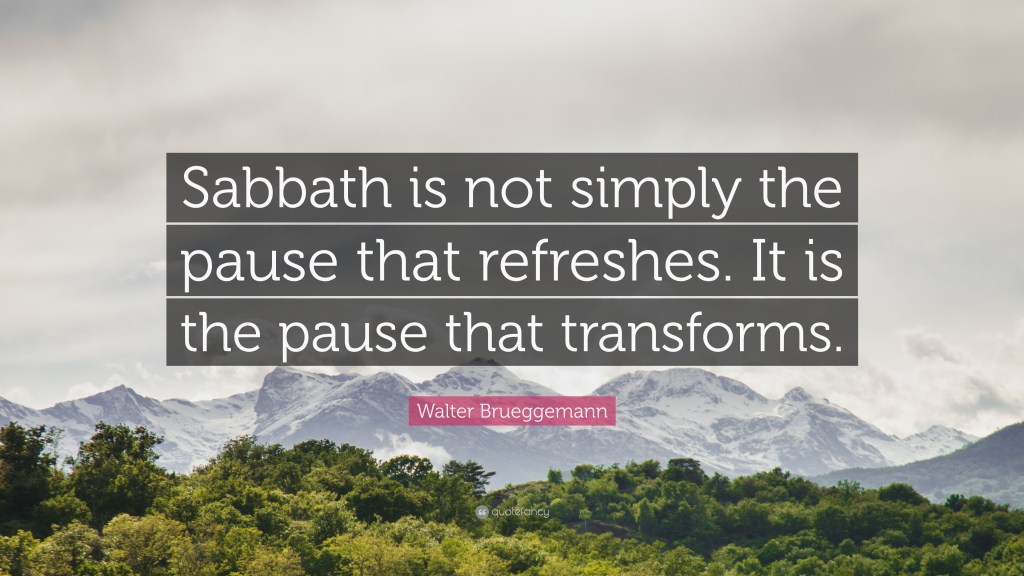
If a car is driven day-after-day and never gets an oil change, the engine will eventually seize and die. And if a person insists on driving their life every day with continual work, and never practices a Sabbath rest, that person will inevitably burn-out and die an early death. 

In this busy world, far too many persons are putting the pedal-to-the-metal with no thought to the consequences, and no plan for any kind of Sabbath rest. Many people throughout the modern world are slowly draining their souls, causing themselves physical harm, and are on the precipice of emotional and spiritual death.

Perhaps you raise a Mr. Spock eyebrow and wonder if I am being too dramatic. Yet, if we are to take today’s Old Testament lesson seriously, we will see that all of life is to be governed by a healthy rhythm of life which benefits both the individual and the community.

Yes, I fully understand that neither the contemporary person nor the Christian is currently living under ancient Israelite law. However, every single law in the Old Testament is grounded in the character of God. 

This means that, although we may not be obliged to hold the detailed specifics of the seven years system and a year of Jubilee, we are still beholden to observe a Sabbath rhythm of rest because God rested. And we ignore this built-in rhythm to our own peril.

Sometimes I watch the news, see all the upset people at one another and think, “Dude, you really need to sit down, relax, and have a sandwich. Just take a breath, man!” I sometimes wonder if God looks down from heaven at all the world’s conflicts and sees the people involved as a bunch of toddlers who simply need a snack and a nap.

Just as God loves, we are to love. As God is holy, so we are to be holy. And the same holds true for a Sabbath rest. Just as God rested from all the work of creating the world, so we, too, are to rest from our work. Laboring 24/7 will only give us regrets, not results.

If I haven’t been explicit enough, I will say it plainly: We are commanded by God to rest.

It is high time we begin building into our weekly planners, smartphone calendars, and long-range goals, a deliberate and purposeful inclusion of Sabbath rest. 

That means not just doing this biblical rest thing once-in-a-while, that is, if I can fit it in somewhere. A complete Sabbath rest entails making it a real actual event on a regular basis in our life, on our calendars. No excuses, no fudging of appointments, and no lame *sigh* about how busy we are. 

Set aside time today to build a Sabbath into your schedule for the rest of the year, and maybe beyond. I’m not saying this is at all easy; in fact, it is terribly hard for me to get this practice into my own life. 

Because I am a church pastor, hospital chaplain, husband, father, and grandfather, my times of scheduling meetings, events, and visits looks more like a Sudoku puzzle than a calendar. Engrafting some serious biblical rest into my life sometimes feels like hacking through a jungle, looking frenetically for some time.

But, without that rest, I am much less the person I need to be for all the people and responsibilities I care for. The people in my life deserve better than that. They don’t need my leftovers. And I suspect the people in your life want you to rest, too, because you matter to them.

Creator God, you formed the earth in six days and then rested on the seventh. Help me not to put Sabbath on some wish list of things to do someday but enable me to practice it with courage and without apology, through the name of Jesus, I live and pray. Amen.

Exodus 20:1-17 – Perspective Changes Everything

Welcome, friends! Sometimes in our lives we can get lost in our thinking – only seeing things from one perspective. God’s Word invites us to see differently – to view ourselves, others, and the world in ways that can change our lives. Click the videos below and let us explore that perspective…

Pastor Tim Ehrhardt
Words written and sung by Michael W. Smith

The instructions of the Lord are perfect,
    reviving the soul.
The decrees of the Lord are trustworthy,
    making wise the simple.
The commandments of the Lord are right,
    bringing joy to the heart.
The commands of the Lord are clear,
    giving insight for living.
Reverence for the Lord is pure,
    lasting forever.
The laws of the Lord are true;
    each one is fair.
They are more desirable than gold,
    even the finest gold.
They are sweeter than honey,
    even honey dripping from the comb.
They are a warning to your servant,
    a great reward for those who obey them.

How can I know all the sins lurking in my heart?
    Cleanse me from these hidden faults.
Keep your servant from deliberate sins!
    Don’t let them control me.
Then I will be free of guilt

    and innocent of great sin.

May the words of my mouth
    and the meditation of my heart
be pleasing to you,
    O Lord, my rock and my redeemer.

Amen. (Psalm 19:7-14, NLT)