All Who Come and Touch are Made Well (Matthew 14:34-36)

They crossed the lake and came to land at Gennesaret, where the people recognized Jesus. So they sent for the sick people in all the surrounding country and brought them to Jesus. They begged him to let the sick at least touch the edge of his cloak; and all who touched it were made well. (Good News Translation)

Jesus showed up. That’s all it took. The very presence of Christ emboldened people to act. And these were not just the religious folk. They were on the other side of the lake – which for us means the other side of the tracks. In other words, the people of Gennesaret were poor and needy with lots of sick persons, as well as spiritually pagan.

This wasn’t a place that pious people visited. It was far from being a destination vacation spot. But it was just the sort of place that Jesus would visit. It was for people like those at Gennesaret that Christ came.

Jesus Recognized

In the previous story of the disciples on the lake during a storm, Jesus walked out on the water to them. When they saw him, they didn’t recognize him. But here, in today’s story, a bunch of people who weren’t following Jesus around, knew who he was straightaway.

One of the great ironies of the New Testament Gospels is that Jesus often got a cool reception of unbelief amongst the religious insiders in his own homeland, while tending to receive faith from spiritual outsiders in heathen places. Christ initiated a seismic shift and a great transfer of replacing the insiders with the outsiders. This sort of activity was so spiritually scandalous and cataclysmic that it eventually got Jesus killed.

“Many who are first will be last, and many who are last will be first.”

Jesus (Matthew 19:30, NIV)

People Respond

The people of Gennesaret demonstrated their faith by acting on the sight of Jesus amongst them. They sent others out into the surrounding countryside to let them know that Jesus was here. That was all it took for the rural folk to not only come but to bring all their sick friends and family with them. Belief abounded, that this man, Jesus, could do the impossible work of curing and healing.

And this is precisely the sort of mentality and heart attitude Jesus was looking for. In telling his parable of the soils, Christ wanted the response of the fourth soil: To not only hear and acknowledge, but to also take the words and ways of God into one’s life in such a way that growth and development happens, fruit matures, and a harvest of righteousness, justice, and peace occurs.

“The seed falling on good soil refers to someone who hears the word and understands it. This is the one who produces a crop, yielding a hundred, sixty or thirty times what was sown.” (Matthew 13:23, NIV)

Jesus Makes All the People Well

The most “touching” thing to me in this short account of Christ encountering the people of Gennesaret is that every single person who came to Jesus was made well, without exception.

Such was the faith of the people, that they neither needed nor expected Jesus to come and lay his hands on them or to even say anything. They simply believed that if they could but touch the fringe of his cloak, healing and wellness would happen.

And the people weren’t just seeking their own betterment, but were concerned for everyone they knew who needed help. Whether there was superstition mingled with the faith is really of no concern; just a smidgeon of faith in Jesus is potent and powerful enough to effect a complete makeover of a person.

Moreover, there wasn’t simply individual and isolated instances of wholeness and healing; there was a mass level miracle, a giant group touch of healing and health.

Jesus welcomed them all, and allowed all the people to touch. Most of us don’t want a bunch of strangers touching us or our clothes, at all. That’s too weird and creepy, and likely makes us uncomfortable. What’s more, no respectable person would ever think of touching a rabbi – especially women. That sort of thing was religiously and culturally unacceptable.

Another irony we see is that the crossing of purity boundaries and laws which made people ritually impure is turned on it’s head. Instead, this kind of activity of people touching Christ made the impure folks pure. As something of a rule-breaker at heart, I find this reality refreshing. We need a lot more of it.

Jesus and People Today

Today’s Gospel lesson might seem a nice story that happened a very long time ago. We may also believe it doesn’t have much to do with me today. After all, Jesus isn’t bodily roaming the countryside today. We don’t see mass healings of people. In some places, we rarely see any healing at all from a direct result of faith. So, why even talk about this? Why bring it up? Do you just want to get my hopes up, only to dash them? Isn’t all this stuff pie-in-the-sky thinking, anyway?

Those are legitimate questions and concerns. And we ought not to disparage or make light of anyone asking them. All of us have likely encountered reaching out in faith without any healing or change of circumstance. Rather than going to one of two extremes, by either berating ourselves for a supposed failure of faith, or of discounting God altogether as a figment of the unenlightened mind, we can take a different approach.

The very nature of faith is contact, connection, and care. Faith is up close, relational, and involves touch. Faith is free, yet it is not cheap. Faith always involves a cost: vulnerability and intimacy. If we ever look for faith from afar and have no intention of getting up close and personal – so close as to touch the hem of a garment – then that which we seek will forever be elusive to us.

I’m not talking about a process or a plan that you can predictably access to get the result you want. Rather, I’m referring to real human contact and relationship that can only happen with being open about needs and wants, and is willing to expose one’s inner person to the outside world. I’m talking about putting away the false front we put up for others to see, and let the true self come out. Yes, it’s risky. Yes, it most likely will hurt. And yes, it will lead to healing.

When a person goes to a doctor for a pain they cannot get rid of, and get a diagnosis of needing surgery to deal with the hurt, we willingly allow the surgeon to create more pain for us by cutting into our body. We allow it because we understand that more pain leads to less pain.

And the same is true for our soul. Our broken hearts, our damaged emotions, our racing thoughts, and our hurting spirits need to experience the invisible scalpel of God. Divine intervention is often unpleasant – at least at first – but then later results in wellness for all who invite it’s touch.

May you come with vulnerable faith, confident hope, and active love, to the One who can help you realize your most intimate longings. Amen.


The Parable of the Weeds (Matthew 13:24-30, 36-43)

Jesus told them another parable: “The kingdom of heaven is like a man who sowed good seed in his field. But while everyone was sleeping, his enemy came and sowed weeds among the wheat, and went away. When the wheat sprouted and formed heads, then the weeds also appeared.

“The owner’s servants came to him and said, ‘Sir, didn’t you sow good seed in your field? Where then did the weeds come from?’

“‘An enemy did this,’ he replied.

“The servants asked him, ‘Do you want us to go and pull them up?’

“‘No,’ he answered, ‘because while you are pulling the weeds, you may uproot the wheat with them. Let both grow together until the harvest. At that time I will tell the harvesters: First collect the weeds and tie them in bundles to be burned; then gather the wheat and bring it into my barn….’”

Then he left the crowd and went into the house. His disciples came to him and said, “Explain to us the parable of the weeds in the field.”

He answered, “The one who sowed the good seed is the Son of Man. The field is the world, and the good seed stands for the people of the kingdom. The weeds are the people of the evil one, and the enemy who sows them is the devil. The harvest is the end of the age, and the harvesters are angels.

“As the weeds are pulled up and burned in the fire, so it will be at the end of the age. The Son of Man will send out his angels, and they will weed out of his kingdom everything that causes sin and all who do evil. They will throw them into the blazing furnace, where there will be weeping and gnashing of teeth. Then the righteous will shine like the sun in the kingdom of their Father. Whoever has ears, let them hear. (New International Version)

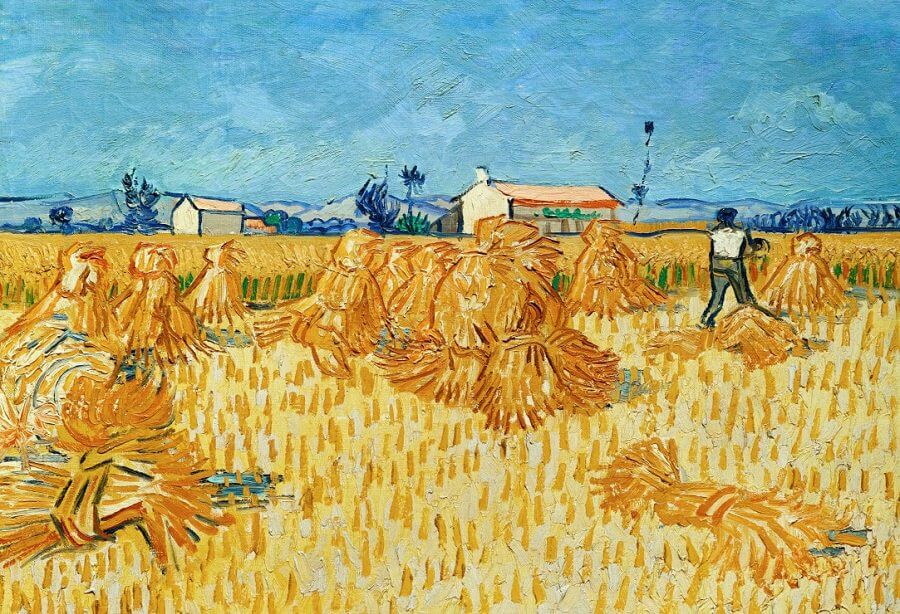
Harvest in Provence, by Vincent Van Gogh, 1888

People of every age struggle with the evil present in this world – and also within the church. For how do we make sense of those who profess Christ but have no fire and passion for their faith? How do we reconcile our own faith with folks in the church who seem to care more about getting their own way than about sacrificing themselves to reach people who do not know Christ. Jesus says, “He who has ears, let him hear.” In other words, listen!

Jesus has informed us that in this present evil age we live in, between his two advents of incarnation and Second Coming, not everything for Christians is going to be rainbows and unicorns.

There are competing pressures on the Church, and sometimes she will fail. The kingdom of God has broken into history and is present, but sin and evil is there, too. So, our focus must be on the hope we have when Christ comes again to judge the living and the dead.

In Christ’s parable of the weeds (or the parable of the wheat and the tares) the enemy of our souls seeks to distract the workers by overwhelming them with evil. If Satan cannot prevent God’s kingdom from being established in the human heart, the devil will try and corrupt the heart by throwing as much evil at it as he can. 

The devil has no problem with people saying they are Christians; the thing Satan has a problem with is people giving themselves unconditionally and unreservedly to God for kingdom business.

“Not everyone who says to me, ‘Lord, Lord,’ will enter the kingdom of heaven, but only the one who does the will of my Father who is in heaven.”

Jesus (Matthew 7:21, NIV)

Where did all these weeds come from?

I’ll frame this question in the modern form that many people have asked me over the years: “If God is a God of love, why is there so much evil in the world?” Or, “If this is Christ’s Church, why is it so messed up?”

Jesus is straightforward in his answer: An enemy did this. In other words, God didn’t plant evil – the source of evil comes from the devil, not God. God’s agenda is for the seed to take root in the human heart and grow into a full-fledged embodiment and commitment to the words and ways of Jesus.

When that growth doesn’t happen, the problem is not because God messed up; it’s because the devil has also done his own work of planting. And the devil wants the opposite of God: to have Christians nit-picking each other like a bunch of crazy chickens, and keeping a demonic pecking order; instead of being the continuing presence of Christ on this earth.

What do we do with all these weeds?

That is, how do we deal with wicked people?  The answer seems obvious: Pull the weeds up and get rid of them. Get rid of wicked people and their wicked behavior. Yet Jesus says in response to this line of reasoning in a clear and unequivocal answer of “No.” But why? Because doing violence to the weeds ends up doing violence to the wheat, as well.

Christ’s answer to the problem of evil is: Let God take care of it. Meanwhile, until that fully happens, we must co-exist with evil, rather than exterminate evil people.

There is always a temptation for believers to force people into the kingdom of God (e.g. the Spanish Inquisition). Yet, at the harvest (the final judgment at the end of the age) evil will be squarely dealt with. Judge Jesus will have the angels separate the wheat from the tares, and the weeds will be burned up.

This teaching from Jesus may open up a whole set of other questions, such as:

  • What am I supposed to do with evil? Just watch it happen? 
  • Am I to let that evil person just be evil? Shouldn’t I give them what they deserve?
  • Shouldn’t I at least tell evil people that they are no good rotten sinners? That they are going to hell because they are wicked?

This doesn’t mean we do nothing. Earlier in Matthew’s Gospel, Jesus has already said: Love your enemies and pray for those who persecute you. (Matthew 5:44)  We are to love and pray people into the kingdom, not force them in.

As for the evil, Jesus will decisively solve the problem of evil, not you, nor me! It isn’t our place to be judge, and if we make it our place, we’ll end up hurting and destroying our brothers and sisters.

Where is evil?

A sobering reality taught by Jesus in this parable is that it’s not a simple matter that we, the wheat are here, and they, the weeds, are over there. It is much more sinister than that; the enemy is within, not out there. 

We have no further to look than in our own hearts and within our own faith communities – which is why we need the lordship of Christ to completely overtake us. Evil is present in the Church, next to the good, seeking to:

  • discourage people in their commitment to Christ
  • offend and hurt others, particularly by overlooking and speaking ill of weaker people
  • step on others in order to get it’s way
  • be a stumbling block to those trying to do God’s will
  • promote ignorance of God’s Word, for no one can live by God’s will if they do not know what it is

The eventual end of sinister people is that, when Christ returns, they will be separated from the righteous and thrown into the fire, just like a harvester would do with a bunch of weeds. As the wicked went about their lives in anger, upsetting others in this life, so they will be tormented in the next.

Conclusion

We may expect God to handle evil in a hurry. But the kingdom of God doesn’t work that way; it’s intended to be planted in the ground, and takes time to grow. While it’s growing, evil is there, like a weed.

Whenever things go sideways because of wickedness, we might expect God to act quickly and drastically to uproot the evil. We may confuse God’s slowness as being uncaring, when in reality it means that God is patient, and desires people to change. And change always begins with you and me.

God Almighty, Creator of heaven and earth, we are a complacent people. While you desire us to be a beacon of light to a world in need, we are preoccupied with all the weeds in the field. We are sorry for the madness unleashed through our own selfish desires. May you plant the seed of love in our hearts for all people, not just our friends. And we shall commit to watering and nurturing that seed with your Word, through Jesus Christ our Lord. Amen.

It’s All About Faith, Grace, and Love (Galatians 5:7-12)

You were running superbly! Who cut in on you, deflecting you from the true course of obedience? This detour doesn’t come from the One who called you into the race in the first place. And please don’t toss this off as insignificant. It only takes a minute amount of yeast, you know, to permeate an entire loaf of bread. Deep down, the Master has given me confidence that you will not defect. But the one who is upsetting you, whoever he is, will bear the divine judgment.

As for the rumor that I continue to preach the ways of circumcision (as I did in those pre-Damascus Road days), that is absurd. Why would I still be persecuted, then? If I were preaching that old message, no one would be offended if I mentioned the Cross now and then—it would be so watered-down it wouldn’t matter one way or the other. Why don’t these agitators, obsessive as they are about circumcision, go all the way and castrate themselves! (The Message)

It’s a beautiful thing when someone comes to faith, connects with their spiritual self, and discovers a deep truth about their need and how to meet it. It’s like starting a whole new life of wonder and freedom.

But then, someone else comes along and questions the life-giving and life-improving project. And, in their estimation, grace needs a bit of help, and love isn’t quite enough. This someone throws doubt on the nature of faith. Then, like a naïve computer user caught in a phishing email scam, they’re caught in a worldwide web of deceit, half-truths, and false teaching.

The Apostle Paul was both sad about and frustrated with the Galatian Church for giving into the scam without even having the spiritual sense to know that they had been duped.

I have found throughout my Christian life that folks with a past in which they did not live by grace, but only looked out for themselves, have a temptation to embrace strict rules from legalistic teachers after they come to faith in Christ. They know what it feels like to not have Jesus in their lives, so they sometimes go beyond Scripture and become open to imposing standards on themselves, and then others, in order to keep on the straight and narrow.

If, and when, that happens, the Apostle Paul has something to say about it. Embracing certain practices to obtain or maintain a right standing with God and others means absolutely nothing. There’s no spiritual value in it. And, in fact, it’s even destructive.

For the Galatian Church who bought the snake oil of strict outward rule-keeping, Paul had strict words. Here is how one version of the New Testament puts it:

“You people who are trying to be made righteous by the Law have been estranged from Christ. You have fallen away from grace! We eagerly wait for the hope of righteousness through the Spirit by faith. Being circumcised or not being circumcised doesn’t matter in Christ Jesus, but faith working through love does matter.” (Galatians 5:4-6, CEB)

Any Christian tradition or individual believer which ignores God’s grace in favor of controlling one’s own faith through certain rules is no Christianity, at all. Paul will have nothing to do with it.

The Apostle’s position was clear and pointed. We are called to freedom, and we are to use that freedom to serve others through love. Freedom is not something where we do whatever we want without regard to others. That is selfishness, not freedom.

Freedom is a gift of grace. It is given to us so that we will live freely into who we are meant to be as humanity. That means there are to be no obstacles of extra-biblical or unbiblical rules impeding us in realizing our full potential as Christians saved by grace through faith.

The possibilities of grace through faith include full unhindered expressions of love, joy, peace, patience, kindness, goodness, faithfulness, gentleness, and self-control for the benefit of ourselves and the entire community of the redeemed.

Grace is the currency of God’s kingdom, flowing freely through love. God has your back – not because you have a superior form of righteousness – but because grace has already given us everything we need for life and godliness in this present evil age. (2 Peter 1:3-4)

God’s amazing grace forgives, and never runs out. God’s love endures and never withdraws. When we grab hold of this essential and beautiful truth about God with spiritual gusto, then the only rule we want to keep is to love one another.

Let no debt remain outstanding, except the continuing debt to love one another, for whoever loves others has fulfilled the law.

Romans 13:8, NIV

Outward displays of righteousness and piety for all to see how spiritual we are is like a dog returning to it’s vomit. Once we get the bad stuff out of our spiritual stomach, it makes no sense whatsoever to turn around and gobble it up again. If grace is what’s needed for deliverance, then grace is good enough to sustain us throughout the entirety of the Christian life.

For when we are in union with Christ Jesus, neither circumcision nor the lack of it makes any difference at all; what matters is faith that works through love. (Galatians 5:6, GNT)

Are there any practices, rules, beliefs, or doctrines you impose on yourself which are burdensome to you, or others?  Why do you do them?  Do you expect others to keep them?  What would change if you threw grace and love into the mix?

May the grace of the Lord Jesus, the love of God the Father, and the encouragement of the Holy Spirit be with you, now and forever. Amen.

Slow Down (2 Kings 2:1-12)

Not long before the Lord took Elijah up into heaven in a strong wind, Elijah and Elisha were leaving Gilgal. Elijah said to Elisha, “The Lord wants me to go to Bethel, but you must stay here.”

Elisha replied, “I swear by the living Lord and by your own life that I will stay with you no matter what!” And he went with Elijah to Bethel.

A group of prophets who lived there asked Elisha, “Do you know that today the Lord is going to take away your master?”

“Yes, I do,” Elisha answered. “But don’t remind me of it.”

Elijah then said, “Elisha, now the Lord wants me to go to Jericho, but you must stay here.”

Elisha replied, “I swear by the living Lord and by your own life, that I will stay with you no matter what!” And he went with Elijah to Jericho.

A group of prophets who lived there asked Elisha, “Do you know that today the Lord is going to take away your master?”

“Yes, I do,” Elisha answered. “But don’t remind me of it.”

Elijah then said to Elisha, “Now the Lord wants me to go to the Jordan River, but you must stay here.”

Elisha replied, “I swear by the living Lord and by your own life that I will never leave you!” So the two of them walked on together.

Fifty prophets followed Elijah and Elisha from Jericho, then stood at a distance and watched as the two men walked toward the river. When they got there, Elijah took off his coat, then he rolled it up and struck the water with it. At once a path opened up through the river, and the two of them walked across on dry ground.

After they had reached the other side, Elijah said, “Elisha, the Lord will soon take me away. What can I do for you before that happens?”

Elisha answered, “Please give me twice as much of your power as you give the other prophets, so I can be the one who takes your place as their leader.”

“It won’t be easy,” Elijah answered. “It can happen only if you see me as I am being taken away.”

Elijah and Elisha were walking along and talking, when suddenly there appeared between them a flaming chariot pulled by fiery horses. At once, a strong wind took Elijah up into heaven. Elisha saw this and shouted, “Israel’s cavalry and chariots have taken my master away!” After Elijah had gone, Elisha tore his clothes in sorrow. (Contemporary English Version)

“For fast-acting relief from stress, try slowing down.”

Lily Tomlin

In placing today’s Old Testament lesson of Elijah ascending to heaven in a whirlwind next to yesterday’s New Testament lesson of Christ’s ascension, the Revised Common Lectionary wants us to consider the relationship between the two.

What goes up, must come down. Two people ascending to heaven will eventually descend back to the earth.

But why all this elapsed time? If there’s something left yet to be done, why not just do it then? Or right now?

Ah, but there’s the issue. In asking such questions, I (we) betray our modern Western mindset of being governed by the god of speed.

The archenemy of faster is to be slow. And, believe me, slow is seen as a sin by most Westerners. For example, because I have a bum back, I tend to walk slow. More than once, I’ve walked from the parking lot into a store and had cars honk at me, and even some drivers swear and flip the bird at me – just for not hurrying along and making them wait a precious few seconds.

Or take the case of the stereotypical boss who is ready to pounce on an employee who shows up a minute late for work (of which I’ve observed a hundred times over my career). I’m sure you have your own examples.

In God’s kingdom, the slow will inherit the earth – not the speedy ones. That’s because God, at least from a human perspective, is slow. Yet, that’s more of a subjective matter and an issue of perspective. Christ ascended to heaven two thousand years ago. And still no Jesus, no Second Coming. What’s “up” with that? Because many people aren’t “down” with it.

But do not forget this one thing, dear friends: With the Lord a day is like a thousand years, and a thousand years are like a day. The Lord is not slow in keeping his promise, as some understand slowness. Instead he is patient with you, not wanting anyone to perish, but everyone to come to repentance. (2 Peter 3:8-9, NIV)

Far from being a sin, slowness is actually a virtue. Spiritual maturity can only result with the element of time – lots of it. There’s no quick way to becoming whole and integrated. Bible Cliff’s Notes aren’t going to get you very far. Most things cannot be rushed – especially when it comes to our words. Running our mouths never ends well.

You must understand this, my beloved brothers and sisters: let everyone be quick to listen, slow to speak, slow to anger, for human anger does not produce God’s righteousness. (James 1:19-20, NRSV)

Elijah will come. So will Jesus. In the meantime, we need to embrace being an Elisha character who learns the unforced rhythms of grace and discerns the power in slowness.

We are to take time in learning from a trusted mentor… time in sitting with difficult emotions, like sorrow, and time in allowing God to be God so that untimely shenanigans like pulling up the wheat when trying to rid the field of weeds doesn’t happen.

People have a job to do while we wait – to bear witness of the things we have seen and heard. Power is given to those who await God’s gracious gift. Pentecost is just around the corner. Be patient.

Gracious and patient God, slow me down so that I may see you in this fast paced life. Give us all a listening heart and contemplative eyes, so that we might hear your voice may see you in our active world, through Christ our Lord. Amen.