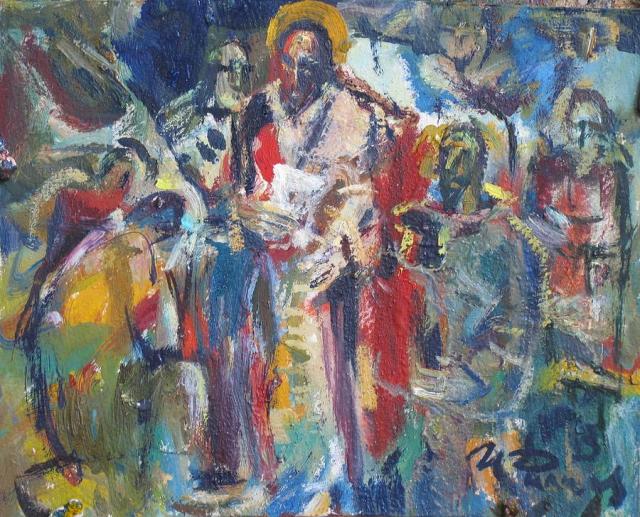
Paul the Missionary (Acts 13:1-12)

Elymas the sorcerer is struck blind by Paul, before Sergius Paulus. painting by Raphael (1483-1520)

Now in the church at Antioch there were prophets and teachers: Barnabas, Simeon called Niger, Lucius of Cyrene, Manaen (who had been brought up with Herod the tetrarch) and Saul. While they were worshiping the Lord and fasting, the Holy Spirit said, “Set apart for me Barnabas and Saul for the work to which I have called them.” So after they had fasted and prayed, they placed their hands on them and sent them off.

The two of them, sent on their way by the Holy Spirit, went down to Seleucia and sailed from there to Cyprus. When they arrived at Salamis, they proclaimed the word of God in the Jewish synagogues. John was with them as their helper.

They traveled through the whole island until they came to Paphos. There they met a Jewish sorcerer and false prophet named Bar-Jesus, who was an attendant of the proconsul, Sergius Paulus. The proconsul, an intelligent man, sent for Barnabas and Saul because he wanted to hear the word of God. But Elymas the sorcerer (for that is what his name means) opposed them and tried to turn the proconsul from the faith. Then Saul, who was also called Paul, filled with the Holy Spirit, looked straight at Elymas and said, “You are a child of the devil and an enemy of everything that is right! You are full of all kinds of deceit and trickery. Will you never stop perverting the right ways of the Lord? Now the hand of the Lord is against you. You are going to be blind for a time, not even able to see the light of the sun.”

Immediately mist and darkness came over him, and he groped about, seeking someone to lead him by the hand. When the proconsul saw what had happened, he believed, for he was amazed at the teaching about the Lord. (New International Version)

Most, if not every, follower of Jesus wants to hear the voice of God’s Spirit. Yet, many don’t. Why? Because they have not yet put themselves in a position to listen and learn.

We can only hear if we are attentive. We cannot hear if we are distracted doing other things.

The Antioch Church heard the Holy Spirit speak to them because they deliberately arranged their Christian lives so that they could learn God’s Word and clearly hear God’s voice. Notice what helped them:

  1. A diversity of leaders. The Church purposely had Christians from various backgrounds, races, ethnicities, and cultures, including Barnabas, a Jewish Levite from the island of Cyprus; Simeon, a Black man from sub-Saharan Africa; Lucius, a Roman from North Africa; and Manaen, an upper class Jew from Judea. They knew that the Spirit’s voice was not limited to one particular group of people, and could come to anyone.
  2. Worship and fasting. Together, the prophets and teachers worshipped the Lord and committed themselves to the spiritual practice of fasting. They knew that focusing on God by abstaining from food for a time, and using that time for prayer, would help them be ready to hear and respond to the Spirit.

As a result, the Church heard the Holy Spirit’s instructions for them to send Barnabas and Saul [Paul] as missionaries to the Gentiles. The Christians obeyed God, blessed the team, and sent them off to do their work.

It was the missionaries practice to find the Jewish synagogues wherever they went. There they would proclaim the good news of God’s grace in Jesus Christ as the fulfillment of divine promises to the people. Early on, Barnabas and Paul encountered Elymas, an esoteric individual who had the ear of the Roman authority in Paphos, a city in Cyprus.

Elymas was, frankly, a spiritual pest who kept interfering with Paul’s ministry to the Roman official. Paul, having many gifts of the Spirit, saw exactly who Elymas was – a windbag who deceived and cheated people for his own advantage.

Paul got down to it with Elymas, bluntly informing him that he has finally come up against God himself, and his trickery is over. Paul declared that Elymas was about to go blind for a good long time. And sure enough, the supposed magician was plunged immediately into a shadowy mist; he stumbled around, begging people to take his hand and show him the way.

It was only fitting that a person who promoted dark ways and crooked paths should be subject to that darkness and have to grope around for a time.

When the Roman official saw what happened, he became a believer on the spot, full of enthusiasm over what Barnabas and Paul were saying about Jesus.

So began years of ministry for the Apostle Paul, missionary to the Gentiles. There never seemed to be a dull moment with him around, making gracious waves of good news for those coming to God; and a tsunami of judgment for people, like Elymas, who were stuck in their selfish ways.

Paul, like Jesus, demonstrated his authority over the forces of darkness. He thus proved himself in Christian mission. The conversion experience and the commissioning of Paul became real and complete at the beginning of this missionary journey.

It is from this point on that the former Saul is now consistently referred to as Paul – signifying his change of status as a person who once opposed Christ to one who is dedicated to serving Christ and making him known throughout the Roman Empire.

Years of mature learning, spiritual growth, and discovering Jesus went into Saul’s life before he then became the missionary Paul. Although Paul was an extremely gifted person with a large intellect, he still needed to go through what we all must go through in the Christian life – put the time and effort into spiritual growth and maturity needed within the church, in order to go out and change the world with the good news of Jesus.

Gracious and almighty God, you have given pastors and teachers to equip us to do your work and to build up the church, the Body of Christ. Help us all together to realize unity in the faith, and knowledge of your Son, so that we will be spiritually mature in Christ, in whose name we are bold to pray. Amen.

Follow God’s Word (Deuteronomy 6:10-25)

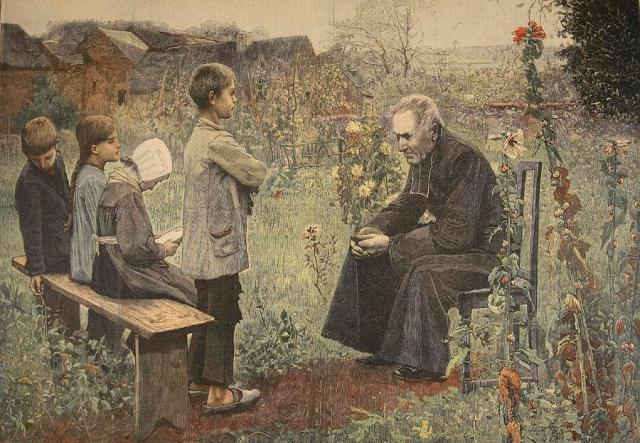
Priest Teaching Children The Catechism, by Jules-Alexis Meunier, 1898

Now once the Lord your God has brought you into the land that he swore to your ancestors, to Abraham, Isaac, and Jacob, to give to you—a land that will be full of large and wonderful towns that you didn’t build, houses stocked with all kinds of goods that you didn’t stock, cisterns that you didn’t make, vineyards and olive trees that you didn’t plant—and you eat and get stuffed, watch yourself! Don’t forget the Lord, who brought you out of Egypt, out of the house of slavery. 

Revere the Lord your God, serve him, and take your solemn pledges in his name! Don’t follow other gods, those gods of the people around you—because the Lord your God, who is with you and among you, is a passionate God. The Lord your God’s anger will burn against you, and he will wipe you off the fertile land. Don’t test the Lord your God the way you frustrated him at Massah. 

You must carefully follow the Lord your God’s commands along with the laws and regulations he has given you. Do what is right and good in the Lord’s sight so that things will go well for you and so you will enter and take possession of the wonderful land that the Lord swore to your ancestors, and so the Lord will drive out all your enemies from before you, just as he promised.

In the future, your children will ask you, “What is the meaning of the laws, the regulations, and the case laws that the Lord our God commanded you?” Tell them: We were Pharaoh’s slaves in Egypt. But the Lord brought us out of Egypt with a mighty hand. Before our own eyes, the Lord performed great and awesome deeds of power against Egypt, Pharaoh, and his entire dynasty. But the Lord brought us out from there so that he could bring us in, giving us the land that he swore to our ancestors. Then the Lord commanded us to perform all these regulations, revering the Lord our God, so that things go well for us always and so we continue to live, as we’re doing right now. What’s more, we will be considered righteous if we are careful to do all this commandment before the Lord our God, just as he commanded us. (Common English Bible)

The Catechism, by Edith Hartry, 1919

Christians often refer to the Bible as “God’s Word.” By that reference we mean that God has graciously revealed the divine nature to us through this Book, the Holy Scriptures. 

The ancient Hebrews referred to the first five books of the Old Testament as the Law of the Lord or the Torah. The Jewish people understood God as a great, high and holy Being who mercifully accommodated or communicated to us on our level by giving the Law. 

Just as a parent coos and babbles and speaks in a very different way to a baby in a crib, so God speaks to us in a way we can understand about the care, concern, and love the Lord has for us. Just as an infant is unable to understand an adult conversation taking place, so God is a lofty Being who is well above our comprehension. We have no ability to understand anything God says unless the Lord graciously and lovingly bends down to speak to us on our level.

God’s Law, the Torah, was the curriculum for Israel’s religious instruction. The Law of the Lord is meant to be a behavior pattern, to be embodied in the lives of God’s people through both teachers and parents who learn God’s Word and, in turn, pass it along to children and others – thereby providing guidance for how to live in God’s world. 

God’s law is an extension of God’s grace, and we are to gratefully accept the grace of God expressed in God’s Word. We are to ingest it, eat it, reflect on it, and dwell with it, in order to know God and be the people God wants us to be.

There are several other words that come from the root word for Law, Torah, in the Hebrew language. A teacher is a “moreh.” A parent is a “horeh.” Parents and teachers are to be living guides in the way of God’s Word. The Hebrew word for teaching is “yarah.” 

So, in other words, the moreh’s and the horeh’s are to yarah the Torah. Parents and teachers are to point and lead others into the ways of the Lord. The fifth book of the Law, Deuteronomy, makes it clear how parents, mentors, teachers, and influencers are to pass on God’s Word:

Israel, listen! Our God is the Lord! Only the Lord! Love the Lord your God with all your heart, all your being, and all your strength. These words that I am commanding you today must always be on your minds. Recite them to your children. Talk about them when you are sitting around your house and when you are out and about, when you are lying down and when you are getting up. Tie them on your hand as a sign. They should be on your forehead as a symbol. Write them on your house’s doorframes and on your city’s gates. (Deuteronomy 6:4-9, CEB)

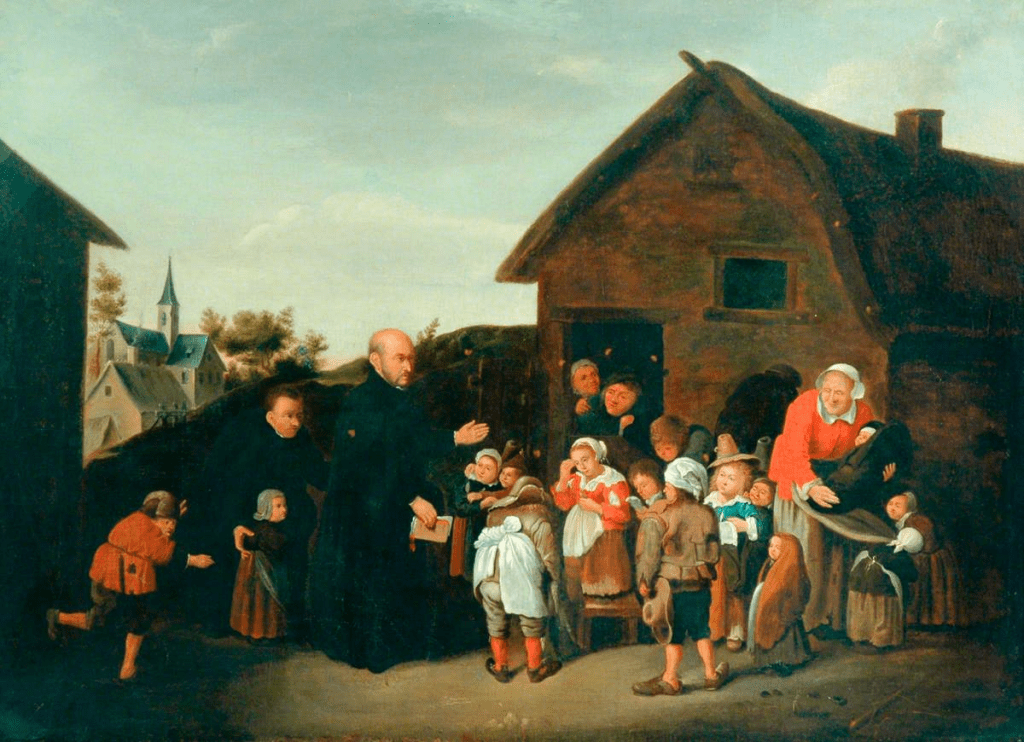
A Village Catechism, by David Rychaert III (1612-1661)

God’s Law, or God’s Word, is to be as familiar to us as our back door and it is to be in front of us all the time. When children ask us anything about God’s commands and regulations, we are to have a ready answer for them, in language and ways that they can understand.

We do this by carefully and systematically engrafting Holy Scripture into our minds and hearts. As we get God’s Word into ourselves, we are to also get it into our children and others. It happens by continually talking about Scripture – at home around the dinner table, as well as when we are working or playing together.

God’s Holy Word is to be continually in front of us, so that we do not forget it. We need to start each day and end each day with God’s Word. We can put the words of God on our refrigerator and our car’s dashboard. There is always an opportunity refer to God’s Word and incessantly chatter about it with others.

Someone may say, “That’s pretty radical – I don’t need to do all that!” Then I would say that you are missing out on living a blessed life because people are blessed when they walk according to God’s Word and keep God’s Law in front of them and seek God through God’s Word with all their heart. 

Let us not be so busy, pre-occupied, nor worried, that we end up pushing God’s Word to the margins of our lives as only a Sunday activity – or something for our discretionary time (which doesn’t actually exist). 

Let’s take the time to carefully look at God’s Word and let God speak to us through it.

Let us be intentional about connecting with the God who has so graciously given us a guide for grateful living. 

And let us lay solid plans to catechize people into the basics of faith and holy living in the church. Amen.

A Spiritual Check-Up (2 Corinthians 13:5-10)

Examine yourselves to see if your faith is genuine. Test yourselves. Surely you know that Jesus Christ is among you; if not, you have failed the test of genuine faith. As you test yourselves, I hope you will recognize that we have not failed the test of apostolic authority.

We pray to God that you will not do what is wrong by refusing our correction. I hope we won’t need to demonstrate our authority when we arrive. Do the right thing before we come—even if that makes it look like we have failed to demonstrate our authority. For we cannot oppose the truth, but must always stand for the truth. We are glad to seem weak if it helps show that you are actually strong. We pray that you will become mature.

I am writing this to you before I come, hoping that I won’t need to deal severely with you when I do come. For I want to use the authority the Lord has given me to strengthen you, not to tear you down. (New Living Translation)

God is concerned about our spiritual health and vitality. And so, it’s important that we have regular spiritual check-ups and tests to evaluate the vitality of our faith. If we are spiritually sick or debilitated, the Lord seeks to restore us back to health.

In the Gospels, whenever Jesus miraculously healed a person, it was for far more than taking away a disease or correcting a disability. The Lord sought to make them well in order to restore a person’s life by including them in the community. For example:

  • Leprosy put a person on the outside, both literally and relationally. Ceasing to be a leper meant that a person now had no obstacles to full participation in communal life.
  • Blindness reduced a person to being a beggar in order to survive. Having sight restored meant that the person can now work with others, make a living, and contribute to the needs of others.
  • Incarceration was (and still is) a complete removal of a person from society. Being in prison severs many human connections. Release from jail opens the way to reconnection and an opportunity to have a different way of being with others.
  • Poverty encumbers a person and weighs them down so heavily that it limits their ability to function socially and relationally. Without poverty, a person is able to establish healthy patterns of giving and receiving within the community.

Those who are physically whole, mentally sharp, emotionally satisfied, and spiritually redeemed are free of obstacles and impediments to communal life.

So, it is a travesty whenever the people who enjoy full inclusion in the community, turn around and separate themselves, keeping relational distance from certain persons, and do not participate in the common good of all. They makes themselves sick and weaken their faith because of their lifestyle.

The type of spiritual examination of faith the Apostle Paul was talking about was not to obsess over whether one is a true believer, or not. He was referring to the person who claims faith yet maintains separation from others. In other words, to exclude others is the kind of behavior that unbelievers do, not Christians.

Yet, there are many sections of Christianity and entire Protestant denominations who pride themselves on such separation. They believe they’re being holy and keeping themselves from impurity. However, far too many of them are really putting a sanctified spin on their own sinful predilections to avoid people they don’t like.

Paul has no tolerance for calling exclusion of others “holiness” and naming the maintenance of an insider/outsider status as “sanctification.” The Apostle knew this was all poppycock and wanted nothing to do with it.

Christ didn’t die on a cruel cross, take away the obstacles to faith, open the way to know God, and create peace through his blood for a pack of so-called “Christians” to then erect imaginary concrete border walls to keep others out of Christian community and fellowship.

In God’s upside-down kingdom, the privileged insiders are really the outsiders; and the underprivileged outsiders are actually the insiders.

The privileged believers are just as sick as the leper, the blind, the poor, and the prisoner; and just as much in need of restoration. The path to their inclusion is solidarity with the entire community of the redeemed – rather than picking and choosing who is in and who is out.

All this, of course, is another way of stating that Christianity is as beset with cliques as anywhere else – with individual believers, local churches, and particular traditions following their pet theologians and pastors and not associating with others who follow a different set of folks.

The ancient Corinthian church was a train wreck of opposing groups and cliques. The Apostle Paul had had enough of it and called the people to do some serious self-examination. And he was careful not to degrade or discourage them but to try and encourage the church to tap into the Christ which dwells within them.

Spiritual health and restoration, for Paul, meant specific behaviors which intentionally include people. To be inclusive means we actively work toward grafting people into community, as well as discourage behaviors that create division, and thus, spiritual illness. Here are three ways of including others:

  • Practice hospitality. The word hospitality literally means, “love of stranger.” A hospitable believer goes out of their way to invite another into their life, to give them the gift of relationship and fellowship.

Take care of God’s needy people and welcome strangers into your home. (Romans 12:13, CEV)

Above all, show sincere love to each other, because love brings about the forgiveness of many sins. Open your homes to each other without complaining. And serve each other according to the gift each person has received, as good managers of God’s diverse gifts. (1 Peter 4:8-10, CEB)

  • Nip bitterness in the bud. In an ideal world, everyone holds hands and sings kumbaya together. We live, however, in a fallen world. Harmony, unity, and peace take copious amounts of energy. Like an attentive gardener, we must do the work of identifying weeds and uprooting them, so they don’t take over the garden.

Make every effort to live in peace with everyone and to be holy; without holiness no one will see the Lord. See to it that no one falls short of the grace of God and that no bitter root grows up to cause trouble and defile many. (Hebrews 12:14-15, NIV)

  • Seek to encourage others, and learn how to do it. Encouragement is both a gift and a skill to be developed. To encourage another is to come alongside and help someone with both affirming words and willing hands. It’s what Jesus did (and does) for us.

Christ died for us so that, whether we are dead or alive when he returns, we can live with him forever. So, encourage each other and build each other up, just as you are already doing. (1 Thessalonians 5:10-11, NLT)

Hospitality, harmony, and help are all forms of love. And love is to be the guiding principle and practice of church and community. Love is always the prescription for a healthy spiritual life and a restored community of faith. It prevents truth decay.

Lord, make me an instrument of your peace:
where there is hatred, let me sow love;
where there is injury, pardon;
where there is doubt, faith;
where there is despair, hope;
where there is darkness, light;
where there is sadness, joy.

O divine Master, grant that I may not so much seek
to be consoled as to console,
to be understood as to understand,
to be loved as to love.
For it is in giving that we receive,
it is in pardoning that we are pardoned,
and it is in dying that we are born to eternal life.
Amen.

How to Handle Criticism (2 Corinthians 12:11-21)

A mosaic of the Apostle Paul in St Isaac’s Cathedral, St. Petersburg, Russia

Well, now I’ve done it! I’ve made a complete fool of myself by going on like this. But it’s not all my fault; you put me up to it. You should have been doing this for me, sticking up for me and commending me instead of making me do it for myself. You know from personal experience that even if I’m a nobody, a nothing, I wasn’t second-rate compared to those big-shot apostles you’re so taken with. All the signs that mark a true apostle were in evidence while I was with you through both good times and bad: signs of portent, signs of wonder, signs of power. Did you get less of me or of God than any of the other churches? The only thing you got less of was less responsibility for my upkeep. Well, I’m sorry. Forgive me for depriving you.

Everything is in readiness now for this, my third visit to you. But don’t worry about it; you won’t have to put yourselves out. I’ll be no more of a bother to you this time than on the other visits. I have no interest in what you have—only in you. Children shouldn’t have to look out for their parents; parents look out for the children. I’d be most happy to empty my pockets, even mortgage my life, for your good. So how does it happen that the more I love you, the less I’m loved?

And why is it that I keep coming across these whiffs of gossip about how my self-support was a front behind which I worked an elaborate scam? Where’s the evidence? Did I cheat or trick you through anyone I sent? I asked Titus to visit, and sent some brothers along. Did they swindle you out of anything? And haven’t we always been just as aboveboard, just as honest?

I hope you don’t think that all along we’ve been making our defense before you, the jury. You’re not the jury; God is the jury—God revealed in Christ—and we make our case before him. And we’ve gone to all the trouble of supporting ourselves so that we won’t be in the way or get in the way of your growing up.

I do admit that I have fears that when I come you’ll disappoint me and I’ll disappoint you, and in frustration with each other everything will fall to pieces—quarrels, jealousy, flaring tempers, taking sides, angry words, vicious rumors, swelled heads, and general bedlam. I don’t look forward to a second humiliation by God among you, compounded by hot tears over that crowd that keeps sinning over and over in the same old ways, who refuse to turn away from the pigsty of evil, sexual disorder, and indecency in which they wallow. (The Message)

Apostle Paul by Ivan Filichev

Criticism is hard to take. It’s even tougher when the criticism is off because you have been misinterpreted or misunderstood. And it’s more difficult to deal with criticism whenever you know you’ve done your best and accomplished good things. There are people who ought to have your back, but instead they do just the opposite and throw you under the bus.

This was the situation with the Apostle Paul. He had spent a good deal of time in the city of Corinth proclaiming the good news of Jesus and establishing a church. It was a rough ministry, filled with plenty of relational drama. (Acts 18:1-18)

Perhaps then, it is no surprise that as the church developed and grew, the people gathered themselves into special interest groups according to both their class and their affinity for particular preachers. Add to this the reality that many of the new Christians continued to embrace some of their old unhealthy practices, and you have the makings of a contentious and critical group of people. (1 Corinthians 1:10-12; 3:1-4; 11:17-22)

It is oddly surreal for Paul to have to defend himself – especially since he put so much ministry effort and wise exhortation into their church and their spiritual lives. Yet here he is needing to remind the Corinthians of his abilities, what he has done, and his credentials as a legitimate Apostle.

The following are some ways I observe how the Apostle Paul dealt with criticism:

  1. Accepting that criticism is going to happen. Paul knew that his life as an Apostle was on full display for all to see and evaluate. He did not always get things right. No one does. Yet Paul was on target about most things. He rarely got stuck on any one leadership decision. And he never let criticism, pushback, or even persecution deter him from his missionary purpose.
  2. Evaluating all things according to Christian standards. The farther people are from the problem, the less context and understanding they have. That’s why Paul planned to see them face to face. The story the Corinthians were telling themselves was inaccurate – filled with perceived motives and false conjectures about Paul and his ministry. Paul stayed focused on the gospel and the values it espouses.
  3. Keeping shame out of the conversation. We all naturally feel defensive when attacked, especially if it feels unjust, exaggerated, or inaccurate. And we may want to shame people into feeling guilt and becoming repentant. But any defensiveness on our part will only fuel people’s derision.
  4. Being transparent and vulnerable. Paul told them how he felt without making it a guilt trip. He was even sarcastic, at times. Maybe it seems counterintuitive, but more transparency works in our favor, and not against it. People get frustrated, hurt, angry, and confused about what we do and say. Our job isn’t to determine whether those feelings are legitimate or not, but instead to demonstrate empathy and concern. Doing anything that conveys dismissiveness risks making people feel like you’re gaslighting them.
  5. Acting on the problem. Paul doubled down on his commitment to transmitting Christian core values, and ensuring that a culture of Christian ethics reached every corner of the church.

It doesn’t feel good to get criticized, especially when it seems unwarranted. If we can stay focused on caring about our values and other people, we will likely handle it well. Because it’s not a matter of if we get criticized, but when.

Almighty and everlasting God, help me to have no corrupt communication proceed out of my mouth, but only words which are good, gracious, and edifying. And I pray for Christ’s Church everywhere, that all of our conversations will influence others for good and build up one another in the faith, through Jesus our Lord, in the strength of the Holy Spirit. Amen.