Slow Down (2 Kings 2:1-12)

Not long before the Lord took Elijah up into heaven in a strong wind, Elijah and Elisha were leaving Gilgal. Elijah said to Elisha, “The Lord wants me to go to Bethel, but you must stay here.”

Elisha replied, “I swear by the living Lord and by your own life that I will stay with you no matter what!” And he went with Elijah to Bethel.

A group of prophets who lived there asked Elisha, “Do you know that today the Lord is going to take away your master?”

“Yes, I do,” Elisha answered. “But don’t remind me of it.”

Elijah then said, “Elisha, now the Lord wants me to go to Jericho, but you must stay here.”

Elisha replied, “I swear by the living Lord and by your own life, that I will stay with you no matter what!” And he went with Elijah to Jericho.

A group of prophets who lived there asked Elisha, “Do you know that today the Lord is going to take away your master?”

“Yes, I do,” Elisha answered. “But don’t remind me of it.”

Elijah then said to Elisha, “Now the Lord wants me to go to the Jordan River, but you must stay here.”

Elisha replied, “I swear by the living Lord and by your own life that I will never leave you!” So the two of them walked on together.

Fifty prophets followed Elijah and Elisha from Jericho, then stood at a distance and watched as the two men walked toward the river. When they got there, Elijah took off his coat, then he rolled it up and struck the water with it. At once a path opened up through the river, and the two of them walked across on dry ground.

After they had reached the other side, Elijah said, “Elisha, the Lord will soon take me away. What can I do for you before that happens?”

Elisha answered, “Please give me twice as much of your power as you give the other prophets, so I can be the one who takes your place as their leader.”

“It won’t be easy,” Elijah answered. “It can happen only if you see me as I am being taken away.”

Elijah and Elisha were walking along and talking, when suddenly there appeared between them a flaming chariot pulled by fiery horses. At once, a strong wind took Elijah up into heaven. Elisha saw this and shouted, “Israel’s cavalry and chariots have taken my master away!” After Elijah had gone, Elisha tore his clothes in sorrow. (Contemporary English Version)

“For fast-acting relief from stress, try slowing down.”

Lily Tomlin

In placing today’s Old Testament lesson of Elijah ascending to heaven in a whirlwind next to yesterday’s New Testament lesson of Christ’s ascension, the Revised Common Lectionary wants us to consider the relationship between the two.

What goes up, must come down. Two people ascending to heaven will eventually descend back to the earth.

But why all this elapsed time? If there’s something left yet to be done, why not just do it then? Or right now?

Ah, but there’s the issue. In asking such questions, I (we) betray our modern Western mindset of being governed by the god of speed.

The archenemy of faster is to be slow. And, believe me, slow is seen as a sin by most Westerners. For example, because I have a bum back, I tend to walk slow. More than once, I’ve walked from the parking lot into a store and had cars honk at me, and even some drivers swear and flip the bird at me – just for not hurrying along and making them wait a precious few seconds.

Or take the case of the stereotypical boss who is ready to pounce on an employee who shows up a minute late for work (of which I’ve observed a hundred times over my career). I’m sure you have your own examples.

In God’s kingdom, the slow will inherit the earth – not the speedy ones. That’s because God, at least from a human perspective, is slow. Yet, that’s more of a subjective matter and an issue of perspective. Christ ascended to heaven two thousand years ago. And still no Jesus, no Second Coming. What’s “up” with that? Because many people aren’t “down” with it.

But do not forget this one thing, dear friends: With the Lord a day is like a thousand years, and a thousand years are like a day. The Lord is not slow in keeping his promise, as some understand slowness. Instead he is patient with you, not wanting anyone to perish, but everyone to come to repentance. (2 Peter 3:8-9, NIV)

Far from being a sin, slowness is actually a virtue. Spiritual maturity can only result with the element of time – lots of it. There’s no quick way to becoming whole and integrated. Bible Cliff’s Notes aren’t going to get you very far. Most things cannot be rushed – especially when it comes to our words. Running our mouths never ends well.

You must understand this, my beloved brothers and sisters: let everyone be quick to listen, slow to speak, slow to anger, for human anger does not produce God’s righteousness. (James 1:19-20, NRSV)

Elijah will come. So will Jesus. In the meantime, we need to embrace being an Elisha character who learns the unforced rhythms of grace and discerns the power in slowness.

We are to take time in learning from a trusted mentor… time in sitting with difficult emotions, like sorrow, and time in allowing God to be God so that untimely shenanigans like pulling up the wheat when trying to rid the field of weeds doesn’t happen.

People have a job to do while we wait – to bear witness of the things we have seen and heard. Power is given to those who await God’s gracious gift. Pentecost is just around the corner. Be patient.

Gracious and patient God, slow me down so that I may see you in this fast paced life. Give us all a listening heart and contemplative eyes, so that we might hear your voice may see you in our active world, through Christ our Lord. Amen.


Spiritual Growth (1 Peter 2:1-3)

Therefore, rid yourselves of all malice and all deceit, hypocrisy, envy, and slander of every kind. Like newborn babies, crave pure spiritual milk, so that by it you may grow up in your salvation, now that you have tasted that the Lord is good. (New International Version)

Spiritual growth is of vital importance.

God made humanity in the divine image and likeness – which means we were created as spiritual persons. We must therefore recognize that the area of our greatest value, potential, fruitfulness, and life fulfillment will be in the realm of the spiritual. 

If we deny our spirituality, whether in thought or in practice, we will inevitably become confused and set ourselves up for failure. That’s because our basic nature is one of being spiritual persons. Our spiritual growth is important; and God has made the provision for us to experience this growth.

For spiritual growth to occur, we will need to do away with everything that prevents that growth from happening. All evil and wickedness, hypocrisy and envy, slander and gossip, must be jettisoned as inconsistent with our spiritual selves and our new birth as believers in Jesus.

Just as babies need milk for growth, Christians need to ingest the apostolic teaching given to them as indispensable to their growth toward salvation. In the words of the psalmist, Christians have found the Lord Jesus as good to the taste.

Taste and see how good the Lord is!
    The one who takes refuge in him is truly happy! (Psalm 34:8, CEB)

Spiritual growth is both a necessity and a command; it’s neither optional nor something to work on if we have some discretionary time. God has made every provision for our spiritual growth; the Lord has not left us alone.

You, therefore, beloved, since you are forewarned, beware that you are not carried away with the error of the lawless and lose your own stability. But grow in the grace and knowledge of our Lord and Savior Jesus Christ. To him be the glory both now and to the day of eternity. Amen. (2 Peter 3:17-18, NRSV)

Grace refers to all the privileges of being a redeemed person. Knowledge denotes all the benefits of God’s revelation to us. This is our sustenance in order to spiritually grow as Christians.

And we are to crave it with the same kind of intensity that a newly born baby will seek for food. As babies, my girls were barracudas when it came to feeding time. They went at breast-feeding with so much gusto that my poor wife was often left in downright pain afterwards. 

That same kind of desire for feeding must be present with us as believers in Christ’s church. When we obey the command of the Apostle Peter and make it a priority in our life, we will grow.

One of the problems with spiritual growth is that there is a disease-like force operating in our lives – a destructive tendency toward lethargy and passivity toward spiritual things. 

It’s ironic that people who confess Jesus as Lord can be so attentive about trivial things, and yet, at the same time, be so unconcerned about giving focus to feeding on the Word of God. We cannot go on living like this and expect to be successful in the Christian life.

To grow spiritually requires speaking the truth in love, instead of using our words for tearing-down others. Loving exhortation and encouragement causes us to grow up into the people Christ wants us to be. (Ephesians 4:15)

We are to have an aggressive application of the truth, in both speech and action, that impacts our daily faith walk with Jesus. The way we grow spiritually, both personally and corporately, is through practicing the truth of Holy Scripture. Our priorities, goals, and values need to reflect a solid commitment to fulfill scriptural truth in daily life. Have we:

  • Come before God and confessed the things we have done and left undone when it comes to God’s revealed will?
  • Humbled ourselves before one another in the church and asked for prayer?
  • Read the Bible on the subject of spiritual growth and followed its teachings so we can know the joy and love God has for us?
  • Been lethargic and passive about our spiritual selves?

The Holy Spirit has been gifted to us for our spiritual growth so that we might be brought into close fellowship with the Lord Jesus. 

By obeying the Scripture in this area of practicing biblical truth, we will begin to experience spiritual growth and the joy of the Lord. 

However, if we allow ourselves to remain lethargic and apathetic concerning spirituality, we will never become our true selves. We must choose to make a biblical response both to God and to one another when it comes to our personal and collective growth as spiritual persons. 

This is not a matter of personal willpower because spiritual growth is much more than our own effort. We must face our spiritual condition and seek both God’s help and the help of God’s community of the redeemed, the church. 

Only then will spiritual growth become a reality.

Good and blessed God, we keep asking that we may be filled with the knowledge of God’s will in all spiritual wisdom and understanding, so that we may live worthy lives, fully pleasing to you, as we bear fruit in every good work and grow in the grace and knowledge of the Lord Jesus. 

May you make us strong with all the strength that comes from your glorious power, so that we may have endurance and patience, joyfully giving thanks to you who has enabled us to share in the inheritance of the saints in the light, through Christ our Savior, in the power of the Holy Spirit. Amen.

Slave or Free? (Galatians 4:21-5:1)

Tell me, you who want to be under the law, are you not aware of what the law says? For it is written that Abraham had two sons, one by the slave woman and the other by the free woman. His son by the slave woman was born according to the flesh, but his son by the free woman was born as the result of a divine promise.

These things are being taken figuratively: The women represent two covenants. One covenant is from Mount Sinai and bears children who are to be slaves: This is Hagar. Now Hagar stands for Mount Sinai in Arabia and corresponds to the present city of Jerusalem, because she is in slavery with her children. But the Jerusalem that is above is free, and she is our mother. For it is written:

“Be glad, barren woman,
    you who never bore a child;
shout for joy and cry aloud,
    you who were never in labor;
because more are the children of the desolate woman
    than of her who has a husband.”

Now you, brothers and sisters, like Isaac, are children of promise. At that time the son born according to the flesh persecuted the son born by the power of the Spirit. It is the same now. But what does Scripture say? “Get rid of the slave woman and her son, for the slave woman’s son will never share in the inheritance with the free woman’s son.” Therefore, brothers and sisters, we are not children of the slave woman, but of the free woman.

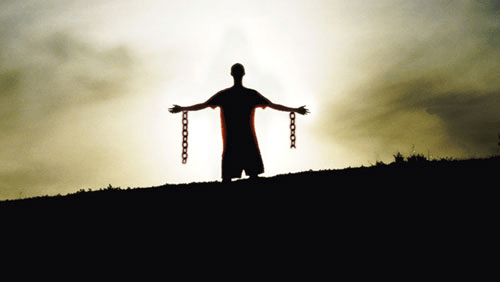
It is for freedom that Christ has set us free. Stand firm, then, and do not let yourselves be burdened again by a yoke of slavery. (New International Version)

Get your hermeneutics together, man

First of all, I want to say that I have little tolerance for Bible readers who insist on an exclusive literal interpretation of Scripture – because it’s downright nonsensical.

Today’s New Testament lesson is one of many biblical passages which really ought to put a wooden stake to the heart of such a misguided hermeneutic. The Apostle Paul himself uses an allegorical or figurative approach to interpreting an Old Testament story.

Holy Scripture interprets itself in many ways. It is, at the least, hubris to believe one has the corner on biblical interpretation through a single mode of literal Bible interpretation; and it is, at the worst, damaging to other’s souls to restrict them in their reading and reflection – not to mention destructive whenever a literalist (who is typically also a legalist) brings their judgmentalism forward to condemn the other approaches.

Okay, I feel better now, getting that off my chest. But, unfortunately, we’ve still got to deal with legalism – which is what Paul set out to do with his writing to the churches in the region of Galatia.

Let go of the legalism

There can be something oddly comforting about law. Having clear black-and-white no-nonsense rules can give a sense of security. You always know where you stand. You’re either in or you’re out, either pure or sinful. 

Yet, here’s the score on the law: it is meant for the immature and is designed as a guide to lead us to maturity. 

If we live by law, we are bound by law. Law can only take us so far in our walk with God. A slavish commitment to rules must, at some point, give way to the greater virtues of grace and love. 

The Galatian churches wanted a religion they could see and hold in their hands. But Paul would have none of it; he was dogged about the devotion to a life of grace. Since Christ has set us free, we are truly and really free. So now, we are to embrace the freedom and never go back to being slaves to the law again – which is closely akin to relapsing into spiritual immaturity. 

We (hopefully) expect a kid to be a kid. When the kid grows up and is an adult with adult responsibilities, we expect him to speak and act like an adult, not a kid.

What’s more, we ought also to expect the adults in the room to treat one another like adults. Layering a bunch of rules and regulations on grown-up people is nothing more than handling them like they’re kids. It’s a nonsensical approach to dealing with each other.

Embrace your freedom

Freedom means that we have no obstacles in expressing grace, love, and hope to others. We are free to bask in the forgiveness we possess in Christ. 

If our Christianity is reduced to a point system or following a list of juvenile rules, then we have missed what the law was all about in the first place. The law is meant to lead us to Christ, and it must, at some point, give way to the larger law of love.

The law has its place. Yet, if we are perpetual slaves to it and never outgrow it’s intended purpose for us, then we need to move onto maturity and embrace the freedom we have in Christ. 

To live in freedom doesn’t mean we can simply do whatever we want, as if there’s no consequences to our words and actions. It’s not “anything goes.” Rather, Christian freedom is a life attuned to the Spirit; an awareness of living for Jesus through the fruit of the Spirit. It doesn’t break laws; it fulfills them. 

All Christians must grow up and become spiritual adults. That means leaving childish ways of the law behind and embracing the freedom of the Spirit. 

So, where are you in your Christian life? Are you a slave to Law or a free person to Love?

Colossians 1:27-2:7 – What Is God’s Goal For Your Life?

Gran Abuelo, a 3,600 year old Cyprus tree in Chile

God chose to make known how great among the gentiles are the riches of the glory of this mystery, which is Christ in you, the hope of glory.It is he whom we proclaim, warning everyone and teaching everyone in all wisdom, so that we may present everyone mature in Christ. For this I toil and strive with all the energy that he powerfully inspires within me.

For I want you to know how greatly I strive for you and for those in Laodicea and for all who have not seen me face to face. I want their hearts to be encouraged and united in love, so that they may have all the riches of assured understanding and have the knowledge of God’s mystery, that is, Christ, in whom are hidden all the treasures of wisdom and knowledge.I am saying this so that no one may deceive you with plausible arguments. For though I am absent in body, yet I am with you in spirit, and I rejoice to see your orderly conduct and the firmness of your faith in Christ.

As you therefore have received Christ Jesus the Lord, continue to walk in him, rooted and built up in him and established in the faith, just as you were taught, abounding in thanksgiving. (New Revised Standard Version)

I invite you to consider the question: “What is God’s goal for my life?” 

This might just be the most important question you ever answer. 

We are created in the image and likeness of God. We were designed for a purpose. Therefore, it is vital and necessary to know the aim, trajectory, and goal for your life.

First, however, let’s consider why we might be out-of-touch with the answer. 

In the beginning God created the heavens and the earth. Man and woman are the apex of God’s imaginative activity. Only humanity has within themselves the ability and the special character to connect with the divine in a special fellowship relationship. 

Yet, the original people fell from their place in Paradise. 

Now, in this current broken world we inhabit, and apart from God, people’s experience is fragmentation, disconnection, confusion, and separation in relationships and self-understanding.

One way of looking at the entirety of the Bible is that it reveals how God is graciously and patiently wooing wayward people back to Paradise. 

The ultimate fulfillment of this re-connection is found in the person and work of Jesus Christ. In Christ, what was lost is found; what was separated is connected; and what was scattered into a thousand pieces is being put back together again.

So, let’s get back to the question of God’s goal for you and me. Since we live in a fallen world, we have to deal with sin, death, and adverse situations. Yet we can take charge of our lives and face reality with a Christian life which thrives and flourishes.

“My friends, be glad, even if you have a lot of trouble.  You know that you learn to endure by having your faith tested.  But you must learn to endure everything, so that you will be completely mature and not lacking anything.  If any of you need wisdom, you should ask God, and it will be given to you.  God is generous and won’t correct you for asking.  But when you ask for something, you must have faith and not doubt.” (James 1:2-6, CEV)

What is God’s goal for my life? Maturity. That you and I will be completely mature. That we will work toward spiritual maturity in our own lives, and what’s more, labor toward presenting others mature in Christ Jesus.

Yes, maturity. Out of all the things which God might want from and for us, maturity is at the top of the list.

Maturity means to be a whole person, not fragmented, a complete and healthy person – in body, soul, spirit, mind, and emotions – all aligned together in a total package of wise living from encouraged hearts and loving faith communities.

Maybe that sounds too far from your own experience. Perhaps you feel that you are all over the place, as if you could never have it all together (or that others are never going to have it together). However, the goal is not about having it all together. 

Rather, maturity is about you and me submitting to adversity and hardship as our teachers. In other words, it’s suffering which leads us to God. Spiritual growth and development happens in the crucible of life. Faith formation occurs in the class of hard knocks.

And we are not to let any spiritual hucksters or charlatans come along and deceive us with all kinds of talk about how the Christian life is having every earthly desire satisfied and never having any significant problems again – that if we just name it and claim it, then our faith will move mountains of money into our bank account or put us into positions of power.

Wi’áaşal, a giant 1,000 year old oak tree in California, on the Pechanga Indian Reservation

Maturity requires spiritual growth over a long period of time. There is no substitute, no other way to be mature in Christ. And our faith will be tried at every turn so that it is strengthened in sustained living for Jesus.

Whenever things are going great, it’s too easy to attribute it to our own ingenuity, ability, or intellect. Yet, when things are rough and there is no apparent way out, we need something or someone outside of ourselves. 

Faith is a muscle that must be stretched, exercised, and used so that it will grow and develop. Trials to our faith and hard situations are the means of strengthening such a faith. The result of all that struggle is maturity, completeness, and wholeness. 

We learn to connect with a generous God who won’t chide us for our messiness and problems. God delights in hearing us and responding to our prayers.

God pays attention and responds… in his own good time and according to his own good grace, and not on our timetable or according to our expectations.

Sometimes we need to learn that the three-ring binder approach to Christian discipleship, with clear proven steps to move forward, is not what we really need. We need Jesus himself. 

In order to return to the Garden, we must walk through the gate of Christ and learn to enjoy the pasture we are currently in. 

Maybe our circumstances will change, and maybe they won’t. But that’s not the point. The aim of all Christian discipleship is that you and I will change, and that our perspective will be different.

So, what will you do today, even right now, to take charge of your life and make a step toward maturity and healthy spiritual wholeness? 

In truth, you know exactly what to do and who to be. You just need some encouragement and affirmation to get over a few fears. It’s okay to be afraid. It’s not okay to remain stuck in fear.

Gracious God of mission who reaches the world with mercy and love, you alone bring growth to your Church everywhere. Send your Holy Spirit to strengthen our faith, give shape to our Christian hope, and love to all our words and actions. May our witness in the world demonstrate a mature Christianity, full of grace and seasoned with salt, through Jesus Christ our Lord. Amen.