Called To a Way of Being – Fourth Sunday of Advent (Romans 1:1-7)

Paul, a servant of Christ Jesus, called to be an apostle, set apart for the gospel of God, which he promised beforehand through his prophets in the holy scriptures, the gospel concerning his Son, who was descended from David according to the flesh and was declared to be Son of God with power according to the spirit of holiness by resurrection from the dead, Jesus Christ our Lord, through whom we have received grace and apostleship to bring about the obedience of faith among all the gentiles for the sake of his name, including you who are called to belong to Jesus Christ,

To all God’s beloved in Rome, who are called to be saints:

Grace to you and peace from God our Father and the Lord Jesus Christ. (New Revised Standard Version)

To be a Christian is to be a servant of Jesus, called to a specific way of being in the world, and set apart for the gospel of God.

Concerning this gospel, this good news, it is all about God the Son, Jesus Christ, who is also fully human. Jesus is the singular person – both God and human at the same time, all the time. His human credentials are linked to the genealogy of the ancient King David, who was promised by God that one of his descendants would sit on throne forever. And as for Christ’s divinity, it was confirmed and established through his resurrection from death.

It is through Christ that we are called to belong to him; we have received the grace to be called children of God; and we are called to holiness for God. We all, therefore, have a calling. Every one of us is important. All of us receive the grace of God to fulfill that calling in this world.

In our contemporary society, we put a lot of stock into what we do, to the point of identifying ourselves primarily by our job titles and positions. But in God’s society, our primary identification is that we belong to God, and specifically to Jesus Christ.

Belonging to Christ means we are to have a certain way of being – not just doing – on this earth. We are first and foremost human beings, and not human doings. What we do is to flow from our being, and not the other way around. We do not gain identity through actions and accomplishments.

Our way of being has a lot to do with the Advent season. Christ’s coming into this world as a vulnerable baby was a deliberate way of being for Jesus in this world. He would go through all the human travails and trials that we do. He would know both joy and suffering, and would know them as coming together into one:

For the joy set before him he endured the cross, scorning its shame, and sat down at the right hand of the throne of God. (Hebrews 12:2, NIV)

It’s normal for us to wonder about the nature of our own personal sufferings. Its hard for us to make sense out of all the nonsensical things in this world, especially when it pertains to us personally.

Indeed, it is hard for us to accept the reality that humble suffering is not only a part of living in this world, but is also an important part of being a Christian who belongs to Jesus.

Whenever we lose something or someone important to us, we struggle with why. We may wonder where God was. We might think there is something wrong with us, as if God is punishing us for some unknown sin we’ve done in the past.

But we would be barking up the wrong tree. Methinks we wrestle so much with adversity and hardship because of our predilection for doing instead of being.

Perhaps our life situations are more about our way of being in this world, rather than what we do on this earth.

Maybe my life is meant primarily to be about being a person who is always loving, kind, compassionate, just, good, righteous, and holy – a saint, set apart as one who belongs to God.

Maybe it has a lot less to do with our vocations and only seeing things through what I’m able to do, or not do.

It could be that I am meant to see God’s grace operating through me by means of love, not hate; kindness, not meanness; compassion and comfort, not indifference and annoyance; justice, not injustice; goodness, not bad attitudes; and holiness, not unrighteousness.

It is quite possible that today (and every day) my Christian life has been about, is about, and will continue to be about my suffering for the sake of Jesus, who suffered for me.

“Why be disturbed of things that do not succeed according to your plans and desires? Who gets everything according to his likes? Neither I, nor you, nor anyone else on this earth. No one in this world is without some trial or illness or affliction, not even a king or a pope. Who, then, has it the best? The one who is willing to suffer for God’s sake.” Thomas à Kempis, The Imitation of Christ

The believers in the Roman Church, for whom the Apostle Paul wrote his letter, were focused primarily on what they had and what they did as Jews and as Gentiles. Because of their understanding of identity, they kept wrangling with each other and looking down on one another – namely, because they failed to each other as belonging equally to God as the one people of God. Jews were too hung up on how they kept the Law for centuries without any Gentiles. And Gentiles were too myopic to see that they were not replacing Jews out of some superior activity.

To love one another, and to simply love, is to suffer. Apart from love there is no suffering. Without love, there is no peace, no grace; and there is no belonging to God and having a way of being in the world which pleases God.

Furthermore, one can never have possessions or wealth without a great deal of anxiety and apprehension. Our happiness does not consist in temporal things, but in the permanence of relationships, because relationships are the only things we take with us in the end.

In the spirit and practice of the Lord Jesus whom the Christian serves, we must pass through the fire before we arrive at redemption and be at peace with God and humanity.

To reach the joy of Christmas, we must endure the weeks of Advent, of anticipating the hope to come, of waiting to see the Christ child who humbly comes into the world for us and for our salvation. And that means we may likely have to endure any current adverse and hard circumstances.

We are called – not for selfish gain, and not to look down on others who are different – but for a way of being in this world which emulates the Lord whom we serve, Jesus Christ our Savior.

Shepherd of Israel: May Jesus, Emmanuel and son of Mary, be more than just a dream in our hearts. With the apostles, prophets, and saints, save us, restore us, and lead us in the way of grace and peace, so that we may bear your promise into the world. Amen.

Be Patient – Third Sunday of Advent (James 5:7-10)

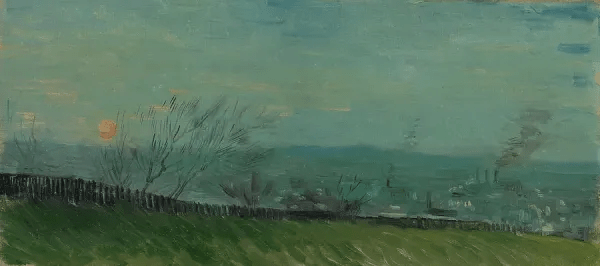
Sunset in Montmartre, by Vincent Van Gogh, 1887

Be patient, therefore, brothers and sisters, until the coming of the Lord.

The farmer waits for the precious crop from the earth, being patient with it until it receives the early and the late rains. You also must be patient.

Strengthen your hearts, for the coming of the Lord is near.

Brothers and sisters, do not grumble against one another, so that you may not be judged. See, the Judge is standing at the doors! 

As an example of suffering and patience, brothers and sisters, take the prophets who spoke in the name of the Lord. (New Revised Standard Version)

Patience is a wonderful virtue… unless you’re smack in the middle of circumstances you neither want nor asked for. Then, patience feels a whole lot more like a vice.

It’s easy to be impatient; it takes little to no effort at all. And praying for patience doesn’t help, because you’re prayer actually gets answered; God puts you in one of those unwanted situations.

The Jewish Christians for whom the Epistle of James was addressed were in that weird life-place of enduring hard circumstances. They were struggling with impatience, so much that the believers began cozying up to the rich and powerful to meet their ever-increasing needs. In their misery, they were looking to the very people who were using them and withholding wages from them. (James 2:1-7; 5:1-6)

It seemed as if God was shuffling his divine feet and not getting around to helping the Christians in their difficulty. They gave everything to Jesus and following him, to the point of being willing to suffer for the Name.

Their suffering led to outright persecution. The believers had to flee Judea for Gentile lands to the West (Acts 8:1-3). In their new homes they got double-trouble. Because they were Jews, they were looked at with suspicion. And because they were Christians, the Jewish community didn’t accept them. The believers were truly alone. All they had was Jesus.

It was enough, at least for a while. But it’s one thing to face difficulty, and quite another thing for the trouble to bleed into next week, next month, next year… When is this ever going to end?

Impatience doesn’t help. In fact, it only exacerbates an already agonizing situation. Grumbling and arguing and verbal fights begin to occur. The community starts to fracture. Blaming and shaming slowly replace the love and encouragement they once had together.

Every good thing in life takes time – lots of time! And the best things in life require a lifetime of endurance, perseverance, and patience. In order to keep going and hold onto our spiritual commitment, we need solid examples of patience, and reasonable ways to think about our situations.

I admit that it has been hard for me to be patient, as of late. I’m weary of American politics and the current administration. I’m tired of seeing my family members struggle with health issues day after day – many of them having to endure debilitating and heart-wrenching trials.

And there are some days when I’ve just had it with my own limitations. I can’t do many of the things I used to do, and it’s frustrating to tears to try and do some things that others do effortlessly.

Yet the Scripture reminds me of my days growing up on the farm. Planting and harvesting never happened in a week; it takes months to realize a return on all the hard work done through the Spring and Summer to get to Fall’s mature crop.

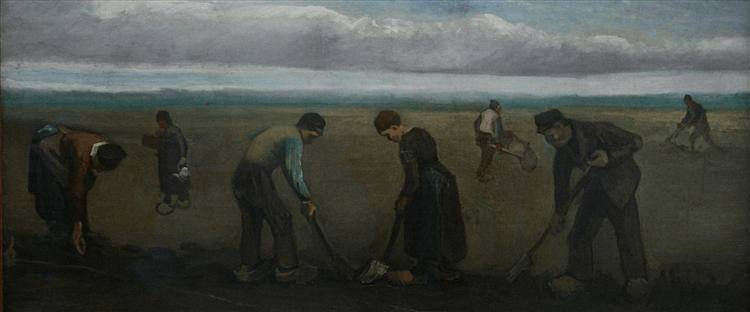
Peasants Planting Potatoes, by Vincent Van Gogh, 1884

I’m also reminded of the biblical prophets who suffered much for their message to the people. Lately, I’ve been reading the prophecy of Ezekiel in the Old Testament. If you have never read Ezekiel, or only read bits of it, you may not realize how incredibly difficult Ezekiel’s life was in serving Yahweh.

The prophet kept up a steady stream of very challenging situations to illustrate the message of judgment he was continually giving. Needless to say, Ezekiel was not always a popular guy. Proclaiming gloom, doom, and death all day every day tends to do that. In one encounter, for month after month, the prophet laid on his side and had to use excrement to light a fire and cook his food every day. God told him to, so that the people would see what was about to happen to them. (Ezekiel 4:1-17)

We have no record of Ezekiel grumbling or talking back to God. He faithfully did all that the Lord commanded him to say and do. He endured all the grumblers around him, and all the grieving people who had been displaced from their homes in Jerusalem.

In every generation, there are people in this world that undergo difficulties and troubles which others could never even imagine. And it’s been going on for millennia. Furthermore, terrible adversity will keep happening… until Christ returns.

Yes, there will be an end to all the suffering. But we may have to persevere to the end of our lives, remaining faithful to our spiritual commitment, and keeping up our love for one another. It won’t be easy to do.

I would be nothing but a hack preacher if I told you that everything will be bunnies and butterflies if you only look to Jesus and have faith. Although there can be joy, even in our mourning, there will always be the need for an agonizing form of patience that continually watches for help, healing, and hope in the return of Christ.

This is why it is so important not to let your own family, church, and faith community break down into fissures of impatience and grumbling.

We must keep our hearts strong. Ironically and paradoxically, that happens through our weakness.

In some ways, I’m weaker than I’ve ever been in my life. Yet, in other ways, I’ve never been stronger. The Trump administration can break me down and mess with my healthcare and my finances… my illness can keep me from ministry that I long to do… and the daily crud of life may redirect me in ways I don’t like… but I can truly say that God is good; God is the strength of my life.

I know that Christmas is coming. I’m looking for the birth of the Savior. I expect to see the angels rejoicing in the sky. I fully look forward to stepping in a few cow pies and horse apples in order to get a glimpse at the baby who changes the world.

Every good thing in life comes with a bit of manure on the shoes. And the best things in life are worth all the hardship one goes through in order to see the glory and majesty of the Divine.

I may not know you, my friend, but please know that I am praying for you. No matter what happens, I can always pray, always watch, always hope, always believe, and always love my neighbor, despite all the hate in this old fallen world.

Be safe. Be strong. Be spiritual. We are all in this life together.

God of joy and exultation, you strengthen what is weak; you enrich the poor and give hope to those who live in fear. Look upon our needs this day. Make us grateful for the good news of salvation and keep us faithful in your service until the coming of our Lord Jesus Christ, who lives forever and ever. Amen.

Christ the King Sunday (Luke 23:33-43)

The 118 feet high Christ the King statue in Świebodzin, Poland

When they came to the place that is called The Skull, they crucified Jesus there with the criminals, one on his right and one on his left. Then Jesus said, “Father, forgive them, for they do not know what they are doing.” And they cast lots to divide his clothing. And the people stood by watching, but the leaders scoffed at him, saying, “He saved others; let him save himself if he is the Messiah of God, his chosen one!” The soldiers also mocked him, coming up and offering him sour wine and saying, “If you are the King of the Jews, save yourself!” There was also an inscription over him, “This is the King of the Jews.”

One of the criminals who were hanged there kept deriding him and saying, “Are you not the Messiah? Save yourself and us!” But the other rebuked him, saying, “Do you not fear God, since you are under the same sentence of condemnation? And we indeed have been condemned justly, for we are getting what we deserve for our deeds, but this man has done nothing wrong.” Then he said, “Jesus, remember me when you come in your kingdom.” He replied, “Truly I tell you, today you will be with me in paradise.” (New Revised Standard Version)

I’m glad that the Gospel text on this Christ the King Sunday is the story of Christ on the cross with the two criminals on each side also crucified. Why?

Because our cultural contexts tend to associate power and authority with high level earthly positions. But, in reality, Christianity is a paradoxical religion full of truths which seem antithetical to each other; yet they are not.

Many people (including many Christians) believe that, in order to influence the culture, Christians must have prominent positions in society. This leaves the majority of Christians feeling as if they have nothing to offer the world. After all, they have no important title at their job, in the government, or within the church.

But nothing could be further from the truth. Christ, in the lowest earthly position possible by being nailed to a cross, was a king who had the highest heavenly position in the universe. One will never come to grips with Jesus apart from understanding that Christianity is an inherently paradoxical religion.

The Sanctuary of Christ the King in Almada, Portugal

One of the criminals crucified with Christ discerned this reality well; the other criminal did not understand at all. One demonstrated the reality that humility is the powerful key to all things, whereas the other criminal remained full of himself.

The scene portrayed for us on Golgotha’s hill shows us what the kingly reign of Jesus Christ truly looks like: It is characterized by the power of humility and sacrifice. It highlights Christ’s authority by giving mercy to those hanging on a cross alongside himself.

True power is not found in the halls of earthly political power, but rather in the elevating power of God’s grace and Christ’s self-sacrifice. Therefore, Christians can best demonstrate their own power and authority by extending grace and mercy toward others, even when it’s hard to do.

It can be difficult to wrap both our heads and our hearts around this reality of possessing power without actually having positions and titles of authority in the world and the church.

Many a church pastor bemoans the fact that a number of their parishioners fail to be active servants in the wrongheaded notion that the clergy are supposed to do all the work. The laity may believe that the clergy are the ones with the educational, experiential, and positional power to influence culture and society.

What’s more, it can be even harder for those who once had positions of power to believe they themselves can no longer effectively work for the good, because they are now nobodies. They may ask, “Who would listen to me?”

The answer is: A lot of people. God uses all sorts of persons in all sorts of places and situations. What we all need, whether clergy or laity, is the willingness to be humble and to sacrifice one’s time or talent in showing mercy to another.

Christians must take their cues from the Lord Jesus. In the setting of the interaction between Christ and the other two crucified men in today’s story, Jesus is the innocent one sandwiched between two guilty persons. Christ’s humiliation is on full public display. The crowd of onlookers mock him, along with one of the criminals. Because of the apparent incongruence between being ‘King of the Jews’ yet not freeing himself from his awful situation.

Whereas most of us might avoid being humiliated in public at any cost, Jesus embraced the rejection and the suffering, knowing that he was offering a sacrifice for the benefit of the whole world.

Even though Jesus was extremely vulnerable, and in emotional, spiritual, and physical pain which we can only imagine, he nonetheless chose to use his kingly power and authority on behalf of others – including those who blatantly rejected and mocked him.

Grace and mercy were demonstrated by submitting to an ignominious death, and by willingly acting to be the bridge connecting others to God. Relationship is at the very heart of the divine will; God would do anything to restore broken relations with his fallen people. No one is beyond the reach of grace.

In a contemporary culture of polarized relations and angry vitriol toward one another, the ordinary Christian without earthly title or authority is in the best position to provide basic human kindness by extending mercy to “enemies” and demonstrating humility in all things.

Christ embodied love and forgiveness. He used his power for mercy, not judgment;  and for grace, not revenge.

Jesus demonstrated for us how grace is the greatest operative force in the universe.

To love and forgive another is the best demonstration of power and authority that anyone could ever show.

God’s action in Christ through the cross is what can move us to true acts of love and selflessness. We participate in Christ by giving grace through acts of mercy in comforting, encouraging, and helping others.

The only way we can give grace is to receive grace. It is God’s action in Christ through the Spirit that moves us to true acts of love and selflessness.

Personally, I am encouraged with the image of Christ as King – the One who is both sovereign over all creation, and yet is with me and knows my every need, giving grace and mercy and unconditional love.

For me, the idea of both God’s transcendence and God’s immanence is the perfect lead-in for the Advent season.

Earthly leaders can be capricious, petty, enamored with earthly power, and wield authority only in ways that serve themselves and not the common good of all. No wonder there is so much corruption and injustice in this old fallen world of ours.

Such hateful leadership has no problem leaving us beaten, bruised, and hanging on a cross. In our pain and our suffering, what will we do?

Hopefully, we will let Jesus transform our understanding of power and authority.

Ideally, in our worst situations of suffering and confusion, we will remember Jesus lifted-up on the cross, lifted-up as sovereign over all things. We will find our own true power in self-giving-love to a world which appears it has given itself to hate and selfish judgment of people they don’t like.

A participation in Christ’s rule and reign over all things means that his crucified power has given us grace and forgiveness, so that we might pass it on, pay it forward, and work for that which is just, right, and good.

May it be so, to the glory of God.

Almighty God, you rescue us from our enemies, so that we may serve you without fear. Strengthen us, that we might share in the inheritance of the saints in your kingdom of light. Amen.

“Oh, That My Words Were Recorded” (Job 19:23-27a)

“Oh, that my words were recorded,
    that they were written on a scroll,
that they were inscribed with an iron tool on lead,
    or engraved in rock forever!
I know that my redeemer lives,
    and that in the end he will stand on the earth.
And after my skin has been destroyed,
    yet in my flesh I will see God;
I myself will see him
    with my own eyes—I, and not another. (New International Version)

The biblical character Job expressed a feeling that all of us, at one time or another, have likely felt: Longing for someone to actually hear our voice, our words of grief, listen to them, and not let them fall into oblivion as if we were alone on this earth.

Job was hurting like no one before or after him. His grief was palpable. His pain was deep and intense. Not knowing what the heck was going on, he had zero understanding of why complete calamity came upon him.

Job’s family was killed, all but his wife. He lost all his earthly possessions to either theft or disaster. And his body was wracked with painful sores that covered his entire body. He was as miserable as one person could be. It was grief stacked upon grief.

In that misery and pain, after losing everything, Job didn’t want his words to be lost. He wanted them to be heard and remembered. Job needed to know that his voice was real, that he was not just speaking into the air.

This gets to the heart of what every grieving person likely wants: For someone to listen to their story of loss – for that story to be heard, listened to, and taken seriously.

I know the feeling. And I know it a bit more intimately than I would like to.

In this past year I was diagnosed with a health disorder that prevented me from continuing to work in a job I absolutely loved. This precipitated a move to another state to be near family. And there are many more losses and griefs to go along with all the changes in my life.

Going through circumstances that we neither asked for nor wanted is hard, especially when it involves significant losses. Without facing our grief, like Job did, we may end up losing ourselves and becoming lost or stuck in that grief.

Rather than me blithering on about the need for vulnerability, I myself will be vulnerable. One of the ways I accept, cope, and transcend hard stuff is through journaling. Here is a portion of my journal from today, unedited:

“I can feel myself sinking down toward the abyss. The darkness is beginning to overwhelm me. Everything – the changes, the transitions, the grief, the state of all things – is too much.

“Lord, have mercy.

“And so, I write, in the hope that my grief and big feelings of loss and of lostness will somehow fade into the background – not the foreground – of my life. Yes, it’s all a part of me. A very important part. And I never want to disavow it. Yet, it is only a part, and not the whole of me.

“Maybe that’s the thing I need to know and remember this day – that grief is not all of me; doesn’t define me as a person; and need not rule my life. There is some sort of ‘sweet spot’ in all this, in which I vulnerably and forthrightly acknowledge and talk about my grief without stuffing it away into an internal junk closet. But also, I do not necessarily focus on it as if grief is all that I am.

“Rather, I’m (like all other people) a complicated soul made up of many moving spiritual and emotional parts.

“It is ironic that a guy who once talked to grieving people on a daily basis is now grieving the loss of no longer talking to grieving people on a daily basis. Yet, here I am.

“One of the reasons I derived so much fulfillment from doing grief work with others is that it is so very much needed! I live in a society where everyone wants you to be okay, likely because they themselves are so very uncomfortable with grief and don’t know what to do with it. So, many people simply want everyone to be ‘normal,’ whatever the heck that actually means.

“Loss is painful, and no one (including me) wants to hurt. But the pain won’t go away magically. I (and everyone) must face the hurt, walk into and through the pain in order to feel better.

“To open-up to the unique pain of loss is the only way to realize emotional healing. In order to move on, we’ve got to stop trying to move on. Instead, let it out.

“In writing this I’m reminding myself what I’ve told hundreds of patients and parishioners who were going through their own unique circumstances of painful loss. Strength is found in embracing weakness, and not by trying to soldier on as if loss doesn’t bother me. It’s okay to grieve. And it’s okay to grieve any sort of loss. It’s more than okay; it’s absolutely needed.”

Eternally righteous God, merciful judge of all the living: In your love you called us to share the glory of Christ. Strengthen our hearts in every good work and word, so that we may be steadfast in your ways and always believe your truth. Amen.