Matthew 23:29-36 – “Woe Is Me!”

Ethiopian Jesus
Jesus, from an Ethiopian Orthodox Church, c.1750 C.E.

“Woe to you, teachers of the law and Pharisees, you hypocrites! You build tombs for the prophets and decorate the graves of the righteous. And you say, ‘If we had lived in the days of our ancestors, we would not have taken part with them in shedding the blood of the prophets.’ So, you testify against yourselves that you are the descendants of those who murdered the prophets. Go ahead, then, and complete what your ancestors started! 

“You snakes! You brood of vipers! How will you escape being condemned to hell? Therefore, I am sending you prophets and sages and teachers. Some of them you will kill and crucify; others you will flog in your synagogues and pursue from town to town. And so upon you will come all the righteous blood that has been shed on earth, from the blood of righteous Abel to the blood of Zechariah son of Berekiah, whom you murdered between the temple and the altar. Truly I tell you; all this will come on this generation. (NIV) 

I almost feel the need to place a warning label on this blog post: “The writer has determined that a careful reading of this Scripture is dangerous to those who think their current state of Christianity is just fine.”  Jesus stands in a long line of Old Testament prophets as the ultimate prophesier calling the people to see things as they really are and come back to the God of all, not the God of their own making. 

I feel yet another warning is warranted, knowing from years of experience that there is an Enemy of our souls: The dark forces of this world will try every which way to get us to believe these words of Jesus are for other people, not me or you – that you and I are okay and that this is for “those” people [probably ones we don’t like] who are clearly deluded. We, however, are simply fine.   

We all need these words from Jesus and to let them speak to us. Christ’s scathing and damning critique was leveled against a distorted spirituality, a false Christianity, a controlling leadership that stifled and snuffed-out the true worship of God. Jesus pronounced seven woes on the religiously pious spiritual brokers of his day. Today’s Gospel lectionary contains only the seventh woe. This woe, along with the rest, are not directed toward the irreligious or the spiritually lackadaisical folks among us – the woes are aimed squarely at the religiously committed. 
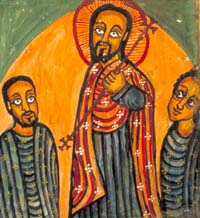
Ethiopian Orthodox Jesus
Ethiopian Orthodox Church depiction of Jesus

The word “woe” literally means “disaster” “calamity” and “misery.” Jesus pronounced a woe against ultra-religious persons who were obsessed with respecting the tombs and the graves of the ancient prophets. It was considered a terrible travesty to walk on such a grave, even accidentally. The concern about it would be something like today’s respect given to the American flag by many people. 

Here is what Jesus is getting at with his woe on those being so concerned with the tombs of the prophets: Honoring dead people and inanimate objects like graves while ignoring live people is not good. Respecting dead people of the past means nothing if we simultaneously ignore the live people right in front of us. For Jesus, one of the surest ways to hell is to give credence to Christian leaders long dead while flippantly disregarding the prophet or pastor presently in our lives who is taking pains to communicate God’s will and care for God’s people right now. 

Jesus knew quite well the telltale signs of hypocrisy: 1) hypocrites don’t practice what they preach; 2) hypocrites keep other people out of God’s kingdom; 3) hypocrites focus on externals; and, 4) hypocrites major on the minors. Hypocrisy, however, never has the last word – grace does. The final word to everything is God’s grace.  

For all of Christ’s severe words, his heart was filled with a love and a longing for his wayward people. Jesus died for the ungodly with deep concern, intention, and hope that everyone would come to know the true worship of God – filled with an abundance of mercy for the penitent sinner. 

When the prophet Isaiah experienced a vision of God his response was “woe is me!” (Isaiah 6:1-5). The appropriate response to today’s Gospel lesson is repentance – to see and turn from our own propensity toward spiritual and/or religious pride and the tendency to view the “other” as needing to repent, but not me.  

Let us, then, come to the cross of Jesus Christ and there find the grace which absolves us from such sin. Let us approach the empty tomb and find Christ’s resurrecting power of transformation. Let us approach the ascended Christ on the throne with both humility and confidence. Let us intercede for a world which desperately needs the peace of Christ. 

Lord Jesus Christ, you prayed that we would be one as you and your Father are one. We confess our resistance to your prayer. We have failed to maintain the unity of the Spirit. We have broken the bond of peace. For the times we have not listened to each other, when we have spoken in anger, haste, or fear, we are sorry. For the times we have not loved each other, when we have competed, or insulted or judged each other, we are sorry. For the harm that our disunity has done to our witness to the Gospel, we are sorry. Have mercy on us, we pray. Restore us to friendship with you and with one another, through the power of your Spirit. Lord, grant your grace for repentance to spiritual charlatans and victimizers; and, give your power to those distressed and victimized for forgiveness of their abusers, so that all of us together may strive to break the chains of oppression and show the peace of Christ in the world. Amen. 

Exodus 10:21-29 – From Darkness to Light

Darkness

Then the Lord said to Moses, “Stretch out your hand toward the sky so that darkness spreads over Egypt—darkness that can be felt.” So, Moses stretched out his hand toward the sky, and total darkness covered all Egypt for three days. No one could see anyone else or move about for three days. Yet all the Israelites had light in the places where they lived.

Then Pharaoh summoned Moses and said, “Go, worship the Lord. Even your women and children may go with you; only leave your flocks and herds behind.”

But Moses said, “You must allow us to have sacrifices and burnt offerings to present to the Lord our God. Our livestock too must go with us; not a hoof is to be left behind. We have to use some of them in worshiping the Lord our God, and until we get there, we will not know what we are to use to worship the Lord.”

But the Lord hardened Pharaoh’s heart, and he was not willing to let them go. Pharaoh said to Moses, “Get out of my sight! Make sure you do not appear before me again! The day you see my face you will die.”

“Just as you say,” Moses replied. “I will never appear before you again.” (NIV)

The ancient Israelites were in bondage to the mighty Egyptian empire. After four-hundred years of bondage, God called Moses to lead them out from Egypt to the Promised Land. The only kink was the Egyptian Pharaoh’s outright reluctance. As the most powerful human on the planet at the time, Pharaoh was used to getting his way on everything. God knew it would be a process of deliverance, and not just a sudden event.

So, a series of ten wonders or miracles occurred that struck at the heart of Egyptian power and religion. A discernible pattern quickly developed in which Pharaoh refused cooperation; God sent an incredible devastation on the land; Pharaoh relented with a half-repentance; God lifted the devastation; and, with things “back to normal” Pharaoh’s heart was hardened and he would not let God’s people go. Rinse and repeat a lot more times.

Today’s Old Testament lesson recounts the ninth wonder done by God, using Moses. Although the miracle of complete and total darkness lasted a full three twenty-four-hour long days without harming any human or animal, the sheer fear and terror it brought to the Egyptians left them in a three-day state of suspense. Living on the edge in anxious apprehension is psychologically overwhelming. At least with the other plagues, you could see what you were up against.

Fear in the dark

In the land known as the “eternally rising sun,” the uncertainty of the perpetual darkness was meant to humble Egypt and put it in its place. Yet, with nine strong and full wonders from God, Pharaoh remained intransigent and stubborn. He was not going to let all that slave labor walk away while he was in charge.

I “wonder” what it takes for most of us to make a major change in our lifestyle – what we need to go through before we cry “uncle” and let go. The more power and control we have, the harder it is to do so. Humans are creatures of habit, and wherever there are long standing routines there you will find great difficulty in changing those practices.

No one simply wakes up in the morning and decides to be a jerk. Instead, it is likely that one day a person will arise, look in the mirror, and not recognize who is looking back at them. A series of choices and habits over a long stretch of time eventually formed the undistinguished blockhead. The Apostle James once described the pathology behind the person in the mirror:

You are tempted by the evil things you want. Your own desire leads you away and traps you. Your desire grows inside you until it results in sin. Then the sin grows bigger and bigger and finally ends in death. (James 1:14-15, ERV)

By reading today’s story Christologically we have a clue as to the remedy and reformation needed to form newer and better habits. Just as all Egypt was in three days of darkness due to sin, so Jesus was three days in the dark grave because of the world’s sin. And just as the ancient Israelites were delivered from their cruel bondage from Egypt and entered the Promised Land, so in Jesus Christ humanity is liberated from their power-hungry, money-grubbing, control-obsessing ways of being insensitive dolts to forming new habits of humility, justice, and love. The Apostle Peter said:

You are a chosen race, a royal priesthood, a holy nation, God’s own people, in order that you may proclaim the mighty acts of him who called you out of darkness into his marvelous light. (1 Peter 2:9, NRSV)

It is the aim of the Christian to look out at the world and bring love where love is not; to discover it is more blessed to give than to receive; and, to have a deep sense of justice which works for egalitarian ways and the equity of all people, not just people of privilege.

So, may we gain a proper perspective of ourselves, others, and the world. And, may we resist the Pharaoh’s among us, while championing the needs of the downtrodden of this old fallen world. May we be like Christ and see Jesus in each person we encounter.

God, you have given all peoples one common origin. It is your will that they be gathered as one family in yourself. Fill the hearts of humanity with the fire of your love and with the desire to ensure justice for all. By sharing the good you give us, may we secure an equality for all our brothers and sisters throughout the world. May there be an end to division, strife, and war. May there be a dawning of a truly human society built on love and peace. We ask this in the name of Jesus, our Lord, through the might of the Holy Spirit. Amen.

Ephesians 4:17-5:2 – Living in Truth

truth

So, I tell you this, and insist on it in the Lord, that you must no longer live as the Gentiles do, in the futility of their thinking. They are darkened in their understanding and separated from the life of God because of the ignorance that is in them due to the hardening of their hearts. Having lost all sensitivity, they have given themselves over to sensuality to indulge in every kind of impurity, and they are full of greed.

That, however, is not the way of life you learned when you heard about Christ and were taught in him in accordance with the truth that is in Jesus. You were taught, with regard to your former way of life, to put off your old self, which is being corrupted by its deceitful desires; to be made new in the attitude of your minds; and to put on the new self, created to be like God in true righteousness and holiness.

Therefore, each of you must put off falsehood and speak truthfully to your neighbor, for we are all members of one body. “In your anger do not sin.” Do not let the sun go down while you are still angry, and do not give the devil a foothold. Anyone who has been stealing must steal no longer, but must work, doing something useful with their own hands, that they may have something to share with those in need.

Do not let any unwholesome talk come out of your mouths, but only what is helpful for building others up according to their needs, that it may benefit those who listen. And do not grieve the Holy Spirit of God, with whom you were sealed for the day of redemption. Get rid of all bitterness, rage, and anger, brawling and slander, along with every form of malice. Be kind and compassionate to one another, forgiving each other, just as in Christ God forgave you. Follow God’s example, therefore, as dearly loved children and walk in the way of love, just as Christ loved us and gave himself up for us as a fragrant offering and sacrifice to God. (NIV)

Okay, a collective confession from the get-go: We know today’s New Testament lesson is the proper way to live. There’s no need to convince you that we must live and speak the truth in love, avoid angry tirades, keep a lid on our wagging tongues, keep bitterness out of our hearts, forgive others, and be compassionate to people. So, what is the real issue? Why, despite knowing better, do we as people have such a doggone hard time following God’s example of holy speech, pure words, and radical forgiveness?

If there was a simple answer/solution to the acerbic tongues of people, it would be easy to avoid using our words like a hot knife through butter and toast others with subtle digs and cranky words. Simply telling ourselves (or others) to stop their bellyaching is only a manifestation of our own belligerent spirit running amok. No, we need a solid practical approach to those nagging white lies we keep putting out there and the bending of truth to suit our own selfish purposes. Neither sheer willpower nor hackneyed homebrewed prescriptions will get the job done.

When we go to the doctor, we want them to be honest with us about our true condition and health.  If we have a clean bill of health, we are glad for that truth.  If, however, we have something wrong, we want to know what it is and how to deal with it. Doctors who avoid the truth so to not make us feel bad or hurt our feelings are performing malpractice, not healing. We need a solid diagnosis and prognosis framed in a caring way. Trying to grow spiritually without hearing the truth about ourselves from a spiritual doctor is like trying to do heart surgery on yourself.

The truth will set us free. Yet, before it will free us, it will make us uncomfortable. We all have a real need to hear the truth spoken in love and wrap our heads and hearts around it. Truth is: People are to be open, honest, and real with each other because we belong to one another. We are to stop being dishonest, and start being truthful.

truth cross

What is truth?

The Christian tradition teaches that Jesus is the way, the truth, and the life. Life together is to be shaped around the person and work of Christ.  Since Christians share a common confession of Jesus together, we are to share a common life together. That life is to revolve around the truth of Jesus. That means we will put off non-Christian ways of relating to each other and put on a Christian way of relating to each other.  We will speak truthfully because we belong to each other – we are responsible for one another.  Just as Jesus so closely identified with us in his life, death, and resurrection, so we are to so closely identify with each other that we take responsibility for each other.  My problems are your problems – your issues are my issues. This is a stance of connection, not division.

We are to put off lying and put on truth. Too often, we are in the habit of pretending and being plastic.  Pretending we are okay when we are not, or even acting like life is hard when it is not is an untruthful presentation – it is a lie. Secrecy and deception are tools of Satan, not God. Therefore, we must put off the bad habit of pretension, and put on the good habit of speaking truthfully to each other.

Why do we not speak truth?

Habits of lying come from the enemy of our souls who whispers in our ears that being truthful and transparent is too traumatic – we can’t do it. Buying into that snake oil thinking believes we cannot be open, honest, real, vulnerable, and genuine because it is not worth the risk. We become convinced that we will be rejected, lose face with others, or be a victim of gossip.  In other words, we let shame take the steering wheel instead of speaking truthfully to one another.  So, we avoid the truth and, so, end up avoiding others.

Why are we to speak truth?

We speak truth because we are responsible to one another. We are not meant to hide in the shadows but to step into the light and forsake all fakery and be truthful.  When Ananias and Sapphira lied to the Apostle Peter, they were judged severely because they betrayed the community (Acts 5:1-11). Lying undermines and erodes true community.

truth 2

How do we speak truth?

We speak truthfully by making and keeping promises to each other because that is what God does with us.  Faith communities which love truth will make a safe place for the awkwardness of confession, forgiveness, and healing.  There must be assurance that members will not abandon one another as they reveal their sins and weaknesses and fumble forward toward maturity and holiness.  Truthful communities are sacred spaces of encouragement and hospitality where we are safe to be real.  No one should ever have to suffer in silence, cry alone, or wonder whether they will be forsaken.  We must have a refreshing openness with each other since we belong to one another.  The late author and psychologist, Lewis Smedes, said in his book The Power of Promises:

“Yes, somewhere people still make and keep promises. They choose not to quit when the going gets rough because they promised once to see it through. They stick to lost causes. They hold on to a love grown cold. They stay with people who have become pains in the neck. They still dare to make promises and care enough to keep the promises they make. I want to say to you that if you have a ship you will not desert, if you have people you will not forsake, if you have causes you will not abandon, then you are like God.  What a marvelous thing a promise is! When a person makes a promise, she reaches out into an unpredictable future and makes one thing predictable: she will be there even when being there costs her more than she wants to pay. When a person makes a promise, he stretches himself out into circumstances that no one can control and controls at least one thing: he will be there no matter what the circumstances turn out to be. With one simple word of promise, a person creates an island of certainty in a sea of uncertainty.”

Where do we go from here with truth?

I harbor no delusions: Being transparent and real is scary. Yet, if we are to be the true humanity we are deigned to be by our Creator, we will speak truthfully and not put up a false front.  We will neither hide nor hurl.  We will neither pretend everything is okay when it is not, nor project our problems onto others using untruthful accusations. We will do the hard work of learning to communicate by speaking the truth in love.

There are two tendencies that may plague us going forward: complacency and mediocrity. When it comes to relationships, we are too easily satisfied with a minimum amount of effort, words, and commitment.  We need to make and keep promises to God and to each other; live into our baptisms; and, renew our covenant of care and commitment to each other.  This means we will allow God to invade our hearts; we will let our mouths say what needs to be said and be open enough to let others in.

Some folks have putrid spiritual abscesses from either hiding the truth or hurling truth without love.  Spiritual healing comes through spiritual surgery. God the Father sent God the Son to die on a cruel cross for all our unhealthy ways of relating to each other – and together sent God the Holy Spirit, the Spirit of Truth, to form a new community of believers around truth.

Putting off and putting on – that is the prescription for realizing truthful speech and life. It is not easy. It is hard as hell. And it takes us all as a human community to do it. Sometimes things are messy before there is order and peace. That is the price of authenticity and truth – and that is okay.

Lord God Almighty, the Creator of all that is good and true, help me so to put aside falsehood and put on truthful living and speaking that love and compassion shine in and through me to the glory of Jesus Christ, your Son, my Savior, who with you and the Holy Spirit live and reign forever together in a Holy Trinity of Truth. Amen.

Romans 7:7-20 – Facing Our Bundle of Contradictions

contradiction
“Humanity is an embodied paradox, a bundle of contradictions.”-Charles Caleb Colton, 1780-1832

What shall we say, then? Is the law sinful? Certainly not! Nevertheless, I would not have known what sin was had it not been for the law. For I would not have known what coveting really was if the law had not said, “You shall not covet.” But sin, seizing the opportunity afforded by the commandment, produced in me every kind of coveting. For apart from the law, sin was dead. Once I was alive apart from the law; but when the commandment came, sin sprang to life and I died. I found that the very commandment that was intended to bring life actually brought death. For sin, seizing the opportunity afforded by the commandment, deceived me, and through the commandment put me to death. So then, the law is holy, and the commandment is holy, righteous and good.

Did that which is good, then, become death to me? By no means! Nevertheless, in order that sin might be recognized as sin, it used what is good to bring about my death, so that through the commandment sin might become utterly sinful.

We know that the law is spiritual; but I am unspiritual, sold as a slave to sin. I do not understand what I do. For what I want to do I do not do, but what I hate I do. And if I do what I do not want to do, I agree that the law is good. As it is, it is no longer I myself who do it, but it is sin living in me. For I know that good itself does not dwell in me, that is, in my sinful nature. For I have the desire to do what is good, but I cannot carry it out. For I do not do the good I want to do, but the evil I do not want to do—this I keep on doing. Now if I do what I do not want to do, it is no longer I who do it, but it is sin living in me that does it. (NIV)

The Apostle Paul’s vulnerable expression of his dilemma resonates deeply with many people. There are times when we say things to ourselves such as, “I told myself I wasn’t going to be like my mother, and here I am responding just like she would;” “I know better than to drive by the liquor store on my way home and pick up a pint of vodka, yet, I still did it;” or, “I don’t want to die, but my thoughts keep racing about a plan for suicide.” And, there are many more situations in which we are both frustrated and befuddled by our doing the things we do not want to do, and not doing the things we want to do.

Yes, indeed, Paul’s existential angst is a timeless description of our common human condition. We all can relate to the seeming inability to do what is right in so many situations. It can really drive us nuts, even to a constant and never-ending low-level discouragement that underlies almost everything we do.

Paul’s prescription for dealing with this does not rely on law. He understood that putting our willpower and effort into obeying commands gets us nowhere because we will eventually fail. Neither our brains nor our spirits work that way. Our willpower was never designed to be the driver of what we do and do not do. If anything, willpower, and the lack thereof demonstrate just how much we are climbing the ladder on the wrong wall. People are a bundle of contradictions, doing good, then bad, and flip-flopping back and forth with great frustration.

God’s law was not crafted to transform us from the inside-out. The law has three solid purposes, none of which are meant to bring deep personal transformation: attention to the law works to restrain sin in the world; use of the law provides us with a helpful guide for grateful living in response to divine grace; and, it’s use here by Paul is to show us how bad off we really are in this world and in need of forgiveness.

We need a change of habits, and this is different than adopting a list of laws. Habits are developed from our desires, our affections. In other words, we do what we love – more specifically, our ultimate love(s) drive us to do what we want. To put it in a straightforward way: We sin because we like it. And the path to overcoming any besetting sin is to have an ultimate love trump the lesser sin which we like.

St Augustine quote 2

For example, I have developed daily habits or rituals of faith which enable me to commune with God. I love God with all my heart, soul, mind, and strength, and this ultimate love enables me to push out all competing gods who want my devotion. I also love my wife with all my heart. We work on developing habits of a marital relationship which reinforce our love for each other. Love is what drives me to do right and good by her.

So, what do we do when we mess up? For the Christian, no matter what the question is, the answer is always grace. God’s grace in the finished work of Jesus Christ applied to us by the Holy Spirit is the operative power that changes lives. The law has no power to do that kind of work. Freedom from the tyranny of our misplaced desires and disordered loves comes from Christ’s forgiveness through the cross. Like a lover enamored with his beloved, our desires become oriented toward Jesus for his indescribable gift to us. That is the strength of grace.

Saving God, I thank you for delivering me from sin, death, and hell through your Son, the Lord Jesus.  May your Holy Spirit apply the work of grace to my life every day so that I can realize spiritual healing and practical freedom from all that is damaging and destructive in my soul.  Amen.