Grace Changes Everything (Isaiah 12:1-6)

In that day [to come] you will say:

“I will praise you, Lord.
    Although you were angry with me,
your anger has turned away
    and you have comforted me.
Surely God is my salvation;
    I will trust and not be afraid.
The Lord, the Lord himself, is my strength and my defense;
    he has become my salvation.”
With joy you will draw water
    from the wells of salvation.

In that day you will say:

“Give praise to the Lord, proclaim his name;
    make known among the nations what he has done,
    and proclaim that his name is exalted.
Sing to the Lord, for he has done glorious things;
    let this be known to all the world.
Shout aloud and sing for joy, people of Zion,
    for great is the Holy One of Israel among you.” (New International Version)

The Bad News

The reason prophecies are made about better times ahead is because the times now are not so good. That was true of Isaiah’s day, and still remains true today.

It’s easy to identify what’s wrong in this world, especially during a political election cycle! It’s not so easy to recognize the ways we keep ourselves as Christians in bad times. A big reason why, and I unabashedly state it, even though I say it much to my chagrin:

Christianity in our day has mostly failed at spiritual transformation because we have not identified and named the real evils we face, thus leaving us largely irrelevant to a world desperately in need of Jesus Christ.

Jesus, speaking to religious folk who should have known better, said:

“You have neglected the more important matters of the law—justice, mercy and faithfulness… You blind guides! You strain out a gnat but swallow a camel.” (Matthew 23:23-24, NIV)

The tragedy of our age, which was the same tragedy of Isaiah’s age, is that there are so many godless followers of God. They fuss about trifles while ignoring more serious matters. Many Christians’ faith is not much more than conforming to cultural Christian norms while mostly ignoring the realities in front of their faces.

We say we need God but then turn to Google for answers and solutions.

We bemoan the lack of righteousness in the nation, then obnoxiously argue with others and create unnecessary relational wedges.

We decry the injustice of our cities and our world, then do nothing to address the problems and change it.

We talk about the need for others to change rather than first looking in the mirror. Yet, even when we do that, we walk away and forget what we look like.

“For it is time for judgment to begin with God’s household; and if it begins with us, what will the outcome be for those who do not obey the gospel of God?” (1 Peter 4:17, NIV)

The Good News

However, judgment is not the last word. Even though the prophecy of Isaiah is thick with it, and I started out with less than uplifting words, there is one word that transcends every word: grace.

The grace of God is remarkable! The Lord made promises to Israel in Isaiah’s day not based upon what they would or would not do; God made promises to the people by God’s own radical and scandalous grace. It wasn’t a matter of playing Let’s Make a Deal, with God saying, “If you get your act together, then I will be good to you.” No, before Israel even had a chance to return to the Lord, God was already choosing to be merciful.

I am absolutely convinced with the firmest conviction possible that the Scriptures of the Old and New Testaments are all about God and God’s own unbounded, unfettered, free, crazy, illogical, and wildly wonderful grace.

Because God is Love, the Lord constantly goes out of the way to be gracious so that we can live up to being the sort of people our dogs think we are already.

If we miss the message of God’s grace in the Holy Scriptures, we have missed salvation – because only grace can save us. Without grace, we are lost. Today’s Old Testament lesson is full of praise because it’s a response to the undeserved grace which God freely gives. 

If grace isn’t the answer, we aren’t asking the right question. Grace is love that seeks you out when you have nothing to give in return. Grace is wildly generous. Grace does not use carrot sticks, scorecards, or power politics. Grace never demands – it only gives. 

Grace is unconditional acceptance given to an undeserving person by an unobligated giver. 

That is what God did for Israel… and for us. And when we get a hold of this truth, even a little bit, our hearts become bubblers of praise.

The Bible is an extended drama of redemption; and Isaiah’s prophecy is an adventure of God’s steadfast love toward unlovable people – which is why Isaiah is one of the most quoted books of the Old Testament by Jesus. Jesus came because of grace. 

Jesus came to release us from our obsessive need to be right, our compulsion to be rewarded, and our demands to be respected. 

Because Jesus came to set sinful captives free, life does not have to be a joyless effort of justifying and validating ourselves before others. The grace of God in Christ is a game-changer. And with but a glimpse of grace, we are forever undone by God’s mercy.

Grace leads us to praise God

“Praise be to the God and Father of our Lord Jesus Christ, who has blessed us in the heavenly realms with every spiritual blessing in Christ. For he chose us… In love he predestined us… to the praise of his glorious grace, which he has freely given us in the One he loves.” (Ephesians 1:3-6, NIV)

Grace causes us to trust God

If God is for us, who can be against us? (Romans 8:31, NIV)

Grace results in our comfort and satisfaction in God

Never again will they hunger;
    never again will they thirst.
The sun will not beat down on them,
    nor any scorching heat.
For the Lamb at the center of the throne
    will be their shepherd;
he will lead them to springs of living water.
    And God will wipe away every tear from their eyes. (Revelation 7:16-17, NIV)

Grace creates in us thanksgiving to God

“We know that the one who raised the Lord Jesus from the dead will also raise us with Jesus and present us with you to himself. All this is for your benefit, so that the grace that is reaching more and more people may cause thanksgiving to overflow to the glory of God.” (2 Corinthians 4:14-15, NIV)

The Lord has seen you at your worst, and still loves you. And if that isn’t something that gets you expressing gratitude to God, then you have failed to see God in your dog. We make known among the nations what God has done because God has really done something in our lives worth babbling our thanksgiving over to everyone. And grace helps us to do it.

Grace causes us to sing together to God

When grace takes hold of a congregation, there is no mumbling of songs – there are loud shouts and singing for joy because God is good! We need times of both silence and contemplative worship and times of becoming unhinged with some noisy worship to the God who has saved us and given us something to sing about. 

Oh, sing to the Lord a new song!
For He has done marvelous things;
His right hand and His holy arm have gained Him the victory. (Psalm 98:1, NKJV)

Conclusion

The world mostly ignores God. Some Christians take God’s grace for granted. The greatest sin of all is the sheer absence of grace – because where there is no grace, there is no God. God is the expert in transforming apathetic people into caring, compassionate, and concerned citizens of the kingdom who raise their voices and declare the works of the Lord.

Isaiah’s entire prophecy is about returning to the Lord. And the upcoming season of Advent is all about God’s relentless pursuit of wayward people – the anticipation of grace coming in the form of an infant – and the bringing of grace to a people living in darkness.

Let us, then, return to the Lord… be captivated by grace… renew our love for Jesus… lose ourselves in praise and adoration of the One who gave everything for us.

Let us worship Christ the King and proclaim the name of Jesus as exalted over everything and everyone.

Gracious God, we come with nothing but ourselves and our baggage of sin. Forgive, cleanse, renew, revive, refresh, and reform us according to the ways of Jesus Christ. Thank you for your undeserved grace. We give you praise for the lengths you went to secure our forgiveness. With a joy too deep for words, we humbly offer to you our lives so that the name of Jesus will be exalted through us, to your glory and honor. Amen.

The Divine Warrior (Isaiah 59:15b-21)

The Lord looked and was displeased
    that there was no justice.

He saw that there was no one,
    he was appalled that there was no one to intervene;
so his own arm achieved salvation for him,
    and his own righteousness sustained him.
He put on righteousness as his breastplate,
    and the helmet of salvation on his head;
he put on the garments of vengeance
    and wrapped himself in zeal as in a cloak.
According to what they have done,
    so will he repay
wrath to his enemies
    and retribution to his foes;
    he will repay the islands their due.
From the west, people will fear the name of the Lord,
    and from the rising of the sun, they will revere his glory.
For he will come like a pent-up flood
    that the breath of the Lord drives along.

“The Redeemer will come to Zion,
    to those in Jacob who repent of their sins,”
declares the Lord.

“As for me, this is my covenant with them,” says the Lord. “My Spirit, who is on you, will not depart from you, and my words that I have put in your mouth will always be on your lips, on the lips of your children and on the lips of their descendants—from this time on and forever,” says the Lord. (New International Version)

The Lord inhabits a lot of roles as God: Creator and Sustainer, Father and Mother, Helper and Healer, Sovereign and King, Shepherd and Spirit, and much more. In today’s Old Testament lesson, we see God as the Divine Warrior and Redeemer.

Readers of the New Testament will pick up on the warrior language in Isaiah’s prophecy (Ephesians 6:10-20). The Divine Warrior readies for battle by putting on armor: a breastplate of righteousness and the helmet of salvation. The Lord prepares to intervene, to make war on injustice, because there are no earthly human warriors willing to eradicate unrighteousness, redeem the oppressed, and establish deliverance for the needy.

The “bystander effect,” or “bystander apathy,” is a social psychology term that refers to cases in which individuals do not offer any means of help to a victim when other people are present. In experiment after experiment over the past fifty years, social psychologists have found that the more bystanders there are, the less likely any one of them will help. 

For example, researchers Bibb Latané and Judith Rodin staged an experiment in 1969 around a woman in distress. 70% of the people who were alone called out or went to help the woman after they believed she had fallen and was hurt. Yet, when there were other people around, only 40% offered help.

The social psychologists found that individuals find it far too easy to stand with their hands in their pockets, whenever there are other people around that could help and do what is right and just. 

The Lord your God is with you, the Mighty Warrior who saves. (Zephaniah 3:17, NIV)

The Lord noticed that justice had disappeared. God was plenty displeased with the lack of justice – and became downright disgusted when no one was doing anything about it. 

“Rationalization is a process not of perceiving reality, but of attempting to make reality fit one’s emotions.”

Ayn Rand

The rationalizations for not becoming involved and avoiding the work of justice in the world are legion: 

  • “Someone else can do it better than me.” 
  • “But what if I screw up?”
  • “I don’t have time for this.”
  • “How could I possibly make any difference?”
  • “That’s not my job.”
  • “They made their own bed, now they can sleep in it.”
  • “I don’t know what to do.”

God puts the responsibility for ensuring that everyone has what they need to live and thrive on us. We truly are our brother’s and sister’s keeper.

So, let’s come back to the Divine Warrior image in the New Testament. Christians are to take up the armor of God, not only to protect themselves from evil, but also to fight the dark forces that keep people locked in systems of injustice. Read the following text from the perspective of ensuring justice for the common good of all people:

Finally, be strong in the Lord and in his mighty power. Put on the full armor of God, so that you can take your stand against the devil’s schemes.For our struggle is not against flesh and blood, but against the rulers, against the authorities, against the powers of this dark world and against the spiritual forces of evil in the heavenly realms. 

Therefore put on the full armor of God, so that when the day of evil comes, you may be able to stand your ground, and after you have done everything, to stand. Stand firm then, with the belt of truth buckled around your waist, with the breastplate of righteousness in place,and with your feet fitted with the readiness that comes from the gospel of peace. In addition to all this, take up the shield of faith, with which you can extinguish all the flaming arrows of the evil one. Take the helmet of salvation and the sword of the Spirit, which is the word of God. (Ephesians 6:10-20, NIV)

The under-privileged, the under-represented, the under-served, the disadvantaged, the deprived, the indigent, and many more groups of people exist because of ignorance and apathy toward their needs. Everyone, including you and me, need to own this and not rationalize why we cannot participate.

The prophet Isaiah lets us know that none of us are anonymous; we have all been given gifts as the people of God in order to serve the greater good. 

The Lord dispenses grace and glory primarily through active people who forsake being bystanders and respond to God’s call on their lives. 

Let’s not bring out the Divine Warrior because of our own negligence. Instead, let’s be attentive to justice, righteousness, and redemption. Perhaps then God will get a more positive press in the public square.

God of justice and righteousness, you care about the people of this world receiving the things they need to live and flourish in life. Inspire and empower all of your people, including me, to spread a spirit of service in our local communities, churches, workplaces, and everywhere we live and go, through Jesus Christ our Lord in the power of the Holy Spirit. Amen.

The Parables of the Lost Sheep and the Lost Coin (Luke 15:1-10)

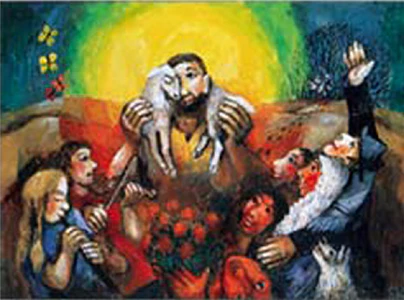
By Sieger Koder (1925-2015)

Now the tax collectors and sinners were all gathering around to hear Jesus. But the Pharisees and the teachers of the law muttered, “This man welcomes sinners and eats with them.”

Then Jesus told them this parable: “Suppose one of you has a hundred sheep and loses one of them. Doesn’t he leave the ninety-nine in the open country and go after the lost sheep until he finds it? And when he finds it, he joyfully puts it on his shoulders and goes home. Then he calls his friends and neighbors together and says, ‘Rejoice with me; I have found my lost sheep.’ I tell you that in the same way there will be more rejoicing in heaven over one sinner who repents than over ninety-nine righteous persons who do not need to repent.“

Or suppose a woman has ten silver coins and loses one. Doesn’t she light a lamp, sweep the house and search carefully until she finds it? And when she finds it, she calls her friends and neighbors together and says, ‘Rejoice with me; I have found my lost coin.’ In the same way, I tell you, there is rejoicing in the presence of the angels of God over one sinner who repents.” (New International Version)

Lost people matter to God… a lot. They matter so much to the Lord that one lost soul who is found is the grounds for a big celestial party. 

Note a simple observation of today’s Gospel lesson: If there is rejoicing in the presence of angels over one sinner who repents, then it is God who is doing the rejoicing. The Lord is absolutely giddy with joy over a lost person being found.

Jesus told two short stories, each teaching the same thing, so that we will be absolutely sure to get it: A loving God has unbounded joy over lost people being found. These parables of Jesus give us a glimpse of God’s own heart. The Lord would do anything to find a lost person, to restore and reconcile that person to right relationships. 

The Lost Sheep by Jorge Cocco Santángelo

God would go dumpster diving and wade through stinky nasty garbage to find just one lost valuable person.

Restoring lost people is such a high priority to God that the Father sent the Son to this earth. Jesus paid the ultimate price of a cruel death on a cross to reconcile a broken lost relationship between people and God.

I have not always been a devoted follower of Christ. I still remember what it felt like to be separated from God and estranged from the Church – it was lonely and awful, like being in a deep black hole with no way of getting out and no one around to help. 

But God mercifully sent people into my life to share good news with me and help me out of my prodigal way of life. I once was lost. But now I am found. When I turned from my path of destruction and embraced Jesus Christ, there was a big party in heaven.

God gathering wayward and lost persons is a gracious activity, seemingly free from criticism. But there was. The rightful Judge of the universe got judged by a group of spiritual simpletons. And because there were complaints leveled at Jesus for purposely going after the lost, it therefore needs to be asked: 

Where do we locate ourselves in these parables? 

The two stories were downright offensive to many of Christ’s original hearers. Those upset with Jesus were so inwardly focused that they believed ministry ought to revolve around them and their needs.

And, what’s more, the religious leaders were offended because they thought all the fuss about sinners would only highlight their sin. In other words, there ought to be no party and no rejoicing for people who have lived an ethically and morally dubious life.

Preaching grace is always offensive to people who work for their salvation. It is scandalous to such persons to hear that Jesus did not come to call the righteous, but sinners to repentance. 

If we hear Christ’s parables and the concern for lost sinners who don’t know Jesus and say, “Well, all this talk about outreach is well and good, but what about us?  What about me? After all, I never went down a path of immorality or hurt anyone. I’m a good person. Where’s my party?” Then, we must locate ourselves as the lost persons in need of being found by God’s grace.

Consider for a moment the worst sinner you can think of – a person for whom you would label as being akin to the devil…. Now picture that person being found by God and becoming a follower of Christ….

Would you attend the party to celebrate that person’s repentance, reconciliation, and recovery? 

If any of us feels justified in our hate, then we are the lost one in need of turning from our sin.

In leaving the ninety-nine sheep in the flock and going after the one sheep, God gave preferential attention to the lost….

Can you live with that? 

These parables of Jesus have significant meaning for church programs, budgets, and committees. By most estimations, only one-in-five lost people in America even knows one Christian. Statistics like that are what keep me up at night; it deeply saddens me. It drives me to prayer.

God’s unconditional mercy and amazing grace is what makes all the difference. 

If we lose the sense of awe and appreciation for what God has done for us in Christ, then there will be no outreach. Finding lost people is not dependent on completing a class on evangelism or getting training in how to answer every question.

Outreach is fueled by passion and desire. Healthy Christians reproduce themselves. I assume you didn’t take a class on how to procreate – you just had the desire and the willingness; and then, you celebrated nine-months later, the birth of new life.

New life always needs to be celebrated because that’s what God does. Yet, the party cannot commence until the lost are found….

O God – blessed Father, Son, and Spirit – sanctify all believers everywhere with your abiding presence. Enlighten the minds of your people more and more with the light of the Gospel. Bring lost people to the knowledge of our Savior Jesus Christ; and those who are walking in the way of life, keep steadfast to the end. Guard those who are strong and prosperous from forgetting you and straying from the flock. Increase in us your grace and love so that we may participate with you in finding the lost. Amen.

Psalm 80:1-2, 8-19 – Longing for Restoration

Shepherd of Israel, listen!
    You, the one who leads Joseph as if he were a sheep.
    You, who are enthroned upon the winged heavenly creatures.
Show yourself before Ephraim, Benjamin, and Manasseh!
    Wake up your power!
Come to save us!…

You brought a vine out of Egypt.
    You drove out the nations and planted it.
You cleared the ground for it;
    then it planted its roots deep, filling the land.
The mountains were covered by its shade;
    the mighty cedars were covered by its branches.
It sent its branches all the way to the sea;
    its shoots went all the way to the Euphrates River.
So why have you now torn down its walls
    so that all who come along can pluck its fruit,
    so that any boar from the forest can tear it up,
    so that the bugs can feed on it?

Please come back, God of heavenly forces!
    Look down from heaven and perceive it!
Attend to this vine,
    this root that you planted with your strong hand,
    this son whom you secured as your very own.
It is burned with fire. It is chopped down.
    They die at the rebuke coming from you.
Let your hand be with the one on your right side—
    with the one whom you secured as your own—
    then we will not turn away from you!
Revive us so that we can call on your name.
    Restore us, Lord God of heavenly forces!
    Make your face shine so that we can be saved! (Common English Bible)

Let us continually keep in mind that the psalms are quite Jewish. Yes, I often refer to the psalms as the Church’s Prayer Book and unabashedly see them through Christian eyes. Yet, the psalter, at its core, are prayers and songs of the Jewish experience.

The deep longings and yearnings of the Jewish people within a constant stream of hardship, difficulty, and persecution give voice to all humanity. In other words, the bearing of the Jewish soul as the people of God is the crying out on behalf of us all.

The Jews know a thing or two about lament. Today’s psalm is a lament, a prayer, a longing for God to come and restore Israel. It is a cry for the Lord to no longer look upon them with anger. The people knew, in their exposed vulnerability, they needed God. They longed for their God to come and save them and to bring a revitalized nation.

Amid awful circumstances and emotional pain, it can be hard to focus with any sort of concentrated prayer. 

The Jews also help us here because they crafted and arranged the psalms in such a way as to enable and foster recall and memory. So, where many of us Gentiles can be rather more like pagans babbling on in our distress, the Jewish psalms offer us the ability of short, succinct, and staccato prayers. Early Christians called them “breath prayers.” 

Throughout the day we can utter “Stir up your power, O God; come to save us.”  The intention of saying it repeatedly in a day is not to get God’s attention – because we already have it. No, the purpose is to connect us with Divine resources for deliverance; to be in constant touch and continual communion with the One who can ultimately restore, renew, revitalize, and reform the world with justice and righteousness. 

Repeated short prayers offer us the opportunity to express our longing for the flourishing of the earth and its inhabitants, as well as to enjoy walking with God in the garden of fellowship, peace, and goodwill.

To pray is to be restored.

Restoration is a beautiful thing. I rarely watch makeover shows on television, but if I notice a program where an old house, seemingly better suited for the wrecking ball, getting restored to its original charm and beauty, I am hooked. 

We as people seem to resonate deeply with things being repaired and rejuvenated to looking brand new again.

Again, the Jewish people go before us, through the psalms, with the vision to see the old become new. Whereas some may get lost in the drab discouragement of a gray and dreary environment, forgetting the original shine of how things once were, Asaph, the consummate Jewish song leader, guided the people in remembering how God’s people enjoyed the covenant and the promises of God. 

Yet, over time, the relationship was not maintained and cared for; the people gradually slid into disrepair, much like a once grand old house, now merely a haunt for critters and birds. Centuries of neglecting prayer and worship brought a situation where it seemed the only recourse was to do away with the people and begin again.

I certainly do not want to be on the bad end of God’s anger. I would much rather learn my lesson from the Jewish experience and enjoy Divine favor.

I also long to see this old fallen world restored to her original beauty. So, we must come to God – not once – but again and again, over, and over. Like the hammer of perseverance, pounding nail after nail, so we must offer our prayers morning, noon, and night, day after day, crying out to God with the great cry of the Jewish people:  “Restore us, O God; let your face shine, that we may be saved!”

Merciful God of all nations bring restoration to our lives, our families, our faith communities, our workplaces, our human institutions, our neighborhoods, and our shared world. Send your Holy Spirit so that we might enjoy seasons of blessing again.  Restore, renew, revive, and rejuvenate our disordered love. May your face shine upon us once again through the mighty name of Jesus. Amen.