Hebrews 11:1-7 – Live By Faith

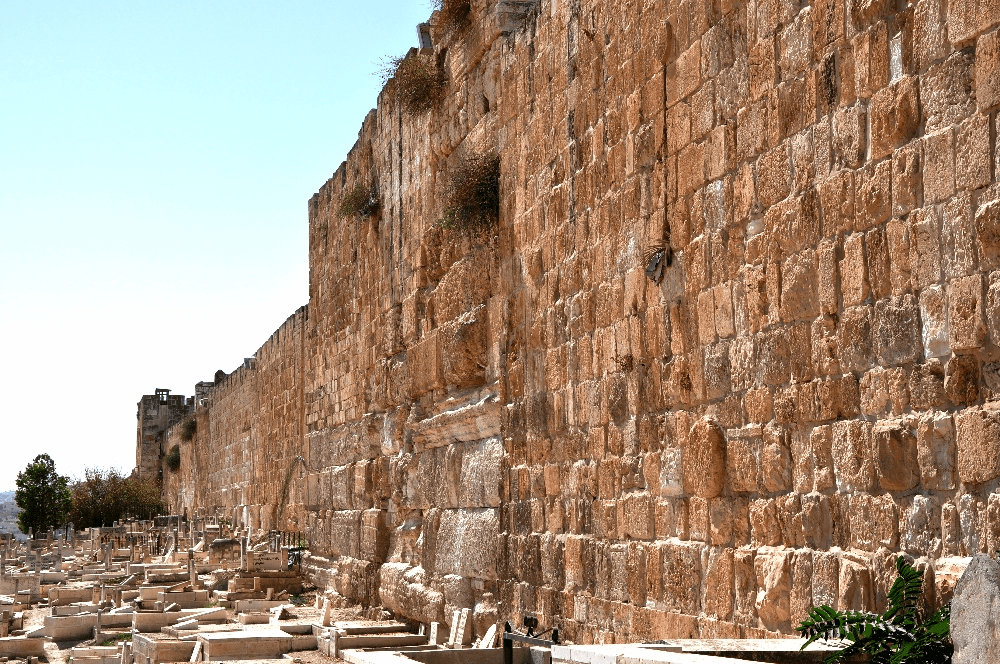
The Mackinac Bridge, joining the upper and lower peninsulas of Michigan

Now faith is confidence in what we hope for and assurance about what we do not see. This is what the ancients were commended for.

By faith we understand that the universe was formed at God’s command, so that what is seen was not made out of what was visible.

By faith Abel brought God a better offering than Cain did. By faith he was commended as righteous when God spoke well of his offerings. And by faith Abel still speaks, even though he is dead.

By faith Enoch was taken from this life, so that he did not experience death: “He could not be found, because God had taken him away.” For before he was taken, he was commended as one who pleased God. And without faith it is impossible to please God because anyone who comes to him must believe that he exists and that he rewards those who earnestly seek him.

By faith Noah, when warned about things not yet seen, in holy fear built an ark to save his family. By his faith he condemned the world and became heir of the righteousness that is in keeping with faith. (New International Version)

“Faith does not eliminate questions. But faith knows where to take them.” Elisabeth Elliot

Faith is dynamic, not static. Faith is both knowledge and mystery. Faith encompasses past, present, and future.

The Mackinac Bridge is the longest suspension bridge in the Western hemisphere at 26,372 feet long. At its highest, the roadway is 200 feet above the strait that separates the upper and lower peninsulas of Michigan in the United States. 

All suspension bridges are designed to move to accommodate wind, change in temperature, and weight. It is possible that the deck at center span could move as much as 35 feet either east or west, due to severe wind conditions.

It’s one thing to know facts about the bridge, and it’s another thing to actually drive on it and cross the strait. 

Some people don’t try it. I’ve driven the Mackinac Bridge many times, and it’s a hoot! In order to cross the bridge, we need to know it will hold us up above the water. And then, we actually need to drive on it.

True biblical faith is neither an existential leap into darkness, nor a simple recognition of certain facts. 

Rather, Christian faith is a reliance upon and commitment to Jesus that results in taking a risk. 

Faith is knowledge that God exists. Faith is stepping out and acting. Faith requires both knowledge and action. 

One can read all the facts about the Mackinac Bridge, but it isn’t the same thing as crossing it. Conversely, one can cross the bridge, even daily, and have no real appreciation for its true magnificence and structural wonder.

The New Testament of the Bible wants us to know Jesus, both intellectually and experientially. Only through those two elements of faith will anyone have a sustainable faith which perseveres throughout life. 

A lack of high-level commitment from professing Christians points to the reality that many believers are missing a crucial part of faith. There are those who rush into situations half-cocked without a solid base of understanding. And then, there are others who talk an issue to death and never act. 

A full-orbed biblical faith seeks knowledge and understanding so that it may respond in loving action.

Faith is important. It’s part of us. We are all people of faith – maybe not sharing the same faith – but it is faith, none-the-less.

“Never be afraid to trust an unknown future to a known God.” Corrie ten Boom

Belief transcends time. Faith is rooted in the past, experienced in the present, and future-oriented. In Christianity, faith is historically moored to the redemptive events of Christ’s incarnation, life, death, resurrection, and ascension. This historic faith has continuing ramifications into the present time. And it is a faith which believes Christ is coming again to judge the living and the dead.

All of this means our salvation encompasses past, present, and future. So, it is appropriate and accurate to say the Christian has been saved, is being saved, and will be saved.

Deliverance from sin, death, and hell was achieved on the cross. We are presently in the process of being delivered from our sinful nature and the effects of a fallen world. And we will be completely delivered at the end of the age from disease, disaster, and death.

The New Testament brings out all these dimensions of time. Whereas the Apostle Paul tended to continually look back to the past of God’s action in history, the author of Hebrews consistently looks ahead and brings out the future orientation of our faith.

And that is what the great Hall of Faith in chapter eleven of Hebrews is about – giving repeated examples of individuals who transcended their present hard circumstances through realizing what will be eventually coming. All of them acted particular ways in the present time because of what they believed would happen in the future.

People of faith allow their belief in what is coming to shape how they live now in daily life.

Abel took the absolute best of his flock and made it an offering, with the intent of giving God an appropriate gift. Whereas his brother Cain cobbled together some of the leftovers from his vegetable harvest and gave them a nonchalant toss to God. Then, he got upset when God looked with disfavor on it.

Abel’s actions demonstrated the attitude of his heart. His knowledge and action worked together. The gift he gave to God cost him his life, as Cain was inflamed with anger and killed his brother. Only by looking ahead and seeing that God’s reward is better than anything this world can offer, can we endure hardship.

Enoch focused on pleasing God through his three-hundred year life, knowing he would then enjoy an eternity with the Lord who provides good rewards. Enoch displayed his faith through obedience to God. He believed God existed and that God is good, and then proceeded to live a life of goodness.

Noah, despite the jeering of his neighbors, took one-hundred years of his life to build a big ark, believing without a doubt that God’s judgment was coming. The daily grind of constructing an ark for such a long time was made possible because Noah was looking ahead. His present actions were shaped by his forward thinking faith.

In each individual’s life, their daily actions were a result of their unshakable belief in what was to come.

Faith enables us to persevere patiently through any kind of adversity.

Knowing we have a better reward ahead; realizing our present trouble will not last forever; and believing Christ will eventually make all things right in this world – forms the foundation of our faith. Such a faith buoys us so that we do not drown in a sea of injustice, microaggressions, unhealthy power dynamics, as well as plain old meanness and insensitivity from others.

So, when we face those times which tempt us to get lost or stuck in an ever-enclosing existential angst, take a pause, check the facts, and then confidently cross the bridge.

Live by faith. You’ll be glad you did.

Christ be with me, Christ within me,

Christ behind me, Christ before me,

Christ beside me, Christ to win me,

Christ to comfort and restore me.

Christ beneath me, Christ above me,

Christ in quiet, Christ in danger,

Christ in hearts of all that love me,

Christ in mouth of friend and stranger.

Amen. – A Prayer of St. Patrick

Isaiah 9:18-10:4 – The Reality in Front of Us

Surely wickedness burns like a fire;
    it consumes briers and thorns,
it sets the forest thickets ablaze,
    so that it rolls upward in a column of smoke.
By the wrath of the Lord Almighty
    the land will be scorched
and the people will be fuel for the fire;
    they will not spare one another.
On the right they will devour,
    but still be hungry;
on the left they will eat,
    but not be satisfied.
Each will feed on the flesh of their own offspring:
    Manasseh will feed on Ephraim, and Ephraim on Manasseh;
    together they will turn against Judah.

Yet for all this, his anger is not turned away,
    his hand is still upraised.

Woe to those who make unjust laws,
    to those who issue oppressive decrees,
to deprive the poor of their rights
    and withhold justice from the oppressed of my people,
making widows their prey
    and robbing the fatherless.
What will you do on the day of reckoning,
    when disaster comes from afar?
To whom will you run for help?
    Where will you leave your riches?
Nothing will remain but to cringe among the captives
    or fall among the slain.

Yet for all this, his anger is not turned away,
    his hand is still upraised. (New International Version)

There are times when God has some very hard things to say.

The Lord does get angry. And that’s a good thing.

The Love/Anger Reality of God

God’s anger and wrath are a form of God’s love. A heartless unloving god is fickle and unconcerned for much of the evil which happens in the world. Conversely, a loving God is not okay with wicked persons having their way. A loving God’s anger is kindled against injustice. A loving God doesn’t long put up with people oppressing other people, and taking advantage of them.

So, this is what the Old Testament prophets are all about – communicating and calling people to change their ways because they are harming others. And when the harming and the hurting is done purposefully and callously, then the ire of a holy God is raised. The Lord will not contend with this sort of attitude and action.

The language of judgment, in today’s Old Testament prophetic lesson, is an invitation for us to take a very hard look at the reality which was responsible for such an angry response from God.

The Social/Economic Reality of Both the Prophet’s World and Today’s World

God expects justice, to have people helping one another thrive and flourish in this life, to be concerned for the common good of all persons, not just some. In Isaiah’s day, all that God saw was greed and selfishness, injustice and corruption. And God was not okay with it. The unjust systems and practices were a failure of the people to live up to the Lord’s expectations for righteous living.

Sadly, issues of justice and righteousness are still relevant in our world today. Throughout the earth, this very day, the powerless are being exploited; the rich get wealthier at the cost of the poor; greed, corruption, outsourcing, and unjust legal systems are the norm and not the exception.

Much of the world gloomily faces racism, poverty, gender injustice, violence, famine, health disparities and inequities. And so called “religious” folk are at the forefront of ensuring that these evils continue to persist. So, why would not a holy God become infuriated at such a situation!?

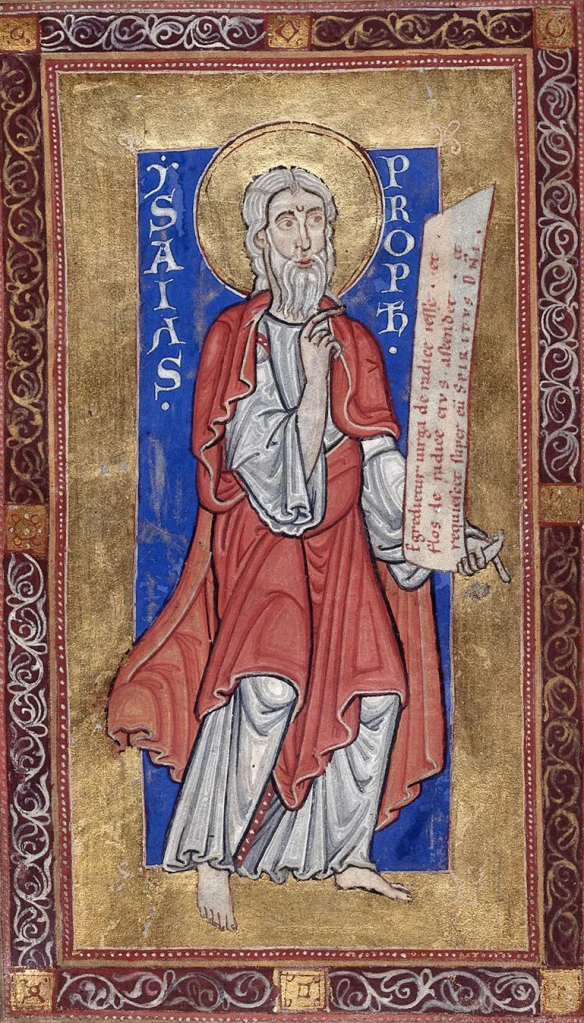
A 12th century German depiction of Isaiah the prophet

The Religious Reality of Isaiah’s Day and Our Day

The religious reality of Isaiah’s day is not so far off from our own today. People were, and are, engaging in forms of spiritual and/or religious activity while being completely devoid of justice. Folks attend religious gatherings and believe in God – and treat others unjustly. They talk of faith in the Lord, while trusting in wealth and assets.

It was, and is, a world where people bow before their own works and ingenuity, focusing their attention on money and power. It’s a world with no room for the God of the Bible and true divine justice.

Far too many “believers” espouse unethical leaders and turn a blind eye to morally bankrupt leadership. Far too many religious folk want what they want, with no regard for the needs of others.

The Divine Reality of God’s Pathos

We as people need to contend with a God who is a profoundly emotional Being.

God is moved and affected by what happens in the world. The Lord’s anger and judgment is aroused because of God’s love and compassion.

God both binds up the injuries of people, as well as inflicts wounds. This ought not be surprising. After all, we readily understand, through our extensive healthcare systems, that medical interventions and surgeries are needed, and that they hurt.

A God of justice is, of course, angered by ethical violations. The Lord is rightly upset that the world often falls so woefully short of instituting a just social, economic, and political order for all citizens to enjoy.

Everyone must deal with the God who is not a brain-on-a-stick but has a deep heart for people everywhere to experience truth, justice, righteousness, salvation, and love.

Conclusion

Yes, there is a coming reality in which a new world will emerge. For the Christian, this occurs when Christ returns to judge the living and the dead. Complete deliverance from sin, death, and hell shall be realized.

But we aren’t there yet. We still need to cope with the world as it is today, and deal with it’s failures, shortcomings, and sins.

There is currently a massive need to be attentive to the needy, to proclaim the gospel to all nations, and to be involved in reforming unjust systems in our cities, communities, and countries. Salvation is meant for the whole person, not just the spiritual part.

Therefore, we have a choice as to how we will approach the world.

Will we withdraw from it? Will we engage it, only to take advantage of others within it? Or will we participate with God in transforming it?

  • Will we hear the cries of the oppressed?
  • Will we live out God’s commitment to the poor, the weak, and the sick?
  • Will we work for economic and social equity?
  • Will we break the bonds of injustice?
  • Will we help people to reach their full potential?
  • Will we preach good news?
  • Will we suffer with those who suffer and show solidarity with the weak?
  • Will we be truly spiritual folk who invest in the concerns of humanity?
  • Will we take up our cross and follow the Lord in being suffering servants for a lost world in need of God and God’s justice?

The reality in front of us is one which demands confrontation, participation, and reformation. Will you do it?

Blessed and holy God and Father of all, it is your will that all people be gathered together as one family in yourself. Fill the hearts of humanity with the fire of your love and with the desire to ensure justice for all. By sharing the good gifts that you give us, may we secure an equality for all our brothers and sisters throughout the world. May there be an end to division, strife and war. May there be a dawning of a just society built on love and peace. We ask this in the name of Jesus, our Lord. Amen.

John 6:41-51 – The Bread of Life

“I Am the Bread of Life” by Lebanese painter Joseph Matar

The Jews there began to grumble about him because he said, “I am the bread that came down from heaven.” They said, “Is this not Jesus, the son of Joseph, whose father and mother we know? How can he now say, ‘I came down from heaven’?”

“Stop grumbling among yourselves,” Jesus answered. “No one can come to me unless the Father who sent me draws them, and I will raise them up at the last day.It is written in the Prophets: ‘They will all be taught by God.’ Everyone who has heard the Father and learned from him comes to me. No one has seen the Father except the one who is from God; only he has seen the Father. Very truly I tell you, the one who believes has eternal life.

I am the bread of life. Your ancestors ate the manna in the wilderness, yet they died. But here is the bread that comes down from heaven, which anyone may eat and not die. I am the living bread that came down from heaven. Whoever eats this bread will live forever. This bread is my flesh, which I will give for the life of the world.” (New International Version)

Christians everywhere hold to Jesus as the Son of God, Lord of the universe, and Savior of all.

However, for most people who were following Jesus around in the first century, this was not their understanding of Christ. In his earthly ministry, Jesus spoke in ways that introduced people to who he really was and sought to bring them to a point of following him based on his identity. 

Jesus wanted the crowds to see him for who he really is – themselves for what they really needed – and follow him based on the deepest needs of their lives.

I believe Jesus is the hope of all nations and all people, and in him humanity’s most basic and profound needs are met for forgiveness, love, and purpose in life. To address this, I ask three basic philosophical and theological questions of life:

What should human beings seek in life?

The responses in history are legion. The ancient Greek philosopher Aristotle thought a proper appreciation for an ethical and virtuous life found in practical wisdom was where people’s most concerted efforts should be. 

Karl Marx, the father of communism and socialism believed the proletariat should use their heads and their hands to rise above their economic conditions and oppression.

In the late 1960’s, Bobby Kennedy said we ought to be working the hardest to achieve justice and not advance ourselves on the misfortunes of others.

In more recent times, the Harvard Business Review is continually on the lookout for the best ways of being efficient, productive, and making the most of time because work itself is paramount.

Jesus insisted that people are not to work for food that spoils, but for food that endures to eternal life. Christ positioned himself as the bread of life – the one who is able to sustain humanity and enable to thrive and flourish in life.

By literally feeding thousands of people, Jesus wanted the people to understand the source of life itself comes from him. Jesus aspired beyond providing a supper for folks – he desired the people to feast on himself – to ingest him, to take him into their lives in a deep and profound way as the fulfillment of all the hope and promises of the Old Testament. 

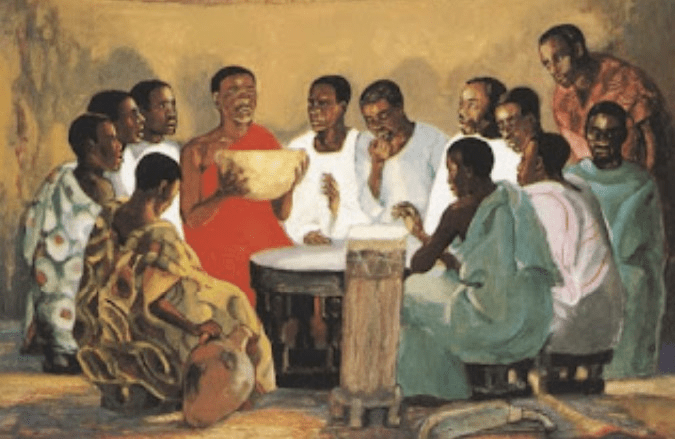
“The Lord’s Supper” by Cameroon artist Jesus Mafa, 1973

Jesus is the bread, the basic staple of life, that meets the cravings and needs of all people everywhere. Starving people, in both body and soul, find in Jesus a meal which keeps on giving, a feast of grace that is both delectable and unending.

The answer to my own question is that, for me, one’s highest pursuit and greatest quest is Jesus. Apart from Christ, I will starve. Furthermore, Jesus is not some cheap fast food off a value menu; he is real soul food to be ingested and enjoyed with others.

I believe people need Jesus. A passionate seeking of Jesus, to follow him, live for him, center life around him, is my most ardent desire. I do not simply desire Jesus for what he can do for me; I vigorously chase after him because if I do not have Jesus, I will die, I will starve to death. 

For me, Jesus is so much more than a nice addition to my life, like a new puppy; Jesus is Lord and Savior. I must consume him, or I will be completely undone, and I will not survive! Jesus is my bread, my food, my life!  I cannot survive on a daily crumb, but I feast on every word that comes from the mouth of Jesus because in Christ there is the life that is truly life.

What should human beings do in life?

Believe. To have and keep faith in the One God has sent, Jesus, is the primary “work” that pleases God.

Jesus communicated to the crowd that they can do so much more than follow him for another earthly meal – they can place their faith and hope in him for food that will last, food that will transcend the three-dimensional world.

Faith is more than an intellectual recognition to some facts about Christianity.

Belief is not about always having clarity and certainty to every facet and loci of Christian doctrine. Rather, Christian faith is a complete trust in Jesus as our hope and our life.

Education, economic uplift, political stability, and institutional peace and justice are important activities for this world. For the Christian, the accomplishment of these and so much more comes from the grace of God in Christ. As people come to the end of themselves with their homebrewed and half-baked attempts at being satisfied, Jesus stands at the door and knocks, the Living Bread who offers himself for humanity’s deepest needs.

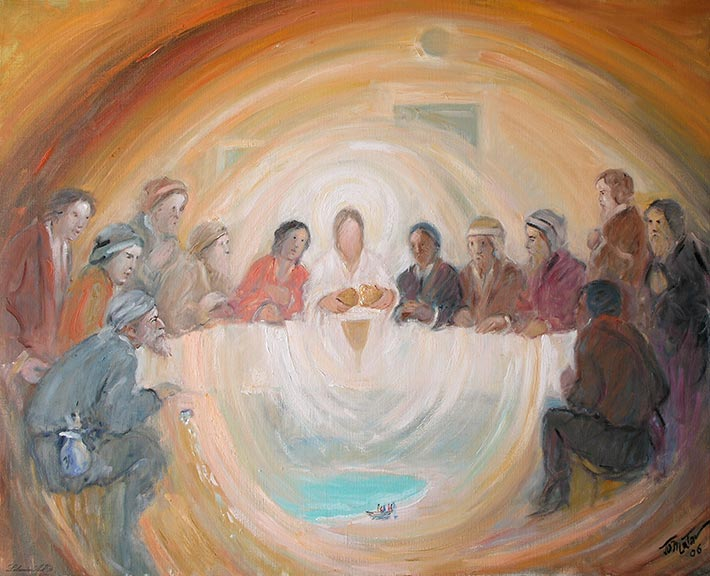
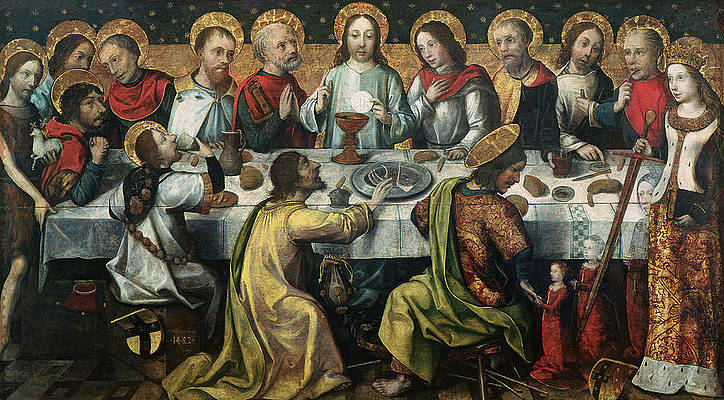
“The Last Supper” by Godefroy, 1482, C.E.

Giving kudos to Jesus might be nice, yet Christ himself cares about folks placing their trust in him for grace, forgiveness, and hope in their world. Jesus longs to reconnect people with God through giving himself as the means of making that happen.

All the works we do in this life, every good deed we accomplish, and each positive action we do are all helpful and necessary… and they all pale in comparison to the greatest work of all, to believe in Jesus Christ as the hope of this world, the hope of your family, the hope of the church, and the hope of your life. It’s all accessed by faith in the Son of God who loved me and gave himself for me.

Church buildings and furniture, stained-glass windows, pews, and even the Bible are not Jesus – they are simply and hopefully signs which point to him. They are all designed to lead us to Christ so that we may come to him. And coming to Christ is what the Lord’s Supper, Holy Communion, the Eucharist, and any other description you want to give about ingesting Jesus is about. The elements of bread and cup bring us to Christ so that we can experience Jesus and be joined to him by faith in a mystical union of human and divine in the unseen heaven.

Conclusion

Where will you find true satisfaction and hope? Probably not in the clearance aisle at Wal-Mart. Likely not in conforming to cultural Christianity or embracing generic forms of Jesus as merely a good teacher and moral example.

Furthermore, life’s ultimate satisfaction and hope are not to be found in a spotless house and perfect kids; in working more hours and making more money. Nor will we find contentment and peace in the radical independence of doing things my way.

Jesus is the Bread of Life. Through ingesting him, passionately pursuing him, believing in him, and coming to him in everything, we find the life that is truly life. Do not settle for any substitutes to Jesus. Come to the real person.

Lord God, you said that when we seek you with all our hearts, you will be found.  As the deer pants for streams of water, so we, your people, long for you in a dry and weary land.  We hunger and thirst for your righteousness.  We deeply desire your presence in all things. So, we die to ourselves and surrender to your will and way for us, by faith trusting you will come into our lives and completely take over. May your blessing rest upon us as we seek Jesus. Amen.

James 2:14-26 – Faith Is Active

My brothers and sisters, what good is it if people say they have faith but do nothing to show it? Claiming to have faith can’t save anyone, can it? Imagine a brother or sister who is naked and never has enough food to eat. What if one of you said, “Go in peace! Stay warm! Have a nice meal!”? What good is it if you don’t actually give them what their body needs? In the same way, faith is dead when it doesn’t result in faithful activity.

Someone might claim, “You have faith and I have action.” But how can I see your faith apart from your actions? Instead, I’ll show you my faith by putting it into practice in faithful action.It’s good that you believe that God is one. Ha! Even the demons believe this, and they tremble with fear. Are you so slow? Do you need to be shown that faith without actions has no value at all? 

What about Abraham, our father? Wasn’t he shown to be righteous through his actions when he offered his son Isaac on the altar? See, his faith was at work along with his actions. In fact, his faith was made complete by his faithful actions. So, the scripture was fulfilled that says, Abraham believed God, and God regarded him as righteous. What is more, Abraham was called God’s friend. So, you see that a person is shown to be righteous through faithful actions and not through faith alone.

In the same way, wasn’t Rahab the prostitute shown to be righteous when she received the messengers as her guests and then sent them on by another road? As the lifeless body is dead, so faith without actions is dead. (Common English Bible)

There is a difference between intent and impact.

A person may have a sincere and heartfelt intention of wanting to see another have their needs met. Yet, if it is only that, there is no impact on actual offerings of resources, friendship, or help.

Genuine authentic faith is more than mere sentiment and head knowledge. Faith without works does not work. Conversely, a strong robust faith is active and is able to withstand adversity.

The rhetorical questions the Apostle James asked were meant to awake his readers to the reality that true faith is always active – and that inactive faith is not really faith at all.

In his letters to the churches, the Apostle Paul typically talked about the relationship between faith and works before a person converts to Christ, whereas the Apostle James emphasized the role of works after a profession of faith in Christ.

St. James was getting at the heart of how a believer in Jesus ought to live. And he did this by giving an illustration of the relationship between faith and works: If someone is in need and a person expresses a sentimental feeling, even if that feeling is sincere, without backing it up with action – the expression is merely an expression, nothing more. 

If a person asks you for something, give it to him. Don’t refuse to give to someone who wants to borrow from you.

Jesus (Matthew 5:42, NCV)

I once came home after a long day at work on a Valentine’s Day several years ago. I had picked up some flowers at a drive through flower shop. I walked into the door and handed my wife the flowers with an “I love you.”  Then, I sat down in a heap and turned on the television. My dear wife’s response was not so favorable to my sentimental overtures. I did not really put any thought or action behind Valentine’s Day, and she knew it. My words of “I love you” just did not sync with my actions. 

I learned from my experience. I redeemed myself the next year by winning a contest on a local radio station for a spouse’s best love note, and it got read on the air several times throughout the day for my lovely wife to hear. My commitment and actions nicely aligned so that when I said “I love you” at the end of that workday, there was no doubt about it.

Faith requires that actions sync with words. For example, when we say “I will pray for you” it needs to be more than an expression of concern – we need to spend the time and commitment it takes in praying for them.

Upholding justice with words (which is very important) but without translating that language into concrete action which truly helps others, ends up speaking into the wind.

Faith involves emotions yet ought not be limited by them. Faith can neither exist nor survive without deeds. Christian works are not an added extra to faith any more than breathing is an added extra to the body. Both faith and action is needed for the Christian life.

True faith is shown as the genuine article by how it acts in real life situations. Faith is more than a checklist of right beliefs to sign-off on, as if it were some fire insurance policy against hell.

“In God’s eyes our words have only the value of our actions.”

St. Ignatius of Loyola

Frankly, as a Pastor, I have heard some pretty lame justifications over the decades for failing to help others, giving to the poor, involving oneself in justice work, and just plain serving in the church, like, “I’m not wired that way,” “That’s not my gift,” “That’s what we pay you to do,” and the ever-prolific, “This church is not meeting my needs.”

Those in the habit of complaining, without an intent to boots-on-the-ground helping, do not yet have an active faith. Each person is to do their part in serving the common good of all. And we all suffer when that does not happen. Bifurcating faith and action leave us with a bogus faith. 

If faith without action is okay, then so is the entire demonic realm. The glimpses of Satan we get in the Bible lead me to think that the devil has the entire thing memorized and knows it quite well. Yet, knowledge puffs up, whereas love builds up. Information by itself is useless unless it is accompanied by gracious and loving action. (1 Corinthians 8:1)

Salvation is a term Christians are familiar with. In the Christian tradition, it refers to being saved from sin, death, and hell. Sanctification is another term most Christians recognize. It means “to become holy,” or, “to be set apart” for God. Sanctification is not an event but a process.

Whereas saving faith is a gift given without works, sanctifying faith requires a great deal of effort. A lot of energy is expended to live the Christian life. The late Dallas Willard used to often say, “Grace is not opposed to effort, it is opposed to earning. Earning is an attitude. Effort is an action.” 

The Apostle James dealt primarily with the sanctifying faith every Christian needs to exhibit. It’s as if we have been graciously granted a full-ride scholarship to a university (salvation) but now the real work begins (sanctification) to learn, grow, and obtain the degree.

Furthermore, just as a student will surely become discouraged at some point throughout their education and wonder if they ought to drop out, so the Christian will face tremendous adversity and challenge. Indeed, a lot of blood-sweat-and-tears goes into our spiritual studies so that our faith will be strengthened for a lifetime of active loving service.

“Each activity of daily life in which we stretch ourselves on behalf of others is a prayer in action.”

Richard Foster

For example, the Old Testament character Abraham was saved from an empty way of life in a pagan country and given a gift of grace to move to the country God would show him. Abraham did nothing to earn this favor.  God just chose him (Joshua 24:2-3).

Abraham sojourned as a pilgrim throughout the land God gave him, which mirrored his spiritual sojourning and learning to be a follower of God. Abraham faced a monumental test of faith when asked to sacrifice his son Isaac (Genesis 22:1-19).

Abraham’s faith was made complete by what he did. Testing of faith is necessary so that we become mature and complete, not lacking anything (James 1:3-4). The way for authentic faith to develop and grow is in the fiery trial of adversity and hardship. Spiritual maturation, holiness, and a well-rounded faith comes through suffering.

To press the significance of faith and works, the example of the Old Testament character Rahab is highlighted. Rahab was a prostitute who lived in the red-light district of Jericho. St. James was doing something profound and important – he took two extreme examples, one a giant of the faith, and the other an almost overlooked example of faith, to demonstrate we all are candidates for real faith.

Rahab’s faith and actions worked harmoniously. She genuinely believed the city of Jericho was going to be overcome by God’s judgment, and, so, she housed the visiting Israelite spies (Joshua 2:1-11).

Methinks we must expand our understanding of faith to include persons others might exclude. Some may be quick to judge those with dubious lives and backgrounds, as well as the poor and needy. We cannot sanitize Rahab as something other than what she was – and because of her faith she ended up being an ancestor of Jesus himself (Matthew 1:5).

From the standpoint of faith, Abraham and Rahab are on the same level. In Christ’s new egalitarian society, all are welcome, all have equality in God’s kingdom.

Holy and active God, I submit to the adversity you bring as my teacher, and I choose to find solace in your Word and Spirit. With the grace, enablement, and resources you give me, I freely give to others in need, through Jesus Christ my Lord. Amen.