Water Is Life (Ezekiel 47:1-12)

Now he brought me back to the entrance to the Temple. I saw water pouring out from under the Temple porch to the east (the Temple faced east). The water poured from the south side of the Temple, south of the altar. He then took me out through the north gate and led me around the outside to the gate complex on the east. The water was gushing from under the south front of the Temple.

He walked to the east with a measuring tape and measured off fifteen hundred feet, leading me through water that was ankle-deep. He measured off another fifteen hundred feet, leading me through water that was knee-deep. He measured off another fifteen hundred feet, leading me through water waist deep. He measured off another fifteen hundred feet. By now it was a river over my head, water to swim in, water no one could possibly walk through.

He said, “Son of man, have you had a good look?”

Then he took me back to the riverbank. While sitting on the bank, I noticed a lot of trees on both sides of the river.

He told me, “This water flows east, descends to the Arabah and then into the sea, the sea of stagnant waters. When it empties into those waters, the sea will become fresh. Wherever the river flows, life will flourish—great schools of fish—because the river is turning the salt sea into fresh water. Where the river flows, life abounds. Fishermen will stand shoulder to shoulder along the shore from En Gedi all the way north to En-eglaim, casting their nets. The sea will teem with fish of all kinds, like the fish of the Great Mediterranean.

“The swamps and marshes won’t become fresh. They’ll stay salty.

“But the river itself, on both banks, will grow fruit trees of all kinds. Their leaves won’t wither, the fruit won’t fail. Every month they’ll bear fresh fruit because the river from the Sanctuary flows to them. Their fruit will be for food and their leaves for healing.” (The Message)

Jesus said, “Let the one who believes in me drink. As the Scripture has said, ‘Out of the believer’s heart shall flow rivers of living water.’”

John 7:38, NRSV

The coming of the Lord is what Advent is all about. It means that God is about to show up. And when God shows up, there are rivers of blessing and an abundance of salvation.

We need water

Just as we need water to survive, so we also need the living water which grants us eternal life.

Every living cell of our body contains water. 65% of your body is water. Up to 90% of plant tissue is water. Water defines our environment and shapes our landscape. We need at least two liters of fresh water to drink every day to stay healthy.

Just as each person on earth ought to have clean, safe, fresh water each day, but don’t, so every person also should have the living water of salvation and blessing flowing from God, yet they don’t.

Water constantly moves around the planet – on, above and below the earth’s surface. The cycle from rainfall to evaporation to rainfall is powered by energy from the sun. Water falls as rain, snow, and sleet. It collects in ice, rivers, groundwater, and the oceans. The water cycle naturally cleans the water.

Just as the natural processes of the water cycle give life and health to the planet, so the unseen spiritual processes working above, below, and on the earth exist to provide the life that is truly life.

Water in the Bible

Water is mentioned 722 times in the Bible. Water flows throughout Holy Scripture, reminding us of its importance, both spiritually and physically. Water is such an essential component of life that God created it on the very first day (Genesis 1:2). And water shows up at the very end of the Bible:

The Spirit and the bride say, “Come!” And let the one who hears say, “Come!” Let the one who is thirsty come; and let the one who wishes, take the free gift of the water of life. (Revelation 22:17, NIV)

Naaman the Syrian was cured from his leprosy in the waters of Jordan River (2 Kings 5:1-14). Water is used as a sign and a seal to purify and provide deliverance, as in Christian baptism (Romans 6:3-4; 1 Peter 3:18-22). And the power of water can also be a destructive force (Genesis 6:17; Exodus 14:1-15:21).

Living Water

Jesus, the source of Living Water, extends an invitation to all who thirst.

“But those who drink the water I give will never be thirsty again. It becomes a fresh, bubbling spring within them, giving them eternal life.” (John 4:14, NLT)

Christ uses water for redemptive purposes, to bring comfort and help.

Jesus got up from the meal, took off his outer clothing, and wrapped a towel around his waist. After that, he poured water into a basin and began to wash his disciples’ feet, drying them with the towel that was wrapped around him. (John 13:4-5, NIV)

“O Christ, He is the fountain,

The deep, sweet well of love;

The streams on earth I’ve tasted

More deep I’ll drink above.

There to an ocean fullness

His mercy doth expand,

And glory, glory dwelleth

In Immanuel’s land.”

The Sands of Time Are Sinking by Sam Rutherford and Anne Cousin

From a Christian perspective, the water flowing from the temple finds its fulfillment in the person and work of Jesus Christ. He is the living water that gives eternal life. We would do well to ensure that all people have access to clean physical water, as well as access to purified spiritual water.

Lord Jesus, Son of God, Savior of humanity, there is a river flowing straight from your heart into mine — replenishing, renewing, sustaining. 

May you, as Living Water, be persistent in me, breaking through every barrier in its path.

Send this hydropower through the dark crevices of my heart like a mighty flood overcoming and pushing everything out of the way that blocks its path.

I want my heart to be washed clean of any debris cluttering and blocking your life-giving flow.

May your love overflow onto your people — your grace, your mercy — into the lives of those we encounter, to your glory and honor, in spirit, and in truth. Amen.

Future Hope (Isaiah 29:17-24)

Soon the forest of Lebanon
will become a field with crops,
    thick as a forest.
The deaf will be able to hear
    whatever is read to them;
the blind will be freed
    from a life of darkness.
The poor and the needy
    will celebrate and shout
because of the Lord,
    the holy God of Israel.

All who are cruel and arrogant
    will be gone forever.
Those who live by crime
    will disappear,
together with everyone
    who tells lies in court
and keeps innocent people
    from getting a fair trial.

The Lord who rescued Abraham
has this to say
    about Jacob’s descendants:
“They will no longer
    be ashamed and disgraced.
When they see how great
    I have made their nation,
they will praise and honor me,
    the holy God of Israel.
Everyone who is confused
    will understand,
and all who have complained
    will obey my teaching.” (Contemporary English Version)

We, who have the first fruits of the Spirit, groan inwardly as we wait eagerly for our adoption to sonship, the redemption of our bodies. For in this hope we were saved. But hope that is seen is no hope at all. Who hopes for what they already have? But if we hope for what we do not yet have, we wait for it patiently.

Romans 8:23-25, NIV

There are better days ahead. And it is this hope which is to help sustain us in present – because the current reality for many people is hard and unforgiving. Malevolent and heartless people exist, and they wreak physical, mental, emotional, and even spiritual havoc on those around them.

When in the throes of difficulty, it is good to be reminded that basic human kindness will once again be exalted and valued. Yet, meanwhile, we must endure the evil of dehumanizing behavior. Until then, we must do our best to connect heaven and earth by rehumanizing every space and place within our sphere on influence. We are to be agents of hope for ourselves and for others.

Every person (and I do mean every person) on planet earth is created in the image and likeness of God. Each individual human being is worthy of basic human kindness and deserving of respect. 

Unfortunately, people do and say terrible things every day. Yet this never means that God’s image has left or has taken a vacation, or that someone deserves a pejorative label which stigmatizes and ostracizes them from the human family. 

For the Christian, the supreme ethic of life is love. We hold to the Great Commandment: Love God and neighbor; all other commands of Holy Scripture hang on these two bedrock commands, upheld by Jesus himself.

Therefore we must all ask ourselves if we are living our lives and loving others in this world as intended by our Creator and Redeemer. Hate speech, unsafe working conditions, political gerrymandering, apathy toward another’s injustice, a lack of empathy, and vilifying particular people groups are just a few examples of dehumanizing behavior.

If ever we move down the path of claiming to know whom God judges or ought to judge, then we have gone the way of extreme hubris and are germinating the seeds of a future holocaust of killing, not a future hope of peace and goodness. 

There is no biblical precedent or place to dehumanize another person or group of people, period. Instead, we must actively build relationships with a broad spectrum of groups and individuals – especially with the ones we least know and understand.

The injustice of dehumanization will not always be with us. Confusion and complaints will give way to clarity, understanding, humility, and obedience. Darkness and deafness, poverty and petulance shall melt away. In its place, love and grace will forever be ensconced upon a new earth, free from crime and shame. Hope will be realized.

Our future hope is a living hope.

We typically use the term “hope” in the wishful thinking sort of way. That’s because we aren’t quite sure if things will shake-out like we want. Biblical hope is not wishful thinking but a confident expectation that knows what is coming. 

Hope is like anticipating the seasons. In the dead of winter when it’s bitter cold with little sunshine, we hopefor Spring. It’s not wishful thinking. We know it’s coming. It might come in early March, maybe in late April. But it’s coming, and you can bet the farm on it. The trees will bud, the grass will turn green, and the temps will warm.

Hope in the Bible is a sure thing. Because of the person and work of Jesus Christ, there is hope, the confident expectation that deliverance from sin, death, and hell will be fully realized.

Hope, inheritance, and salvation are all words that describe nearly the same thing. They all point to Jesus. We are saved from the slavery of sin through the cross and resurrection of Christ. We are delivered into an inheritance which can never perish, spoil, or fade. But an inheritance isn’t activated until death. Someday, when this present life of earthly brokenness is over, we have the hope, the confident expectation, of a permanent inheritance with Jesus forever. (1 Peter 1:3-9)

Outwardly, we suffer in all kinds of earthly grief from others who don’t understand us. Inwardly, we have the silent pain and terrible wrestling of wanting to forgive but desiring revenge; of seeking to be gracious but seething with anger; of looking to express kind words but having hate speech blurt out instead.

But it won’t always be this way. We have a future living hope. In this season of Advent, we are reminded that God shall break into this fallen world with all of its dehumanizing behaviors and hate speech. The hopes and fears of all the years are met in a humble feeding trough, in a little baby.

Hope is as real as anything you’ll ever know this side of heaven. You might not always find what you’re looking for in this life; but in the next life, you can find the life that is truly life. For Jesus Christ is our hope.

God of hope, we seek you. During this holy season of Advent, help us to see you in all whom we encounter. We seek you in the crude manger, a child born to save the world. May your hope be a comfort to all who long for justice; and may that hope overflow in our hearts and grace our lips so that we might reflect your hope for all the world. Amen.

A Living Hope (1 Peter 1:3-9)

Let us give thanks to the God and Father of our Lord Jesus Christ! Because of his great mercy he gave us new life by raising Jesus Christ from death. This fills us with a living hope, and so we look forward to possessing the rich blessings that God keeps for his people. He keeps them for you in heaven, where they cannot decay or spoil or fade away. They are for you, who through faith are kept safe by God’s power for the salvation which is ready to be revealed at the end of time.

Be glad about this, even though it may now be necessary for you to be sad for a while because of the many kinds of trials you suffer. Their purpose is to prove that your faith is genuine. Even gold, which can be destroyed, is tested by fire; and so your faith, which is much more precious than gold, must also be tested, so that it may endure. Then you will receive praise and glory and honor on the Day when Jesus Christ is revealed. 

You love him, although you have not seen him, and you believe in him, although you do not now see him. So you rejoice with a great and glorious joy which words cannot express, because you are receiving the salvation of your souls, which is the purpose of your faith in him. (Good News Translation)

There’s no need for hope if everything’s going just the way you like it. I remember when I was a college undergraduate, I hoped for Christ’s return toward the end of every semester. The prospect of all those final exams and the pressure of grades had me longing for heaven.

But that’s life. Maturity, resilience, perseverance, and just about every virtue you can think of comes as a result of life’s trials and sufferings. The Christian has hope, precisely because things aren’t the way they’re supposed to be.

Faith has to be tried and tested. And hard circumstances are the way of purifying it. Like gold being purged of any dross by being exposed to extreme heat, so our faith becomes strong, robust, and genuine by the purgative fires of life’s many large and small sufferings.

The whole point of it all is to make us people worthy of our spiritual calling. Resurrection only happens because there’s been a death. Glory is only realized through suffering.

New life, the Christian life, isn’t a matter of making a new set of resolutions, as if it were nothing more than aspirations at the beginning of a calendar year. Rather, Christian faith is a response to the mercy of God in Jesus Christ.

One of my all-time favorite stories is Victor Hugo’s Les Miserables. It’s a story of grace and new life, of a hopeless man given the chance at hope.

The main character is Jean Valjean, who spends nineteen years in jail for stealing a loaf of bread for his starving family. The experience in prison caused him to become a bitter and cynical man. After his release, Jean Valjean has nowhere to go. 

In desperation, he seeks lodging one night at the home of a Catholic bishop, who treats him with genuine kindness, which Valjean sees only as an opportunity to exploit. In the middle of the night, he steals the bishop’s silver and skedaddles. 

The next day, however, Valjean is caught by the police. When they bring him back to the bishop’s house for identification, the police are surprised when the bishop hands two silver candlesticks to Jean, implying that he had given the stolen silver to him, saying, “You forgot these.” 

After dismissing the police, the bishop turns to Jean Valjean and says, “I have bought your soul for God.” In that moment, by the bishop’s act of mercy, Valjean’s bitterness is broken. Hope springs to life.

Jean Valjean’s forgiveness is the beginning of a new life. The bulk of Victor Hugo’s novel demonstrates the utter power of a redeemed life. Jean chooses the way of mercy, as the bishop had done. Valjean raises an orphan, spares the life of a parole officer who spent fifteen years hunting him, and saves his future son-in-law from death, even though it nearly cost him his own life. 

“Jean Valjean, my brother, you no longer belong to what is evil but to what is good. I have bought your soul to save it from black thoughts and the spirit of perdition, and I give it to God.” ― Victor Hugo, Les Misérables

Throughout Jean Valjean’s new life, there are trials and temptations all along the way. Yet, mercy keeps his faith strong, and hope kindled. Whereas before, Valjean responded to mercy with a brooding melancholy and inner anger, now – after being shown grace – he responds to each case of unjust suffering with gratitude, deeply thankful for the chance to live a new life full of grace.

Hope is kept alive because of suffering. Faith is strengthened by means of adversity. And both originate because of mercy and grace.

Christianity is a worldview perspective that enables one to rejoice in difficulty. For the Christian, there is no empty meaningless grief; there is the hope that our suffering means something. Like the athlete who endures all the painful practice in order to realize a future hope, so the believer in Jesus goes into strict training for the development of faith – all in the confident expectation of a fulfilled salvation.

It’s a hard lesson to learn, this seemingly weird alchemy of faith, suffering, hope, joy, and new life. And every generation of Christians needs to experientially discover it. Each believer eventually learns, in the crucible of hard circumstances, that the promises of God are the ballast to persevere in faith and patience throughout life.

Christian hope is a confident expectation that the promises of God will be completely realized.

A Christian’s salvation encompasses past, present, and future.

We were saved back there in the past when Christ died on the cross for us. We were crucified with him.

We are presently being saved from the world, the sinful nature, and the devil, through the sanctifying work of the Spirit in making us holy.

And we will be saved in the future when Christ returns to judge the living and the dead. Then, our salvation will be fully realized. Since that hasn’t happened yet, we have hope to sustain us.

It was hope that sustained me in college. I endured all the hours of study, all the exams, all the various courses taken, with the confident expectation that I would someday walk across that stage, receive my diploma, and graduate with my intended degree.

We ourselves, who have the first fruits of the Spirit, groan inwardly as we wait eagerly for our adoption to sonship, the redemption of our bodies. For in this hope we were saved. But hope that is seen is no hope at all. Who hopes for what they already have? But if we hope for what we do not yet have, we wait for it patiently. (Romans 8:23-25, NIV)

The Christian’s hope for ultimate deliverance is imperishable, undefiled, and unfading. This means we can live through a difficult day or week or month or a year, or even decades, with spiritual endurance. Our goal shall come in all its fullness. 

Then I saw a new heaven and a new earth, for the first heaven and the first earth had passed away, and the sea was no more. And I saw the holy city, the new Jerusalem, coming down out of heaven from God, prepared as a bride adorned for her husband. And I heard a loud voice from the throne saying,

“See, the home of God is among mortals.
He will dwell with them;
they will be his peoples,
and God himself will be with them and be their God;
he will wipe every tear from their eyes.
Death will be no more;
mourning and crying and pain will be no more,
for the first things have passed away.” (Revelation 21:1-4, NRSV)

Eventually, suffering will have done its work and we will be with Christ forever. Until that day, let us explore all that God has for us, embracing both the meaning and the mystery of faith. 

Since our salvation is assured, let us live with confidence and run the race marked out for us.

Heavenly Father, you created us and lovingly care for us. We accept all our sufferings willingly, and as truly obedient children we submit ourselves to your holy will. Give us the strength to accept your loving visitation to us through adversity, and never let us grieve your heart by giving-in to impatience. We offer you our pains to be used for your honor and glory, through Jesus Christ our Lord, in the strength of the Holy Spirit. Amen.

Real Forgiveness (Hebrews 9:23-28)

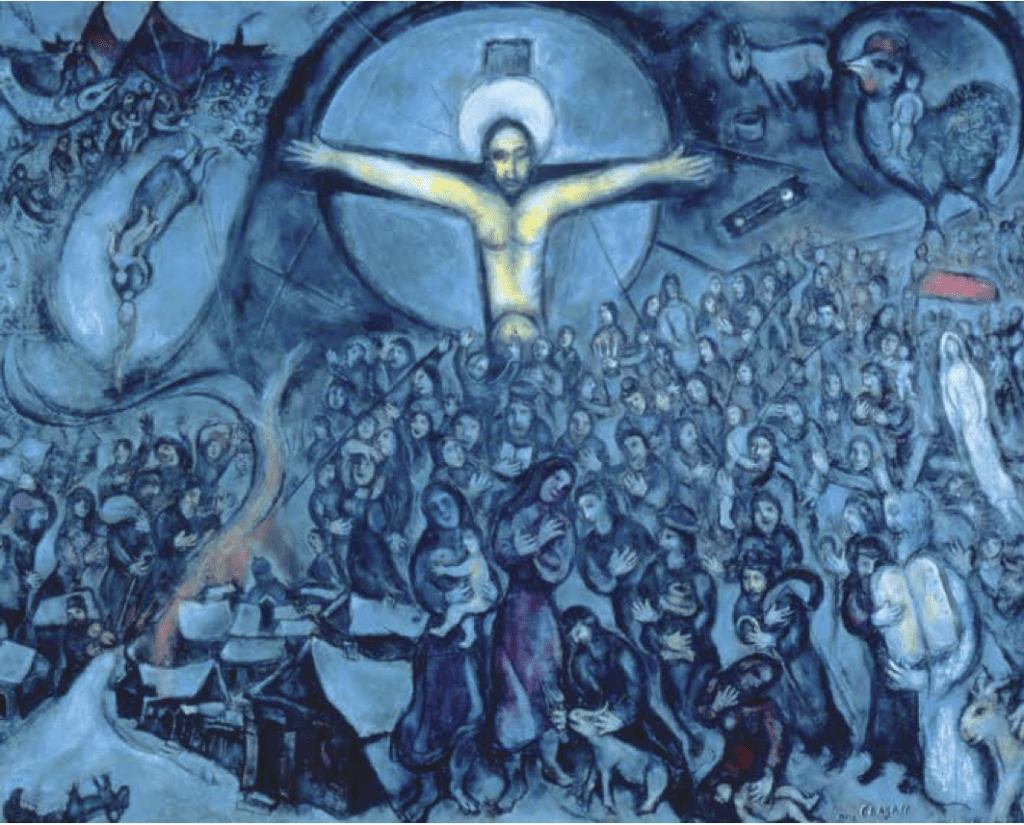
By Marc Chagall, 1941

It was necessary, then, for the copies of the heavenly things to be purified with these sacrifices, but the heavenly things themselves with better sacrifices than these. For Christ did not enter a sanctuary made with human hands that was only a copy of the true one; he entered heaven itself, now to appear for us in God’s presence. Nor did he enter heaven to offer himself again and again, the way the high priest enters the Most Holy Place every year with blood that is not his own. Otherwise Christ would have had to suffer many times since the creation of the world. 

But he has appeared once for all at the culmination of the ages to do away with sin by the sacrifice of himself. Just as people are destined to die once, and after that to face judgment, so Christ was sacrificed once to take away the sins of many; and he will appear a second time, not to bear sin, but to bring salvation to those who are waiting for him. (New International Version)

In truth, I could preach on the Cross every Sunday and never exhaust the immensely rich implications of Jesus Christ’s death for us. 

Perhaps, for many Christians, today’s New Testament lesson seems like a re-hashing of things we already know. Yet, it is important to keep plumbing the depths of Christ’s once-for-all sacrifice, because, through continual examination of Christ and the Cross:

  • We will know, both intellectually and experientially, that our forgiveness is real. 
  • We will be able, both spiritually and emotionally, to extend real forgiveness to others.

The original recipients of Hebrews were experiencing spiritual fatigue due to their difficult circumstances. The believers were so worn down from swimming upstream of their problems, that they considered throwing in the towel and giving up on Christianity (or at least the Church). 

The author of Hebrews truly believed that the way to combat this tiredness was through a robust understanding of Christ and the Cross. So, he sought to demonstrate that Jesus is superior to the old sacrificial system and has superseded it. 

There are three main distinctions between the old sacrificial system and the new way of Christ so that we will be encouraged to know that our forgiveness is real.

Reality vs. Simulation

The Old Testament sacrificial system, and its worship rituals in dealing with the sin issue, were only a copy and a shadow of the real sacrifice, which is Christ. The Temple sacrifices, in other words, were merely a facsimile of the real thing.

The difference between the old temple sacrifices and the sacrifice of Christ, is like the difference between riding a mechanical horse and an actual horse. Mechanical horses are merely a simulation of real riding.

Since Christ has come as the real sacrifice for sin, we need no longer be content with simulations and copies of the real deal. The Christian’s forgiveness is neither a simulation nor a copy because Christ is the real thing. 

By Marc Chagall, 1952

Jesus did not just mechanically mouth words of forgiveness to us; Christ secured real forgiveness through his death on a cross. This is no cheap imitation of forgiveness. Christ died an actual violent death.

The emphasis in Scripture on blood and sacrifice can be upsetting for many people. Yet, we need to understand that the brokenness of this world is so bad that it requires drastic action. Christ’s death reflects the horrible sin of humanity. Since Jesus has secured forgiveness for us at such a steep price, we are to receive it with great humility and joy, knowing that God loves us that much.

Permanent vs. Temporary

Jesus Christ dealt with the sin issue once and for all through his blood. He came to do away with sin, not just veneer over it. The old sacrificial system was like whitewashing a barn – it took care of the issue for a while, but it would need to be done over and over again.

We are familiar with temporary arrangements. For example, annual fees need to be paid and renewal stickers have to be put on a car’s license plate every year. Christ’s atonement, however, is no temporary arrangement. The forgiveness Jesus offers is permanent.

There is no need to keep offering sacrifices over and over because Christ is the sacrifice to end all sacrifices. The forgiveness we possess is not like paying an annual fee and getting a forgiveness sticker for the year. In Jesus Christ, we are forgiven! And this forgiveness was purchased with Christ’s own blood.

The cross that held Christ’s naked and marred body, exposed the violence and injustice of this world. The Cross revealed what kind of world we have and what kind of God we have: a world of gross unfairness, and a God of sacrificial love. Because Jesus was willing to do this on our behalf, we have a permanent forgiveness, settled once and for all, through his blood.

This old world needs real forgiveness that lasts forever – not a cheap sentimental forgiving that is merely a flash in the pan. 

Salvation vs. Judgment

A lot of religious energy can be spent trying to figure out how to make ourselves acceptable to God.

Part of the good news is that, in Christ, we do not need to fear the future. We have been made right with God through the death of Jesus. Through Christ’s sacrifice, the doors to heaven and earth get flung wide open. The way has been secured, the trail has been blazed, and the road has been made smooth to come to God.

Jesus, unlike any Levitical priest, has entered God’s presence, providing access to the living God. Christ did not need to offer sacrifice for his own sins but offered himself solely on our behalf. Jesus did more than offer the sacrifice; he himself became the sacrifice. It was a sacrifice to bring deliverance to humanity, not judgment.

Either to justify or to judge is God’s business, not ours. Our concern is to believe in the once-for-all sacrifice of Jesus that brings a permanent forgiveness; and, to share that life-giving message with others so that they, too, can experience deliverance from sin, death, and hell.

We can have such a hard time forgiving others because we struggle with experiencing our own forgiveness. The path to extending grace to others is in deepening our knowledge, understanding, and awareness of God’s grace in Christ.

Conclusion

The author of Hebrews meant for the Christian life to be an exciting and abundant adventure of following Jesus, the pioneer of our salvation.

And yet, many Christians do not know anything about this kind of life. They only see the Christian life as a duty and a chore, a kind of cross to bear. We must recognize that it is the Savior, Jesus Christ, the object of our faith, who has delivered us so that we can live a new life of freedom, enjoying our forgiveness and inviting others on the journey.

For he has rescued us from the kingdom of darkness and transferred us into the Kingdom of his dear Son, who purchased our freedom and forgave our sins.

Colossians 1:13-14, NLT

Jesus didn’t die on a cruel cross, then rise from death so that we could live ho-hum Christian lives.

Christ has granted us forgiveness so that we will enjoy the Christian life, appreciate the Word of God; relish in laboring together for the Gospel; and look forward with anticipation to how the Spirit will transform lives through Christ’s forgiveness. 

Real forgiveness opens our minds, hearts, and energies to live for Jesus, the pioneer of our salvation.

Lord Jesus Christ, you stretched out your arms of love on the hard wood of the cross that everyone might come within the reach of your saving embrace. Clothe us in your Spirit that we, reaching forth our hands in love, may bring those who do not know you to the knowledge and love of you; for the honor of your Name. Amen.