It’s Time To Wake Up – First Sunday of Advent (Romans 13:11-14)

Besides this, you know what time it is, how it is already the moment for you to wake from sleep. For salvation is nearer to us now than when we became believers; the night is far gone; the day is near. Let us then throw off the works of darkness and put on the armor of light; let us walk decently as in the day, not in reveling and drunkenness, not in illicit sex and licentiousness, not in quarreling and jealousy. Instead, put on the Lord Jesus Christ, and make no provision for the flesh, to gratify its desires. (New Revised Standard Version)

But make sure that you don’t get so absorbed and exhausted in taking care of all your day-by-day obligations that you lose track of the time and doze off, oblivious to God. The night is about over; dawn is about to break. Be up and awake to what God is doing! God is putting the finishing touches on the salvation work he began when we first believed. We can’t afford to waste a minute, must not squander these precious daylight hours in frivolity and indulgence, in sleeping around and dissipation, in bickering and grabbing everything in sight. Get out of bed and get dressed! Don’t loiter and linger, waiting until the very last minute. Dress yourselves in Christ, and be up and about! (The Message)

I like metaphors, that is, word-pictures that help illustrate and visualize a concept or idea. That’s probably why I like the Apostle Paul, because I find in him a guy who appears to have the same affinity for metaphors that I do.

In the New Testament reading on this First Sunday of Advent, Paul gives four metaphors to help us grab ahold of what he wants to get across to us:

We are not in some holding pattern, passively awaiting heaven. This is because our salvation is not yet complete. Completeness won’t happen until Jesus returns, until the second advent of Christ. Therefore, we are to be active now, working on our faith commitment to Jesus and to his church.

In this advent season, as we remember Christ’s first “advent” (or “coming”) to this earth, we are equally anticipating the second coming of Christ – not knowing quite when that will occur. Only until this event happens will our salvation come in all of its fullness.

The church is a unique community of persons who continually have an eye toward the future return of Jesus. And this future orientation is supposed to give shape to how we live in the present time.

The world-wide Christian community presently follows the way of deliverance. This current time and place is not the arrival point. Today doesn’t mark the time in which our salvation is fully realized or acquired.

In other words, we are to avoid acting as if this is our permanent home. Rather, we are pilgrims on this earth, sojourning through it as if we were but camping out. Our true home is someplace else. And we will get there when Christ comes again.

There is a stark contrast between those who put all their eggs into the present earthly basket, and those who maintain a future orientation of working now with an eye out for Jesus to return. This contrast is illustrated by Paul with images of what it’s like to live for and in the Roman society; and what it’s like to live with Jesus as Lord, instead of Ceasar.

Are you asleep or awake, living for the night or in the day?

Therefore, keep awake, for you do not know when the master of the house will come, in the evening or at midnight or at cockcrow or at dawn, or else he may find you asleep when he comes suddenly. (Mark 13:35-36)

Paul, taking his cues from Jesus, exhorted the believers to stay alert and be prepared for the end when it comes. Living for the nighttime is a metaphor for giving-in to one’s personal sinful desires; whereas living in the daylight hours is a picture of following the words and ways of Jesus.

What are you wearing? What are you taking off, and what are you putting on?

Using the metaphor of clothes – undressing and dressing oneself – Paul is talking about exchanging one set of clothing for another. This isn’t merely putting on a different pair of jeans than what you already have on. It’s much more radical than that. It’s doffing the tuxedo and donning the overalls. The picture is one of doing something completely different than what you’ve been doing before.

Paul wanted a complete makeover, a total change of moral and ethical behavior that is consistent with the gospel of Christ, and not with typical Roman society. It involves taking up one’s cross and following Jesus. It’s gritty and dirty and gets down to it; instead of avoiding hard work and seeking to have someone else do what is unpleasant to me.

Our allegiance and commitment to Christ is on full public display – not in placards with Bible verses on them, but with the sweet aroma of living a humble and just life in all of its simplicity and holiness.

Will you do the works of darkness, or take up the armor of light?

The darkness represents the unjust life of lies, selfishness, conflicts of interest, relational discord, and immoral actions. The light is meant to convey a beautiful life of integrity, wholeness, righteousness, and peace through loving actions.

Christians are to progressively take on the character of Christ, and not of whatever political character happens to be in power.

Using the metaphor of armor points us not only toward the struggle we confront in living a moral and righteous life, but also toward Christ who is our Divine Warrior. Jesus is the One who fights the battle and wins the victory.

Our struggle is not against flesh and blood, but “against the rulers, against the authorities, against the cosmic powers of this present darkness, against the spiritual forces of evil in the heavenly places.” (Ephesians 6:12)

Do you know what time it is? Is there any hopeful expectation?

The Christian is one who knows the time is nearer now than when they first believed. We may not know the precise date on the calendar when Jesus will come again, yet we are convinced that he is returning soon.

Therefore, the believer has no business spending time in trying to predict the day of the end. Instead, the believer must remain faithful and persevere to the end with a firm commitment to Christ, and a dedication to doing what is good, right, and just.

So, herein lies the challenge for every believer: Those of us who name Jesus as Lord will continue to live in a world of injustice and unrighteousness. Christians are continually being pulled in differing directions all at once, all the time.

It’s a hard slog. Yet the Christian finds joy and satisfaction in knowing who they are, who they believe in, and who is coming back to make all things new.

Christianity involves a whole lot more than praying a salvation prayer once, then going on one’s merry way, doing whatever the heck one wants to do.

Rather, Christianity is a radical existence of waking from sleep and changing allegiances from immoral leaders to the true sovereign of the universe.

It’s like moving from seeing shadowy forms just before the dawn to seeing clearly in the sun’s full light of day.

It’s as if I’ve been given a completely new set of clothes to put on, giving up the rags of this world for the raiment of being adopted into royalty.

We remain continually vigilant, always watching, always praying, always believing, always loving – knowing that our salvation is at hand, nearly here, and could happen at any moment.

God of justice and peace, from the heavens you rain down mercy and kindness, so that all on earth may stand in awe and wonder before your marvelous deeds. Raise our heads in expectation, that we may yearn for the coming day of the Lord and stand without blame before your Son, Jesus Christ, who lives and reigns forever and ever. Amen.

Love Never Fails

“When we ask whether someone is a good man, we are not asking what he believes, or hopes, but what he loves.” St. Augustine

I believe there are few things in life which have sustainability and permanence, things which make the world go ‘round. Love is one of them; maybe even the greatest of them.

Love Language

And yet, in the English language, we really only have one word for “love.” That strikes me as curious and interesting.

I enjoy language and languages, as well as the use and smithing of words. One observation I’ve made about language is that any particular society, culture, or nation has several words for whatever is important or valuable to them.

For example, Indonesia has seven different words for the one English word “rice.” Since rice is so vital to the life of the people, it makes sense that they have several words to bring out all of the various nuances of “rice.”

By contrast, the West simply places adjectives in front of “rice” when needed (i.e. white or brown or jasmine). So, what does it say about us, about me and my fellow Americans, when we have only one word for “love?”

We certainly have plenty of words for “money.” It does little good to even use the word “money” unless one is speaking in very general terms. Americans make liberal use of words like “stocks and bonds,” “cash,” “checking and savings accounts,” etc. We even have several words for institutions which handle money: banks, savings and loans, credit unions, and mutual organizations.

Indeed, what does it say about us that we have a plethora of words for money? What’s more, in contrast to our one word for “love,” what does this tell us about Western society in general?

No wonder that American society has a love problem. Even when we borrow words for love from other languages, we seem to transform it into something else.

The Greek word “phileo” is engrafted into many of our English words such as philosophy (love of wisdom); philanthropy (love of humanity); or Philadelphia (brotherly love).

Often the last thing on our minds about the city of Philadelphia is an association with love; philanthropy is widely understood as being generous with one’s money (there it is again!); and few people think of love when describing philosophy.

Please know that it’s not my purpose to rant about American culture. I just want us to think about how we tend to use the word, and the implications of that use.

Oftentimes, I find that my own understanding of the word tends to be in contrast with so many other uses of “love.”

St. Augustine and Love

I admit to being influenced most heavily by St. Augustine and Holy Scripture. Augustine was enamored with love. That’s likely because he knew what it felt like to be on the outside of God’s redeeming love in Christ. For Augustine, love explains everything. Love is to be our true nature, and the proper direction of everything we say and do in this world, insisted Augustine.

Augustine, of course, derived his understanding from Jesus – especially from the New Testament Gospels:

“Love the Lord your God with all your heart and with all your soul and with all your mind.’ This is the first and greatest commandment. And the second is like it: ‘Love your neighbor as yourself.”

Matthew 22:37-39, NIV

Unless there is love, we go nowhere – which is precisely what seems to be happening in our world today. Apart from love, there are no social problems which can be alleviated; no wars which will stop; and no rights and respect extended to particular people. Without love, peace and happiness are nothing but a pipe dream.

It is imperative that we have a robust understanding and practice of love. If we don’t, I believe that we are ruined, no matter how savvy or powerful we are.

Designed For Love

People are designed for love; it is our very purpose. And if we go against our basic inherent design, it will be like disrespecting gravity itself by walking off the roof of the house in the wrongheaded belief that I won’t get hurt.

Fullness of life (and fullness of any religious practice) comes only through love. In Christianity, it is clearly understood that God is Love with a capital “L.” Thus, we were created in love, stamped with the image of God’s love, and expected to love one another.

Love is so ubiquitous throughout the Bible that listening to a biblical sermon on love every day for the rest of your life would not exhaust love’s height, depth, breadth, and width within Scripture.

It is an understatement to say that love is the goal of religion, the purpose for being, and the best expression of human community.

For in Christ Jesus neither circumcision nor uncircumcision has any value. The only thing that counts is faith expressing itself through love. (Galatians 5:6, NIV)

For the entire law is fulfilled in keeping this one command: “Love your neighbor as yourself.” (Galatians 5:14, NIV)

Love does no harm to a neighbor. Therefore love is the fulfillment of the law. (Romans 13:10)

Love never fails. (1 Corinthians 13:8, NIV)

And this is my prayer: that your love may abound more and more in knowledge and depth of insight… (Philippians 1:9, NIV)

The thing about love is that it can either get choked-out, or it can flourish. Love gets suppressed by attaching ourselves to things rather than people. This is a gross misuse of our capacity for love. A radical detachment from stuff may be necessary in order to gain relational connection.

On the other hand, by learning to direct our love toward God and neighbor (and, by the way, our neighbor is everyone we encounter) we begin to discover the peace of being in sync with the way the universe is wired.

We need salvation from our own worldly self. For it is this false self which the devil can so easily deceive and woo us from attachments to God and neighbor. In other words, we must be saved from ourselves, because left to ourselves, there is no hope for us.

To be lost is to be fooled by my own ego that the false self is the true self. To live and love in God is the essence of the true self.

That means humility, gentleness, peaceful relations, mercy, and purity characterize us. If it doesn’t, we’ve been fooling ourselves by believing that peace can only be achieved through unconditional winning; and that I am not responsible for my neighbor’s welfare and well-being.

Here’s a little test of where you might be in your false self/true self, and in your actual ability to love: The more importance you attach to your own ideas, your own abilities, and your own work, the more you will find yourself building up the very idea of you. This inevitably comes out by condemning other people and becoming judgmental of most things they do. If we are continually critical of others, we have lost sight of love.

The true self, however, recognizes and remembers that I am made in the image and likeness of God; that God is my very reason for existence; and that, therefore, love is my true identity because God is Love.

That’s right. Love is your genuine true character, deep down. The late Trappist monk, Thomas Merton, got it right when he said:

“If I do anything or think anything or say anything or know anything that is not purely for the love of God, it cannot give me peace, or rest, or fulfillment, or joy.” Thomas Merton, Seeds of Contemplation

This is one reason why it’s so important to love my neighbor. Since God’s love is truly within me, hardwired into my very existence, this love can come to you and me from any person, any direction, any time.

Love comes not only directly from God, but also indirectly by means of the jewel of love placed within the other person I am encountering.

For it is only in love that we at last can become real. If we feel unworthy of love, we will probably feel that other persons are not worthy of it either. This is where hate is born, and why it manifests itself so hideously in a politics of hate where large groups of people are simply labeled as “monsters” or “evil.”

But that’s really only a projection of how the person feels about themselves. And the only way out of it for the hateful person is to know that they are loved – irrespective of one’s worth.

If and when we become out of sorts, it is best to come back to love. Which means returning to my first and original love, God; and to the love that I actually have for the people in my family and my life.

Maybe it’s high time we start inventing all sorts of new words for love in the English language. Because, after all is said and done, Love never fails.

The Holy Name of Jesus (Luke 2:15-21)

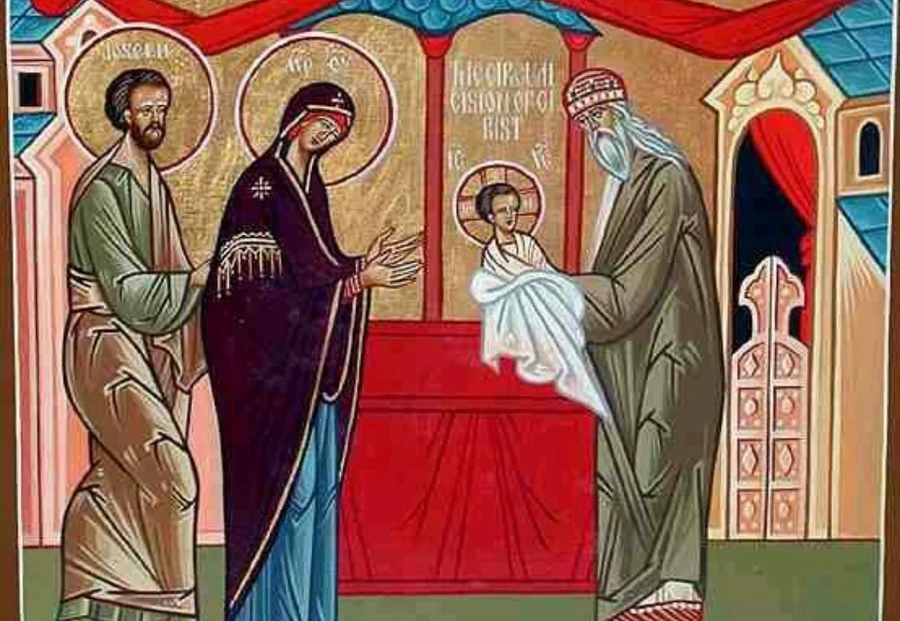
Orthodox depiction of the circumcision and naming of Jesus

When the angels had left them and gone into heaven, the shepherds said to one another, “Let us go now to Bethlehem and see this thing that has taken place, which the Lord has made known to us.” So they went with haste and found Mary and Joseph and the child lying in the manger. When they saw this, they made known what had been told them about this child, and all who heard it were amazed at what the shepherds told them, and Mary treasured all these words and pondered them in her heart. The shepherds returned, glorifying and praising God for all they had heard and seen, just as it had been told them.

When the eighth day came, it was time to circumcise the child, and he was called Jesus, the name given by the angel before he was conceived in the womb. (New Revised Standard Version)

“The Holy Name of Jesus” is a celebration, observed by some Christian traditions, each year on January 1 – which is the eighth day after the birth of Jesus, when he was named and circumcised at the temple in Jerusalem.

An angel of the Lord appeared to him in a dream and said, “Joseph, son of David, do not be afraid to take Mary as your wife, for the child conceived in her is from the Holy Spirit. She will bear a son, and you are to name him Jesus, for he will save his people from their sins.” (Matthew 1:20-21, NRSV)

In the Law of Moses, all male infants are to be circumcised on the eighth day after their birth (Leviticus 12:3). Throughout most of the history of the Christian Church, January 1 has been celebrated as a feast day devoted to the naming of Jesus.

The name “Jesus” comes from the Hebrew Yeshuah (Joshua) which means “Yahweh will save.” It is a name fitting for the person and work of Christ.

Therefore God exalted him even more highly
    and gave him the name
    that is above every other name,
so that at the name given to Jesus
    every knee should bend,
    in heaven and on earth and under the earth,
and every tongue should confess
    that Jesus Christ is Lord,
    to the glory of God the Father. (Philippians 2:9-11, NRSV)

Faith is always followed by obedience. So, the faith of Joseph and Mary in believing the words of the angel Gabriel, translated into the obedient naming of their son as “Jesus.” (Luke 1:31-32)

Jesus, bearing the name of savior, is holy in every way. Not only does the name of Jesus point to his divinity – because of his miraculous conception by the Holy Spirit – but it also directs us toward the special mission for which he entered this world.

Jesus Christ, the Son of God, and Son of Humanity, is God’s agent of deliverance for both Israel and the whole world.

“Do not be afraid, for see, I am bringing you good news of great joy for all the people: to you is born this day in the city of David a Savior, who is the Messiah, the Lord….” (Luke 2:10-11, NRSV)

The Gospel writer Luke provides us with a birth narrative “pregnant” with theological information and importance:

  • Jesus has divine sonship, and possesses the status of king (Luke 1:31-35)
  • Jesus comes from the city of David, which is Bethlehem, not Jerusalem (Luke 2:4, 11)
  • Jesus is described by the angel Gabriel as Son of the Most High, Son of God, Savior, Messiah, and Lord; each of these titles direct us to his identity and mission (Luke 1:32, 35; 2:11)

I like the collective response of the shepherds, after they received heavenly good news from a group of angels.

They could have dismissed the entire thing as having drunk too much brandy on a brisk winter night. They could have kept the whole affair to themselves, reasoning that nobody would believe a bunch of stinky shepherds.

Instead, much like Mary who hurried off to Elizabeth after receiving the angelic message, the shepherds dropped everything to go and see the feeding trough with a newborn baby wrapped in swaddling cloth.

In other words, the shepherds belief in what they heard and experienced, quickly translated into action. It was only appropriate that it was shepherds who discovered the newborn king, the Son of David, himself a shepherd who was anointed by God.

The shepherds went and followed the signs given to them by the angel. And they believed. A motley group of shepherds returned to their fields, kicking up their heels, praising and glorifying God. They knew that things would never be the same again.

The name of Jesus is holy, simply because the Lord Jesus Christ is the Holy One. Christians recognize Jesus as Savior, the fulfillment of all God’s promises. His singular birth, life, death, resurrection, and ascension is exactly, I believe, what this old fallen world is most in need of.

It is never too late to resolve knowing Jesus. At the beginning of this year, there is perhaps no better resolution to make, again and again, of knowing Jesus Christ and honoring his holy name.

Eternal Father, you gave to your incarnate Son the holy name of Jesus to be the sign of our salvation. Plant in our hearts the love of Jesus, truly God and truly human, and grant that we may praise and bless your Holy Name with our whole mind, heart, body, and spirit, that we may know your boundless compassion and mercy. In Christ’s name, we pray. Amen.

The Gospel Is For Everyone (Acts 11:1-18)

The Preaching of St. Peter In Jerusalem, by Charles Poërson, 1642

The apostles and the believers throughout Judea heard that the Gentiles also had received the word of God. So when Peter went up to Jerusalem, the circumcised believers criticized him and said, “You went into the house of uncircumcised men and ate with them.”

Starting from the beginning, Peter told them the whole story:“I was in the city of Joppa praying, and in a trance I saw a vision. I saw something like a large sheet being let down from heaven by its four corners, and it came down to where I was. I looked into it and saw four-footed animals of the earth, wild beasts, reptiles and birds. Then I heard a voice telling me, ‘Get up, Peter. Kill and eat.’

“I replied, ‘Surely not, Lord! Nothing impure or unclean has ever entered my mouth.’

“The voice spoke from heaven a second time, ‘Do not call anything impure that God has made clean.’ This happened three times, and then it was all pulled up to heaven again.

“Right then three men who had been sent to me from Caesarea stopped at the house where I was staying. The Spirit told me to have no hesitation about going with them. These six brothers also went with me, and we entered the man’s house. He told us how he had seen an angel appear in his house and say, ‘Send to Joppa for Simon who is called Peter. He will bring you a message through which you and all your household will be saved.’

“As I began to speak, the Holy Spirit came on them as he had come on us at the beginning. Then I remembered what the Lord had said: ‘John baptized with water, but you will be baptized with the Holy Spirit.’ So if God gave them the same gift he gave us who believed in the Lord Jesus Christ, who was I to think that I could stand in God’s way?”

When they heard this, they had no further objections and praised God, saying, “So then, even to Gentiles God has granted repentance that leads to life.” (New International Version)

In this Advent season, the Revised Common Lectionary Daily Readings for Year C direct us toward the good news that Christ’s incarnation is not only for Jewish people; it is also for everyone.

But Peter needed some remedial teaching about this gospel. He had to get the reality that God grants repentance leading to new life for Gentiles, firmly into his Jewish head and heart.

The first advent of Jesus Christ – his incarnation as the God-Man on this earth – was meant for the world, and not exclusively for the Jewish people. Sometimes, however, it takes a vision or a dream to really get the message across.

And God is gracious to do whatever it takes in order to gain our attention and bring us to a point of changing our minds about things we are in error about.

The Gospel is for everyone.

The Gospel is Jews and Gentiles. The Gospel is for you and for me. It’s for your grumpy neighbor and your crazy uncle. It’s for that obnoxious co-worker and the persnickety church lady. It’s for the Grinches and Scrooges of this world, as well as for the already convinced.

Yes, indeed, the good news of Jesus Christ is for everyone, without exception.

I do so hope that you don’t have to learn that truth the hard way. I do rather hope that you have a wonderful experience of discovering a Cornelius of whom you had no idea even existed, until the mercy of God led you otherwise.

It is my prayer that you have (or will have) a story to tell, much like Peter’s, in which you found that the grace of God has no limits, that there is plenty of Christ to go around for everyone.

There is no need to stand in God’s way, because no one can stop God’s grace. When the mercy of God starts moving, it becomes a giant snowball gaining speed and strength and size going downhill. And when it hits, you’re going to feel it!

Grace overcomes and overwhelms everything. 

One of the most scandalous truths of Christianity is that God graces common ordinary people who seem as dead as a bowling ball with the Holy Spirit and gives them life. 

The Apostle Peter had to learn this with some difficulty, but he embraced the work of God among the non-Jewish Gentiles. “The Holy Spirit fell on them just as on us at the beginning” was Peter’s plain account and confession of the reality that God grants repentance that leads to life for all kinds of people no matter what their race, ethnicity, gender, class, or background. 

It is a wondrous and astounding spiritual truth that God’s gracious concern is not limited to a certain type of person.

Along with Peter and the other believers so long ago, let us rejoice in the work of God that brings deliverance and transformation. 

Grace is and ought to be the guiding factor in how we interact with people. 

Losing sight of grace leads to being critical and defensive. Whereas, embracing grace leads to the humility of seeing the image of God in people very different from ourselves. 

Grace tears down barriers and causes us to do away with unnecessary distinctions between others. Our appropriate response to such a grace is to glorify God for his marvelous and amazing work. 

The Gospel is not only a gift to receive; it is also a wonderful gift to give.

Gracious God, just as you brought deliverance and salvation that leads to life for people from ancient times, and gifted them with your Holy Spirit, so today continue your mighty work of transformation in the hearts of people that I share the good news of Jesus with. Amen.