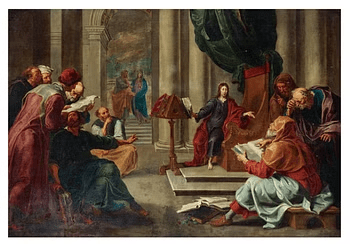
The Gospel Is For Everyone (Acts 11:1-18)

The Preaching of St. Peter In Jerusalem, by Charles Poërson, 1642

The apostles and the believers throughout Judea heard that the Gentiles also had received the word of God. So when Peter went up to Jerusalem, the circumcised believers criticized him and said, “You went into the house of uncircumcised men and ate with them.”

Starting from the beginning, Peter told them the whole story:“I was in the city of Joppa praying, and in a trance I saw a vision. I saw something like a large sheet being let down from heaven by its four corners, and it came down to where I was. I looked into it and saw four-footed animals of the earth, wild beasts, reptiles and birds. Then I heard a voice telling me, ‘Get up, Peter. Kill and eat.’

“I replied, ‘Surely not, Lord! Nothing impure or unclean has ever entered my mouth.’

“The voice spoke from heaven a second time, ‘Do not call anything impure that God has made clean.’ This happened three times, and then it was all pulled up to heaven again.

“Right then three men who had been sent to me from Caesarea stopped at the house where I was staying. The Spirit told me to have no hesitation about going with them. These six brothers also went with me, and we entered the man’s house. He told us how he had seen an angel appear in his house and say, ‘Send to Joppa for Simon who is called Peter. He will bring you a message through which you and all your household will be saved.’

“As I began to speak, the Holy Spirit came on them as he had come on us at the beginning. Then I remembered what the Lord had said: ‘John baptized with water, but you will be baptized with the Holy Spirit.’ So if God gave them the same gift he gave us who believed in the Lord Jesus Christ, who was I to think that I could stand in God’s way?”

When they heard this, they had no further objections and praised God, saying, “So then, even to Gentiles God has granted repentance that leads to life.” (New International Version)

In this Advent season, the Revised Common Lectionary Daily Readings for Year C direct us toward the good news that Christ’s incarnation is not only for Jewish people; it is also for everyone.

But Peter needed some remedial teaching about this gospel. He had to get the reality that God grants repentance leading to new life for Gentiles, firmly into his Jewish head and heart.

The first advent of Jesus Christ – his incarnation as the God-Man on this earth – was meant for the world, and not exclusively for the Jewish people. Sometimes, however, it takes a vision or a dream to really get the message across.

And God is gracious to do whatever it takes in order to gain our attention and bring us to a point of changing our minds about things we are in error about.

The Gospel is for everyone.

The Gospel is Jews and Gentiles. The Gospel is for you and for me. It’s for your grumpy neighbor and your crazy uncle. It’s for that obnoxious co-worker and the persnickety church lady. It’s for the Grinches and Scrooges of this world, as well as for the already convinced.

Yes, indeed, the good news of Jesus Christ is for everyone, without exception.

I do so hope that you don’t have to learn that truth the hard way. I do rather hope that you have a wonderful experience of discovering a Cornelius of whom you had no idea even existed, until the mercy of God led you otherwise.

It is my prayer that you have (or will have) a story to tell, much like Peter’s, in which you found that the grace of God has no limits, that there is plenty of Christ to go around for everyone.

There is no need to stand in God’s way, because no one can stop God’s grace. When the mercy of God starts moving, it becomes a giant snowball gaining speed and strength and size going downhill. And when it hits, you’re going to feel it!

Grace overcomes and overwhelms everything. 

One of the most scandalous truths of Christianity is that God graces common ordinary people who seem as dead as a bowling ball with the Holy Spirit and gives them life. 

The Apostle Peter had to learn this with some difficulty, but he embraced the work of God among the non-Jewish Gentiles. “The Holy Spirit fell on them just as on us at the beginning” was Peter’s plain account and confession of the reality that God grants repentance that leads to life for all kinds of people no matter what their race, ethnicity, gender, class, or background. 

It is a wondrous and astounding spiritual truth that God’s gracious concern is not limited to a certain type of person.

Along with Peter and the other believers so long ago, let us rejoice in the work of God that brings deliverance and transformation. 

Grace is and ought to be the guiding factor in how we interact with people. 

Losing sight of grace leads to being critical and defensive. Whereas, embracing grace leads to the humility of seeing the image of God in people very different from ourselves. 

Grace tears down barriers and causes us to do away with unnecessary distinctions between others. Our appropriate response to such a grace is to glorify God for his marvelous and amazing work. 

The Gospel is not only a gift to receive; it is also a wonderful gift to give.

Gracious God, just as you brought deliverance and salvation that leads to life for people from ancient times, and gifted them with your Holy Spirit, so today continue your mighty work of transformation in the hearts of people that I share the good news of Jesus with. Amen.

Second Sunday of Advent – Prepare the Way (Luke 3:1-6)

The Call from John the Baptist to Repent, by Renier de Huy, 12th century

In the fifteenth year of the reign of Tiberius Caesar, when Pontius Pilate was governor of Judea, and Herod was ruler of Galilee, and his brother Philip ruler of the region of Ituraea and Trachonitis, and Lysanias ruler of Abilene, during the high priesthood of Annas and Caiaphas, the word of God came to John son of Zechariah in the wilderness. He went into all the region around the Jordan, proclaiming a baptism of repentance for the forgiveness of sins, as it is written in the book of the words of the prophet Isaiah,

“The voice of one crying out in the wilderness:
‘Prepare the way of the Lord;
    make his paths straight.
Every valley shall be filled,
    and every mountain and hill shall be made low,
and the crooked shall be made straight,
    and the rough ways made smooth,
and all flesh shall see the salvation of God.’ ” (New Revised Standard Bible)

In this Christian season of Advent, we are reminded that God is not only high above us, transcendent, far away; God is also close to us, immanent, and with us.

We remember at this time of year that God does not remain distant, but entered our time and space at a particular moment in history, for a distinct purpose.

The Roman Empire was powerful, large, and very much in control of every place where it existed. The litany of imperial rulers and authorities which the Gospel writer Luke listed is meant to give us a feel of the Roman weight, and how much Roman might was ensconced in Judea.

The world at the turn of the common era was under the dominion of powerful people with lots of influence. But God did not come to any of them. Instead, God came to a loner – a man who spent his time out in the wilderness. His name was John, the son of Zechariah. We know him as John the Baptist.

With God coming to John at a precise point of time in a particular place, that made John a prophet with a singular message. John was born for this. (Luke 1:76)

It is fitting that a man hanging out on the fringes of society all by himself would be the one to prepare the way for Messiah.

After all, Messiah’s message would be one of bringing good news to the poor, proclaiming release to prisoners, and freeing those who are oppressed. (Luke 4:18-19; Isaiah 61:1-2)

God’s prophetic calling for John was one of preparation. John was to prepare the way of the Lord. He was to get the people ready to receive Messiah.

John went about his ministry of preparation by calling folks to repent, to change their minds and amend their ways, so that there might be forgiveness.

In a reference from the prophet Isaiah, Luke alluded to Jewish exiles returning from their Babylonian captivity. The actual physical road from Babylon to Jerusalem was a hard journey due to the distance and topography.

The “road” or the “way” in Holy Scripture is also a metaphor for the spiritual journey we take in this life. And that road has a lot of challenges to it. The very act of walking as a pilgrim over a long arduous journey changes a person.

It is rarely the destination that makes a person; it’s the journey itself which leads one to a changed life of thinking differently, and seeing things from a perspective we’ve never seen before.

The smoothing out of the road is a way of saying God is making it easier for people to return to the Lord, to get them ready for a new life with promises fulfilled and unexpected joy.

In other words, valleys raised and mountains flattened represent God’s efforts at helping us experience a complete transformation of life. The Lord will do everything possible to make renewal and restoration happen for us.

The Lord will set things right. In our contemporary world that is now largely controlled by powerful oligarchs and the super-rich, God will turn it upside-down. All of the world’s current powerful people will find themselves looking up, not down.

It would be nice and reassuring if I could give you certainty about the journey ahead. But I cannot do that. Yet, what I can do is assure us of what is at the end of the road. Look beyond the current days of self-centered leadership and popular ignorance, and understand that all flesh shall see the salvation of God.

Prepare the way of the Lord. We do that by how we go about walking the road. Each step we take every day is important and makes a difference. And when we stumble, there is plenty of grace to help get us back on our feet and moving forward.

We are all collectively journeying together to Bethlehem. And as we daily move and walk, at the end of our journey, Jesus is there.

But when the fullness of time had come, God sent his Son, born of a woman, born under the law, in order to redeem those who were under the law, so that we might receive adoption as children. (Galatians 4:4, NRSV)

And nothing can stop us or separate us from the love of God that is in Jesus Christ our Lord.

For I am convinced that neither death, nor life, nor angels, nor rulers, nor things present, nor things to come, nor powers, nor height, nor depth, nor anything else in all creation will be able to separate us from the love of God in Christ Jesus our Lord. (Romans 8:38-39, NRSV)

The journey may be arduous. You might feel like giving up. But Jesus is our Immanuel, God with us. In him, is our hope and our joy.

O Holy One of Israel, out of the embrace of mercy and righteousness, you have brought forth joy and dignity for your people. Remember now your ancient promise; make straight the paths that lead to you, and smooth the rough ways, so that in our day we might bring forth your compassion for all humanity. Amen.

Pray and Give Thanks (1 Timothy 2:1-7)

First of all, then, I urge that supplications, prayers, intercessions, and thanksgivings be made for everyone, for kings and all who are in high positions, so that we may lead a quiet and peaceable life in all godliness and dignity. This is right and acceptable before God our Savior, who desires everyone to be saved and to come to the knowledge of the truth. For

there is one God;
    there is also one mediator between God and humankind,
Christ Jesus, himself human,
    who gave himself a ransom for all

—this was attested at the right time. For this I was appointed a herald and an apostle (I am telling the truth; I am not lying), a teacher of the gentiles in faith and truth. (New Revised Standard Version)

In our extreme busyness, do any of us stop long enough to consider what is of upmost importance in our lives? Or do we scurry about, not considering why we fill every minute of the day with constant motion and activities which – if we are honest – only frustrate us?

Whether we know anything about William Shakespeare’s tragic play, Hamlet, or not, many a person lives out his centuries old words:

Life’s but a walking shadow, a poor player,

That struts and frets his hour upon the stage,

And then is heard no more. It is a tale

Told by an idiot, full of sound and fury,

Signifying nothing.

Writing to Timothy, a new and young pastoral leader of the Ephesian Church, the Apostle Paul made it clear what is, above all, the activity which the church and all believers in Jesus are to engage in: prayer.

Perhaps that sounds too trite or simple. Yet, there is really nothing easy about prayer. To pray is more like heading out on a wrestling mat with the Incredible Hulk. This is going to take some serious work.

The most important activity we can do is to keep persevering in prayer, never giving up, but continually getting back out there on the wrestling mat of prayer and putting all of your energy into it.

Everyone in leadership must be prayed for. Yes, each person who leads needs our prayers, without exception.

Christians are to be, first and foremost, people of prayer. And those prayers are to be for all sorts of various situations, and for all sorts of persons.

We are to pray for specific needs; general circumstances and situations; urgent and emergent requests; and, as the capstone to all prayer, expressions of thanksgiving and gratitude are most needed.

A weak and ineffective prayer is one that gives no thanks to God, nor offers gratitude to God for anyone.

Conversely, however, prayer filled with power and effectiveness is stuffed with thanksgiving to God, and liberally offers thanks to God for everyone, including the ones we don’t much care about.

Specifically, whenever we fail to pray for, and give thanks for, the very people we don’t much like, and would rather not pray for, at all, then we ought not expect any of our prayers to be heard nor answered by the God who is concerned for every human being on the face of this planet.

For the Christian, prayer is never optional nor merely occasional; prayer is necessary and vital, all the time. And prayer is a close relative to thanksgiving.

Pray in the Spirit at all times in every prayer and supplication. To that end, keep alert and always persevere in supplication for all the saints.

Ephesians 6:18, NRSV

Do not be anxious about anything, but in everything by prayer and supplication with thanksgiving let your requests be made known to God. (Philippians 4:6, NRSV)

In the ancient world of Paul and Timothy, much like our present contemporary world, prayers are needed so that we can live peaceably, with godliness and dignity.

We need religious tolerance and political stability, guaranteed by people in leadership positions. We need God’s sovereign and gracious enablement and direction of world leaders, so that God’s benevolent kingdom will come, and God’s ethical will be done, here on this earth, as it is always done in God’s heaven.

Christians recognize one God. The ancient Romans acknowledged many gods. In fact, veneration of the Roman Emperor as a god began after the assassination of Julius Ceasar in 27 B.C.E. He was proclaimed as divine, and added to the official pantheon of state gods in the Empire. Praying to divinized Ceasars became a real thing in the Roman world.

Paul clearly instructed Timothy to pray for Kings and Caesars, and not to them. Just like everyone else, rulers are dependent upon the mercy of God. Leaders are mortal, not divine; and ought never to be treated like gods.

So, when the Apostle stated that there is one God and one Mediator between God and humanity, he was clearly saying that Christ is King, and Ceasar is not. This was subversive language, at the time, and could get a Christian into some serious trouble.

For us today, it may seem silly to worship a ruler. Yet, we in our contemporary culture have a definite bent toward divinizing particular celebrities, politicians, sports icons, and music and movie stars. Some of what folks do certainly looks like worship of famous persons.

All of the celebrities of this world need God, and need our prayers for them (and not to them!) as people, like us, requiring deliverance from guilt and shame, just like we do.

I am a Calvinist, a person who holds to a Christian tradition from the Reformer John Calvin. I have encountered many people who believe that Calvinism is determinism, as if people are wholly bad, and cannot make choices because everything is already predetermined.

A Reformed Christian tradition simply places emphasis where (we believe) emphasis is due: upon God, and God’s sovereign decrees, commands, will, and decisions. Because ultimately, everything comes down to God, not us.

We worship God, not our choices, or anyone else’s. Before we ever chose God, God chose us.

Everyone needs deliverance, but not everyone receives it. The Reformed concept of “limited atonement” simply recognizes that not everyone will be redeemed. The atonement of Christ is unlimited in its scope for all people, but limited in its application to some persons.

The heart of God is that everyone would be saved and come to a knowledge of the truth. Yet, not everyone experiences this.

This, in no way, flies in the face of a Christian theological tradition like Calvinism. A human judge may pronounce a severe sentence upon the accused; but that does not necessarily mean that the judge desires it, or enjoys putting someone away.

Jesus, the Son of God, and Son of Humanity, gave himself as a ransom for all. This assumes we all carry a significant debt that cannot simply be canceled; it must be reckoned with and redeemed.

Statue of Christ the Redeemer, Rio de Janeiro, Brazil

Spiritual captives need freedom. Spiritual debtors need redemption. The spiritually oppressed need a champion, a warrior. Spiritual slaves need someone to pay for their release from bondage.

The death of Christ is the atoning act which provides new life for humanity. An existential exchange happened, in which Jesus vicariously took our place, and released us from the power of sin, death, and hell.

This is the good news which Christianity proclaims: In Jesus Christ, we are forgiven, and are now free to live a good, right, and just life. There is now nothing hindering our prayers. We have full access to God through Christ.

Thus, we are to use this incredible privilege of accessibility by praying to God on behalf of everyone; and giving thanks for all things, especially the deliverance which has been secured for us.

There are quite enough grumpy curmudgeons in this world. We don’t need any more of them. What we do need, and can never get enough of, are people who have heartfelt thanksgiving – and are grateful for both the good and the bad; those they don’t like, as well as the people they do like; those in an opposing political party, along with their own; their enemies, and their friends.

The good news of Jesus changes us to be people who exist in the world for good; and not for ill. And those who insist on hate speech and hateful actions, are evidencing that they are not people of prayer, and are ingrates who do not know God.

They shall find out the hard way that there is no unlimited atonement.

The Gospel is not a tale told by an idiot.

Lord Jesus Christ, Son of God, have mercy on me, a sinner.

Christ, have mercy, and grant me your peace. Amen.

Be Ready (Mark 13:9-23)

Art by Mark Keathley

“As for yourselves, beware, for they will hand you over to councils, and you will be beaten in synagogues, and you will stand before governors and kings because of me, as a testimony to them. And the good news must first be proclaimed to all nations. 

“When they bring you to trial and hand you over, do not worry beforehand about what you are to say, but say whatever is given you at that time, for it is not you who speak but the Holy Spirit. 

“Sibling will betray sibling to death and a father his child, and children will rise against parents and have them put to death, and you will be hated by all because of my name. But the one who endures to the end will be saved.

“But when you see the desolating sacrilege set up where it ought not to be (let the reader understand), then those in Judea must flee to the mountains; the one on the housetop must not go down or enter to take anything from the house; the one in the field must not turn back to get a coat. Woe to those who are pregnant and to those who are nursing infants in those days! Pray that it may not be in winter. 

“For in those days there will be suffering, such as has not been from the beginning of the creation that God created until now and never will be. And if the Lord had not cut short those days, no one would be saved, but for the sake of the elect, whom he chose, he has cut short those days. 

“And if anyone says to you at that time, ‘Look! Here is the Messiah!’ or ‘Look! There he is!’—do not believe it. False messiahs and false prophets will appear and produce signs and wonders, to lead astray, if possible, the elect. But be alert; I have already told you everything. (New Revised Standard Version)

The genuineness and strength of one’s faith is demonstrated through the testing of it. A believer’s faith must and will be tried. How will that faith hold up when the world is angry and pours out its hate against them?

Jesus teaching in the Temple, by Willem van Herp (1614-1677)

The follower of Jesus will undergo afflictions and be oppressed by others. They will suffer.

Since that is true, the Christian must ensure that whatever suffering they endure is not because they have been obnoxious and unhelpful to people in this world; but that they are suffering because of their commitment to the words and ways of Jesus, because of their humility, gentleness, righteousness, purity, mercy, and peace.

Christians are meant to bear the cross, so that they may be conformed to the image of their Lord Jesus. There will be times when believers are the brunt of ungodly rage and fury, gossip and slander, opposition and injustice.

Jesus was warning his disciples that they needed to be prepared for endurance, to persevere over the long haul for their faith in him. Otherwise, they might be overwhelmed by temptation.

Christ followers are to remain steady in their purpose of living into the words of Jesus, and living out his ways in a world that prizes the opposite of Christian values.

The godly person values humility. The ungodly persons values pride.

The godly grieve and mourn over injustice in the world. The ungodly celebrate getting ahead by any means possible in this world.

The godly are meek. The ungodly are mean.

The godly seek right relationships with God and others. The ungodly leverage relationships to get what they want.

The godly prize mercy. The ungodly champion being merciless.

The godly are pure in heart. The ungodly have spiders in their heart, and garlic in their soul.

The godly engage in peacemaking. The ungodly engage in warmongering.

The godly end are persecuted for embracing the virtues of Jesus. The ungodly are the persecutors of good people.

The godly will be comforted, inherit the earth, receive mercy, see God, and belong to the kingdom of heaven. The ungodly will be judged, inherit the wind, receive condemnation, see nothing, and belong to the kingdom of darkness.

Sermon on the Mount, by Jorge Cocco Santángelo

The Lord wants us relieved of anxiety, and cheerfully living life with our burdens laid upon Jesus, for he gently and ably carries them. We can cast all our cares on him, because he cares for us. (Matthew 11:28-30; 1 Peter 5:7)

Whenever we are in the position of being afflicted by others, wisdom shall be granted to the godly who follow in the way of Christ.

The grace of God exists for those who seek to do justice, love mercy, and walk humbly. But there is nothing for the proud and arrogant, who believe they themselves are sufficient – because they refuse to receive any gift of God being offered to them.

All sorts of false prophets come along to try and deceive the godly into listening and following them. They make empty promises and blame others for unwanted situations. Know that whatever they say about others, is actually true of themselves.

So, when they accuse another of lying, cheating, stealing, murdering, etc. you can be sure that this is precisely what they themselves do to get ahead and get what they want in this life. Therefore, don’t be tempted by any rhetoric which demeans others.

Love of God and humanity is to be kindled hot, and not cooled through ingratitude and treachery. For whenever courage is weakened, a flood of violent speech and behavior follows.

We must strive against anything which harms the whole of humanity, and puts God at a distance. Instead, good news needs to be proclaimed.

The end will eventually come. Yet, we need not wander around in darkness, as if we don’t know what to do or where to go. We will indeed go through testing and many trials to our faith.

The desolating sacrilege, the abomination of desolation, will appear – which will be the sign that the time is short. An abomination, or desolation, means to profane something, to make it unclean or impure, to treat a holy thing as if it were simply not significant nor important.

In other words, whenever and wherever corruption is rife, and people (and God) are treated as disposable, then you know destruction is at hand. Thus, you must flee, because there is danger.

In such a situation, the rule of law will not help you. Services which were once helpful will be abolished and thrown away like garbage. And it could all happen rather quickly. So, don’t run back and try to save pieces of that previous life and existence; it isn’t worth it. You life is on the line.

Malicious motives and meanness of heart have no intention for the common good of all persons on this earth. A few people want what they want, and they don’t care who gets hurt in the process.

None of this awful behavior will go on forever. God’s judgment can and will deal with it. Yet, no one knows the time or date when that judgment will be rendered. For the sake of the godly, those days will be shortened.

Jesus was not attempting scare his disciples, but to exhort and arouse them to beware of the ungodly; and to keep watch, so that they would not fall into temptation and have their faith weakened.

As believers, we may experience troubles, but we need not be troubled.

The Good Shepherd of the sheep, Jesus Christ, is watching over us so that we don’t need to become distressed and discouraged.

My sheep hear my voice. I know them, and they follow me. I give them eternal life, and they will never perish. No one will snatch them out of my hand. My Father, in regard to what he has given me, is greater than all, and no one can snatch them out of the Father’s hand.  (John 10:27-29, NRSV)

The permanence of our deliverance from guilt, shame, sin, death, and hell does not depend on any of us. It is relies firmly upon the grace of God in Christ. And none who have been given to God shall perish. (John 17:12)

Be encouraged. But also be ready.

Keep watch, dear Lord, with those who work, or watch, or weep this night, and give your angels charge over those who sleep. Tend the sick, Lord Christ; give rest to the weary, bless the dying, soothe the suffering, pity the afflicted, shield the joyous; and all for your love’s sake. Amen.