From Where Will Our Help Come? (Psalm 121)

I lift up my eyes to the hills—
    from where will my help come?
My help comes from the Lord,
    who made heaven and earth.

He will not let your foot be moved;
    he who keeps you will not slumber.
He who keeps Israel
    will neither slumber nor sleep.

The Lord is your keeper;
    the Lord is your shade at your right hand.
The sun shall not strike you by day
    nor the moon by night.

The Lord will keep you from all evil;
    he will keep your life.
The Lord will keep
    your going out and your coming in
    from this time on and forevermore. (New Revised Standard Version)

One of the rituals my family does when leaving on a long road trip is to pray. It’s in those special times of traveling, and anticipating the destination, that we can be especially cognizant of both the blessings and the dangers which may lie ahead.

When the Israelites set out together from places all over Israel to go to Jerusalem and ascend the temple mount for a special festival, they also prayed. Specifically, they prayed many of the psalms and sang them together.

One never knows what lies ahead. We trust the Lord to protect us by being our divine keeper and guardian, to help us and watch out for us. This is why today’s psalm reading is alongside the Old Testament lesson of the Passover. (Exodus 12:14-28)

In Exodus, God was readying the people for deliverance from Egypt. The ancient Israelites were about to leave the land of slavery and travel to the Promised Land. They would be vulnerable to all sorts of dangers and obstacles on their way. The people needed Yahweh’s oversight and protection on their long journey.

Will we arrive safely? Can we get where we need to go without an accident or trouble? Those are questions people ask in any age with any significant trip.

Throughout the psalms of ascent (or the pilgrimage psalms) there are some fundamental convictions about God through them all:

  1. The Lord is a mighty God, the Creator and Sustainer of the universe
  2. The Lord is a caring God, the people’s Helper and Deliverer
  3. The Lord is near, an imminent God who is close to us as our Immanuel
  4. The Lord is an attentive God, always watching and never sleeping on the job in order to guard us
  5. The Lord is far above, a transcendent God who is able watch over everything and always see us

If you think about it, life itself is one long extended pilgrimage from birth to death. Life is an earthly sojourn, continually moving about the earth from one place to the next. Even if we stay put and never move, the world itself is continually spinning on it’s axis and furthermore circling in space around the sun. In other words, no matter what we do, life is always risky.

We need the consistent and continual divine presence to go before us, with us, and after us wherever we are and wherever we go. There is a constant need for God’s watching and caring for us. What’s more, we are invited to move and participate in the Lord’s dealings in this world. The call of every Christian is Christ’s call to “follow me.”

The life of the believer is a call to a life of pilgrimage and discipleship. It is to step out in faith and live life to the full, knowing that God has your back. We need not run for the hills whenever there is trouble; we can look beyond the mountains to the God of heaven who is our divine helper.

At the end of the day, we can lay our head on the pillow to sleep with trust that the non-slumbering God keeps watch over us during the dark night hours. Unlike the gods who need to be stirred from their rest, Yahweh is never absent and always alert to whatever is happening.

In the morning, we can rise with confidence knowing that our going out and coming home again will be watched with vigilance and care from the Lord who is our keeper. Nothing escapes the God who is both far and near, able to see the big picture of our lives, as well as notice every little nuance by being up close and personal.

We exist in a day and age where God is looked upon with askance – as if the universe’s Sovereign has neither the ability nor the will to impact our daily lives and positively govern the world’s affairs. This is not the God of the Psalms – a grand Being who knows the score of everything going on, cares about the intimate details of life, and has the power to bring about a good outcome for humanity.

Even though God may at times be silent, and although the Lord rarely acts quickly, we ultimately know down deep in our soul that we matter and that Yahweh is there. The real issue is whether we will take the time and effort to connect with this incredible benevolent Being and take a walk, that is, a pilgrimage of faith and encounter God.

When all is said and done, from where will our help come? It will ultimately come from the Lord, the maker of heaven and earth.

Eternal God, in whose benevolent realm there is no weapon drawn except the sword of righteousness, and there is no strength known but the strength of love: Mightily spread abroad your gracious and powerful Spirit, so that all people everywhere may be gathered under the banner of the Prince of Peace, as children of one God and Father of all, to whom belongs dominion and glory, now and forever. Amen.

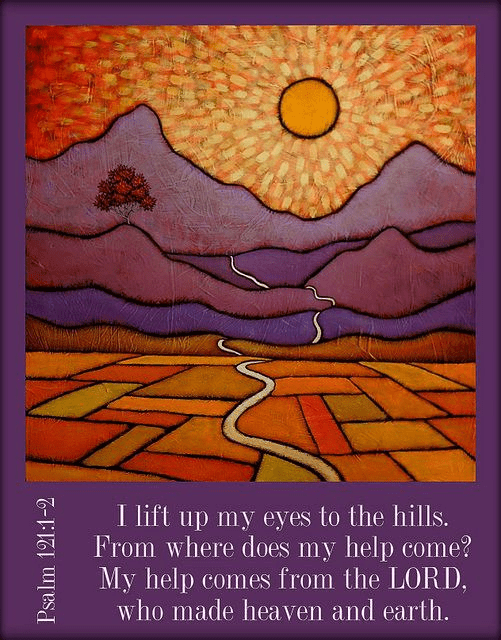
The Divine Helper (Psalm 121)

I lift up my eyes to the mountains—
    where does my help come from?
My help comes from the Lord,
    the Maker of heaven and earth.

He will not let your foot slip—
    he who watches over you will not slumber;
indeed, he who watches over Israel
    will neither slumber nor sleep.

The Lord watches over you—
    the Lord is your shade at your right hand;
the sun will not harm you by day,
    nor the moon by night.

The Lord will keep you from all harm—
    he will watch over your life;
the Lord will watch over your coming and going
    both now and forevermore. (New International Version)

Not a one of us gets off this planet without needing help – a lot of help! Even people who are in helping professions or who identify themselves primarily as helpers need help themselves.

There is no such thing as complete, total, and irrevocable independence. We humans are hard-wired by our Creator for community. That means we can only find our greatest fulfillment within interdependent relationships; and, furthermore, discover our highest happiness in a dependent relationship to God.

To need others, and especially to need God, is not a weakness; it’s a sign of strength. To have an awareness that help is needed allows us to make wise and confident choices. Only the fool goes it alone, believing they can pull themselves up by their bootstraps. “God helps those who help themselves,” was originally said by Benjamin Franklin, not Holy Scripture.

So, the question becomes: To whom and to where do we go for help? Who do we consult? With whom do we collaborate?

The most important step any of us can make is to realize that our own personal resources, although important and necessary, are inadequate. Therefore, we must admit, “I need help with this.” The next step is to go to the right source for that help.

The psalmist insists that the Lord is our helper, our keeper. Keeping is a large part of helping. God as our Divine Keeper means that the Lord watches over us, guards our lives, and seeks to preserve us from harm, wrongdoing, injustice, and oppression.

The very identity of God is wrapped up in being a Protector, Guard, and Watchkeeper. The Lord shields and shelters us, much like a mother hen over her chicks. God watches over us, just as a watchman keeps guard over a city at night when the residents are sleeping. And since the Lord is everywhere present, there is a continual divine presence in all of our life journeys. The dangers of both the day and the night are no match for the God who is our Keeper.

The promises of safety in today’s psalm are not meant to suggest that those who walk in the shelter of God will never endure harm or that nothing ill will ever befall them. The Psalter knows all too well that the wicked are everywhere and that they thrive unjustly.

Rather, these divine promises are general promises—they are blessings God does for those who rely on the Lord, call upon God’s name, and seek divine help. We are to have a continual awareness of God’s presence in this world. Although we are not inoculated from pain, God is always with us in our hurt and bewilderment.

It can be hard to ask for help. Our pride, stubbornness, and independence might cause us to experience harm rather than seek assistance. Be specific about the help needed. The following are some “helpful” ways of approaching God by answering some basic newsgathering type questions. The goal isn’t to convince the Lord to help us, but rather to enable us in connecting with what we truly need and being specific about God’s assistance for us or for others:

Who needs help?

Be clear and specific if the help is for yourself, another, or a group of people.

When Jesus had entered Capernaum, a centurion came to him, asking for help. “Lord,” he said, “my servant lies at home paralyzed, suffering terribly.”

Jesus said to him, “Shall I come and heal him?”

The centurion replied, “Lord, I do not deserve to have you come under my roof. But just say the word, and my servant will be healed. (Matthew 8:5-8, NIV)

How will God’s intervention help?

God is an expert listener. Tell the story of what you have tried already and where you fall short.

Jesus asked the boy’s father, “How long has he been like this?”

“From childhood,” he answered. “It has often thrown him into fire or water to kill him. But if you can do anything, take pity on us and help us.”

“‘If you can’?” said Jesus. “Everything is possible for one who believes.”

Immediately the boy’s father exclaimed, “I do believe; help me overcome my unbelief!” (Mark 9:21-24, NIV)

Why are you asking for God’s help?

Explain what’s going on and the reasons why you believe the Lord is the One to help. Mention the divine attributes and actions of God, as well as your own personal connection.

Then Asa called to the Lord his God and said, “Lord, there is no one like you to help the powerless against the mighty. Help us, Lord our God, for we rely on you, and in your name we have come against this vast army. Lord, you are our God; do not let mere mortals prevail against you.” (2 Chronicles 14:11, NIV)

Where is the help needed?

Is it a geographical location, a specific spot in the human body, or a place such as a building or home?

Jesus left the synagogue and went to the home of Simon. Now Simon’s mother-in-law was suffering from a high fever, and they asked Jesus to help her. So, he bent over her and rebuked the fever, and it left her. She got up at once and began to wait on them. (Luke 4:37-39, NIV)

When do you need help?

Immediately? Tomorrow? At a specific time?

O Lord, God of my salvation,

    when, at night, I cry out in your presence,

let my prayer come before you;

    incline your ear to my cry.

For my soul is full of troubles,

    and my life draws near to Sheol. (Psalm 88:1-3, NRSV)

What, exactly, is the need?

Spell out what you want in detail, holding nothing back. Don’t be concerned about the words or saying it right. Speak in your own plain language.

Help, O Lord, for the godly are fast disappearing!

    The faithful have vanished from the earth!

Neighbors lie to each other,

    speaking with flattering lips and deceitful hearts.

May the Lord cut off their flattering lips

    and silence their boastful tongues. (Psalm 12:1-3, NLT)

The help you and I need is in the name of the Lord who made heaven and earth. We only need to ask, and it will be given; seek, and we will find; knock, and the answer will open to us.

I Cannot Do This Alone

A Prayer by Dietrich Bonhoeffer

O God, early in the morning I cry to you.
Help me to pray and to concentrate my thoughts on you;
I cannot do this alone.
In me there is darkness, but with you there is light;
I am lonely, but you do not leave me; I am feeble in heart, but with you there is help;
I am restless, but with you there is peace. In me there is bitterness, but with you there is patience;
I do not understand your ways, but you know the way for me….
Restore me to liberty, and enable me to live now, that I may answer before you and before men.
Lord whatever this day may bring, Your name be praised. Amen.

Psalm 121 – The Divine Helper

I lift up my eyes to the hills—
    from where will my help come?
My help comes from the Lord,
    who made heaven and earth.

He will not let your foot be moved;
    he who keeps you will not slumber.
He who keeps Israel
    will neither slumber nor sleep.

The Lord is your keeper;
    the Lord is your shade at your right hand.
The sun shall not strike you by day,
    nor the moon by night.

The Lord will keep you from all evil;
    he will keep your life.
The Lord will keep
    your going out and your coming in
    from this time on and forevermore. (New Revised Standard Version)

Not a one of us gets off this planet without needing help – a lot of help! Even people who are in helping professions or who identify themselves primarily as helpers need help themselves.

There is no such thing as complete, total, and irrevocable independence. We as humans are hard-wired by our Creator for community. We only find our greatest fulfillment within interdependent relationships, and only discover our highest happiness in a dependent relationship to God.

To need others, and especially God, is not a weakness. It’s a sign of sage awareness and confident strength whenever we assess that help is needed. Only the fool goes it alone, believing they can pull themselves up by their bootstraps. “God helps those who help themselves,” was originated by Ben Franklin, not Holy Scripture.

So, the real question is: To whom and to where do we go for help? Who do we consult? With whom do we collaborate?

The most important step any of us can make is to realize that our own personal resources are inadequate, and that we admit, “I need help with this.” The next most important step is to go to the right source for that help.

The psalmist insists that the Lord is our helper, our keeper. Keeping is a large part of helping. God as our Divine Keeper means that the Lord watches over us, guards our lives, and seeks to preserve us from harm, wrongdoing, injustice, and oppression.

The very identity of God is wrapped up in being a Protector, Guard, and Watchkeeper. The Lord shields and shelters us, much like a mother hen over her chicks. God watches over us, just as a watchman keeps guard over a city at night when the residents are sleeping. And since the Lord is everywhere present, there is a continual divine presence in all of our life journeys. The dangers of both the day and the night are no match for the God who is our Keeper.

The promises of safety in today’s psalm are not meant to suggest that those who walk in the shelter of God will never endure harm or that nothing ill will ever befall them. The Psalter knows all too well that the wicked are everywhere and that they thrive unjustly.

Rather, these divine promises are general promises—they are blessings God does for those who rely on the Lord, call upon God’s name, and seek divine help. We are to have a continual awareness of God’s presence in this world. Although we are not inoculated from pain, God is always with us in our hurt and bewilderment.

It can be hard to ask for help. Our pride, stubbornness, and independence might cause us to experience harm rather than seek assistance.

Be specific about the help needed. The following are some “helpful” ways of approaching God by answering some basic newsgathering type questions. The goal isn’t to convince the Lord to help us, but rather to enable us in connecting with what we truly need and being specific about God’s assistance for us or for others:

Who? 

Who needs help? Clarify if the help is for yourself, another, or a group of people.

When Jesus had entered Capernaum, a centurion came to him, asking for help. “Lord,” he said, “my servant lies at home paralyzed, suffering terribly.”

Jesus said to him, “Shall I come and heal him?”

The centurion replied, “Lord, I do not deserve to have you come under my roof. But just say the word, and my servant will be healed. (Matthew 8:5-8, NIV)

How? 

How will God’s action help? God is an expert listener. Tell the story of what you have tried already and where you fall short.

Jesus asked the boy’s father, “How long has he been like this?”

“From childhood,” he answered. “It has often thrown him into fire or water to kill him. But if you can do anything, take pity on us and help us.”

“‘If you can’?” said Jesus. “Everything is possible for one who believes.”

Immediately the boy’s father exclaimed, “I do believe; help me overcome my unbelief!” (Mark 9:21-24, NIV)

Why? 

Why are you soliciting God’s help? Explain what’s going on and the reasons why you believe the Lord is the One to help. Mention the divine attributes and actions of God, as well as your own personal connection.

Then Asa called to the Lord his God and said, “Lord, there is no one like you to help the powerless against the mighty. Help us, Lord our God, for we rely on you, and in your name we have come against this vast army. Lord, you are our God; do not let mere mortals prevail against you.” (2 Chronicles 14:11, NIV)

Where? 

Where is the help needed? Is it a geographical location, a specific spot in the human body, or a place such as a building or home?

Jesus left the synagogue and went to the home of Simon. Now Simon’s mother-in-law was suffering from a high fever, and they asked Jesus to help her. So, he bent over her and rebuked the fever, and it left her. She got up at once and began to wait on them. (Luke 4:37-39, NIV)

When? 

When do you need help? Immediately? Tomorrow? At a specific time?

O Lord, God of my salvation,
    when, at night, I cry out in your presence,
let my prayer come before you;
    incline your ear to my cry.

For my soul is full of troubles,
    and my life draws near to Sheol. (Psalm 88:1-3, NRSV)

What? 

What, exactly, is the need? Spell out what you want in detail, holding nothing back. Don’t be concerned about the words or saying it right. Speak in your own plain language.

Help, O Lord, for the godly are fast disappearing!
    The faithful have vanished from the earth!
Neighbors lie to each other,
    speaking with flattering lips and deceitful hearts.
May the Lord cut off their flattering lips
    and silence their boastful tongues. (Psalm 12:1-3, NLT)

May you find the help you need today and every day, in Jesus’ name. Amen.

Psalm 121 – My Help

Mountain landscape

I lift up my eyes to the hills—
    from where will my help come?
My help comes from the Lord,
    who made heaven and earth.

He will not let your foot be moved;
he who keeps you will not slumber.
He who keeps Israel
will neither slumber nor sleep.

The Lord is your keeper;
the Lord is your shade at your right hand.
The sun shall not strike you by day,
nor the moon by night.

The Lord will keep you from all evil;
he will keep your life.
The Lord will keep
your going out and your coming in
from this time on and forevermore. (NRSV)

This is my favorite psalm.  I have read and mulled it over so many times that it is almost second nature for me to draw from its rich theological statement about God when times are difficult.  This is a psalm designed for worship – to be used by God’s people through song and prayer.  A community without Psalm 121 near to its heart is a group of people in danger. Yet, with it, there is a continual sense of security, confidence, and hope.

Psalms are meant to be spoken aloud and repeated. So, here is another version:

I look to the hills!
Where will I find help?
It will come from the Lord,
who created the heavens
and the earth.

The Lord is your protector,
and he won’t go to sleep
or let you stumble.
The protector of Israel
doesn’t doze
or ever get drowsy.

The Lord is your protector,
there at your right side
to shade you from the sun.
You won’t be harmed
by the sun during the day
or by the moon at night.

The Lord will protect you
and keep you safe
from all dangers.
The Lord will protect you
now and always
wherever you go. (CEV)

This beautiful majestic psalm can be used for any and every occasion.  So, I often use it within hospital visits, counseling in a wide array of situations, and for my own personal edification.  It seems to me that one cannot possibly overuse this psalm.  The psalm was originally used for ascending the hill into Jerusalem, anticipating meeting with God.  Just like a lover who looks forward to meeting his beloved and thinking about how wonderful she is, so the psalmist looks with adoring affection on the God he is about to encounter.

I Lift My Eyes to the Hills

Here is yet another version of this wonderful psalm:

I look up to the mountains—
does my help come from there?
My help comes from the Lord,
who made heaven and earth!

He will not let you stumble;
the one who watches over you will not slumber.
Indeed, he who watches over Israel
never slumbers or sleeps.

The Lord himself watches over you!
The Lord stands beside you as your protective shade.
The sun will not harm you by day,
nor the moon at night.

The Lord keeps you from all harm
and watches over your life.
The Lord keeps watch over you as you come and go,
both now and forever. (NLT)

The psalm is rich with a theology of grace, watch care, and loving attention.  This is a God who is powerful and merciful, a God able to help and desiring to do so.  In a world which seems so often distant and unaffected by the divine, this is a psalm to utter repeatedly in every situation of life so that the truth of the Lord is grafted deep into the soul.  In each unwanted circumstance the psalm can be spontaneously used as an immediate prayer, and with every anticipated event it can provide the words to address the most pressing of needs.  Let the words resonate within you as people created in the image of God, connecting with him on both the cerebral and visceral levels of your life in this last version:

I will lift up my eyes to the hills—
From whence comes my help?
My help comes from the Lord,
Who made heaven and earth.

He will not allow your foot to be moved;
He who keeps you will not slumber.
Behold, He who keeps Israel
Shall neither slumber nor sleep.

The Lord is your keeper;
The Lord is your shade at your right hand.
The sun shall not strike you by day,
Nor the moon by night.

The Lord shall preserve you from all evil;
He shall preserve your soul.
The Lord shall preserve your going out and your coming in
From this time forth, and even forevermore. (NKJV)

 Amen.