2 Samuel 7:18-29 – A Model Prayer

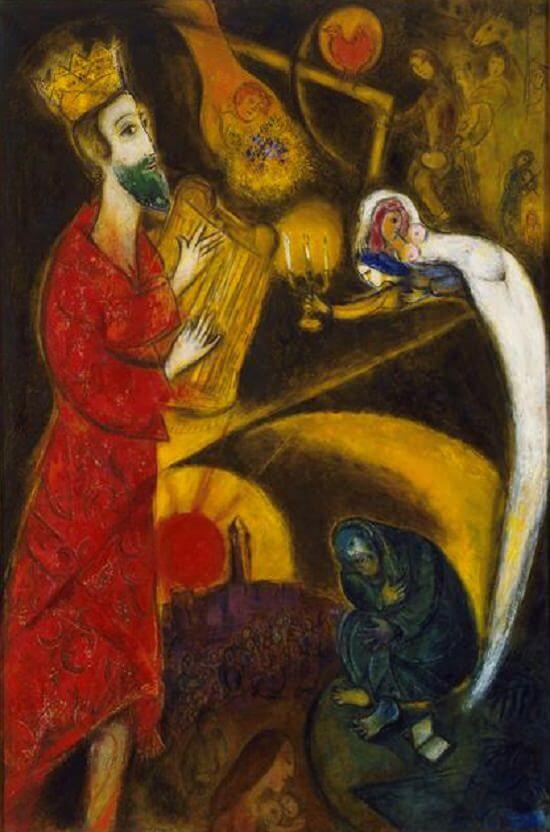
King David by Marc Chagall, 1962

Then King David went in and sat before the Lord, and he said:

“Who am I, Sovereign Lord, and what is my family, that you have brought me this far? And as if this were not enough in your sight, Sovereign Lord, you have also spoken about the future of the house of your servant—and this decree, Sovereign Lord, is for a mere human!

“What more can David say to you? For you know your servant, Sovereign Lord. For the sake of your word and according to your will, you have done this great thing and made it known to your servant.

“How great you are, Sovereign Lord! There is no one like you, and there is no God but you, as we have heard with our own ears. And who is like your people Israel—the one nation on earth that God went out to redeem as a people for himself, and to make a name for himself, and to perform great and awesome wonders by driving out nations and their gods from before your people, whom you redeemed from Egypt? You have established your people Israel as your very own forever, and you, Lord, have become their God.

“And now, Lord God, keep forever the promise you have made concerning your servant and his house. Do as you promised, so that your name will be great forever. Then people will say, ‘The Lord Almighty is God over Israel!’ And the house of your servant David will be established in your sight.

“Lord Almighty, God of Israel, you have revealed this to your servant, saying, ‘I will build a house for you.’ So, your servant has found courage to pray this prayer to you. Sovereign Lord, you are God! Your covenant is trustworthy, and you have promised these good things to your servant. Now be pleased to bless the house of your servant, that it may continue forever in your sight; for you, Sovereign Lord, have spoken, and with your blessing the house of your servant will be blessed forever.” (New International Version)

“The whole reason why we pray is to be united into the vision and contemplation of God to whom we pray.”

Julian of Norwich (1343-1416)

Perhaps you wish you had a better prayer life. To pray, as with most things in life, requires both motivation and how to do it. So, it’s appropriate to find answers about prayer by observing the biblical models of prayer contained in Holy Scripture.

Today’s Old Testament lesson is King David’s prayer in response to God’s revelation to him about fulfilling covenant promises. Looking at David’s prayer, there is a three-fold division which models for us a good way to approach God.

The Present: Gratitude for God’s Grace

David began his prayer with an attitude, posture, and words of humility, recognizing and affirming the relationship between himself and God. Although David is the king over all Israel and Judah, he repeatedly refers to himself as a servant (10 times).

God didn’t have to communicate anything to David about the future. Yet, the Lord graciously made known that it would be through David’s descendants that all of God’s good promises will be fulfilled. And David is overwhelmed with such gracious words. It comes tumbling out of him in a heartfelt prayer of gratitude and thanksgiving.

It is good for us to think about the spiritual blessings we have received from God. Not only can prayers of thanksgiving be uttered at any time to the Lord, but we can also write our gratitude in a journal as a prayer offering to God.

It’s also good to be specific about the circumstances and the praises. In the future, whenever there are discouraging situations, we can look back to what we wrote and remember the ways in which God showed up and encouraged us with very great and precious promises.

The Past: Praise for God’s Actions

David affirms there is no one and no god which can compare to Yahweh, the great I Am. It is the Lord God almighty who displayed divine power and presence in redeeming the Israelites out of Egyptian slavery and into the Promised Land.

Any greatness which arises from humans is the direct result of God’s greatness. Apart from God, there is no distinctive way of living. God’s presence makes all the difference:

Then Moses said to him [Yahweh], “If your Presence does not go with us, do not send us up from here. How will anyone know that you are pleased with me and with your people unless you go with us? What else will distinguish me and your people from all the other people on the face of the earth?” (Exodus 33:15-16, NIV)

The Lord specializes in bending hopeless situations to divine purposes, transforming people to new life, and turning systemic evil on its head so that the humble, meek, and penitent will be first, not last.

The Future: Prayer for God to Fulfill Divine Promises

King David already knew God’s promises to the Israelites. Now, however, David understands how he personally fits into the Lord’s plan.

Courage arises whenever God’s people know God’s promises and then discern how to fit into God’s plan. Confident assurance and settled peace cannot simply be ginned-up through positive thinking; bold faith needs a foundation of truth – a rock solid base which cannot be moved and is always there.

King David found his ultimate motivation in life in God’s revelation. His basis of prayer was God’s Word. Biblical prayers, like David’s, are there for us to model our own prayers.

Accept, O Lord, our thanks and praise for all that you have done for us. We thank you for the splendor of the whole creation, for the beauty of this world, for the wonder of life, and for the mystery of love. We thank you for the blessing of family and friends, and for the loving care which surrounds us on every side. We thank you for setting us at tasks that demand our best efforts, and for leading us to accomplishments that satisfy and delight us. We thank you also for those disappointments and failures that lead us to acknowledge our dependence on you alone.

Above all, we thank you for your Son Jesus Christ; for the truth of his Word and the example of his life; for his steadfast obedience, by which he overcame temptation; for his dying, through which he conquered death; and for his rising to life again, in which we are raised to the life of your kingdom. Grant us the gift of your Spirit, that we may know Christ and make him known; and through him, at all times and in all places, may give thanks to you in all things. Amen.

Psalm 63 – I Will

You are my God. I worship you.
    In my heart, I long for you,
    as I would long for a stream
    in a scorching desert.

I have seen your power
and your glory
    in the place of worship.
Your love means more
than life to me,
    and I praise you.
As long as I live,
    I will pray to you.
I will sing joyful praises
and be filled with excitement
    like a guest at a banquet.

I think about you
    before I go to sleep,
    and my thoughts turn to you
    during the night.
You have helped me,
    and I sing happy songs
    in the shadow of your wings.
I stay close to you,
    and your powerful arm
    supports me.

All who want to kill me
    will end up in the ground.
Swords will run them through,
    and wild dogs will eat them.

Because of you, our God,
    the king will celebrate
with your faithful followers,
    but liars will be silent. (Contemporary English Version)

Regulars to this blog know that I believe the Old Testament Psalms to be a vast untapped resource of devotion and prayer for many Christians. The biblical psalms provide believers with words for prayer, song, and thought so that we might remain close and connected to the Lord.

I Will Worship

Worship involves gratitude to God for God’s inherent love; and praise to God for divine works done in the world.

God’s people, gathered together for worship, affords a wonderful opportunity to express gratitude and praise, as well as listen to the stories of others who have experienced the gracious works of God in their lives.

Therefore, both personal and corporate worship is needed. Personal worship, even if engaged daily, will inevitably lead to a truncated understanding of God and God’s Law without corporate worship – because we need the encouragement and the accountability of others for mature spiritual growth. In addition, to only participate in corporate worship, without attending to daily personal worship, leads to a bifurcation between Sunday and our Monday-Friday workaday existence.

Worship isn’t so much an event, as it is a life. So, it makes sense to have healthy rhythms of personal and corporate worship which enable us to glorify God in our neighborhoods, families, workplaces, and faith communities.

I Will Pray

In those dark times when we don’t know what to pray, how to lament, or what to say to God; in the joyful times when we want to proclaim praise, give thanks, or express our blessings and longings; in every season of our lives the psalms help give voice to our relationship with the God of all creation.

Today’s psalm was originally uttered to God when David was roaming in the wilderness avoiding King Saul’s malevolent intent. David prayerfully expressed his yearning, desire, and hope to connect with God and be guided by the Lord, step by step. David praised God in an awkward and adverse circumstance, longing to be satisfied with spiritual food and drink.

I Will Sing

Just as we are to pray the psalms, we are to also speak the psalms out loud with singing. The Psalter Hymnal of old, as well as many contemporary praise and worship songs, are words from the psalms, meant to help, encourage, and give voice to our own current experiences.  

Inspired by the psalms, take a few minutes today to sing and/or listen to songs such as, “God You Are My God” by Michael W. Smith, or check out a compilation of music from the psalms, like, “The Psalms Project,” which aims to put all 150 psalms to music. Maybe even craft your own tune to today’s psalm and sing it to the Lord.

I Will Think

Specifically, the psalmist mentions thinking about the Lord before retiring for sleep, as well as turning to God when awake during the night.

In today’s modern (and postmodern) society, anxiety and racing thoughts are ubiquitous – the result of overthinking and fixating on particular troubling thoughts. Contemplating God through reflecting on the psalms can be a way of taming the out-of-control thinking, while positively engrafting sound theology into the inner workings of our brains.

There’s a reason why the daily lectionary has a reading from the psalms every day. It is one of the best sources for practical spirituality and heartfelt worship, as well as transforming the way we think.

I Will Stay Close

Whatever we do, whatever we say, and wherever we go, let the psalms help form and shape within you a profound spirituality which helps foster a deeper connection with the God we long to know more and more. 

May our celebrations be raucous and robust because the God of the psalms has showed up and given grace and mercy to our troubling circumstances.

Soli Deo Gloria

1 Kings 8:22-30 – Solomon’s Prayer of Dedication

Then Solomon stood before the altar of the Lord in the presence of all the assembly of Israel and spread out his hands to heaven. He said, “O Lord, God of Israel, there is no God like you in heaven above or on earth beneath, keeping covenant and steadfast love for your servants who walk before you with all their heart, the covenant that you kept for your servant my father David as you declared to him; you promised with your mouth and have this day fulfilled with your hand. Therefore, O Lord, God of Israel, keep for your servant my father David that which you promised him, saying, ‘There shall never fail you a successor before me to sit on the throne of Israel, if only your children look to their way, to walk before me as you have walked before me.’ Therefore, O God of Israel, let your word be confirmed, which you promised to your servant my father David.

“But will God indeed dwell on the earth? Even heaven and the highest heaven cannot contain you, much less this house that I have built! Regard your servant’s prayer and his plea, O Lord my God, heeding the cry and the prayer that your servant prays to you today; that your eyes may be open night and day toward this house, the place of which you said, ‘My name shall be there,’ that you may heed the prayer that your servant prays toward this place. Hear the plea of your servant and of your people Israel when they pray toward this place; O hear in heaven your dwelling place; heed and forgive. (New Revised Standard Version)

I grew up in rural Iowa, a place with lots of gravel roads. In the seasons of Spring and Fall, the thawing and re-freezing lead to some impressive ruts in those roads. It’s difficult to avoid them since they nearly dominate the driving space. 

With our prayers, there are seasons of life where we can slip into ruts – times where focused wrestling in prayer is set aside by just going along with the rut of prayer with the same lifeless words and phrases. There are Christians who pray wonderful prayers… over and over again with almost no thought to it, continually saying the same things anytime they pray.

In today’s Old Testament lesson, we have a prayer of Solomon at the dedication of the Lord’s temple. The two aspects of this prayer that jump out to me are: 

  1. Solomon reminded God of divine promises to the covenant people.
  2. Solomon reminded God of who God is. 

Solomon, as the wisest person to ever live, did not believe that somehow God forgot about promises made or had some sort of divine dementia about theology proper. Instead, Solomon prayed with the kind of prayer that God delights to hear. 

“Prayer does not change God, but it changes him who prays.”

Søren Kierkegaard 

God enjoys hearing us pray. The Lord likes it when we pray according to the promises given us. God adores when we pray with a focused understanding of whom we are praying to.

So, then, in our prayers, it is good to emulate the example of King Solomon. Know the promises of God contained in Holy Scripture and pray they will be confirmed in our lives, families, churches, and world. 

Also, pray with the intention of declaring God’s inherent nature, attributes, and character. Acknowledge the basic trait of God’s steadfast love. Believers serve a big God whose hugeness is continually above all things, and whose work is always continuing according to divine decrees and words. 

One way of moving our prayers out of the ruts of familiar language and thoughts is to journal them. Writing our prayers can become for us an act of worship as we slow down enough to craft a response to God that is thoughtful and connects us with him beyond the rote and routine.

In its simplest definition prayer is a conversation between the one who is praying and the one to whom those prayers is directed. So, whenever we craft a written or spoken prayer, it’s good to get out of a rut by:

  • Using language and words that are meaningful to you.
  • Making your intentions clear by stating exactly what you need or want.
  • Taking your time and not rushing.
  • Lighting candles, burning incense, or creating a special sacred space for prayer. 

Thank you Lord God for the opportunity of prayer and worship. Thank you that I can put aside uncertainties of this world and rest and rely upon the certainties of your good promises. Thank you that we can bring to your feet all the hurts and fears that trouble us and leave them there knowing that your strength and assurance are all that we require. May all your people find peace, healing, wholeness, and joy in your presence, through Jesus Christ, your Son, our Savior, who with you and the Holy Spirit exist as one God, now and forever. Amen.

1 Samuel 2:1-10 – A Hope Fulfilled

Then Hannah prayed:

“My heart rejoices in the Lord!
    The Lord has made me strong.
Now I have an answer for my enemies;
    I rejoice because you rescued me.
No one is holy like the Lord!
    There is no one besides you;
    there is no Rock like our God.

“Stop acting so proud and haughty!
    Don’t speak with such arrogance!
For the Lord is a God who knows what you have done;
    he will judge your actions.
The bow of the mighty is now broken,
    and those who stumbled are now strong.
Those who were well fed are now starving,
    and those who were starving are now full.
The childless woman now has seven children,
    and the woman with many children wastes away.
The Lord gives both death and life;
    he brings some down to the grave but raises others up.
The Lord makes some poor and others rich;
    he brings some down and lifts others up.
He lifts the poor from the dust
    and the needy from the garbage dump.
He sets them among princes,
    placing them in seats of honor.
For all the earth is the Lord’s,
    and he has set the world in order.

“He will protect his faithful ones,
    but the wicked will disappear in darkness.
No one will succeed by strength alone.
    Those who fight against the Lord will be shattered.
He thunders against them from heaven;
    the Lord judges throughout the earth.
He gives power to his king;
    he increases the strength of his anointed one.” (New Living Translation)

This is the song of Hannah, a woman unable to conceive children. She offered a heartfelt petition to God for a child. Hannah’s prayer was answered. A thousand years later, Mary, the mother of Jesus, took this same song, reworked it, and personalized it, to voice and sing her own praise to God. (Luke 1:46-55)

Hannah dared to hope. It might seem from the perspective of one who has never struggled with being childless that offering a prayer for children is easy. However, when hope has been dashed and all seems impossible, putting oneself out there to ask, even to beg, is downright hard. In the fear of having what little hope remains be crushed, it is far easier to stay away from God and keep the prayers to oneself.

Hannah actively sought divine help and risked praying and emoting. The Lord heard. Hannah’s weeping turned to singing. And, like Mary’s Magnificat, Hannah quickly moved from her own experience to the experiences of people everywhere. Hannah focused on the God of the impossible and the divine accessibility which exists when we become vulnerable and put ourselves out there in risky hope.

“Hope is to our spirits what oxygen is to our lungs. Lose hope and you die. They may not bury you for awhile, but without hope you are dead inside. The only way to face the future is to fly straight into it on the wings of hope….hope is the energy of the soul. Hope is the power of tomorrow.”

Lewis Smedes (1921-2002)

The great reversal of Hannah’s condition from barren to fertile gives hope for the weak to become strong, the hungry to be filled, and the lost person to be found. In a world where God is the Sovereign, nothing needs to stay the same – nothing is carved in stone. Since no part of our existence as humans is outside the purview of God, there is always the possibility of change, of a reversal of fortunes.

The underdog has a champion with God. The misfits, the exploited, and the downtrodden – those who cannot lift themselves or pull themselves up by their bootstraps – are precisely the persons whom the Lord raises up. God’s providential care shall oversee them, and justice will be dispensed with perfect equity.

It is one thing to hope; it is another thing altogether in daring to hope against all odds and while others poo-poo your dreams. Godly hope is not wishful thinking; it is a confident expectation that God will show up and be gracious, merciful, and kind.

The place of crying and weeping is important because it is our tears which find a better way.

Anyone can offer cheap praise. Yet, the person who sits with their sadness and feels the heart-wrenching agony of a hope unfulfilled is the one who is able to give genuine praise and to sing with authenticity. Since their hope was planted and watered with tears, their joy in the harvest is abundant and plenteous.

As Christians anticipate the season of Advent, allow the daring hope of Mary and Hannah to conceive a fresh hope in your own life so that you will give birth to new life.

God of hope, in these times of change, helplessness, and uncertainty give us courage to overcome our fears, and help us to build a future in which all may prosper and share together, through Jesus Christ our Lord. Amen.