Psalm 72 – Justice and Righteousness

Give the king your justice, O God,
    and your righteousness to a king’s son.
May he judge your people with righteousness,
    and your poor with justice.
May the mountains yield prosperity for the people,
    and the hills, in righteousness.
May he defend the cause of the poor of the people,
    give deliverance to the needy,
    and crush the oppressor.

May he live while the sun endures,
    and as long as the moon, throughout all generations.
May he be like rain that falls on the mown grass,
    like showers that water the earth.
In his days may righteousness flourish
    and peace abound, until the moon is no more.

May he have dominion from sea to sea,
    and from the River to the ends of the earth.
May his foes bow down before him,
    and his enemies lick the dust.
May the kings of Tarshish and of the isles
    render him tribute,
may the kings of Sheba and Seba
    bring gifts.
May all kings fall down before him,
    all nations give him service.

For he delivers the needy when they call,
    the poor and those who have no helper.
He has pity on the weak and the needy,
    and saves the lives of the needy.
From oppression and violence he redeems their life;
    and precious is their blood in his sight.

Long may he live!
    May gold of Sheba be given to him.
May prayer be made for him continually,
    and blessings invoked for him all day long.
May there be abundance of grain in the land;
    may it wave on the tops of the mountains;
    may its fruit be like Lebanon;
and may people blossom in the cities
    like the grass of the field.
May his name endure forever,
    his fame continue as long as the sun.
May all nations be blessed in him;
    may they pronounce him happy.

Blessed be the Lord, the God of Israel,
    who alone does wondrous things.
Blessed be his glorious name forever;
    may his glory fill the whole earth.
Amen and Amen.

The prayers of David son of Jesse are ended. (New Revised Standard Version)

Today’s psalm is a prayer of King David – beseeching the Lord to help him rule with justice and righteousness – because G-d is just and right in all divine dealings with humanity.

“Justice” in the Old Testament is neither fairness nor the good being rewarded and the wicked punished. Rather, justice (Hebrew משפט, pronounced “mish-pot”) in its most basic sense is caring for the poor. A society is “just” to the degree in which every person has enough for the basic necessities of life and is lifted up as persons worthy of care and respect.

So, the way in which David measured his kingly rule was not by how big of an army he had, or how much gold there was in the royal treasury. Rather, a successful rule for David was measured by whether the interests of the poor were defended and provided for.  

A similar word to justice, “righteousness,” is neither some sort of smug godliness nor a sense of superior piety. Instead, righteousness (Hebrew צדקה pronounced “zed-a-ka”) is a relational term of being in sync with G-d and G-d’s ways. It works itself out in a philanthropic spirit of giving what is needed – both physically and spiritually – through acts of mercy such as forgiveness, debt relief, friendship, charity, etc.

Together, justice and righteousness are concerned for giving needed resources with a compassionate spirit of relationship. It seeks to meet the holistic needs of underprivileged people.

Psalm 72 is read in this Christian liturgical season of Christmas (December 25-January 5) because the celebration of the Christ child entering humanity gives great hope for the poor, the needy, the indigent, and all those who struggle to daily survive grinding situations of hardship and adversity.

This is why, when Jesus announced his earthly ministry, he made it clear the nature of that work would be upholding and extending justice and righteousness:

“The Spirit of the Lord is upon me,
    because he has anointed me
        to bring good news to the poor.
He has sent me to proclaim release to the captives
    and recovery of sight to the blind,
        to let the oppressed go free,
to proclaim the year of the Lord’s favor.” (Luke 4:18-19, NRSV)

The least, the lost, the lonely, and the lame have a champion – a Divine Advocate who will take up their cause and ensure they are treated as deserving human beings, with adequate care of both body and soul. Done properly, our living a just and right life requires we share compassion and empathy along with the monetary and physical resources.

“Whoever gives justice to the poor with a sour expression and in a surly manner, even if he gives a thousand gold pieces, loses his merit. One should instead give cheerfully and joyfully and empathize with him in his sorrow.”

Maimonides (1138-1204, C.E.)

Both the hand and the heart are always involved in biblical justice and righteousness. That way both the giver and the recipient benefit. Whereas the poor receive money or other material assistance, the donor receives the merit of sharing in G-d’s work.

So then, righteousness and justice involve giving assistance with the hand as well as encouragement with the mouth so that needs are met with no residual bitterness of heart.

Each of you should give what you have decided in your heart to give, not reluctantly or under compulsion, for God loves a cheerful giver. And God is able to bless you abundantly, so that in all things at all times, having all that you need, you will abound in every good work. As it is written:

“They have freely scattered their gifts to the poor;
    their righteousness endures forever.” (2 Corinthians 9:7-9, NIV)

May you know the joy and celebration of both giving and receiving with a grateful heart, attuned to the blessings of a generous G-d who stands behind it all.

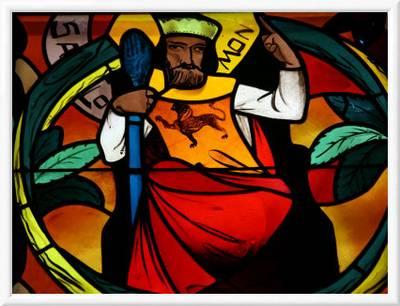
1 Kings 3:5-14 – A Prayer for Discernment

Stained glass window of King Solomon in Saint-Joseph Des Fins Church, France

The Lord appeared to Solomon at Gibeon in a dream at night. God said, “Ask whatever you wish, and I’ll give it to you.”

Solomon responded, “You showed so much kindness to your servant my father David when he walked before you in truth, righteousness, and with a heart true to you. You’ve kept this great loyalty and kindness for him and have now given him a son to sit on his throne. And now, Lord my God, you have made me, your servant, king in my father David’s place. But I’m young and inexperienced. I know next to nothing. But I’m here, your servant, in the middle of the people you have chosen, a large population that can’t be numbered or counted due to its vast size. Please give your servant a discerning mind in order to govern your people and to distinguish good from evil, because no one is able to govern this important people of yours without your help.”

It pleased the Lord that Solomon had made this request. God said to him, “Because you have asked for this instead of requesting long life, wealth, or victory over your enemies—asking for discernment so as to acquire good judgment— I will now do just what you said. Look, I hereby give you a wise and understanding mind. There has been no one like you before now, nor will there be anyone like you afterward. I now also give you what you didn’t ask for: wealth and fame. There won’t be a king like you as long as you live. And if you walk in my ways and obey my laws and commands, just as your father David did, then I will give you a very long life.” (Common English Bible)

You will recognize today’s Old Testament lesson as being the same as yesterday – just in a different book of the Bible. The books of 1 and 2 Chronicles are a restatement and edited version of 1 and 2 Kings. That’s because each was written in a different time for a particular context. Kings was compiled at the time of the Jewish exile when the Babylonians captured Jerusalem. Chronicles was put together for the exiles returning to Jerusalem.

Both accounts were meant to be lessons in how to live rightly as God’s people. For the people going into exile, the Kings narrative was to serve as a remembrance of how far the people had strayed from their roots in basic life wisdom.

“It is said that wisdom lies not in seeing things, but seeing through things.”

Manly P. Hall

Solomon was a very wise king. And today’s lesson makes it clear why. At the outset of his reign, Solomon could have asked for anything from God. A typical request might be for power in subduing enemies, popularity for appealing to the masses, or perks for maintaining political stability. 

Instead, Solomon asked for understanding and wisdom to govern God’s people so that he could discern between good and evil. It was the kind of asking which the Lord was pleased to hear and to give. All these millennia later, Solomon still has the reputation of being the wisest king that ever lived.

Solomon’s prayer resonates with me. As a church pastor, rather than focusing prayers on a bigger budget, more people reached, or adding programs, I can make the choice to pray for wisdom so that I will have my ministerial ladder on the right wall. 

As a hospital chaplain, instead of praying for greater visibility of the spiritual in healthcare, increased impact within the system, or more healing of patients, I can pray for understanding so that I will be able to make sound ethical, practical, and ministerial decisions in each context and case I encounter.

Solomon’s request was borne of a clear realization of who God is (the One who shows steadfast love) and who he himself is (like a little child with a big responsibility). God’s greatness and Solomon’s humility collided in a wonderful prayer for discernment to carry out God’s will on earth and to bless God’s people.

In this time of year, in which it is vogue to make New Year’s resolutions based upon the individual’s willpower, let’s take a different approach. Let’s pray and invite God to do the kind of deep change needed in our lives so that we can accomplish the will of God on this earth for this time. 

May we pray for discernment to serve well, ask for wisdom to be good stewards of our callings, and seek understanding from the God who delights in answering altruistic requests from humble people.

May you walk in the way of wisdom so that you will make good decisions and act in all good understanding.

Lord God, give me a mind and heart of wisdom so that I might rightly discern good and evil, right and wrong, and the best decisions to made in every situation. I choose to seek your ways and follow the narrow way of Jesus Christ through the enablement of your Holy Spirit. Amen.

Romans 8:18-30 – Anticipating Hope

I consider that the sufferings of this present time are not worth comparing with the glory about to be revealed to us. For the creation waits with eager longing for the revealing of the children of God; for the creation was subjected to futility, not of its own will but by the will of the one who subjected it, in hopethat the creation itself will be set free from its bondage to decay and will obtain the freedom of the glory of the children of God. We know that the whole creation has been groaning in labor pains until now; and not only the creation, but we ourselves, who have the first fruits of the Spirit, groan inwardly while we wait for adoption, the redemption of our bodies. For in hope, we were saved. Now hope that is seen is not hope. For who hopes for what is seen? But if we hope for what we do not see, we wait for it with patience.

Likewise, the Spirit helps us in our weakness; for we do not know how to pray as we ought, but that very Spirit intercedes with sighs too deep for words. And God, who searches the heart, knows what the mind of the Spirit is, because the Spirit intercedes for the saints according to the will of God.

We know that all things work together for good for those who love God, who are called according to his purpose.For those whom he foreknew he also predestined to be conformed to the image of his Son, in order that he might be the firstborn within a large family. And those whom he predestined he also called; and those whom he called he also justified; and those whom he justified he also glorified. (New Revised Standard Version)

Christians everywhere are presently anticipating the Nativity of the Lord, the birth of the Christ child. Not only Christians, but all people anticipate better days, hoping that during this season of goodwill that basic human kindness will be prolific and extend into the new year.

The brokenness of the world is dominated by disease and dissent. As of this writing, well over five million people have died worldwide due to COVID-19. I myself have attended dozens of those deaths. The grief, not only of losing a loved one, but many of them dying alone, is palpable.

If that weren’t bad enough, disease has become a political game. While there are currently two-hundred fifty million people infected with some strain of the coronavirus, far too many without the disease are using it to posture and position for their shortsighted rights.

And I haven’t even mentioned the hundreds of other world and national problems, beset with such a cacophony of dissenting voices bickering at one another, that innocent lives get ruined or lost. Who will rescue us from this body of death?

“The celebration of Advent is possible only to those who are troubled in soul, who know themselves to be poor and imperfect, and who look forward to something greater to come.”

Dietrich Bonhoeffer

Thanks be to God. There is an intervention. Hope is imminent. A star rises in the east. A leader is to be born – one who is deeply concerned for the common good of all people – one who will rule with equity and justice.

The believer’s salvation, in a gestation period of anticipation, is nearly full term. Expectation, patience, joy, and pain are part of the experience while we wait. Meanwhile, we must remain encouraged and healthy, keeping our future hope always in front of us so that we will not lose heart.

When injustice runs amok, and we are limited in what we can do about it, we pray. And then, there are times when we are flat on our backs, overwhelmed with our circumstances, not even able to utter any words in prayer.

Christians are awaiting their redemption. So, perseverance is needed. While waiting, it does no good to be like Eeyore and feel sorry for ourselves. Yet, on the other hand, it also does no good to always be smiling, positive, and upbeat as if nothing is worth grieving over. 

Grief and lament, hope and joy, must all be held together at the same time. Without the simultaneous embrace, we will live in abject denial – tightly gripping one hand while ignoring the other, as if we don’t have two of them.

Indeed, we live in an awkward time. Nothing is as it was, and nothing is as it should be… yet. This time of spiritual pregnancy, in which we possess salvation but do not yet possess it in all its fullness, is a weird liminal space in which we often don’t quite know what to do.

There is so much groaning going on because we realize there is such a large gap between where we are and where we want to be. If women could have babies without nine months of struggle, limitation, and pain I think they would opt for that instead of the way it is now. There is a time coming when every tear will be wiped away and unending joy will rule. No more disease. No more dissent. No more death.

All of creation groans because where it is now and where it will be seems like such a long time in coming.  Every creature and every living thing will experience decay and death. The world is not yet redeemed from its cursed bondage. So, the earth vomits disasters and diseases because we live in this fallen world that is not yet redeemed.

Humanity groans because we fall victim to circumstances beyond our control. We also groan because of our own poor choices that give us grief. Although we have been delivered from sin, death, and hell and experience spiritual power… we still must wait eagerly for the redemption of our bodies.

Yes, we are keenly aware of the terrible disconnect between where we are as people and where we want to be. It is something of feeling like Pinocchio, not yet a real boy who has to deal with strings and other puppeteers who do not care about him; and, who feels the need to lie because of his situation and pays the consequence of his nose growing.

Yet, a deeper thing is happening under the surface: Our frustrations, longings, lusts, jealousies, and escapist daydreams, things we might be ashamed of to take to prayer, are in fact already lifting our hearts and minds to God in more honest ways than we ever do consciously.

Take courage. The time is at hand.

“Do not be afraid; for see—I am bringing you good news of great joy for all the people: to you is born this day in the city of David a Savior, who is the Messiah, the Lord.” (Luke 2:10-11, NRSV)

Glory to God in the highest, and on earth peace, goodwill toward humanity.

Psalm 80:1-7 – Restore Us

Give ear, O Shepherd of Israel,
    you who lead Joseph like a flock!
You who are enthroned upon the cherubim, shine forth
    before Ephraim and Benjamin and Manasseh.
Stir up your might,
    and come to save us!

Restore us, O God;
    let your face shine, that we may be saved.

O Lord God of hosts,
    how long will you be angry with your people’s prayers?
You have fed them with the bread of tears,
    and given them tears to drink in full measure.
You make us the scorn of our neighbors;
    our enemies laugh among themselves.

Restore us, O God of hosts;
    let your face shine, that we may be saved. (New Revised Standard Version)

Restoration is a beautiful thing. I don’t often watch makeover shows on television. But if I’m channel surfing and see an old house, appearing ready for the wrecking ball, getting restored to its original charm and beauty, I’m hooked. We resonate deeply with things being repaired and rejuvenated, as if it is brand new.

For that to occur, someone needs to have a vision to see the old become new. If not, then the drab discouragement of a gray and dreary environment can easily take over. We then forget the original shine of how things once were to the point where we cannot even imagine that it’s worth salvaging. 

In the context of today’s psalm, God’s people once enjoyed the covenant and the promises of God. But over time, the relationship was not maintained and cared for. So, the people gradually slid into disrepair. Centuries of sheer neglect brought a situation where it seemed the only recourse was to raze everything and begin again.

The psalms have been the prayer book of God’s people for over three millennia. Suffering and hard circumstances provide the backdrop for many of them. Sometimes the difficulty is external – another nation oppressing the people. Yet other times, like in today’s psalm, the problem is internal – sheer neglect of God’s commands over time. It went on to the point that God’s longsuffering ran out.

I would much rather enjoy God’s favor than God’s disappointing anger. To begin addressing any sort of spiritual neglect, the work of prayer becomes the tool we need. Restoring broken lives and broken communities to their original beauty starts with prayer and praise, offered daily and often. 

Seven times a day I praise you
    for your righteous laws. (Psalm 119:164, NIV)

What’s more, our tears, which seem, at times, to be our daily bread, are a kind of baptismal offering to God – prayers coming through groans which words cannot express. Even with our prayers, the Lord is gracious to help us with the requests themselves and not just the answers.

And the Holy Spirit helps us in our weakness. For example, we don’t know what God wants us to pray for. But the Holy Spirit prays for us with groanings that cannot be expressed in words. (Romans 8:26, NLT)

God is waiting for us to approach the throne of grace with confidence. And we must keep coming to the Lord, again and again. 

Jesus understands every weakness of ours because he was tempted in every way that we are. But he did not sin! So whenever we are in need, we should come bravely before the throne of our merciful God. There we will be treated with undeserved kindness, and we will find help. (Hebrews 4:15-16, CEV)

Like the continual routine of using the hammer, pounding nail after nail, so we must offer our prayers morning, noon, and night, day after day, crying out to God with the great cry of the church: Restore us, O God; let your face shine, that we may be saved!

May the hope of Advent, the love of God in Christ, and the encouragement of the Holy Spirit restore your soul and enliven your spirit, now and forever. Amen.

O loving and gracious God, bring restoration to my life, to my church, to my family, to my workplace, and to my community.  Things are not as they once were.  Send your Holy Spirit so that we might enjoy seasons of blessing again.  Restore, renew, revive and rejuvenate our disordered churches.  May your face shine upon us once again through the mighty name of Jesus.  Amen.