Listen to what’s right, Lord; pay attention to my cry! Listen closely to my prayer; it’s spoken by lips that don’t lie! My justice comes from you; let your eyes see what is right! You have examined my heart, testing me at night. You’ve looked me over closely, but haven’t found anything wrong. My mouth doesn’t sin. But these other people’s deeds? I have avoided such violent ways by the command from your lips. My steps are set firmly on your paths; my feet haven’t slipped.
I cry out to you because you answer me. So tilt your ears toward me now— listen to what I’m saying! Manifest your faithful love in amazing ways because you are the one who saves those who take refuge in you, saving them from their attackers by your strong hand. Watch me with the very pupil of your eye! Hide me in the protection of your wings, away from the wicked who are out to get me, away from my deadly enemies who are all around me! They have no pity; their mouths speak arrogantly. They track me down— suddenly, they surround me! They make their plans to put me in the dirt. They are like a lion eager to rip its prey; they are like a strong young lion lying in wait.
Get up, Lord! Confront them! Bring them down! Rescue my life from the wicked— use your sword! Rescue me from these people— use your own hands, Lord! Rescue me from these people whose only possession is their fleeting life. But fill the stomachs of your cherished ones; let their children be filled full so that they have leftovers enough for their babies.
But me? I will see your face in righteousness; when I awake, I will be filled full by seeing your image. (Common English Bible)
This is one of David’s personal psalms of lament. It’s a prayer forged smack in the middle of adversity with unjust adversaries seeking to take his life.
The psalm is a visceral plea for God to vindicate David and subdue those who wanted to harm him. Today’s psalm is also a heartfelt lament that wickedness exists and often gets its way; it is an expression of grief about the constant threats swirling around David.
There was so much mean and arrogant violence that David prayed God would keep him as the apple of his eye and hide him in the shadow of his wings.
Indeed, perhaps no better prayer could be said in times when there are people who make untrue accusations and only wish harm to be done to you, that the Lord will keep a continual watchful, focused, and vigilant gaze upon us.
In times when angry simpletons spew their worst and misguided miscreants seek us harm, we need to confidently know: God watches over us with affection and cares for us as a mother hen protects her chicks.
Even before we make the request, neither our predicament nor our hearts are strangers to the Lord. Our human ingenuity and stamina is not enough to overcome intense hardship and adversity. The Lord must be there to help us and to guide our hearts toward the good. Even when the way is painful, later it will bear the fruit of righteousness.
You and I are precious to God. We can run to the Lord when there is trouble. There truly is a benevolent God showing firm commitment to those who seek truth, loving actions, and merciful words.
When going through a difficult season, in which another or others accuse you of wrongdoing and you know you are innocent, the proper prescription is to pray this very psalm repeatedly at night before bed. For we all know that sleep can be elusive and hard to come by in such difficult circumstances. The palpable stress can make it impossible to tone down the racing thoughts.
Trying to fall asleep through sheer willpower is totally ineffective. Instead, try to stay awake by praying. While it may sound counterintuitive, trying to stay awake through prayer lessens the anxiety around trying to fall asleep. Since falling asleep is an involuntary process, taking our minds off of the task at hand gives the brain the break it needs, and the heart the comfort it needs.
Perhaps, along with David, you will be able to say that your prayers are answered – that you beheld the face of righteousness and had good sleep. And in the morning, when you awake, you will feel satisfied with having seen the likeness of a God who hears and cares.
Gracious and merciful Lord, you are the holy One who has pity for all our weakness. Put away from us worry and every anxious fear so that at the end of a hard day – in which you saw all of our labor and all our adversities – your compassionate eye will watch over us and your loving hand will hold us as we lay down for rest. And when the night has come, may we receive from you your priceless gift of sleep, through Jesus Christ our Lord. Amen.
Have mercy on me, God, according to your faithful love! Wipe away my wrongdoings according to your great compassion! Wash me completely clean of my guilt; purify me from my sin! Because I know my wrongdoings, my sin is always right in front of me. I’ve sinned against you—you alone. I’ve committed evil in your sight. That’s why you are justified when you render your verdict, completely correct when you issue your judgment. Yes, I was born in guilt, in sin, from the moment my mother conceived me. And yes, you want truth in the most hidden places; you teach me wisdom in the most secret space.
Purify me with hyssop and I will be clean; wash me and I will be whiter than snow. Let me hear joy and celebration again; let the bones you crushed rejoice once more. Hide your face from my sins; wipe away all my guilty deeds! Create a clean heart for me, God; put a new, faithful spirit deep inside me! Please don’t throw me out of your presence; please don’t take your holy spirit away from me. Return the joy of your salvation to me and sustain me with a willing spirit. Then I will teach wrongdoers your ways, and sinners will come back to you.
Deliver me from violence, God, God of my salvation, so that my tongue can sing of your righteousness. Lord, open my lips, and my mouth shall proclaim your praise. You don’t want sacrifices. If I gave an entirely burned offering, you wouldn’t be pleased. A broken spirit is my sacrifice, God. You won’t despise a heart, God, that is broken and crushed. (Common English Bible)
Ash Wednesday is an ancient holy day on the Church Calendar. It marks the beginning of the season of Lent—a time of penitence, discipline, and renewal.
We are reminded of our mortality, we confess our sins, and we experience forgiveness through Christ’s death and resurrection. The “imposition of ashes” is a central part of Ash Wednesday observances, whereby the penitent worshiper receives ashes on the forehead in the sign of the cross.
In Holy Scripture, ashes serve both as a symbol of mortality and as a sign of mourning and repentance. But neither sin nor death is the final word. So, we also have confidence and gratitude that Christ has conquered death, and nothing can separate us from the love of God, which is in Jesus, our Lord.
Today, on this Ash Wednesday, the appropriate posture of the devout Christian is prayer. Specifically, prayers of confession of our great and many sins, shortcomings, and moral failures.
This might sound negative and a major downer. Yet, to not look evil square in the face and call it out for what it is, is at best denial, and at the worst allowing a bitter seed of unforgiveness to gestate in the depths of your soul.
It seems to me there is no better way to confront the darkness within than with using the ancient prayer book of the Old Testament Psalms. I encourage you to pray Psalm 51 out loud and slowly, with a generous amount of emotional flavor – even, and especially, if you don’t feel like it.
Pray the ancient psalm over more than once, and perhaps several times punctuated throughout the day today. In doing so, you will be joining the faithful across this entire big world who today offer to God a prayer of subversion against the blackness on this earth.
Holy God, as the season now turns to Lent, we pray that you will guide us in the days ahead. As we journey with Jesus, give us an abiding sense of your presence, an unguarded sense of ourselves, and an awareness of the needs of this world.
Loving God, as we are marked with the ashes of earth, we bring before you the frailty of our very human lives: our fragile health; the uncertainty of our plans; the changing nature of our relationships. Grant us patience in suffering and healing from our ills. Give us, in equal measure, humility and hope in our pursuits. Bind us in love that is constant, yet able to change according to the needs and circumstances before us.
Just God, you call us to action; to bring freedom to the oppressed; to care for those in need; to lift the burdens of others. We ask you to increase our courage and our will to work for the peace you envision and desire. We pray for an end to warfare and conflict, accepting our call to be peacemakers. We pray for an end to hunger and homelessness, knowing we are called to share with others and show hospitality. We pray for an end to false righteousness, evil speech, and shallow faith in our lives, in the church, in our public life, and among all the nations.
Eternal God, we pray your kingdom will come in fullness; that what is perishable will be raised imperishable; that death itself will be swallowed up in victory; through Jesus Christ, our Savior and Lord. Amen.
Jesus took Peter, John and James with him and went up onto a mountain to pray. As he was praying, the appearance of his face changed, and his clothes became as bright as a flash of lightning. Two men, Moses and Elijah, appeared in glorious splendor, talking with Jesus. They spoke about his departure, which he was about to bring to fulfillment at Jerusalem. Peter and his companions were very sleepy, but when they became fully awake, they saw his glory and the two men standing with him. As the men were leaving Jesus, Peter said to him, “Master, it is good for us to be here. Let us put up three shelters—one for you, one for Moses and one for Elijah.” (He did not know what he was saying.)
While he was speaking, a cloud appeared and covered them, and they were afraid as they entered the cloud. A voice came from the cloud, saying, “This is my Son, whom I have chosen; listen to him.” When the voice had spoken, they found that Jesus was alone. The disciples kept this to themselves and did not tell anyone at that time what they had seen.
The next day, when they came down from the mountain, a large crowd met him. A man in the crowd called out, “Teacher, I beg you to look at my son, for he is my only child. A spirit seizes him, and he suddenly screams; it throws him into convulsions so that he foams at the mouth. It scarcely ever leaves him and is destroying him. I begged your disciples to drive it out, but they could not.”
“You unbelieving and perverse generation,” Jesus replied, “how long shall I stay with you and put up with you? Bring your son here.”
Even while the boy was coming, the demon threw him to the ground in a convulsion. But Jesus rebuked the impure spirit, healed the boy and gave him back to his father. And they were all amazed at the greatness of God.(New International Version)
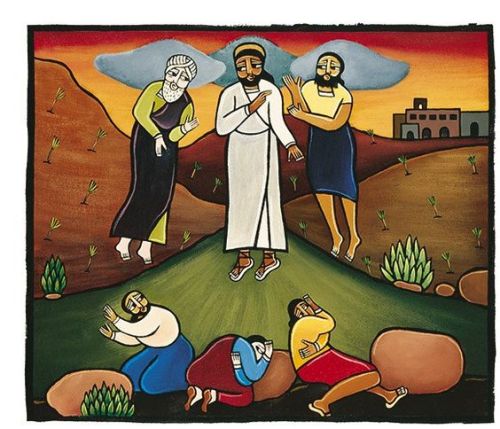
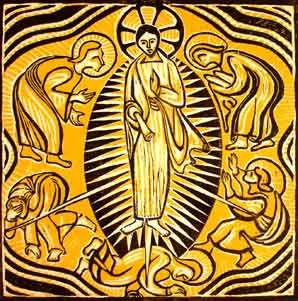
When Jesus is around, extraordinary things happen. And yet, sometimes we just don’t perceive it. The three disciples of Jesus – Peter, James, and John – experienced something incredible, yet they were not really aware of what it meant, at the time. The Transfiguration of Jesus on the mountain was unimaginable and awesome. The disciples, however, were confused, sleepy, and walked away silent about the whole affair.
Woodcut of the Transfiguration by Sister Mary Grace Thul
Coming down from the mountain, the other disciples were found scratching their heads about a boy in need of healing. Jesus seemed rather perturbed about the all-around lack of faith. After curing the boy, everyone was amazed, as if they did not expect such a thing to occur.
We are not always told in the Gospels why Christ’s disciples often did not understand or perceive the significance of the miraculous, supernatural, or extraordinary events that took place right in front of them. Maybe their minds were somewhere else.
It could be that Peter had ADD (Attention Deficit Disorder) and was having trouble focusing.
Perhaps James trying to do some sort of ancient multi-tasking.
Maybe John had some road rage on his way to the meeting on the mountain and was having a hard time thinking straight.
It could be that the three disciples were caught up in the anxiety of wondering where their next shekel was coming from.
Perhaps they were just up too late the night before binge watching the fishermen on the lake. But whatever was going on with the disciples, they were distracted.
So, we actually have God the Father step into the scene at the Transfiguration of Jesus on the mountain and speak. God isn’t typically in the business of exhorting people to listen unless they are not paying attention. The heavenly Father is clear, succinct, and to the point:
“This is my Son, whom I have chosen; listen to him.”
We are to listen to Jesus because he is God’s Son. Everything centers round him.
Jesus is the full bodily and human representation of God on earth. Jesus is Savior, Lord and Master, Teacher and Healer.
Jesus is the complete fulfillment of all the Old Testament promises, and the one who will come again to judge the living and the dead.
Jesus is the mid-point of history, the hinge upon which all the universe swings. Jesus is the one whom we must listen to when he speaks and acts.
Therefore, our identity is to be fully bent, molded, and shaped in Jesus Christ. This spiritual formation of our lives happens as we intentionally seek to be with Jesus, listen to him, and do what he says.
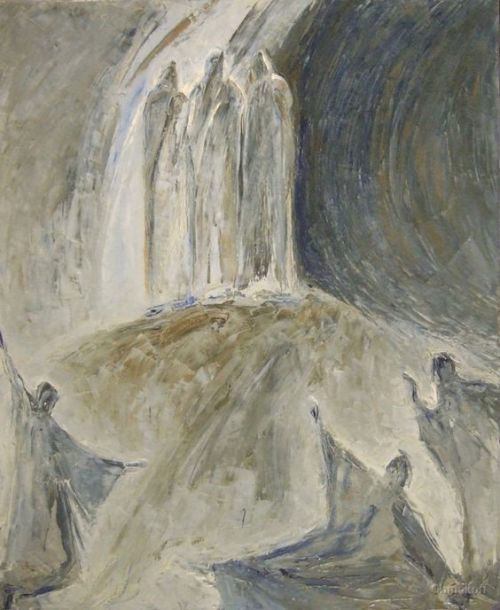
Transfiguration by Macha Chmakoff
Jesus took Peter, James, and John up the mountain to experience his Transfiguration in a prayer meeting. Extraordinary things happen in prayer meetings. The early church gathered often in prayer meetings, following the example of their Lord Jesus. As the church listened to God and responded (in a rhythm of revelation and response) they saw Peter miraculously delivered from jail; ordinary people delivered from empty lives and demonic influence; and guidance in how to proceed as followers of Christ.
Prayer is as much or more about listening to God as it is talking to him. It is in listening to God that we are filled with God’s Spirit and empowered to come down from the mountain and engage in God’s mission.
Jesus wanted the disciples to learn and discern something on the mountain. Jesus was changed in front of them. Moses and Elijah showed up and talked with him about his “departure,” that is, his “exodus.”
Moses was the one who listened to God and led the people in a mass exodus from slavery in Egypt to the freedom of the Promised Land.
Elijah was a prophet who listened to God and led the people out of centuries of idol worship and dead religion into the freedom of spiritual and national revival in Israel.
And Jesus came to lead people in an exodus out of sin, death, and hell so that they can experience a new life of freedom, hope, peace, and joy.
Changed lives are God’s goal for us. And a changed life will occur when we listen to God’s Son, Jesus, learn from him, and lean into faith in him – all of which takes humility.
Eventually, Jesus and his disciples came down from the mountain. Prayer meetings are great, but there is a time to descend the mountain and engage in God’s mission.
We are to participate with God in seeing changed lives through the work of Jesus.
We must bear witness to the redemptive saving events of Jesus to a world which desperately needs him – his healing work of both body and spirit.
The glory of God is presently here among us. We need to perceive it and be aware of it. But to do so, we must listen well.
Erik Weihenmayer is blind, yet on May 25, 2001, he reached the peak of Mount Everest. Suffering from a degenerative eye disease, he lost his sight when he was thirteen years old. But that did not stop him from mountain climbing. On a mountain where 90% of climbers never make it to the top—and 165 have died trying since 1953—Erik succeeded in large measure because he listened well.
He listened to the little bell tied to the back of the climber in front of him, so he would know what direction to go. He listened to the voice of teammates who would shout back to him, “Death-fall two feet to your right!” so he would know what direction not to go. He listened to the sound of his pick jabbing the ice, so he would know whether the ice was safe to cross.
When we journey through this life, listening well makes all the difference. So, how might we listen well to Jesus? Here are some basic principles of active listening:
Stop talking. It was Mark Twain who said: “If we were supposed to talk more than we listen, we would have two tongues and one ear.” Proverbs 12:15 says, “The way of a fool seems right to him (therefore he has no need to listen) but a wise person listens to advice.”
Prepare yourself to listen to God. One of the ways I do this is by sitting in a quiet spot, free of distraction, and repeat several times to God, “Speak Lord, for your servant is listening” (1 Samuel 3:10). Then, I am quiet… and listen…. If this practice is way off your radar then I would recommend, at first, being quiet for only a few minutes. Then, after a few weeks, be quiet in longer stretches so that you can go 20-30 minutes or even an hour. We might even consider a silent retreat in which the sole purpose is to listen to what God is saying to us.
Slowly and carefully read God’s Word. Scripture is meant to be digested in small bites and thoroughly savored. Slow down and be quiet enough to hear God speak through the Word. A contemplative and meditative readings of Holy Scripture will always yield spiritual health and vitality.
Pray back to God what you hear him saying to you. This is active listening – a genuine dialogue between us and God. “Come, now, let us reason together,” the Lord has said (Isaiah 1:18). God wants a conversation with us.
God speaks, if we have ears to hear, through so much more than an audible voice.
The Lord’s Supper is a tangible proclamation of the person and work of Jesus Christ. It speaks to us, and, so, we must listen well. The Table proclaims Christ’s identity as God’s Son, the one who came to live a holy life, teaches us the way to live, and how Jesus died a cruel death so that we might be born again and experience new life.
We Are All One in Jesus Christ by Soichi Watanabe, 2009
The Table proclaims our mission, that as often as we share in communion, we proclaim the Lord’s death until he comes again. That is, we witness to the reality of Christ’s redemption in our own lives. We share our own changed lives with others. We pray for them so that they will experience new life, as well.
The Table proclaims our spiritual formation in Christ. At the Table, we are lifted and joined with Christ through the Holy Spirit. It is a mysterious joining that defies description, just as the disciples had a mysterious encounter that they could not fully explain. Yet they experienced it, nonetheless.
May we listen well, without distraction, to God’s Son. May we know God’s purpose for our life. And may we encounter Jesus at the Table, and in all of life, so that we experience new life.
O God, teach us to listen to those nearest to us, our family, our friends, our co-workers. Caring God, teach us to listen to those far from us – the whisper of the hopeless, the plea of the forgotten, and the cry of the anguished. Holy Spirit of God, teach us to listen for your voice — in busyness and in boredom, in certainty and doubt, in noise and in silence. Gracious God, teach us to listen well to the message of your Table. May you change and transform us to be like Jesus. Teach us, Lord, to listen. Amen.
One day the Lord said to Moses, “Climb one of the mountains east of the river and look out over the land I have given the people of Israel. After you have seen it, you will die like your brother, Aaron, for you both rebelled against my instructions in the wilderness of Zin. When the people of Israel rebelled, you failed to demonstrate my holiness to them at the waters.” (These are the waters of Meribah at Kadesh in the wilderness of Zin.)
Then Moses said to the Lord, “O Lord, you are the God who gives breath to all creatures. Please appoint a new man as leader for the community. Give them someone who will guide them wherever they go and will lead them into battle, so the community of the Lord will not be like sheep without a shepherd.”
The Lord replied, “Take Joshua son of Nun, who has the Spirit in him, and lay your hands on him. Present him to Eleazar the priest before the whole community, and publicly commission him to lead the people. Transfer some of your authority to him so the whole community of Israel will obey him. When direction from the Lord is needed, Joshua will stand before Eleazar the priest, who will use the Urim—one of the sacred lots cast before the Lord—to determine his will. This is how Joshua and the rest of the community of Israel will determine everything they should do.”
So, Moses did as the Lord commanded. He presented Joshua to Eleazar the priest and the whole community. Moses laid his hands on him and commissioned him to lead the people, just as the Lord had commanded through Moses. (New Living Translation)
Moses was one of the most humble persons who ever lived on this earth (Numbers 12:3). Whereas many people are concerned for their legacy at end of life, Moses, instead, had a deep pastoral concern for his fellow Israelites. He didn’t want them without a capable and godly leader. So, in his humility, Moses was willing to obey God, let go of power, and share his authority so that the people would be well-cared for.
“All streams flow to the ocean because it is lower than they are. Humility gives it its power.”
Lao Tzu (Chinese philosopher, 6th century B.C.E.)
I believe humility is the queen of all virtue, especially that of leadership. Yet, humility is one of the hardest virtues to practice because it requires that we willingly put aside pride, ego, and personal agendas in order to embrace God’s agenda.
Rather than having large statues erected to honor us and our proud accomplishments, or having our names plastered on buildings (and churches!) to recognize our wonderful charity, we really need to orient our energies toward passing the baton to trustworthy people who are capable of faithfully fulfilling the role of servant leader. (2 Timothy 2:2)
Being poor in spirit (Matthew 5:3), becoming like a little child (Matthew 18:3), and thinking of others as better than ourselves (Philippians 2:3) are the cornerstones to becoming open to what God has for us. To be a humble leader means to steadfastly seek God’s will and way in everything. Then, to have the courage in leading others toward God’s direction, despite resistance and opposition from those who want to follow a different path.
Therefore, a leader’s task is to be consumed with seeking God’s direction rather than living purely according to instinct, pragmatic desire, or personal views. We continually need a radical openness to God. So, we must work to develop an ever-deepening awareness of where God is leading us.
God, in divine mercy, is always up to something good. The Lord has plans for us and for the people we lead. It’s humility that allows us to listen well to God’s Spirit and gain the direction needed for leadership.
Yet, being open to God is not quite as easy as it sounds. We must recognize that not everyone is open to God. There are those, maybe even including us, who may be closed to God.
If our focus is more on creating safety and security or trying to do enough good deeds to be recognized by God and others, or having our institution be what we want it to be, then we have become closed to what God wants. This comes out in a couple of different ways….
Maintaining tradition, at all costs. Whenever we do everything the way we have always done it, to make us feel safe and secure, then anything that threatens that security angers us. This is where folks practice either fight or flight – they wage either a holy war or just leave. Living with uncertainty and ambiguity is too much for them. But faith is what it takes if we are going to follow God. Like Abraham in the Old Testament, we are called to move and change without always knowing the destination.
Getting rid of traditions, at all costs. Sometimes folks who want new or different, desire to create a place of their own making to serve them and their needs. They aren’t really focused on what God is calling them to do. Rather, like Timothy in the New Testament, we are to hold onto the great deposit of doctrine and heritage given to us and not always be looking for the next new thing to turn things around.
So, what to do? Have the humility to ask the question continually and constantly: “What is God’s will?” We need leadership that is incredibly open to God, allowing decision-making to come from a position of faith, and not fear. This enables us….
To let God, flow in and through us, rather than willfully insisting it should be our way or the highway.
To practice hope and love, rather than relying on our own strength and desires.
To make prayer and discernment the foundation of what we do, always seeking what God wants and then leading others in that direction by inviting them to the same kind of prayerful process.
To read our Bibles as if our lives depended on it and pray like there is no tomorrow.
If we have humility and a deep openness to God; a conviction that we are primarily called to follow Jesus Christ; a willingness to let God’s power flow through us; and, a determined readiness to move people lovingly and graciously in God’s direction, then amazing things can happen.
Let our prayer together be this: I am yours, God, no matter where you call me to go, what you call me to do, and how you call me to be. I will seek your will and way as I lead others to do the same. Amen.