Romans 8:18-30 – Anticipating Hope

I consider that the sufferings of this present time are not worth comparing with the glory about to be revealed to us. For the creation waits with eager longing for the revealing of the children of God; for the creation was subjected to futility, not of its own will but by the will of the one who subjected it, in hopethat the creation itself will be set free from its bondage to decay and will obtain the freedom of the glory of the children of God. We know that the whole creation has been groaning in labor pains until now; and not only the creation, but we ourselves, who have the first fruits of the Spirit, groan inwardly while we wait for adoption, the redemption of our bodies. For in hope, we were saved. Now hope that is seen is not hope. For who hopes for what is seen? But if we hope for what we do not see, we wait for it with patience.

Likewise, the Spirit helps us in our weakness; for we do not know how to pray as we ought, but that very Spirit intercedes with sighs too deep for words. And God, who searches the heart, knows what the mind of the Spirit is, because the Spirit intercedes for the saints according to the will of God.

We know that all things work together for good for those who love God, who are called according to his purpose.For those whom he foreknew he also predestined to be conformed to the image of his Son, in order that he might be the firstborn within a large family. And those whom he predestined he also called; and those whom he called he also justified; and those whom he justified he also glorified. (New Revised Standard Version)

Christians everywhere are presently anticipating the Nativity of the Lord, the birth of the Christ child. Not only Christians, but all people anticipate better days, hoping that during this season of goodwill that basic human kindness will be prolific and extend into the new year.

The brokenness of the world is dominated by disease and dissent. As of this writing, well over five million people have died worldwide due to COVID-19. I myself have attended dozens of those deaths. The grief, not only of losing a loved one, but many of them dying alone, is palpable.

If that weren’t bad enough, disease has become a political game. While there are currently two-hundred fifty million people infected with some strain of the coronavirus, far too many without the disease are using it to posture and position for their shortsighted rights.

And I haven’t even mentioned the hundreds of other world and national problems, beset with such a cacophony of dissenting voices bickering at one another, that innocent lives get ruined or lost. Who will rescue us from this body of death?

“The celebration of Advent is possible only to those who are troubled in soul, who know themselves to be poor and imperfect, and who look forward to something greater to come.”

Dietrich Bonhoeffer

Thanks be to God. There is an intervention. Hope is imminent. A star rises in the east. A leader is to be born – one who is deeply concerned for the common good of all people – one who will rule with equity and justice.

The believer’s salvation, in a gestation period of anticipation, is nearly full term. Expectation, patience, joy, and pain are part of the experience while we wait. Meanwhile, we must remain encouraged and healthy, keeping our future hope always in front of us so that we will not lose heart.

When injustice runs amok, and we are limited in what we can do about it, we pray. And then, there are times when we are flat on our backs, overwhelmed with our circumstances, not even able to utter any words in prayer.

Christians are awaiting their redemption. So, perseverance is needed. While waiting, it does no good to be like Eeyore and feel sorry for ourselves. Yet, on the other hand, it also does no good to always be smiling, positive, and upbeat as if nothing is worth grieving over. 

Grief and lament, hope and joy, must all be held together at the same time. Without the simultaneous embrace, we will live in abject denial – tightly gripping one hand while ignoring the other, as if we don’t have two of them.

Indeed, we live in an awkward time. Nothing is as it was, and nothing is as it should be… yet. This time of spiritual pregnancy, in which we possess salvation but do not yet possess it in all its fullness, is a weird liminal space in which we often don’t quite know what to do.

There is so much groaning going on because we realize there is such a large gap between where we are and where we want to be. If women could have babies without nine months of struggle, limitation, and pain I think they would opt for that instead of the way it is now. There is a time coming when every tear will be wiped away and unending joy will rule. No more disease. No more dissent. No more death.

All of creation groans because where it is now and where it will be seems like such a long time in coming.  Every creature and every living thing will experience decay and death. The world is not yet redeemed from its cursed bondage. So, the earth vomits disasters and diseases because we live in this fallen world that is not yet redeemed.

Humanity groans because we fall victim to circumstances beyond our control. We also groan because of our own poor choices that give us grief. Although we have been delivered from sin, death, and hell and experience spiritual power… we still must wait eagerly for the redemption of our bodies.

Yes, we are keenly aware of the terrible disconnect between where we are as people and where we want to be. It is something of feeling like Pinocchio, not yet a real boy who has to deal with strings and other puppeteers who do not care about him; and, who feels the need to lie because of his situation and pays the consequence of his nose growing.

Yet, a deeper thing is happening under the surface: Our frustrations, longings, lusts, jealousies, and escapist daydreams, things we might be ashamed of to take to prayer, are in fact already lifting our hearts and minds to God in more honest ways than we ever do consciously.

Take courage. The time is at hand.

“Do not be afraid; for see—I am bringing you good news of great joy for all the people: to you is born this day in the city of David a Savior, who is the Messiah, the Lord.” (Luke 2:10-11, NRSV)

Glory to God in the highest, and on earth peace, goodwill toward humanity.

Psalm 80:1-7 – Restore Us

Give ear, O Shepherd of Israel,
    you who lead Joseph like a flock!
You who are enthroned upon the cherubim, shine forth
    before Ephraim and Benjamin and Manasseh.
Stir up your might,
    and come to save us!

Restore us, O God;
    let your face shine, that we may be saved.

O Lord God of hosts,
    how long will you be angry with your people’s prayers?
You have fed them with the bread of tears,
    and given them tears to drink in full measure.
You make us the scorn of our neighbors;
    our enemies laugh among themselves.

Restore us, O God of hosts;
    let your face shine, that we may be saved. (New Revised Standard Version)

Restoration is a beautiful thing. I don’t often watch makeover shows on television. But if I’m channel surfing and see an old house, appearing ready for the wrecking ball, getting restored to its original charm and beauty, I’m hooked. We resonate deeply with things being repaired and rejuvenated, as if it is brand new.

For that to occur, someone needs to have a vision to see the old become new. If not, then the drab discouragement of a gray and dreary environment can easily take over. We then forget the original shine of how things once were to the point where we cannot even imagine that it’s worth salvaging. 

In the context of today’s psalm, God’s people once enjoyed the covenant and the promises of God. But over time, the relationship was not maintained and cared for. So, the people gradually slid into disrepair. Centuries of sheer neglect brought a situation where it seemed the only recourse was to raze everything and begin again.

The psalms have been the prayer book of God’s people for over three millennia. Suffering and hard circumstances provide the backdrop for many of them. Sometimes the difficulty is external – another nation oppressing the people. Yet other times, like in today’s psalm, the problem is internal – sheer neglect of God’s commands over time. It went on to the point that God’s longsuffering ran out.

I would much rather enjoy God’s favor than God’s disappointing anger. To begin addressing any sort of spiritual neglect, the work of prayer becomes the tool we need. Restoring broken lives and broken communities to their original beauty starts with prayer and praise, offered daily and often. 

Seven times a day I praise you
    for your righteous laws. (Psalm 119:164, NIV)

What’s more, our tears, which seem, at times, to be our daily bread, are a kind of baptismal offering to God – prayers coming through groans which words cannot express. Even with our prayers, the Lord is gracious to help us with the requests themselves and not just the answers.

And the Holy Spirit helps us in our weakness. For example, we don’t know what God wants us to pray for. But the Holy Spirit prays for us with groanings that cannot be expressed in words. (Romans 8:26, NLT)

God is waiting for us to approach the throne of grace with confidence. And we must keep coming to the Lord, again and again. 

Jesus understands every weakness of ours because he was tempted in every way that we are. But he did not sin! So whenever we are in need, we should come bravely before the throne of our merciful God. There we will be treated with undeserved kindness, and we will find help. (Hebrews 4:15-16, CEV)

Like the continual routine of using the hammer, pounding nail after nail, so we must offer our prayers morning, noon, and night, day after day, crying out to God with the great cry of the church: Restore us, O God; let your face shine, that we may be saved!

May the hope of Advent, the love of God in Christ, and the encouragement of the Holy Spirit restore your soul and enliven your spirit, now and forever. Amen.

O loving and gracious God, bring restoration to my life, to my church, to my family, to my workplace, and to my community.  Things are not as they once were.  Send your Holy Spirit so that we might enjoy seasons of blessing again.  Restore, renew, revive and rejuvenate our disordered churches.  May your face shine upon us once again through the mighty name of Jesus.  Amen.

2 Samuel 7:18-29 – A Model Prayer

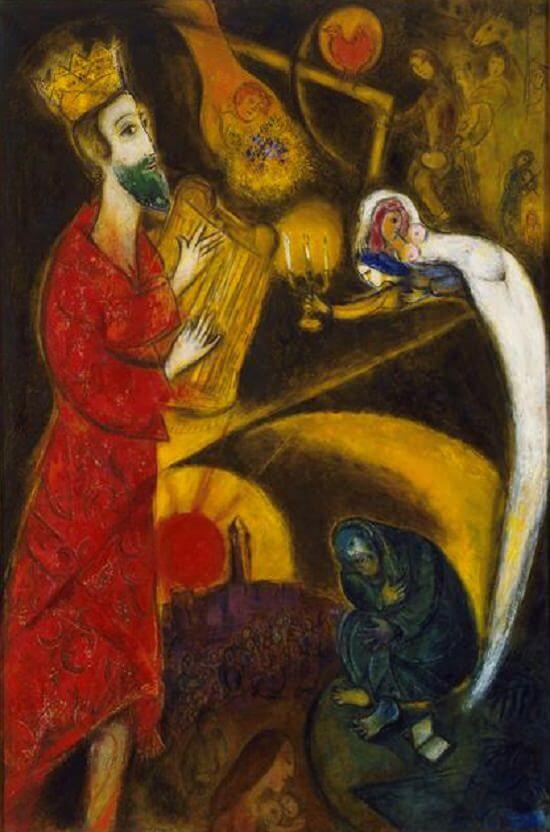
King David by Marc Chagall, 1962

Then King David went in and sat before the Lord, and he said:

“Who am I, Sovereign Lord, and what is my family, that you have brought me this far? And as if this were not enough in your sight, Sovereign Lord, you have also spoken about the future of the house of your servant—and this decree, Sovereign Lord, is for a mere human!

“What more can David say to you? For you know your servant, Sovereign Lord. For the sake of your word and according to your will, you have done this great thing and made it known to your servant.

“How great you are, Sovereign Lord! There is no one like you, and there is no God but you, as we have heard with our own ears. And who is like your people Israel—the one nation on earth that God went out to redeem as a people for himself, and to make a name for himself, and to perform great and awesome wonders by driving out nations and their gods from before your people, whom you redeemed from Egypt? You have established your people Israel as your very own forever, and you, Lord, have become their God.

“And now, Lord God, keep forever the promise you have made concerning your servant and his house. Do as you promised, so that your name will be great forever. Then people will say, ‘The Lord Almighty is God over Israel!’ And the house of your servant David will be established in your sight.

“Lord Almighty, God of Israel, you have revealed this to your servant, saying, ‘I will build a house for you.’ So, your servant has found courage to pray this prayer to you. Sovereign Lord, you are God! Your covenant is trustworthy, and you have promised these good things to your servant. Now be pleased to bless the house of your servant, that it may continue forever in your sight; for you, Sovereign Lord, have spoken, and with your blessing the house of your servant will be blessed forever.” (New International Version)

“The whole reason why we pray is to be united into the vision and contemplation of God to whom we pray.”

Julian of Norwich (1343-1416)

Perhaps you wish you had a better prayer life. To pray, as with most things in life, requires both motivation and how to do it. So, it’s appropriate to find answers about prayer by observing the biblical models of prayer contained in Holy Scripture.

Today’s Old Testament lesson is King David’s prayer in response to God’s revelation to him about fulfilling covenant promises. Looking at David’s prayer, there is a three-fold division which models for us a good way to approach God.

The Present: Gratitude for God’s Grace

David began his prayer with an attitude, posture, and words of humility, recognizing and affirming the relationship between himself and God. Although David is the king over all Israel and Judah, he repeatedly refers to himself as a servant (10 times).

God didn’t have to communicate anything to David about the future. Yet, the Lord graciously made known that it would be through David’s descendants that all of God’s good promises will be fulfilled. And David is overwhelmed with such gracious words. It comes tumbling out of him in a heartfelt prayer of gratitude and thanksgiving.

It is good for us to think about the spiritual blessings we have received from God. Not only can prayers of thanksgiving be uttered at any time to the Lord, but we can also write our gratitude in a journal as a prayer offering to God.

It’s also good to be specific about the circumstances and the praises. In the future, whenever there are discouraging situations, we can look back to what we wrote and remember the ways in which God showed up and encouraged us with very great and precious promises.

The Past: Praise for God’s Actions

David affirms there is no one and no god which can compare to Yahweh, the great I Am. It is the Lord God almighty who displayed divine power and presence in redeeming the Israelites out of Egyptian slavery and into the Promised Land.

Any greatness which arises from humans is the direct result of God’s greatness. Apart from God, there is no distinctive way of living. God’s presence makes all the difference:

Then Moses said to him [Yahweh], “If your Presence does not go with us, do not send us up from here. How will anyone know that you are pleased with me and with your people unless you go with us? What else will distinguish me and your people from all the other people on the face of the earth?” (Exodus 33:15-16, NIV)

The Lord specializes in bending hopeless situations to divine purposes, transforming people to new life, and turning systemic evil on its head so that the humble, meek, and penitent will be first, not last.

The Future: Prayer for God to Fulfill Divine Promises

King David already knew God’s promises to the Israelites. Now, however, David understands how he personally fits into the Lord’s plan.

Courage arises whenever God’s people know God’s promises and then discern how to fit into God’s plan. Confident assurance and settled peace cannot simply be ginned-up through positive thinking; bold faith needs a foundation of truth – a rock solid base which cannot be moved and is always there.

King David found his ultimate motivation in life in God’s revelation. His basis of prayer was God’s Word. Biblical prayers, like David’s, are there for us to model our own prayers.

Accept, O Lord, our thanks and praise for all that you have done for us. We thank you for the splendor of the whole creation, for the beauty of this world, for the wonder of life, and for the mystery of love. We thank you for the blessing of family and friends, and for the loving care which surrounds us on every side. We thank you for setting us at tasks that demand our best efforts, and for leading us to accomplishments that satisfy and delight us. We thank you also for those disappointments and failures that lead us to acknowledge our dependence on you alone.

Above all, we thank you for your Son Jesus Christ; for the truth of his Word and the example of his life; for his steadfast obedience, by which he overcame temptation; for his dying, through which he conquered death; and for his rising to life again, in which we are raised to the life of your kingdom. Grant us the gift of your Spirit, that we may know Christ and make him known; and through him, at all times and in all places, may give thanks to you in all things. Amen.

Psalm 63 – I Will

You are my God. I worship you.
    In my heart, I long for you,
    as I would long for a stream
    in a scorching desert.

I have seen your power
and your glory
    in the place of worship.
Your love means more
than life to me,
    and I praise you.
As long as I live,
    I will pray to you.
I will sing joyful praises
and be filled with excitement
    like a guest at a banquet.

I think about you
    before I go to sleep,
    and my thoughts turn to you
    during the night.
You have helped me,
    and I sing happy songs
    in the shadow of your wings.
I stay close to you,
    and your powerful arm
    supports me.

All who want to kill me
    will end up in the ground.
Swords will run them through,
    and wild dogs will eat them.

Because of you, our God,
    the king will celebrate
with your faithful followers,
    but liars will be silent. (Contemporary English Version)

Regulars to this blog know that I believe the Old Testament Psalms to be a vast untapped resource of devotion and prayer for many Christians. The biblical psalms provide believers with words for prayer, song, and thought so that we might remain close and connected to the Lord.

I Will Worship

Worship involves gratitude to God for God’s inherent love; and praise to God for divine works done in the world.

God’s people, gathered together for worship, affords a wonderful opportunity to express gratitude and praise, as well as listen to the stories of others who have experienced the gracious works of God in their lives.

Therefore, both personal and corporate worship is needed. Personal worship, even if engaged daily, will inevitably lead to a truncated understanding of God and God’s Law without corporate worship – because we need the encouragement and the accountability of others for mature spiritual growth. In addition, to only participate in corporate worship, without attending to daily personal worship, leads to a bifurcation between Sunday and our Monday-Friday workaday existence.

Worship isn’t so much an event, as it is a life. So, it makes sense to have healthy rhythms of personal and corporate worship which enable us to glorify God in our neighborhoods, families, workplaces, and faith communities.

I Will Pray

In those dark times when we don’t know what to pray, how to lament, or what to say to God; in the joyful times when we want to proclaim praise, give thanks, or express our blessings and longings; in every season of our lives the psalms help give voice to our relationship with the God of all creation.

Today’s psalm was originally uttered to God when David was roaming in the wilderness avoiding King Saul’s malevolent intent. David prayerfully expressed his yearning, desire, and hope to connect with God and be guided by the Lord, step by step. David praised God in an awkward and adverse circumstance, longing to be satisfied with spiritual food and drink.

I Will Sing

Just as we are to pray the psalms, we are to also speak the psalms out loud with singing. The Psalter Hymnal of old, as well as many contemporary praise and worship songs, are words from the psalms, meant to help, encourage, and give voice to our own current experiences.  

Inspired by the psalms, take a few minutes today to sing and/or listen to songs such as, “God You Are My God” by Michael W. Smith, or check out a compilation of music from the psalms, like, “The Psalms Project,” which aims to put all 150 psalms to music. Maybe even craft your own tune to today’s psalm and sing it to the Lord.

I Will Think

Specifically, the psalmist mentions thinking about the Lord before retiring for sleep, as well as turning to God when awake during the night.

In today’s modern (and postmodern) society, anxiety and racing thoughts are ubiquitous – the result of overthinking and fixating on particular troubling thoughts. Contemplating God through reflecting on the psalms can be a way of taming the out-of-control thinking, while positively engrafting sound theology into the inner workings of our brains.

There’s a reason why the daily lectionary has a reading from the psalms every day. It is one of the best sources for practical spirituality and heartfelt worship, as well as transforming the way we think.

I Will Stay Close

Whatever we do, whatever we say, and wherever we go, let the psalms help form and shape within you a profound spirituality which helps foster a deeper connection with the God we long to know more and more. 

May our celebrations be raucous and robust because the God of the psalms has showed up and given grace and mercy to our troubling circumstances.

Soli Deo Gloria