Prayer Is the Heartbeat of the Church (Acts 1:12-17, 21-26)

“The Forerunners of Christ with Saints and Martyrs” by Italian painter Fra Angelico (1395-1455)

Then the apostles returned to Jerusalem from the hill called the Mount of Olives, a Sabbath day’s walk from the city. When they arrived, they went upstairs to the room where they were staying. Those present were Peter, John, James and Andrew; Philip and Thomas, Bartholomew and Matthew; James son of Alphaeus and Simon the Zealot, and Judas son of James. They all joined together constantly in prayer, along with the women and Mary the mother of Jesus, and with his brothers.

In those days Peter stood up among the believers (a group numbering about a hundred and twenty) and said, “Brothers and sisters, the Scripture had to be fulfilled in which the Holy Spirit spoke long ago through David concerning Judas, who served as guide for those who arrested Jesus. He was one of our number and shared in our ministry….”

Therefore it is necessary to choose one of the men who have been with us the whole time the Lord Jesus was living among us, beginning from John’s baptism to the time when Jesus was taken up from us. For one of these must become a witness with us of his resurrection.”

So they nominated two men: Joseph called Barsabbas (also known as Justus) and Matthias. Then they prayed, “Lord, you know everyone’s heart. Show us which of these two you have chosen to take over this apostolic ministry, which Judas left to go where he belongs.” Then they cast lots, and the lot fell to Matthias; so he was added to the eleven apostles. (New International Version)

So, what do you do when you don’t know what to do? And what do you do when you have a problem or challenge?

Good old American ingenuity, the Protestant work ethic, and fixing things is the reflexive response of many people. In the belief that we can solve anything, what typically gets left out of the equation is seeking God’s presence and power in order to rightly discern next steps.

But that wasn’t the response of the earliest church. When faced with their small numbers and a large mission to accomplish, they prayed. They more than prayed. They continually got together, just to pray. Prayer was the air they breathed. The believers understood they needed God (not simply to rubber stamp their plans) for moving forward in mission and ministry.

Christians need the vision and imagination that can only come through consistent daily prayer. Otherwise, they will not choose wisely and find themselves in a quandary of their own making.

Imagine not having to purchase what you need the most today.

Maybe you’re in a real pinch. Your financial budget isn’t budging. Perhaps you’re wondering what items you need to do without for a while. It could be that the bills aren’t all getting paid. Or maybe you’re concerned with how in the world you’re going to buy Christmas presents for the family.

Imagine having all the love you need today without working to earn it.

Maybe you have a strained relationship. It might be that you’re hurt from a marriage or a love that has gone sour. Perhaps a friendship is on the rocks, or a family member won’t talk to you. You’re wondering if it will ever be better, wondering if love will find you again.

Imagine continually having a church experience of being full of the grace of Jesus, the love of God the Father, and the power of the Holy Spirit.

Maybe your church has a legalistic bent. Perhaps the church is withdrawn into cliques and special interest groups. It could be that the Spirit hasn’t shown up since 1959. You’re tired, weary of the chronic sameness and status quo of a stagnant place.

For all these things, and so many more of life’s problems and situations, there is good news… really good news!

Prayer is the currency to what you need most, the means of receiving and giving love, and the path to a gracious and powerful Christian and Church life.

Prayer is the heartbeat of the church. The promise of prayer still stands. God gives. We receive. But we must ask!

You didn’t choose me, but I chose you. I have appointed you to go, to produce fruit that will last, and to ask the Father in my name to give you whatever you ask for. (John 15:16, GW)

Sometimes God just gives without us asking. That’s great. Yet, God wants so much more for you and me and our faith communities. God longs for us to be vitally connected to Christ, and that connection happens through prayer. We can bank on the answers to our prayers when we:

  • Stay joined to Jesus (John 15:4)
  • Let Christ’s teachings become part of you (John 15:7)
  • Remain faithful to Christ’s love for you (John 15:9)
  • Obey Jesus (John 15:10)

Imagine having your will align with the perfect will of God.

Stay joined to me and let my teachings become part of you. Then you can pray for whatever you want, and your prayer will be answered. (John 15:7, CEV)

Perhaps you are skeptical. You’ve prayed a long time with nothing happening. You’re discouraged and feel like prayer doesn’t work, or that something is wrong with you. 

There is a mysterious and mystical aspect to prayer that we will never quite understand. However, I do know that Jesus didn’t put a timetable on the answers – they will come when they come. And they will come. 

Maybe we’ll discover that what we want and need the most is to let God’s will and way be done in us, no matter what it is. Perhaps the point is to change us, and not always to change our circumstances.

We have an incredible privilege; we get to ask, without having to buy answers to prayer.

We don’t have to do backflips to get God’s attention. We simply ask. 

We don’t have to try and work to earn God’s favor. We don’t have to draw up detailed plans like some sort of architectural design to see a fruitful, loving, and powerful church. We just ask and remain closely connected to Jesus. 

O Lord, grant me to greet the coming of this day in peace. 

Help me in all things to rely upon Your holy will. 

In every hour of the day, reveal your good and holy will to me. 

Bless my dealings with all who surround me. 

Teach me to treat all that comes to me throughout the day with peace of soul and with the firm conviction that your will governs all. 

In all my deeds and words, guide my thoughts and feelings. 

In unforeseen events, let me not forget that all situations, no matter what, are sent by you. 

Teach me to act firmly and wisely, without embittering and embarrassing others. 

Give me the strength to bear the fatigue of this day with all that it shall bring. 

Direct my will; teach me to pray; pray you yourself in me. Amen.

 –A Prayer from St. Philaret of Moscow (1782-1867)

The Longing of Christ’s Heart (Matthew 23:37-24:14)

“If Thou Had’st Known” by William Brassey Hole (1846-1917)

“Jerusalem, Jerusalem, you who kill the prophets and stone those sent to you, how often I have longed to gather your children together, as a hen gathers her chicks under her wings, and you were not willing. Look, your house is left to you desolate. For I tell you, you will not see me again until you say, ‘Blessed is he who comes in the name of the Lord.’”

Jesus left the temple and was walking away when his disciples came up to him to call his attention to its buildings. “Do you see all these things?” he asked. “Truly I tell you, not one stone here will be left on another; everyone will be thrown down.”

As Jesus was sitting on the Mount of Olives, the disciples came to him privately. “Tell us,” they said, “when will this happen, and what will be the sign of your coming and of the end of the age?”

Jesus answered: “Watch out that no one deceives you. For many will come in my name, claiming, ‘I am the Messiah,’ and will deceive many. You will hear of wars and rumors of wars but see to it that you are not alarmed. Such things must happen, but the end is still to come. Nation will rise against nation, and kingdom against kingdom. There will be famines and earthquakes in various places. All these are the beginning of birth pains.

“Then you will be handed over to be persecuted and put to death, and you will be hated by all nations because of me. At that time many will turn away from the faith and will betray and hate each other, and many false prophets will appear and deceive many people. Because of the increase of wickedness, the love of most will grow cold, but the one who stands firm to the end will be saved. And this gospel of the kingdom will be preached in the whole world as a testimony to all nations, and then the end will come. (New International Version)

Christ’s cry of love for the city of Jerusalem– the longing to bring the people together and shepherd them with care and compassion – came after a very pointed pronouncement of woes against a distorted religion that was in vogue at the time. Jesus saw the current state of worship, found it to be terribly wanting, gave a scathing rebuke, and saw ahead to its ultimate demise.

Jesus did not just blast the establishment, then humph and walk away disgusted. Instead, he looked with sadness over the city and broke into a tear-filled, heart-wrenching love song for his wayward people. Jesus was both angry and sad because of his deep concern for all people to know the true worship of God and to find their ultimate purpose and meaning in him.

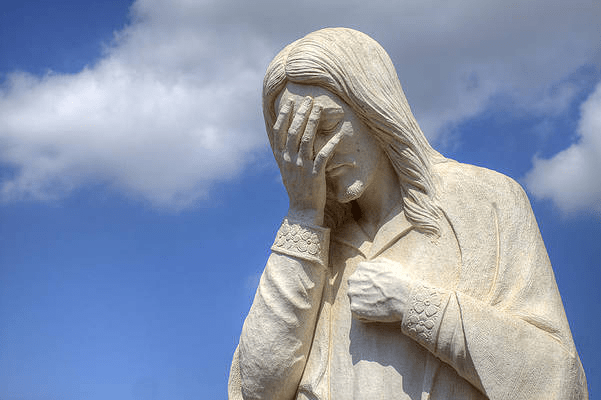
“And Jesus Wept” statue in Oklahoma City, Oklahoma

Any religious fool can rant about the ills of the world, ungodly persons, and defective institutions. However, it takes a person with the heart of Jesus to weep over it all and follow him into suffering on behalf of others so that they might come to the peaceable kingdom of righteousness. 

If our hearts are not unraveled over the sin and injustice of the world, we are in no position to rant about anything. That’s because grace and mercy is the currency of God’s economy. 

Thus, we need to repent like we mean it, pray as if our lives depended on it, and proclaim the good news of Christ as if there is not a tomorrow.

In a results-driven culture, congregations want clear strategy plans for ministry. Yet, a group of people can implement the best of ministries and still not realize their well-laid plans. If Jesus didn’t see what he wanted to happen come to fruition in Jerusalem, then I’m not sure how any of us can always expect success in ministry. We may fail in many ways; but let us not fail to weep over our communities and neighborhoods and long for them to know Christ.

It’s okay that neither every ministry goes as planned nor every person is blessed by what we do. If we find it hard to accept this, and feel out of control, then we want to know the future – how everything is going to shake-out. This is precisely what the disciples wanted to know, since their expectations weren’t realized.

Jesus essentially told them that things were going to get even tougher. Therefore, they need to be ready and persevere through the adversity. And some of that trouble will be downright cataclysmic. Jesus did not give his disciples a seminar on having a successful ministry; he simply told them to endure suffering and focus on proclaiming the gospel.

But for that to happen, we need to accept that we cannot control every variable of ministry and plan for every contingency. The only guarantees we have is that God is with us, and Christ is coming again. That’s it, my friends.

So, instead of control, we must accept our limitations and practice self-control. We can continually monitor our own internal motivations and desires so that they are in constant alignment with the words and ways of Jesus – including a heart of love that weeps over the brokenness and stubbornness of the world. 

Followers of Jesus walk the only true road of Christian discipleship: the path of humility. Out of all the characteristics that Jesus could have described himself, the only two words he ever used were “gentle and humble.” (Matthew 11:29)

Jesus Weeping Over Jerusalem, by Enrique Simonet Lombardo (1866-1927)

Jesus is the perfect example of a leader who always ministered with a complete sense of his divine power, human limitations, and concern for others. Christ never believed he was the reason for his own success, nor thought he was the reason for another’s failure of faith. Instead, Jesus always connected what he was doing to the will of his Father in heaven.

You can only avoid the seduction of arrogant pride when you recognize that you are not God and need the help of others. Truly humble folk dig a hole, throw their ego into it, and pour concrete on top of it. This allows them to listen deeply, give generously, and encourage others liberally.

Standing firm to the end doesn’t come through crafting complicated charts of the end times; it comes through being humble, being grounded in the here-and-now, being attentive to the people around us, and being a guide for the lost. More importantly, it’s what Christ wants us to be.

Loving Lord Jesus, let me have your zeal for God’s house and your heart for lost people! Change my heart, O God, and let it reflect your grace and truth in everything I say and do; through Christ my Savior, who with you and the Holy Spirit, reign now and forever. Amen.

God Is Both Near and Far (Psalm 145:1-5, 17-21)

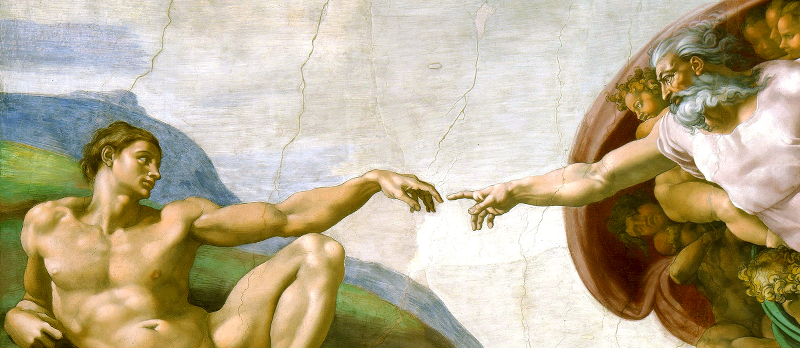
God giving life to Adam, by Michelangelo (1475-1564) on the ceiling of the Sistine Chapel, Rome

I will exalt you, my God the King;
    I will praise your name for ever and ever.
Every day I will praise you
    and extol your name for ever and ever.

Great is the Lord and most worthy of praise;
    his greatness no one can fathom.
One generation commends your works to another;
    they tell of your mighty acts.
They speak of the glorious splendor of your majesty—
    and I will meditate on your wonderful works….

The Lord is righteous in all his ways
    and faithful in all he does.
The Lord is near to all who call on him,
    to all who call on him in truth.
He fulfills the desires of those who fear him;
    he hears their cry and saves them.
The Lord watches over all who love him,
    but all the wicked he will destroy.

My mouth will speak in praise of the Lord.
    Let every creature praise his holy name
    for ever and ever. (New International Version)

The Lord is both near and far. The God of Holy Scripture is, at the same time, both:

  • approachable and aloof
  • close and distant
  • beside us and beyond us
  • available and elusive
  • revealing and remote
  • warm and cool
  • knowable and mysterious
  • readily at hand and at arm’s length
  • a good neighbor next door and a politician over in a city you’ve never been

The technical theological terms for describing God in such a way is that the Lord is both immanent and transcendent. And that is a good thing. We need the Lord to be both.

This psalm is a hymn of praise to God. The psalmist, David, celebrates the attributes and the actions of the Lord. David understood, better than most, that God is so far above humanity in divine majesty that miracles are always possible. Because God is God, the Lord’s arm is never too short to extend help and deliverance.

David knew that God’s powerful ability and God’s loving affection go hand-in-hand together; God’s mighty strength and God’s compassionate spirit work together harmoniously for our benefit.

They did not conquer the land with their swords;
    it was not their own strong arm that gave them victory.
It was your right hand and strong arm
    and the blinding light from your face that helped them,
    for you loved them. (Psalm 44:3, NLT)

God’s interventions, wonders, and miracles are never done dispassionately; the Lord’s arm is extended with deep concern and loving care for people.

The Lord acts as a close relative, like a parent, exhibiting qualities of both father and mother. God is close enough to not only hear our verbal prayers but to also hear our faint whispers. Indeed, the Lord is so close that we don’t even have to speak for the prayers of our heart to be heard.

The righteous call to the Lord, and he listens;
    he rescues them from all their troubles.
The Lord is near to those who are discouraged;
    he saves those who have lost all hope.

Good people suffer many troubles,
    but the Lord saves them from them all. (Psalm 34:17-19, GNT)

In the New Testament Gospels, Jesus gave us instruction on how to address God: “Our Father in heaven.” Not just “my” Father, but “our” Father. We are to pray with the mindful sense of our union with the Lord, as well as our connection with one another as believers.

The Lord sits in heaven as the Most High God, the transcendent Lord of me, you, and all people – watching over and protecting all whose hearts are in the right place, and effectively guarding us from a lofty divine vantage point.

My shield is God Most High, who saves the upright in heart. (Psalm 7:10, NIV)

Clap your hands, all you nations;
    shout to God with cries of joy.

For the Lord Most High is awesome,
    the great King over all the earth.
He subdued nations under us,
    peoples under our feet. (Psalm 47:1-3, NIV)

With our transcendent God always having a watchful eye over us, we need not fear anything or anyone. The Lord knows the score of how things are going in the world and in your life. And, what’s more, God knows the ropes in providing for us, protecting us, and powerfully handling any and all enemies to our souls.

Yet, at the same time, all the time, God is both our high holy King, and our close intimate Friend. Indeed, the Lord is graciously immanent as my Abba – the Father who is near and dear to our hearts.

Because you are [adopted] sons and daughters, God sent the Spirit of his Son into our hearts, crying, “Abba, Father!” Therefore, you are no longer a slave but a son or daughter, and if you are his child, then you are also an heir through God. (Galatians 4:6-7, CEB)

Christians everywhere in the world, and throughout the ages, gather together and repeat the Lord’s Prayer, every Sunday, as well as in weekly small groups, and daily individual prayers. We cry out, “Our Father in heaven” as the most used phrase over the course of our Christian lives.

And that sort of repetition is a good thing. It is important to verbalize that God is transcendent – far above all earthly powers as the sovereign Lord of the universe; and to vocalize that God is immanent – near to us as a father to a child.

Just because a phrase can become vain repetition doesn’t mean that repeating it is a bad thing. Using our words to reiterate both the far distance and the close relation of God is a worthy activity which fortifies our faith, and which passes truth to successive generations of the faithful.

The best way I know of cultivating a healthy sense of God’s transcendence and immanence (outside of reading scripture and praying) is through clouds and kids – both of which require mature adults to practice some much needed humility.

There is nothing quite like putting clocks and schedules aside, stretching out a blanket on a hill, laying back, and watching the clouds roll by. The perspective of massive highness reminds us that our problems are neither as daunting nor as important as we thought.

In contrast to the high clouds, there’s also nothing quite like forgetting your age and getting on the ground to be eye level with a kid. Fortunately, I have rambunctious and curious grandsons who continually remind me that, the lower I get, the better I understand what’s truly most important.

Neither my kids nor my grandkids care all that much about the what’s in my life – what I do – my work, my hobbies, my angst, my daily activities. But they do care a great deal about who I am and why I’m with them.

Intentionally developing a sense of God as both far and near, helps us remember who we are and why are here.

Ironically, the closer I get in touch with the reality that I’m mere dust, and will return back to the ground, the better I’m able to see the Most High God. And, conversely, the more I gaze into the sky, the greater awareness I have of the people around me. I learn to love God and neighbor, as I ought.

There’s no better time than now to get out there and take advantage of the clouds and the kids. It will likely help you to know God better; and it will probably bring a greater awareness, clarity, and connection to the truly significant which is always around us.

Father God, you formed us from the dust of the earth. Remind us of our place as your creatures at home in your creation. Forgive us when we forget our connection to the earth, and our dependence upon the goodness of your world. Lord have mercy.

Brother Jesus, you were born into this world, and made your earthly home in Nazareth. Help us to know and love the people and places where you have set us. Forgive us when we fail to care for our homes, our communities, and your creation. Christ, have mercy.

Blessed Holy Spirit, you desire to grow in us your fruit of love, joy, peace, patience, kindness, goodness, faithfulness, gentleness, and self-control. Forgive us when our roots are so shallow, and our hearts so restless, that our lives fail to bear fruit. Enable us to find our home in you, and in the places to which you call us. Lord have mercy.

Blessed Holy Trinity – Father, Son, and Spirit – the God who is both far and near: Forgive us our sins, settle us in a place of belonging, and enable us to bear fruit for your kingdom. Amen.

Get Me Out of This Scary Dungeon Cave! (Psalm 142)

I pray to you, Lord.
    I beg for mercy.
I tell you all my worries
    and my troubles,
and whenever I feel low,
    you are there to guide me.

A trap has been hidden
    along my pathway.
Even if you look,
    you won’t see anyone
who cares enough
    to walk beside me.
There is no place to hide,
    and no one who really cares.

I pray to you, Lord!
    You are my place of safety,
and you are my choice
    in the land of the living.
Please answer my prayer.
    I am completely helpless.

Help! They are chasing me,
    and they are too strong.
Rescue me from this prison,
    so I can praise your name.
And when your people notice
your wonderful kindness to me,
    they will rush to my side. (Contemporary English Version)

The modern holiday of Halloween is kitschy with a funny sort of scary. But there’s nothing funny about being truly frightened and feeling helpless. Its anything but a holiday.

The psalmist, David, was in both a literal and a metaphorical cave. Before he ever became king of Israel and Judah, David was on the run from King Saul. He hid in a cave. He had more suspense and was on the edge of his seat much more than any horror slasher film could portray.

David was hiding and just trying to stay alive. There was nothing in his life which deserved such maltreatment. It was sheer jealousy on Saul’s end of things that caused him to give his soul over to oppressive pride. And David was the brunt of that oppression.

As biblical readers, we know the end of the story. Saul is eventually killed in battle and David is exalted as the new king. Yet, here, in today’s psalm, we have the genuine cry of a desperate man who longed for the justice of God – not knowing what the end of it all would be.

One of the reasons David was a person after God’s own heart is that he was humble and remained connected to God without succumbing to the bitterness of his situation. I strongly suggest that David was able to keep his life free from pride because he regularly liberated his spirit through real and raw expressions of his emotions and experiences to God.

Spiritual confidence cannot be ginned-up through pretending that all is well, and everything is okay. Rather, spiritual courage is forged in the most awful of circumstances through loud cries of emotional pain to the God who truly hears it all.

Anyone who tells you different is flimsily trying to maintain their puny sense of delusional power. God sees you in the dark place and he hears your cry for mercy. He knows your dark cave better than you know it yourself.

One of the reasons I love the psalms so dearly is that they know the human condition. There is no pretense with the psalmist, David. He opens his mind and heart. He lets the genuine feelings of his life pour out in an offering to the God who pays attention to the humble and contrite.

The proud and arrogant will forever be flummoxed by the psalms, not understanding why they are even in the canon of Holy Scripture.

Yet, here they are, for all to examine and experience. Whereas the piously insincere are continually putting up a false front of godliness and keeping up appearances of superior spirituality, here we have authentic religion smack in front of our faces.

For me, the psalms liberate us from the shackles of trying to be someone I am not and enable us to connect with a God who encourages us in our strange wonderings, our emotional pain, and our sometimes horrific situations.

The Lord is perfectly at home with hearing loud cries, agonizing shouts, and desperate prayers directed to heaven.

Those who oppress others, I believe, are easy to spot because they:

  • Ask rhetorical questions to make a point.
  • Assume their thoughts and ways are always best.
  • Accuse without evidence based on their faulty assumptions.
  • Seek to harm and destroy.
  • Enjoy chaos and thrive on taking advantage of others’ misfortune.
  • Refuse to listen and learn from others.
  • Suppress all competing voices contrary to their own.

Autocrats are too smug and too far into their delusions of power, authority, and self-righteousness to be able to hear any voice other than their own.

A self-absorbed despot in power feels like being in a dingy dank prison cave with no ability to leverage a release.

A self-abnegated deliverer in authority feels like being in a wide open field with freedom to help others in bondage.

God hears when others don’t. The Lord advocates on behalf of those caught in the crosshairs of tyrannical injustice and maltreatment. Divine benevolence is always on the lookout for those being oppressed.

The Almighty uses power to listen and respond when distressed persons are scared silly with maltreatment. Voices raised to heaven shall never go unheard.

Since God listens to those in need of mercy, this is precisely the disposition we are to adopt, as well.

The proud, convinced of their superiority, either cannot or will not see those languishing underneath unjust power structures. There is no space within arrogant hearts to accommodate the cries for justice from people beneath them.

Therefore, recourse for the oppressed comes from God – because God acts with equity, integrity, and justice.

It is not the oppressed who need our pity; it is the ungodly, because they don’t know anything about pity, or empathy, or mercy. Oppressors have no stomach for any of that. So, they keep people locked in systems of oppression. They maintain relational distance and turn a blind eye to the genuine frightened screams of those under their boot.

The weak, the distressed, and the spiritually tired in this corrupt world, however, have the chance for appeal. They can call out to the God who knows them and their situations.

Although cries for deliverance may not happen immediately, we can be assured that divine help is forthcoming. And that is scary good stuff.

Lord Jesus Christ, by your patience in suffering you made my earthly pain sacred and gave me the example of humility. Be near to me in my time of weakness and pain; sustain me by your grace so that my strength and courage may not fail. Heal me according to your will. Loving Jesus, as you cried out on the cross, I cry out to you in my desperation. Do not forsake me. Grant me relief and preserve me in your perfect peace. Amen.