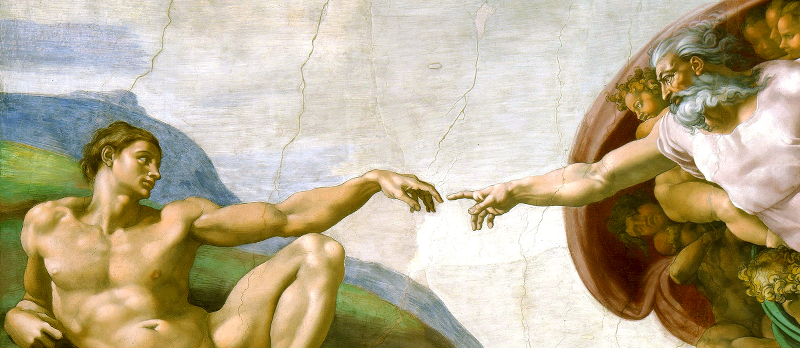
God Is Both Near and Far (Psalm 145:1-5, 17-21)

God giving life to Adam, by Michelangelo (1475-1564) on the ceiling of the Sistine Chapel, Rome

I will exalt you, my God the King;
    I will praise your name for ever and ever.
Every day I will praise you
    and extol your name for ever and ever.

Great is the Lord and most worthy of praise;
    his greatness no one can fathom.
One generation commends your works to another;
    they tell of your mighty acts.
They speak of the glorious splendor of your majesty—
    and I will meditate on your wonderful works….

The Lord is righteous in all his ways
    and faithful in all he does.
The Lord is near to all who call on him,
    to all who call on him in truth.
He fulfills the desires of those who fear him;
    he hears their cry and saves them.
The Lord watches over all who love him,
    but all the wicked he will destroy.

My mouth will speak in praise of the Lord.
    Let every creature praise his holy name
    for ever and ever. (New International Version)

The Lord is both near and far. The God of Holy Scripture is, at the same time, both:

  • approachable and aloof
  • close and distant
  • beside us and beyond us
  • available and elusive
  • revealing and remote
  • warm and cool
  • knowable and mysterious
  • readily at hand and at arm’s length
  • a good neighbor next door and a politician over in a city you’ve never been

The technical theological terms for describing God in such a way is that the Lord is both immanent and transcendent. And that is a good thing. We need the Lord to be both.

This psalm is a hymn of praise to God. The psalmist, David, celebrates the attributes and the actions of the Lord. David understood, better than most, that God is so far above humanity in divine majesty that miracles are always possible. Because God is God, the Lord’s arm is never too short to extend help and deliverance.

David knew that God’s powerful ability and God’s loving affection go hand-in-hand together; God’s mighty strength and God’s compassionate spirit work together harmoniously for our benefit.

They did not conquer the land with their swords;
    it was not their own strong arm that gave them victory.
It was your right hand and strong arm
    and the blinding light from your face that helped them,
    for you loved them. (Psalm 44:3, NLT)

God’s interventions, wonders, and miracles are never done dispassionately; the Lord’s arm is extended with deep concern and loving care for people.

The Lord acts as a close relative, like a parent, exhibiting qualities of both father and mother. God is close enough to not only hear our verbal prayers but to also hear our faint whispers. Indeed, the Lord is so close that we don’t even have to speak for the prayers of our heart to be heard.

The righteous call to the Lord, and he listens;
    he rescues them from all their troubles.
The Lord is near to those who are discouraged;
    he saves those who have lost all hope.

Good people suffer many troubles,
    but the Lord saves them from them all. (Psalm 34:17-19, GNT)

In the New Testament Gospels, Jesus gave us instruction on how to address God: “Our Father in heaven.” Not just “my” Father, but “our” Father. We are to pray with the mindful sense of our union with the Lord, as well as our connection with one another as believers.

The Lord sits in heaven as the Most High God, the transcendent Lord of me, you, and all people – watching over and protecting all whose hearts are in the right place, and effectively guarding us from a lofty divine vantage point.

My shield is God Most High, who saves the upright in heart. (Psalm 7:10, NIV)

Clap your hands, all you nations;
    shout to God with cries of joy.

For the Lord Most High is awesome,
    the great King over all the earth.
He subdued nations under us,
    peoples under our feet. (Psalm 47:1-3, NIV)

With our transcendent God always having a watchful eye over us, we need not fear anything or anyone. The Lord knows the score of how things are going in the world and in your life. And, what’s more, God knows the ropes in providing for us, protecting us, and powerfully handling any and all enemies to our souls.

Yet, at the same time, all the time, God is both our high holy King, and our close intimate Friend. Indeed, the Lord is graciously immanent as my Abba – the Father who is near and dear to our hearts.

Because you are [adopted] sons and daughters, God sent the Spirit of his Son into our hearts, crying, “Abba, Father!” Therefore, you are no longer a slave but a son or daughter, and if you are his child, then you are also an heir through God. (Galatians 4:6-7, CEB)

Christians everywhere in the world, and throughout the ages, gather together and repeat the Lord’s Prayer, every Sunday, as well as in weekly small groups, and daily individual prayers. We cry out, “Our Father in heaven” as the most used phrase over the course of our Christian lives.

And that sort of repetition is a good thing. It is important to verbalize that God is transcendent – far above all earthly powers as the sovereign Lord of the universe; and to vocalize that God is immanent – near to us as a father to a child.

Just because a phrase can become vain repetition doesn’t mean that repeating it is a bad thing. Using our words to reiterate both the far distance and the close relation of God is a worthy activity which fortifies our faith, and which passes truth to successive generations of the faithful.

The best way I know of cultivating a healthy sense of God’s transcendence and immanence (outside of reading scripture and praying) is through clouds and kids – both of which require mature adults to practice some much needed humility.

There is nothing quite like putting clocks and schedules aside, stretching out a blanket on a hill, laying back, and watching the clouds roll by. The perspective of massive highness reminds us that our problems are neither as daunting nor as important as we thought.

In contrast to the high clouds, there’s also nothing quite like forgetting your age and getting on the ground to be eye level with a kid. Fortunately, I have rambunctious and curious grandsons who continually remind me that, the lower I get, the better I understand what’s truly most important.

Neither my kids nor my grandkids care all that much about the what’s in my life – what I do – my work, my hobbies, my angst, my daily activities. But they do care a great deal about who I am and why I’m with them.

Intentionally developing a sense of God as both far and near, helps us remember who we are and why are here.

Ironically, the closer I get in touch with the reality that I’m mere dust, and will return back to the ground, the better I’m able to see the Most High God. And, conversely, the more I gaze into the sky, the greater awareness I have of the people around me. I learn to love God and neighbor, as I ought.

There’s no better time than now to get out there and take advantage of the clouds and the kids. It will likely help you to know God better; and it will probably bring a greater awareness, clarity, and connection to the truly significant which is always around us.

Father God, you formed us from the dust of the earth. Remind us of our place as your creatures at home in your creation. Forgive us when we forget our connection to the earth, and our dependence upon the goodness of your world. Lord have mercy.

Brother Jesus, you were born into this world, and made your earthly home in Nazareth. Help us to know and love the people and places where you have set us. Forgive us when we fail to care for our homes, our communities, and your creation. Christ, have mercy.

Blessed Holy Spirit, you desire to grow in us your fruit of love, joy, peace, patience, kindness, goodness, faithfulness, gentleness, and self-control. Forgive us when our roots are so shallow, and our hearts so restless, that our lives fail to bear fruit. Enable us to find our home in you, and in the places to which you call us. Lord have mercy.

Blessed Holy Trinity – Father, Son, and Spirit – the God who is both far and near: Forgive us our sins, settle us in a place of belonging, and enable us to bear fruit for your kingdom. Amen.

Get Me Out of This Scary Dungeon Cave! (Psalm 142)

I pray to you, Lord.
    I beg for mercy.
I tell you all my worries
    and my troubles,
and whenever I feel low,
    you are there to guide me.

A trap has been hidden
    along my pathway.
Even if you look,
    you won’t see anyone
who cares enough
    to walk beside me.
There is no place to hide,
    and no one who really cares.

I pray to you, Lord!
    You are my place of safety,
and you are my choice
    in the land of the living.
Please answer my prayer.
    I am completely helpless.

Help! They are chasing me,
    and they are too strong.
Rescue me from this prison,
    so I can praise your name.
And when your people notice
your wonderful kindness to me,
    they will rush to my side. (Contemporary English Version)

The modern holiday of Halloween is kitschy with a funny sort of scary. But there’s nothing funny about being truly frightened and feeling helpless. Its anything but a holiday.

The psalmist, David, was in both a literal and a metaphorical cave. Before he ever became king of Israel and Judah, David was on the run from King Saul. He hid in a cave. He had more suspense and was on the edge of his seat much more than any horror slasher film could portray.

David was hiding and just trying to stay alive. There was nothing in his life which deserved such maltreatment. It was sheer jealousy on Saul’s end of things that caused him to give his soul over to oppressive pride. And David was the brunt of that oppression.

As biblical readers, we know the end of the story. Saul is eventually killed in battle and David is exalted as the new king. Yet, here, in today’s psalm, we have the genuine cry of a desperate man who longed for the justice of God – not knowing what the end of it all would be.

One of the reasons David was a person after God’s own heart is that he was humble and remained connected to God without succumbing to the bitterness of his situation. I strongly suggest that David was able to keep his life free from pride because he regularly liberated his spirit through real and raw expressions of his emotions and experiences to God.

Spiritual confidence cannot be ginned-up through pretending that all is well, and everything is okay. Rather, spiritual courage is forged in the most awful of circumstances through loud cries of emotional pain to the God who truly hears it all.

Anyone who tells you different is flimsily trying to maintain their puny sense of delusional power. God sees you in the dark place and he hears your cry for mercy. He knows your dark cave better than you know it yourself.

One of the reasons I love the psalms so dearly is that they know the human condition. There is no pretense with the psalmist, David. He opens his mind and heart. He lets the genuine feelings of his life pour out in an offering to the God who pays attention to the humble and contrite.

The proud and arrogant will forever be flummoxed by the psalms, not understanding why they are even in the canon of Holy Scripture.

Yet, here they are, for all to examine and experience. Whereas the piously insincere are continually putting up a false front of godliness and keeping up appearances of superior spirituality, here we have authentic religion smack in front of our faces.

For me, the psalms liberate us from the shackles of trying to be someone I am not and enable us to connect with a God who encourages us in our strange wonderings, our emotional pain, and our sometimes horrific situations.

The Lord is perfectly at home with hearing loud cries, agonizing shouts, and desperate prayers directed to heaven.

Those who oppress others, I believe, are easy to spot because they:

  • Ask rhetorical questions to make a point.
  • Assume their thoughts and ways are always best.
  • Accuse without evidence based on their faulty assumptions.
  • Seek to harm and destroy.
  • Enjoy chaos and thrive on taking advantage of others’ misfortune.
  • Refuse to listen and learn from others.
  • Suppress all competing voices contrary to their own.

Autocrats are too smug and too far into their delusions of power, authority, and self-righteousness to be able to hear any voice other than their own.

A self-absorbed despot in power feels like being in a dingy dank prison cave with no ability to leverage a release.

A self-abnegated deliverer in authority feels like being in a wide open field with freedom to help others in bondage.

God hears when others don’t. The Lord advocates on behalf of those caught in the crosshairs of tyrannical injustice and maltreatment. Divine benevolence is always on the lookout for those being oppressed.

The Almighty uses power to listen and respond when distressed persons are scared silly with maltreatment. Voices raised to heaven shall never go unheard.

Since God listens to those in need of mercy, this is precisely the disposition we are to adopt, as well.

The proud, convinced of their superiority, either cannot or will not see those languishing underneath unjust power structures. There is no space within arrogant hearts to accommodate the cries for justice from people beneath them.

Therefore, recourse for the oppressed comes from God – because God acts with equity, integrity, and justice.

It is not the oppressed who need our pity; it is the ungodly, because they don’t know anything about pity, or empathy, or mercy. Oppressors have no stomach for any of that. So, they keep people locked in systems of oppression. They maintain relational distance and turn a blind eye to the genuine frightened screams of those under their boot.

The weak, the distressed, and the spiritually tired in this corrupt world, however, have the chance for appeal. They can call out to the God who knows them and their situations.

Although cries for deliverance may not happen immediately, we can be assured that divine help is forthcoming. And that is scary good stuff.

Lord Jesus Christ, by your patience in suffering you made my earthly pain sacred and gave me the example of humility. Be near to me in my time of weakness and pain; sustain me by your grace so that my strength and courage may not fail. Heal me according to your will. Loving Jesus, as you cried out on the cross, I cry out to you in my desperation. Do not forsake me. Grant me relief and preserve me in your perfect peace. Amen.

The Finite and the Infinite (Psalm 65)

God of Zion, to you even silence is praise.
    Promises made to you are kept—
    you listen to prayer—
    and all living things come to you.
When wrongdoings become too much for me,
    you forgive our sins.
How happy is the one you choose to bring close,
    the one who lives in your courtyards!
We are filled full by the goodness of your house,
    by the holiness of your temple.

In righteousness you answer us,
    by your awesome deeds,
    God of our salvation—
    you, who are the security
        of all the far edges of the earth,
        even the distant seas.
    You establish the mountains by your strength;
    you are dressed in raw power.
    You calm the roaring seas;
        calm the roaring waves,
        calm the noise of the nations.
Those who dwell on the far edges
        stand in awe of your acts.
    You make the gateways
        of morning and evening sing for joy.
You visit the earth and make it abundant,
    enriching it greatly
        by God’s stream, full of water.
You provide people with grain
    because that is what you’ve decided.
Drenching the earth’s furrows,
        leveling its ridges,
    you soften it with rain showers;
        you bless its growth.
You crown the year with your goodness;
    your paths overflow with rich food.
Even the desert pastures drip with it,
    and the hills are dressed in pure joy.
The meadowlands are covered with flocks,
    the valleys decked out in grain—
        they shout for joy;
        they break out in song! (Common English Bible)

The biblical psalms present God as sovereign over all creation. Today’s psalm extols the Lord of the universe as God of both temple and terra, of people and the earth.

God of the temple

Praise is the appropriate offering to God – because it is the Lord who listens, forgives, and chooses to fill persons with the holiness and goodness of God’s presence, exemplified in the temple.

Infinite righteousness cannot be fulfilled by finite beings. In other words, we need God.

The nineteenth century philosopher and theologian, Søren Kierkegaard (1813-1855) insisted that the humans did not established themselves; therefore, no one can simply exercise their will toward better and brighter circumstances.

Kierkegaard argued that humanity, at its core, is a synthesis of the infinite and the finite, the temporal and the eternal. A finite human is not a self; only when connected and aware of the infinite is someone a self. (The Sickness Unto Death)

Creatures can never lift themselves above anxiety, worry, distress, or hardship with only finite resources; we need infinite supplies and divine capital, to tap into the image of God within us, to realize that our true identity is inextricably dependent upon our Creator.

“Prayers” by Yoram Raanan

We are more than bodies and brain synapses; we are also souls. And as souls, we shall never realize our true selves through the temporary means of possessions, prestige, and power. A person cannot construct a self, by themselves, to bear the weight of who we really are. That’s because our real identity is hidden with Christ in God. (Colossians 3:3)

Just as the temple in Jerusalem was much more than a physical structure, so we, as the people of God, are so much more than tangible beings.

Do you not know that you are God’s temple and that God’s Spirit dwells in you? (1 Corinthians 3:16, NRSV)

Praise, prayer, and worship are practices designed to connect with the infinite God. Indeed, the kingdom of God is much nearer than we know.

Jesus said, “The kingdom of God is not coming with things that can be observed, nor will they say, ‘Look, here it is!’ or ‘There it is!’ For, in fact, the kingdom of God is among you.” (Luke 17:20-21, NRSV)

God of terra

We walk upon and inhabit this present terra firma, this earth. The earth, and all that is in it, belongs to the Lord. God is something of a cosmic farmer, taking care of the earth, watching over it, tending to its needs.

All that takes place on this celestial ball we live upon is under the gracious and loving eye of God. It is the Lord who brings the seasons and the rains, calming the storms of the seas, as well as the storms of our lives.

One of the reasons we find ourselves in such an impending climate debacle on this earth, is that we continue to utilize all the finite resources we can muster and fail to acknowledge and become aware of the grand infinite wherewithal we have with our Creator and Sustainer.

“I am the Lord, your savior;
I am the one who created you.
I am the Lord, the Creator of all things.
    I alone stretched out the heavens;
    when I made the earth, no one helped me. (Isaiah 44:24, GNT)

The earth is beautiful. Yet, in our insistence upon merely using the temporal and physical, ugliness has come upon the earth, obscuring the true nature of God’s good creation. Distancing ourselves from the Creator only builds bigger obstacles to solving the earth’s most significant issues.

Self-imposed and ensconced impediments need to be cleared away. The weeds have overtaken the garden; we can no longer see the good plants that are supposed to grow and produce a harvest. And yet, as any farmer or gardener knows, you cannot simply yank such weeds from the ground without also pulling up what you are trying to preserve.

The Lord will provide – but if we keep to our stubborn independence from God, the process of weeding the garden will take much longer to accomplish. Yet, God is patient, not wanting any to perish but all to come around to the infinite. (2 Peter 3:9)

Conclusion

Let us come to God in our neediness and failure. We must see ourselves as infinite souls with finite solutions who can cry out to the God who hears and forgives. We need to connect with the Lord who hears our prayers. It is imperative that we rely upon the infinite Creator who is concerned to cultivate justice and righteousness upon an earth which is full of plenty for everyone.

Praise, pray, give thanks, and be connected to the infinite One whom we need for life and godliness in this present, evil, and finite age.

Stay joined to me and I will stay joined to you. No branch can produce fruit alone. It must stay connected to the vine. It is the same with you. You cannot produce fruit alone. You must stay joined to me. (John 15:4, ERV)

Blessed God and Father of all, yours is the kingdom, the power, and the glory forever. To you belongs the heavens and the earth. It is you who made all that is – sun, moon, stars, rivers, forests, minerals, birds, animals, fish, and us – and pronounced it all “good.” We seek your divine mercy and help so that our work and our worship may curb the sin that so easily entangles and bring your intended shalom to the earth. Amen.

Get Up and Pray! (Luke 22:39-46)

The Garden of Gethsemane by He Qi

Jesus went out as usual to the Mount of Olives, and his disciples followed him. On reaching the place, he said to them, “Pray that you will not fall into temptation.” He withdrew about a stone’s throw beyond them, knelt down and prayed, “Father, if you are willing, take this cup from me; yet not my will, but yours be done.” An angel from heaven appeared to him and strengthened him. And being in anguish, he prayed more earnestly, and his sweat was like drops of blood falling to the ground.

When he rose from prayer and went back to the disciples, he found them asleep, exhausted from sorrow. “Why are you sleeping?” he asked them. “Get up and pray so that you will not fall into temptation.” (New International Version)

The prayer of Jesus and the sleeping of his disciples presents a contrast of approach when severe stress is upon us.

The Prayer of Jesus

Christ’s prayer expresses the tension all devout persons face: expressing our own wishes while seeking to submit to the Father’s wishes.

However, what is not the same, between our own prayers and the prayers of Jesus, is that we too often believe that if we are intense, wordy, and insistent enough with God, that our prayers will be answered.

While only feigning a few words about God’s will, we put our real efforts into lawyer-like presentations of why the Lord should answer our prayers in the way we want them answered.

Thus, prayer can too easily become a willful imperative that God grant our demands based in a very limited understanding of the big picture.

There is a big difference between willfulness and willingness. We must embrace the latter and eschew the former.

Jesus clearly stated exactly what he wanted: to have this terrible suffering, especially the pain about to be experienced, taken from him. Yet, he asks this with a willingness to accept the Father’s will for his life. Although an angel comes to bring comfort and strength, Christ’s request was denied. And Jesus was good with that.

We can, following the example of Jesus, unashamedly express our anguish, while at the same time, accepting God’s will for us, no matter what it may be.

Christ in Gethsemane by Michael O’Brien

It was God’s will for Jesus to suffer. And Christ not only suffered in the Garden of Gethsemane and on the cross; Jesus experienced the full range of human suffering throughout his life. He knew what it felt like to face continual adversity and hardship. 

The suffering of Christ helps us make sense of our own suffering. We can only truly be free from our stubborn expectations by embracing that which makes us suffer. 

Some suffer through the death of a loved one; some through cancer or a serious health issue; other believers right now throughout the world are suffering due to grinding poverty and la ack of food and clean water; many others suffer through violence done to them or their families.

Because of this reality, some of us may not even express our anguish to God in prayer. After all, what is a harshly worded e-mail, or trying to lose a few extra pounds, or an unexpected car repair, compared to starving children in the world? 

It’s good to keep our life situations in proper perspective, but it is also not good to tell God what he should and shouldn’t care about in this world. 

If the only things that matter and qualify as hardship and difficulty is human trafficking or the terrors of war, then you will soon find yourself plastering a smile on your face and nodding over-enthusiastically whenever someone asks you how you are doing…. Good grief…. I find chronically happy Christians to be insufferable (pun intended).

The sufferings of Christ qualified him to be a compassionate high priest, able to help us (Hebrews 2:5-18). A priest is one who stands in between the person and God, making things right with God. Christians possess a union with Jesus Christ because of his suffering, death, and resurrection. He is our champion. He stands with us in our suffering and temptations.    

The Sleep of the Disciples

Even though their Lord told them to pray, the disciples nod-off in a stress-induced sleep. Jesus wanted them to remain awake, and he was talking of more than just physical alertness. The disciples needed to keep watch so that they didn’t fall into temptation.

Throughout his earthly ministry, Jesus had been warning them that his cross will lead to their own cross to bear. They, too, will have times of trial, so intense that it will be emotionally and spiritually overwhelming. Christ desired the disciples to follow his own example of offering anguished prayer which is thoroughly submissive to God.

So, our great task is to get up and pray!

Get up and pray so that no temptation can overtake you! (1 Corinthians 10:13)

Get up and pray so that you can endure hardship! (Hebrews 12:7)

Get up and pray for the enemies who persecute you so that you may be children of your Father in heaven! (Matthew 5:44-45)

Get up and pray so that you can encourage others and build them up in the faith! (1 Thessalonians 5:10-11)

Get up and pray so that you can be joyful in hope and patient in affliction! (Romans 12:12)

Get up and pray so that you may have peace in this world of trouble! (John 16:33)

Get up and pray so that you can submit to God and resist the devil! (James 4:7)

Get up and pray so that you will not be overcome by evil but overcome evil with good! (Romans 12:11)

Get up and pray so that you can submit to one another out of reverence for Christ! (Ephesians 5:21)

Get up and pray so that you can be the salt of the earth and the light of the world! (Matthew 5:13-16)

Get up and pray so that you can proclaim that the kingdom of God is near! (Matthew 10:7)

Get up and pray so that you can preach the Word with great patience and careful instruction! (2 Timothy 4:1-2)

Get up and pray so that you can have confidence in your leaders and submit to their authority, because they keep watch over you as those who must give an account. (Hebrews 13:17)

Get up and pray!…