
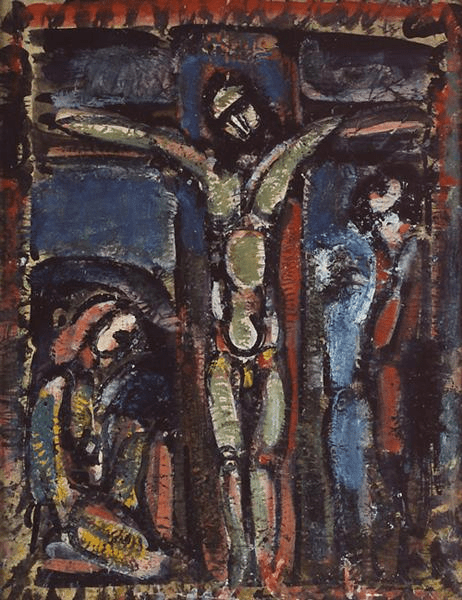
Where Is God in My Suffering? (Psalm 22:23-31)

“Praise him, you servants of the Lord!
    Honor him, you descendants of Jacob!
    Worship him, you people of Israel!
He does not neglect the poor or ignore their suffering;
    he does not turn away from them,
    but answers when they call for help.”

In the full assembly I will praise you for what you have done;
    in the presence of those who worship you
    I will offer the sacrifices I promised.
The poor will eat as much as they want;
    those who come to the Lord will praise him.
May they prosper forever!

All nations will remember the Lord.
    From every part of the world they will turn to him;
    all races will worship him.
The Lord is king,
    and he rules the nations.

All proud people will bow down to him;
    all mortals will bow down before him.
Future generations will serve him;
    they will speak of the Lord to the coming generation.
People not yet born will be told:
    “The Lord saved his people.” (Good News Translation)

I find that a great deal of truth and reality in this world is something of a mystery and a paradox. Christianity, especially, is a religion of paradox, in my opinion. For example, God is Three – Father, Son, and Spirit – but God is One. Jesus Christ is fully human and fully divine, at the same time, all the time. And when it comes to the spiritual life, suffering exists, and God is sovereign and in control of all things.

This then, is what prompts many people to question if there is really a God – since so much suffering exists throughout the world. Yet, it’s necessary to maintain the tension that hard circumstances, adversity, and difficulty in the form of awful suffering, and the preeminence of the Lord God almighty, both exist without taking anything away from either of them.

The severity of suffering, nor the supreme majesty of God, need to be watered down in any way in order to try and make sense of our existential situations.

“Suffering” is a word we would like to avoid. Even saying or reading the word might make some folks cringe. Suffering? No thanks. I think I’ll pass on that. Yet, something inside of us instinctively knows we cannot get around it. Everyone suffers in some way. It is endemic to the human condition that at times we will suffer physically, financially, mentally, emotionally, and spiritually. 

That’s why I believe there is so much talk within some Christian circles about miracles. It’s more than understandable:

  • a chronic pain sufferer wants relief, so she prays for a miracle of health
  • a small business owner is bleeding financially, and looks to God for an immediate miracle of wealthy clients
  • a beloved senior saint knows she is afflicted with Alzheimer’s, so she prays for the miracle of deliverance, even to be taken home to be with the Lord
  • a young adult finds himself in the throes of depression and has tried everything to cope and get out of it, so he petitions God for a miracle out of the deep black hole
  • a believer in Jesus keeps experiencing a besetting sin and cannot get over it, so she looks to God for the miracle of not struggling any more with it

These scenarios and a thousand other maladies afflict people everywhere. There are a multitude of stories out there. Folks who have experienced a miracle tell of their wonderful deliverance. But what about the rest? Those without the miracle? Do they have a lack of faith? Has God forgotten them?

Oh, my, no! God sees, and God knows. God is acquainted with suffering. Jesus knows it first-hand. Remember that it was Jesus who said, “My God, my God, why have you forsaken me?” (Psalm 22:1; Mark 15:34; Matthew 27:46)

Even Jesus cried out in his suffering. But there was no deliverance coming for him.  There was, however, deliverance coming for us.

Sometimes the greatest miracle and deliverance of all is to be freed from the need for a miracle. The reason God doesn’t just offer immediate relief from everyone’s suffering and bring a divine miracle is that the Lord is doing something else: Walking with us through our suffering. God oftentimes has plans and purposes for us that are well beyond our understanding. 

We simply are not privy to everything in God’s mind.

We may not get the miracle we desire. Yet, what we will get without fail, is God’s provision and steadfast love all the way through the suffering.

Where is God in your suffering? Right beside you. Jesus is suffering with you. You are not crying alone; Christ weeps with you.

Let, then, those who suffer, eat and be full. Let them be satisfied with the portion God has given them. And, what’s more, let them offer praise to the God who is squarely beside them in every affliction and each trouble.

God Almighty, you are the One who knows suffering and affliction better than anyone. I admit I don’t often understand what in the world you are doing or not doing in my life and in the lives of those I love. Yet, I admit that I have found in you the comfort, encouragement, and strength to live another day in my trouble. For this, I praise you, in the Name of Jesus Christ, in the power of the Holy Spirit. Amen.

Do You Really Know? Probably Not (Job 38:22-38)

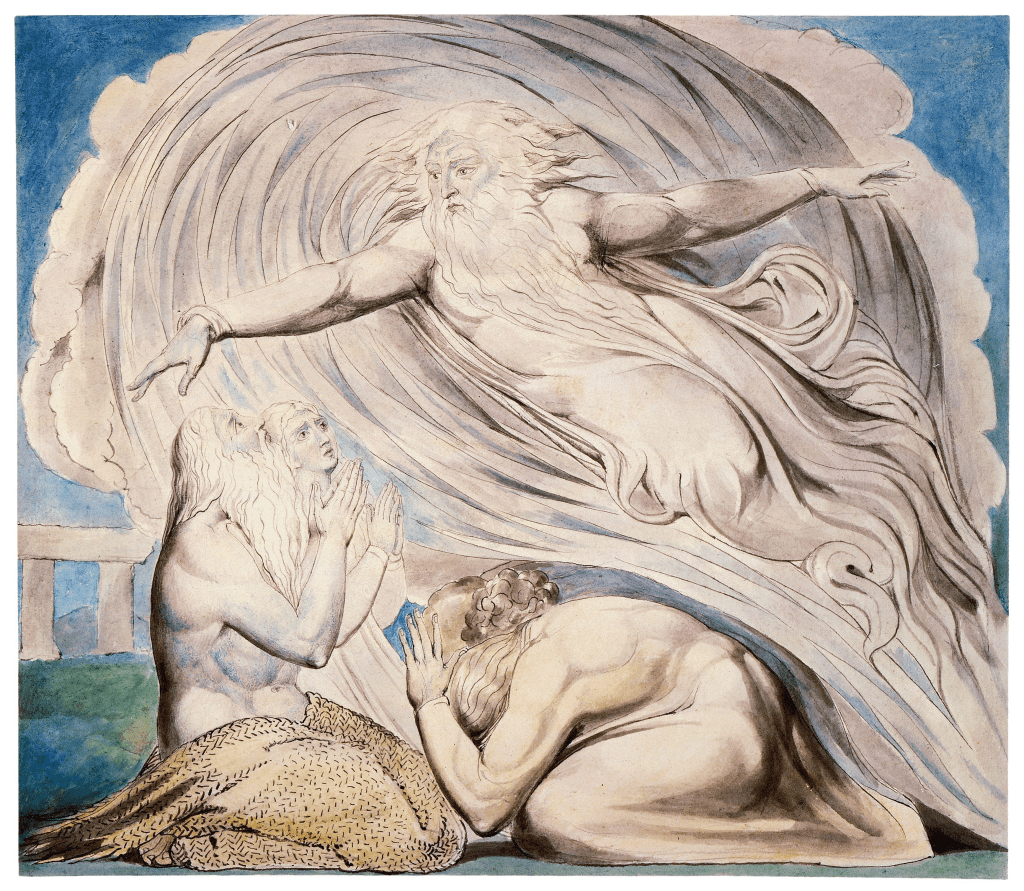
God Answers Job Out of the Whirlwind, by William Blake, 1826

“Have you entered the storehouses of the snow
    or seen the storehouses of the hail,
which I reserve for times of trouble,
    for days of war and battle?
What is the way to the place where the lightning is dispersed,
    or the place where the east winds are scattered over the earth?
Who cuts a channel for the torrents of rain,
    and a path for the thunderstorm,
to water a land where no one lives,
    an uninhabited desert,
to satisfy a desolate wasteland
    and make it sprout with grass?
Does the rain have a father?
    Who fathers the drops of dew?
From whose womb comes the ice?
    Who gives birth to the frost from the heavens
when the waters become hard as stone,
    when the surface of the deep is frozen?

“Can you bind the chains of the Pleiades?
    Can you loosen Orion’s belt?
Can you bring forth the constellations in their seasons
    or lead out the Bear with its cubs?
Do you know the laws of the heavens?
    Can you set up God’s dominion over the earth?

“Can you raise your voice to the clouds
    and cover yourself with a flood of water?
Do you send the lightning bolts on their way?
    Do they report to you, ‘Here we are’?
Who gives the ibis wisdom
    or gives the rooster understanding?
Who has the wisdom to count the clouds?
    Who can tip over the water jars of the heavens
when the dust becomes hard
    and the clods of earth stick together? (New International Version)

The older I get, and the more understanding I gain, the more I realize how little knowledge I truly possess.

When I was eighteen years old, I thought I had the world pretty much figured out. Since then, it’s all been downhill. With each passing year, my ignorance seems to grow. I suppose this all really makes some sense when talking about God’s upside-down kingdom.

There’s so much of life that is a mystery; and as we accumulate our life experiences, it seems all, not just some, of life is a mystical encounter. In other words, the more discernment I gain, I discover I know a lot less than I thought I did.

God Answers Job from the Whirlwind, by William Blake, c.1804

It seems as if the biblical character of Job found this out the hard way. If there is any person in Holy Scripture that would be wise and understanding, its him. God speaks highly of Job in the Bible.

Regarding the upcoming destruction of Jerusalem, God said, “even if these three men—Noah, Daniel and Job—were in it, they could save only themselves by their righteousness, declares the Sovereign Lord.” (Ezekiel 14:14)

Job is held up as the model of patience under suffering: “As you know, we count as blessed those who have persevered. You have heard of Job’s perseverance and have seen what the Lord finally brought about. The Lord is full of compassion and mercy.” (James 5:11)

Yet, with all of Job’s integrity, patience, and righteousness, his understanding barely moves the Richter Scale of God’s expansive knowledge.

We might be somewhat familiar with the story of Job. Being a conscientious follower of God, Job is careful to live uprightly. He acknowledges God in all things and worships him alone. Yet, suffering befell him – for no other reason than that God allowed it. Job knew fully well that there was no personal sin behind his awful ordeal of grief and grinding pain.

So, Job contended with God. For an agonizing thirty-five chapters (Job 3:1-37:24) Job questions God and respectfully takes him to task – as Job’s supposed friends questioned him and assume his guilt. Through it all God is there… silent… saying nothing.

The Desperation of Job, by William Blake, 1821

Then, just when we think God is paying no attention whatsoever, the Lord suddenly speaks.

And what is so remarkable about God’s speech is that for four chapters (Job 38:1-41:34) the Lord gives no answers. It’s all rhetorical questions. God said, “Brace yourself like a man; I will question you and you shall answer me.” (Job 38:3)

It becomes abundantly clear after just a few questions that it would be impossible for any human being to even come close to having the understanding God has. And that was the whole point.

God is God, and we are not. Our questions, however legitimate, real, and raw they are, come from a very puny perspective. Turns out, we just don’t know as much as we think we do.

To Job’s credit, he keeps his mouth shut and listens. At the end of the questioning, Job responds in the only wise way one could, after such an encounter: “Surely I spoke of things I did not understand, things too wonderful for me to know.” (Job 42:3)

None of this means that, for us, we need to face our hardships and our sufferings with a stoic keep-a-stiff-upper-lip approach. Trapped grief will inevitably come out sideways and only cause more hurt. I believe God allowed Job to express his terrible physical, emotional, and spiritual pain for chapter after chapter because he needed to.

Only when God sensed it was the proper timing did he jump in and bring the perspective Job then needed. And even after being challenged by God about his vantage point, Job still did not receive answers as to why he had to endure the awfulness of loss beyond what most of us could comprehend.

Maybe we lack being able to understand, even if God directly answered all our questions. Most likely, God protects us from knowing things that might bring irreparable damage to our human psyches. Again, this is all pure conjecture. Which leaves us with perhaps one of our greatest challenges as human beings:

We must eventually come to the place of being comfortable with mystery – and even embracing it. We simply will not have all things revealed to us that we want to know. And that’s okay.

There is yet one more comment to observe about God’s questioning of Job: God is sarcastic. Sarcasm often gets a bad rap, much like anger does, because it is so often associated with unacknowledged emotions and/or expressing our feelings in an unhelpful way.

Yet, there the sarcasm is, with the God of the universe. I take some odd comfort in knowing that God can be snarky at times – in a good way.

Anytime we try to pin God down to some tidy understandable categories, the Lord typically colors outside our human contrived lines and demonstrates to us that the divine cannot be contained in our ramshackle box.

I like it that God is playful, wild, and free to be God – even if there are times it may bug me.

God is unbound by any human knowledge, understanding, ideas, or plans. God will do what God will do. God will be who God will be. “I AM who I AM.” Now that’s a God I can put my trust in.

O Lamb of God that takes away the sins of the world, have mercy upon me.

O Lamb of God that takes away the sins of the world, have mercy upon me.

O Lamb of God that takes away the sins of the world, grant me your peace. Amen.

Galatians 4:8-20 – It’s All About Grace

A mosaic of the Apostle Paul in St Isaac’s Cathedral, St. Petersburg, Russia

Formerly, when you did not know God, you were slaves to those who by nature are not gods. But now that you know God—or rather are known by God—how is it that you are turning back to those weak and miserable forces? Do you wish to be enslaved by them all over again? You are observing special days and months and seasons and years!I fear for you, that somehow I have wasted my efforts on you.

I plead with you, brothers and sisters, become like me, for I became like you. You did me no wrong. As you know, it was because of an illness that I first preached the gospel to you, and even though my illness was a trial to you, you did not treat me with contempt or scorn. Instead, you welcomed me as if I were an angel of God, as if I were Christ Jesus himself. Where, then, is your blessing of me now? I can testify that, if you could have done so, you would have torn out your eyes and given them to me. Have I now become your enemy by telling you the truth?

Those people are zealous to win you over, but for no good. What they want is to alienate you from us, so that you may have zeal for them. It is fine to be zealous, provided the purpose is good, and to be so always, not just when I am with you. My dear children, for whom I am again in the pains of childbirth until Christ is formed in you, how I wish I could be with you now and change my tone, because I am perplexed about you! (New International Version)

Grace is the most wonderful spiritual reality of all. It is forgiveness, freedom, faith, acceptance, and love all rolled up in a package given specially to you and me.

Grace is also terribly hard for a lot of folks to wrap both their heads and their hearts around. It is scandalous, subversive, and stupefying.

It was hard for the Galatian Church. Having embraced the grace of God in Christ for their deliverance from guilt and a shameful past, they then set their lives on the law to work out their sanctification. In other words, the Galatian believers did a sort of half-repentance; they turned from useless ways and were saved by grace, then turned around and decided, like a dog returning to it’s vomit, to go back to the law for the governing rule of their Christian lives.

If grace was good enough for salvation (which it was) it’s also good enough for sanctification, to be the chief operating force of the Christian’s life and ministry (which it is).

“Grace fills empty spaces but it can only enter where there is a void to receive it, and it is grace itself which makes this void.”

Simone Weil

A life filled with endless rules and regulations is unable to receive the life-flowing life-giving stream of grace. Grace is even so wondrously powerful that it is the force which breaks all other lesser forces and takes over.

This was the Apostle Paul’s experience. Having been the ultimate rule-keeper and law-abider, he was completely overtaken by a tsunami of grace. It stripped him of all the laws which kept him from Christ and the gospel. Grace changed his mind, his heart, and his life. He would never be the same again.

So, with the confidence of grace behind him, Paul could implore the Galatians to be just like him. I wonder if any of us could say the same.

Paul was a committed follower of Jesus – so much so that he ached and longed for others to embrace a life of grace, just as he had. It was actually painful for Paul to see others held by the cold grip of the law and not the warm embrace of grace. Like a mother about to give birth, he was laboring and working hard to give spiritual birth to those that would become like Jesus.

If you have experienced a transformed life in Jesus Christ, as if you have been born again by grace through the Spirit, then you likely feel and resonate with the travail of Paul. Knowing the elixir of grace, you want everyone to drink it in and be inebriated with its effects. You want it so bad that it hurts. You desire it to the point of exclaiming, “I beg you to be like me!”

You may spend many of your days with family, friends, neighbors, or co-worders who are strangers to grace. Either they are stuck in the clutches of the law and are fearful stick-in-the-muds because of it, or they simply do not know what they are missing. 

It is good to regularly ask ourselves, “What am I afraid of? Will this thing matter in the end? Is it worth holding on to?”

Grace will lead us into our fears and emptiness, and grace alone can fill them up, that is, if we are willing to stay in the void. We must become comfortable with asking questions for which we might never get answers.

People of deep faith develop a high tolerance for ambiguity and find less and less a need for the certainty of rules and regulations. Grace teaches us to swim in the river of mystery and find our home in faith.

Gracious God, may you weave your way into the lives of those who need you the most, so that mercy will be more than a theological idea. Work in me in such a way that I can stand with Paul and encourage others to be like me, through Jesus Christ, in the power of the Holy Spirit. Amen.

Job 7:1-21 – Why God?

Why is life so hard?
    Why do we suffer?
We are slaves in search of shade;
we are laborers longing
    for our wages.
God has made my days drag on
    and my nights miserable.
I pray for night to end,
but it stretches out
    while I toss and turn.
My parched skin is covered
    with worms, dirt, and sores,
and my days are running out
quicker than the thread
    of a fast-moving needle.

I beg you, God, don’t forget!
My life is just a breath,
    and trouble lies ahead.
I will vanish from sight,
and no one, including you,
    will ever see me again.
I will disappear in the grave
or vanish from sight
    like a passing cloud.
Never will I return home;
    soon I will be forgotten.

And so, I cry out to you
    in agony and distress.
Am I the sea or a sea monster?
    Is that why you imprison me?
I go to bed, hoping for rest,
but you torture me
    with terrible dreams.
I’d rather choke to death
    than live in this body.
Leave me alone and let me die;
    my life has no meaning.
What makes you so concerned
    about us humans?
Why do you test us
    from sunrise to sunset?
Won’t you look away
just long enough
    for me to swallow?
Why do you watch us so closely?
    What’s it to you, if I sin?
Why am I your target
    and such a heavy burden?
Why do you refuse to forgive?
Soon you won’t find me,
    because I’ll be dead. (Contemporary English Version)

Few people have ever suffered such agonizing loss as the Old Testament character of Job. He literally lost everything but his life. All his children were killed in one horrific event. He was so racked with physical pain and ill health that even his closest friends barely recognized him. 

Yet the most severe suffering of all came from the grinding silence of God about the whole affair. Job acutely experienced the spiritual pain of a seemingly distant God. He felt like God’s target, being pierced with sharp arrows, one after the other. It seemed to Job as if God was burdened with his very presence on the earth.

Indeed, when one is in the throes of grief, and there is no response from God, the suffering seems pathetically senseless. 

We are currently living in a world of pandemic. There is social and political unrest everywhere. Hurricanes and natural disasters wreak havoc. Religious persecution is on the rise. It may cause one to wonder where God is, in all this human suffering.

As families grieve the loss of home and property, as mothers lament the loss of sons and daughters, and as communities reel in shock over neighborhood violence, how can the loss of life and safety square with a God who is supposed to be sovereign over all creation?

And then there is the very real psychological suffering of mental illness, brain disorders, and unfeeling friends and family who fail to understand the biology and pathology around it – not to mention the extreme trauma of complicated grief.

“Does God understand? Is God even seeing any of this? Why doesn’t God seem to give a @#$!? Am I so odious to God that he’s left the room?” we might say, either out loud or in the deep hurt of our hearts.

It’s the silence that can hurt so badly. Groans, laments, and anguish seem to fly up and away with no easy answers and no immediate relief. 

Yet, God hears. God sees. And God knows. 

We, as readers, have a big picture perspective of Job’s life. We know the end of the story. We even know why Job suffered, even when he himself never knew. However, even with the understanding we have, there is still a large mystery to the ways and the silence of God.

It is a great temptation for many people to give neatly wrapped answers to life’s most difficult realities. But the book of Job does not allow for it. What we have is a man who never understood all that happened in his life yet held onto his integrity and his faith in the God he never fully understood. 

After all, if we understood all there is to understand about God, God would not be God at all.

Invisible God, you are not only unseen physically, but many times spiritually and emotionally unseen, as well.  Open the eyes of my heart so that I might catch but a glimpse of your working. Even though I am but a child and know so little, yet I trust in your steadfast love even in the most difficult experiences of life. Amen.