Hosea 6:1-10 – “I Want Mercy, Not Sacrifice”

“Come, let us return to the Lord.
He has torn us to pieces
    but he will heal us;
he has injured us
    but he will bind up our wounds.
After two days he will revive us;
    on the third day he will restore us,
    that we may live in his presence.
Let us acknowledge the Lord;
    let us press on to acknowledge him.
As surely as the sun rises,
    he will appear;
he will come to us like the winter rains,
    like the spring rains that water the earth.”

“What can I do with you, Ephraim?
    What can I do with you, Judah?
Your love is like the morning mist,
    like the early dew that disappears.
Therefore I cut you in pieces with my prophets,
    I killed you with the words of my mouth—
    then my judgments go forth like the sun.
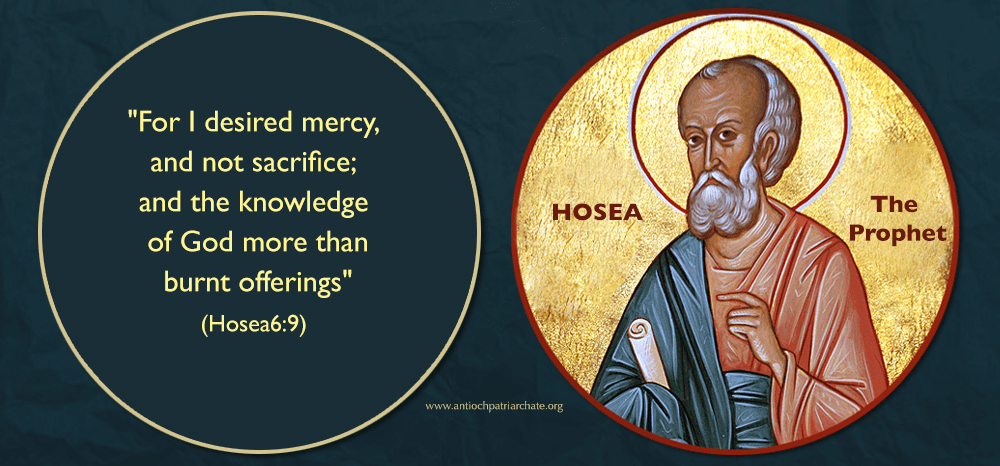
For I desire mercy, not sacrifice,
    and acknowledgment of God rather than burnt offerings.
As at Adam, they have broken the covenant;
    they were unfaithful to me there.
Gilead is a city of evildoers,
    stained with footprints of blood.
As marauders lie in ambush for a victim,
    so do bands of priests;
they murder on the road to Shechem,
    carrying out their wicked schemes.
I have seen a horrible thing in Israel:
    There Ephraim is given to prostitution,
    Israel is defiled. (New International Version)

My favorite word in all of Holy Scripture is the Hebrew word חסד (“chesed” pronounced in English “kes-ed).  It is such a rich word that no one English word can capture its depth and import. 

So, chesed is translated in various ways across English translations of the Bible as:

  • Goodness (American Standard Version)
  • Faithful love (Common English Bible)
  • Loyalty (God’s Word Translation)
  • Constant love (Good News Translation)
  • Mercy (King James Version)
  • Love that lasts (The Message)
  • Faithfulness (New English Translation)
  • Loving-kindness (New Life Version)
  • Steadfast love (New Revised Standard Version)

Chesed is God’s committed, gracious, and loving covenant loyalty to people. The Lord’s very attributes are sheer Love.

Since chesed marks the character and activity of God, the Lord very much desires people to reflect this same stance toward one another. In other words, because God is merciful and kind, we, as people created in God’s image, are to be marked with this same character in all we do. 

In today’s Old Testament lesson, God is calling and wooing wayward people to return to a life of closeness with the Lord. God demonstrated chesed by not sending the people away, like a spouse outright divorcing an unfaithful partner. Instead, the Lord is committed to loving the Israelites even when they were unlovely.

At all times, the response God wants from people is not simply to go through the motions of outward worship. Ritual practices mean little if there is no heart behind them. The Lord longs for people to demonstrate both fidelity and fealty through mercy and a steadfast love to God and neighbor.

Both our work and our worship are to be infused with divine mercy. 

God deeply desires a close relationship with humanity. The Lord is deeply grieved when people whore after other gods to meet their needs for love and belonging. Hosea’s prophecy is an impassioned plea for all persons to find their true fulfillment and enjoyment in a committed loving divine/human union, like a marriage.

In Christian readings of Hosea’s prophecy, repentance means accepting God’s chesed through Jesus Christ.

The believer is to allow the character of God to rule and reign in their heart so that love and commitment come flowing out in words, actions, thoughts, and dispositions.

Mercy, in Christianity, finds its highest expression in the person and work of Jesus.

It is no wonder, then, that Jesus lifted Hosea’s prophecy as a treasured principle of operation when asked why he deliberately made connections with “questionable” people:

As Jesus continued on from there, he saw a man named Matthew sitting at a kiosk for collecting taxes. He said to him, “Follow me,” and he got up and followed him. As Jesus sat down to eat in Matthew’s house, many tax collectors and sinners joined Jesus and his disciples at the table.

But when the Pharisees saw this, they said to his disciples, “Why does your teacher eat with tax collectors and sinners?”

When Jesus heard it, he said, “Healthy people don’t need a doctor, but sick people do. Go and learn what this means: I want mercy and not sacrifice. I didn’t come to call righteous people, but sinners.” (Matthew 9:9-13, CEB)

And when confronted about “questionable” activities, Jesus appealed to the same source of Hosea’s prophecy:

“Look! Your disciples are doing something that is not right to do on the day of rest—a holy day.”

Jesus asked them, “Haven’t you read what David did when he and his men were hungry? Haven’t you read how he went into the house of God and ate  the bread of the presence? He and his men had no right to eat those loaves. Only the priests have that right. Or haven’t you read in Moses’ Teachings that on the day of rest—a holy day, the priests in the temple do things they shouldn’t on the day of rest yet remain innocent? I can guarantee that something  greater than the temple is here. If you had known what ‘I want mercy, not sacrifices’ means, you would not have condemned innocent people. (Matthew 12:2-7, GW)

One can never go wrong with mercy and grace. If in doubt between whether to judge another or show mercy, the Christian’s choice is clear.

Grace and love reconnects the disconnected. The heart of true Christian spirituality is a deep kinship with the divine. Whenever that relation is broken or severed, it is vital to restore it. The means of doing so is not judgment; it’s mercy.

Chesed is more than a word; it is a way of life.

God wants mercy. Grace is the Lord’s divine will. So, let us today receive the forgiveness of Jesus and devote ourselves to prayer and works of love which come from a heart profoundly touched by grace. 

May the result of our return to the Lord be healing of that which has been broken, and reconciled relationships with others.

Merciful and loving God, the One who shows amazing grace, forgive us for our wanderings away from the divine life. Return us, again, to the grace of Jesus Christ our Savior so that our hearts will be renewed and aflame with love for others. In the Name of the Father, Son, and Spirit, the Great Three in One. Amen.

Psalm 85 – God Gives Grace

Psalm 85 by American artist John August Swanson, 2003

Lord, you poured out blessings on your land!
    You restored the fortunes of Israel.
You forgave the guilt of your people—
    yes, you covered all their sins.
You held back your fury.
    You kept back your blazing anger.

Now restore us again, O God of our salvation.
    Put aside your anger against us once more.
Will you be angry with us always?
    Will you prolong your wrath to all generations?
Won’t you revive us again,
    so your people can rejoice in you?
Show us your unfailing love, O Lord,
    and grant us your salvation.

I listen carefully to what God the Lord is saying,
    for he speaks peace to his faithful people.
    But let them not return to their foolish ways.
Surely his salvation is near to those who fear him,
    so our land will be filled with his glory.

Unfailing love and truth have met together.
    Righteousness and peace have kissed!
Truth springs up from the earth,
    and righteousness smiles down from heaven.
Yes, the Lord pours down his blessings.
    Our land will yield its bountiful harvest.
Righteousness goes as a herald before him,
    preparing the way for his steps. (New Living Translation)

Unfailing love, truth, righteousness, and peace are terms which all spiritual folk need to be familiar with, as well as experience every day.

Such love and commitment have their ground in God’s covenant loyalty and kindness which always holds on, even despite people’s fickle commitment.

Righteousness and peace are primarily relational terms which communicate a harmonious way of being with others and all creation.

Today’s psalm informs us that God will give exactly what the people have prayed for. This divine giving is a blessing by the Lord to those who long for wholeness, integrity, and unhindered connection with God and creation.

The metaphors surrounding the wonderful words give us a beautiful picture of the blessing realized, as if a big bucket of grace were being liberally poured over our heads.

This is no generic blessing from the almighty and everlasting God; it is personal.

In the grand immensity of the universe, the Creator God bends and condescends to the individual, as well as to all humanity. God’s steadfast love and ever-present faithfulness will meet to bless you and me.

The Lord will come alongside us with divine blessing. God’s grace will stick to us like glue in the form of right relationships and unity. It’s as personal as a kiss on the lips.

All of God’s attributes and character work in a seamless whole to bring divine acceptance and assistance to our lives. The good news here is that our struggles to be right and live right amidst terrible conditions of disease, war, and unrest will be vindicated with divine help.

So, take a big breath and exhale, allowing the worries and anxieties of adverse situations to be expelled from your weary soul. The Lord will give what is good.

“God gives where he finds empty hands.”

St. Augustine

Today’s psalm is a good reminder that salvation is not limited to a future state; it is also deliverance in this present world we inhabit, basking in the Lord’s love and shalom, and enjoying the good gifts God wants to give us right now.

But what if we have strayed from the truth and wandered down a bad road with unsavory characters?

The Lord will restore us. Why? Because that’s what God does.

Grace isn’t grace if we deserved it. Grace is only operable whenever there is a stink of a situation we have created for ourselves. God’s mercy exists to deal with all of our shortcomings, failings, sins, confusion, and misguided attempts at life.

Without mercy we are lost. Apart from grace, there’s no hope. The good news is that mercy really does exist, and, what’s more, there is an infinite storehouse of it. There is no point in which our screw-ups exhaust the supply of grace.

This reality brings us confident hope and inner gratitude. God’s unfailing and steadfast love brings deliverance, not bondage. The Lord’s infinite mercy, when truly experienced, is not taken as a license to do whatever I want but as a joyous get-out-of-jail-free-card which leads to a righteous life of wanting to please God in all I say and do.

He Giveth More Grace by Annie Johnson Flint, 1941

1. He giveth more grace as our burdens grow greater,
He sendeth more strength as our labors increase;
To added afflictions He addeth His mercy,
To multiplied trials He multiplies peace.

2. When we have exhausted our store of endurance,
When our strength has failed ere the day is half done,
When we reach the end of our hoarded resources
Our Father’s full giving is only begun.

3. Fear not that thy need shall exceed His provision,
Our God ever yearns His resources to share;
Lean hard on the arm everlasting, availing;
The Father both thee and thy load will upbear.

4. His love has no limits, His grace has no measure,
His power no boundary known unto men;
For out of His infinite riches in Jesus
He giveth, and giveth, and giveth again.

Amen.

Luke 10:25-37 – The Parable of the Good Samaritan

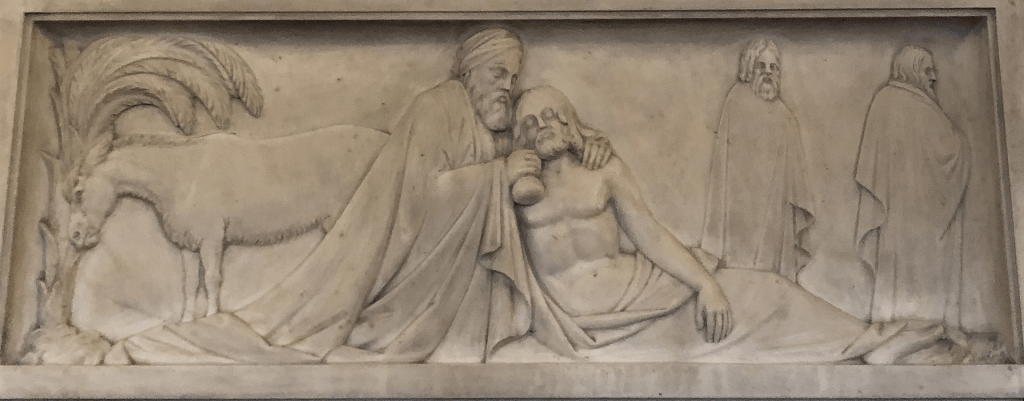
The Good Samaritan by Samuel Nixon. St. Paul’s Church, Halifax, Nova Scotia, Canada

 On one occasion an expert in the law stood up to test Jesus. “Teacher,” he asked, “what must I do to inherit eternal life?”

“What is written in the Law?” he replied. “How do you read it?”

He answered, “‘Love the Lord your God with all your heart and with all your soul and with all your strength and with all your mind’; and ‘Love your neighbor as yourself.”

“You have answered correctly,” Jesus replied. “Do this and you will live.”

But he wanted to justify himself, so he asked Jesus, “And who is my neighbor?”

In reply Jesus said: “A man was going down from Jerusalem to Jericho, when he was attacked by robbers. They stripped him of his clothes, beat him and went away, leaving him half dead. A priest happened to be going down the same road, and when he saw the man, he passed by on the other side. So too, a Levite, when he came to the place and saw him, passed by on the other side. 

But a Samaritan, as he traveled, came where the man was; and when he saw him, he took pity on him. He went to him and bandaged his wounds, pouring on oil and wine. Then he put the man on his own donkey, brought him to an inn and took care of him. The next day he took out two denarii and gave them to the innkeeper. ‘Look after him,’ he said, ‘and when I return, I will reimburse you for any extra expense you may have.’

“Which of these three do you think was a neighbor to the man who fell into the hands of robbers?”

The expert in the law replied, “The one who had mercy on him.”

Jesus told him, “Go and do likewise.” (New International Version)

Who do you relate to in the story? Which character most resonates with you in your life right now?

The Lawyer (an expert in the Old Testament Law)

The Gospel writer, Luke, gives us insight into the thought process of the person for whom Jesus told the parable to. That man sought to justify himself. In Christianity, no one justifies themselves. The kingdom of God turns on grace, and not with us working more or harder. 

Christ’s mercy is not dependent on what kind of people we are but is simply based on need. God graciously gives us the gift of faith and the mercy of deliverance. By Christ’s wounds we are healed. 

As Christians, we already possess justification by grace alone apart from human effort.

Each individual must realize they are in a theological ditch. We are all unable to get out of our predicament. Everyone needs the compassion of Christ.

But now God’s way of putting people right with himself has been revealed. It has nothing to do with law, even though the Law of Moses and the prophets gave their witness to it. God puts people right through their faith in Jesus Christ. God does this to all who believe in Christ, because there is no difference at all: everyone has sinned and is far away from God’s saving presence. But by the free gift of God’s grace all are put right with him through Christ Jesus, who sets them free. (Romans 3:21-24, GNT)

We do not need to justify ourselves.

The Priest and the Levite (experts in the Law)

The shock that hits closes to home, from Christ’s parable, is how frequently we are the ones who pass by and ignore the other. The command to “Go and do likewise,” extends about as far as the end of the story for modern hearers, landing us in the ditch between knowing the Samaritan and his compassionate generosity are set forth as an example and our tendency to ignore the cries of the downtrodden and disenfranchised.

Do not seek revenge or bear a grudge against anyone among your people but love your neighbor as yourself. I am the Lord…. When a foreigner resides among you in your land, do not mistreat them. The foreigner residing among you must be treated as your native-born. Love them as yourself, for you were foreigners in Egypt. I am the Lord your God. (Leviticus 19:18, 33-34, NIV)

The Lord defends the cause of the fatherless and the widow, and loves the foreigner residing among you, giving them food and clothing. And you are to love those who are foreigners, for you yourselves were foreigners in Egypt. (Deuteronomy 10:18-19, NIV)

We are to go and do likewise.

The Samaritan

The Samaritan, the Christ figure in the story, comes and shows the man mercy. This grace was free, lacked any sort of favoritism, and was full of sheer kindness. Without the Samaritan’s actions of binding up the man’s wounds and getting him to a safe place, the victim would have died.  

It is no coincidence that there are many hospitals throughout the country named “Good Samaritan.” Christians were at the forefront of establishing hospitals because of this very parable of Jesus. It was a significant way of living into the values of God’s kingdom.

Mercy is at the heart of all Christian ministry.

Jesus, responding to those who questioned his acts of mercy toward questionable people, said:

“Those who are well have no need of a physician, but those who are sick. Go and learn what this means, ‘I desire mercy, not sacrifice.’ For I have not come to call the righteous but sinners.” (Matthew 9:12-13, NRSV)

I appeal to you therefore, brothers and sisters, on the basis of God’s mercy, to present your bodies as a living sacrifice, holy and acceptable to God, which is your reasonable act of worship. (Romans 12:1, NRSV)

Do justice. Love mercy. Walk humbly. (Micah 6:8)

The Victim

The wounded hapless man was left for dead. In the story, we know he would die apart from help – the kind of help the man could not do for himself. He was completely dependent on someone to rescue him from his plight.

The victim in the ditch reminds us of what it feels like to be forgotten by others — and perhaps even by God. The feeling of loneliness and forsakenness invites compassion and empathy for all who experience it.

Victimization needs a voice and a champion. There are powerless people who either cannot speak or who are not heard by others. There are people, victims of abuse, who cannot get out of their traumatic ditch – overwhelmed by what another did to them.

God stands for the victim and against the robbers.

You will never again
    make victims of others
or send messengers to threaten
    everyone on this earth. (Nahum 2:13, CEV)

God will send help.

When the righteous cry out, the Lord listens;
    he delivers them from all their troubles.
The Lord is close to the brokenhearted;
    he saves those whose spirits are crushed.

The righteous have many problems,
    but the Lord delivers them from every one of them. (Psalm 34:17-19, CEB)

By his wounds we are healed.

Conclusion

The victim in the ditch is worthy of help because he carries the divine image of God.

The one who showed compassion and mercy, the Samaritan, reflected God’s likeness through his actions.

Those who passed by, the priest and the Levite, also bear the indelible mark of their Creator, yet chose to ignore their gut and got lost in their heads.

Maybe God — through Christ — comes to us as the one in the ditch or maybe as the one who shows compassion and mercy; perhaps God even comes to us as a reminder that the call to care for others frequently goes unheeded as we pass by the cries of those in need of help.

Lord God, heavenly Father, you did not spare your only Son, but gave him up for us all to be our Savior, and along with him you have graciously given us all things. We thank you for your precious, saving gospel, and we pray that you would help us to believe in the name of our Savior faithfully and steadfastly, for he alone is our righteousness and wisdom, our comfort and peace, so that we may stand on the day of his appearing, through Jesus Christ, your dear Son, our Lord. Amen.

Ephesians 2:11-22 – Included

Therefore, remember that formerly you who are Gentiles by birth and called “uncircumcised” by those who call themselves “the circumcision” (which is done in the body by human hands)—remember that at that time you were separate from Christ, excluded from citizenship in Israel and foreigners to the covenants of the promise, without hope and without God in the world. But now in Christ Jesus you who once were far away have been brought near by the blood of Christ.

For he himself is our peace, who has made the two groups one and has destroyed the barrier, the dividing wall of hostility, by setting aside in his flesh the law with its commands and regulations. His purpose was to create in himself one new humanity out of the two, thus making peace, and in one body to reconcile both of them to God through the cross, by which he put to death their hostility. He came and preached peace to you who were far away and peace to those who were near.For through him we both have access to the Father by one Spirit.

Consequently, you are no longer foreigners and strangers, but fellow citizens with God’s people and also members of his household, built on the foundation of the apostles and prophets, with Christ Jesus himself as the chief cornerstone. In him the whole building is joined together and rises to become a holy temple in the Lord. And in him you too are being built together to become a dwelling in which God lives by his Spirit. (New International Version)

There is perhaps no better explanation in the entire New Testament about what the Church truly is than here in today’s lesson.

The redemptive events of Jesus – especially the crucifixion of Christ – has completely changed everything. The cross is the mid-point of history, the fulcrum in which all things in heaven and on earth hinge.

The cross has totally transformed our status from being:

  • in Adam (fallen and separated from God) to being in Christ (now lifted and in union with God)
  • in the flesh (driven by our immoral and unethical impulses) to being in the Spirit (now driven by moral and ethical desires)
  • a Jew or a Gentile (defined by race, ethnicity, etc.) to being one people of God, a new egalitarian society, the community of the redeemed, the Church.

We were once far from God. Now we are brought near through the blood of Christ.

We are included, not excluded; graced and loved, not shamed and shunned.

And our status isn’t based on physical circumcision but on circumcision of the heart, that is, by faith.

There was a time when we were estranged from God, as if we were migrants from another country, or aliens from another world. We were strangers with no visible hope in anything or anyone.

But now, because of Christ’s cross, we have become near to God, gained an inheritance in Christ, and are seated in the heavens as royalty. Everything has mercifully changed. All is incredibly different – a good different.

Jesus Christ himself is our peace. He is the superglue who has bonded us to God and to one another as the one people of God. Because of this gracious union, there is no more anger and malice toward each other. There is, instead, peace.

The Lord Jesus has torn down the walls of separation between people, stripped the armor off of those who used it to keep a distance, and obliterated all obstacles to genuine relational connection – including the obstacle of the Law.

By his crucifixion, death, and resurrection, Christ Jesus fulfilled all the demands of the Law. Therefore, the Law of Moses is no longer needed. Those who love one another and carry one another’s burdens are the ones who fulfill the Law of Christ.

The reason for abolishing all the laws and layers of separation is so that Christ could create one new people from the disparate groups – thus making peace through the cross.

Just as two people come together in marriage and create an entirely new relationship – one new person from the two – so Christ has joined Jew and Gentile together and formed an entirely new society of unity and one-ness.

We are, then, on equal footing with one another. One group is no longer privileged over another. There is no such thing as an underprivileged people-group in God’s new society.

The Church is to be the one place on earth where all are privileged, all are included, and none are left behind.

There is reconciliation. The situation isn’t of people simply not fighting with each other, not at one another’s throats and sitting with a grumpy affect and arms folded. Quite the opposite. It is a restored relationship, harmonious interactions, and working together in loving fellowship.

Christianity is distinct from all other religions and all other ethical systems because everything is based, tethered, and moored in Christ’s crucifixion and resurrection. In Christianity, enmity, hate, and rage aren’t managed; they’re put to death – nailed to the cross and done away with.

Unfettered access to God, through Christ and the Spirit, means that we have an open channel to receiving the faith, hope, and love needed to address the darkness of this world and those still stuck in chaos, disconnection, and shame.

Christ himself is the cornerstone to the superstructure of peace and love which has been erected – the very things we have longed for throughout our personal lives and throughout history.

Jesus is the King who brought radical amnesty and hospitality to the entire country by making us all fellow citizens, enjoying all the rights and privileges thereof.

The Lord Jesus Christ is the Son who welcomed us into God’s family, embracing our adoption and making us full-blooded brothers and sisters, and giving us a prominent place at the Table.

All of these things about Christians and the Church aren’t ideals; they’re reality.

Anytime we are spiteful, ignorant, prejudiced, or unkind, we are not living in reality – we’re living in an old evil world that isn’t ours.

Therefore, we are called to fully live into God’s new society – a community of equals – loving and leading like Jesus, living into his words and ways, embracing our new status as children of God, offering radical mercy and grace because that’s exactly what our Lord did for us.

Creator God, who made us different from one another in myriad ways, yet all made in your image: Fill our hearts with your love and our minds with your wisdom so that we may truly become brothers and sisters of your only Son, our Savior Jesus Christ our Lord; who lives and reigns with you in the unity of the Holy Spirit, one God, now and forever. Amen.