Luke 14:1, 7-14 – How Can I Be Blessed?

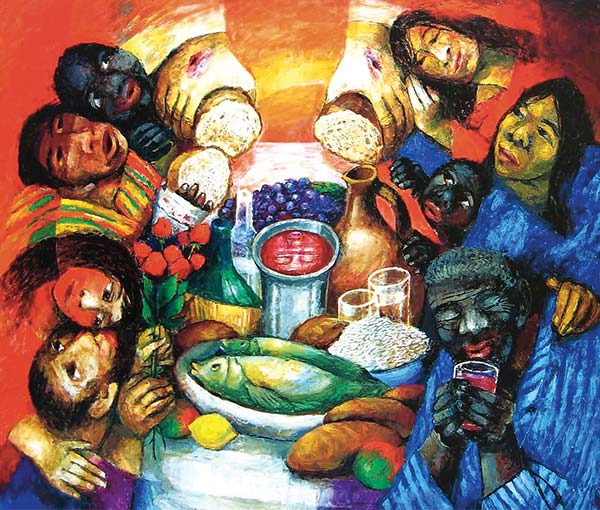
Jesus eating with “sinners.”

One Sabbath, when Jesus went to eat in the house of a prominent Pharisee, he was being carefully watched….

When he noticed how the guests picked the places of honor at the table, he told them this parable:“When someone invites you to a wedding feast, do not take the place of honor, for a person more distinguished than you may have been invited. If so, the host who invited both of you will come and say to you, ‘Give this person your seat.’ Then, humiliated, you will have to take the least important place. But when you are invited, take the lowest place, so that when your host comes, he will say to you, ‘Friend, move up to a better place.’ Then you will be honored in the presence of all the other guests. For all those who exalt themselves will be humbled, and those who humble themselves will be exalted.”

Then Jesus said to his host, “When you give a luncheon or dinner, do not invite your friends, your brothers or sisters, your relatives, or your rich neighbors; if you do, they may invite you back and so you will be repaid. But when you give a banquet, invite the poor, the crippled, the lame, the blind, and you will be blessed. Although they cannot repay you, you will be repaid at the resurrection of the righteous.” (New International Version)

A lot of people live by the old adage, “You scratch my back and I’ll scratch yours.” It’s a phrase referring to reciprocity. In other words, if you give me something I want, I will then respond by giving you something you want.

That old adage works fine, that is, unless you have no ability to give or give back to another. If we only operate by the principle of reciprocity, a large chunk of people automatically get left out. And this situation is untenable and unacceptable to Jesus.

Christ observed that the religious insiders of his day were keeping entire groups of people on the outside through their practice of scratching one another’s backs.

We need to get ahold of the reality that God loves us, as well as everyone else – even the people we may not give the time of day to. God so loved the world that he sent his Son. Jesus has come to feed us all, not just some.

Jesus eats with sinners by Sieger Köder (1925-2015)

The kingdom of God is about food. The food given by Jesus is to feed the hungry by staging a banquet. It is a feast of God’s abundance. Yet, many seem to hoard the resources they have, only thinking about their friends, family, and people just like them. They act as if there is no need to invite outsiders, consumed as they are with their own daily lives.

We have an incredible abundant feast contained in Scripture – in fact, Jesus said that his food and drink was to do the Father’s will, that Scripture was his bread. (Matthew 4:4; John 4:34) 

It’s much too easy to take our blessings of food for granted. After all, when we are well-fed, it’s easy to assume that everyone else is, too. Feeling healthy, it’s easy to forget that others are hurting. Making money, it’s easy to think there are not many poor people around. Living in a community with plenty of churches and more bibles than people, it’s natural to assume that everyone knows the gospel of Jesus – but they don’t!

Then, whenever we get around to acknowledging there are people who need Jesus, we keep devising ways to reach them without having to change or accommodate our own lives to do it.

Christ’s call to faithful discipleship requires people to change from having a narrow focus on our small circle of friends, to including those who have no means to pay us back.

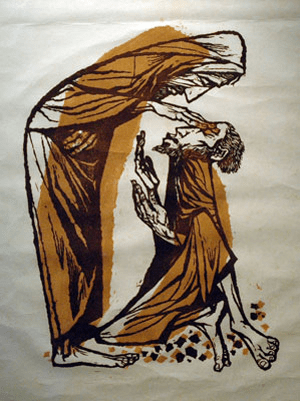
Table fellowship by Sieger Köder 

The gospel of Jesus Christ is open to outcasts and failures, to problem people and unimpressive persons. People with needs and flaws are especially dear to Jesus. It’s the people who outwardly have it all together who are being replaced wholesale with those who admit their need. 

We must not be picky about who we invite to participate in the largess of abundance we possess. We are to avoid the spiritual snobbery of looking down our noses at the needy and less fortunate, who have nothing to offer us in return.

Those who give need to do so without prejudice or favoritism. Even the lazy, the fool, and the sinner still need basic resources to live. By opening our hearts in almsgiving, we open ourselves to Christ, who is present in the least of those among us.

Refusing mercy to people deemed as unworthy, givers then actually shut themselves off from the very mercy God desires for them. There is no reward from God when there is only reward from others.

“If we are going to examine lives, we will never have mercy upon any human being; rather, hindered by this inopportune meddlesomeness, we will remain fruitless and destitute of all help ourselves.”

St. John Chrysostom, On Repentance and Almsgiving

It’s not only the poor who suffer when the rich fail to give. In judging whether or not a particular person is worthy of love and aid, the wealthy person rejects the spiritual fruit that he would have received by giving with humility.

Giving to the poor, simply to relieve our own conscience, is not real charity; it doesn’t consider the other. We attend fully to the other by observing their spiritual and holistic needs for community, purpose, respect, and dignity. Dispassionate giving from a distance, without relationship, refuses to acknowledge the whole person. It exploits the poor for the mental comfort of the rich.

We need to be involved in people’s lives, and that takes a lot of blood, sweat, and tears. There are too many lost people who need Jesus – and, I may add, too many Christians who are the walking wounded and need the healing touch of Jesus – for us to pay scant attention to the call of Jesus to invite the needy into our lives. 

Seeing people come into God’s great banquet, and into a joyous and vital relationship with Christ, will likely take ten times more work than what you are thinking it does right now. Yet, this is the pathway of true blessing – to having God’s stamp of approval on our lives.

How can I be blessed? Not by posturing for the best place in the room but by being a blessing to the most vulnerable and needy amongst us.

Merciful God, thank you for the abundance of life, relationships, health, comfort, and wealth you have provided to so many. Thank you that, even in times of need, despair, and brokenness, you are there. Please, put your arms around children and families in  poverty and disability so that they feel your comfort and hope. Meet their needs both physically and spiritually. And guide me so I can be your hands and feet pursuing justice for the poor and upholding the cause of the needy, in the way of Jesus Christ our Lord. Amen.

Luke 6:6-11 – Every Day is Meant for Doing Good

On another Sabbath, Jesus went into the synagogue and was teaching, and a man was there whose right hand was shriveled. The Pharisees and the teachers of the law were looking for a reason to accuse Jesus, so they watched him closely to see if he would heal on the Sabbath. But Jesus knew what they were thinking and said to the man with the shriveled hand, “Get up and stand in front of everyone.” So, he got up and stood there.

Then Jesus said to them, “I ask you, which is lawful on the Sabbath: to do good or to do evil, to save life or to destroy it?”

He looked around at them all, and then said to the man, “Stretch out your hand.” He did so, and his hand was completely restored. But the Pharisees and the teachers of the law were furious and began to discuss with one another what they might do to Jesus. (New International Version)

Lectio Divina is an ancient Latin term which means “spiritual reading.”  It means to read Holy Scripture not just to know its contents, but to experience its power to restore, heal, transform, and draw close to God.

Lectio Divina is a simple way to prayerfully read Scripture, meditate on its message, and listen for what God may be saying for us to do. It can be done privately, or with a small group of people. The goal is to become more Christ-like.

Lectio Divina is based upon reading a selected text of Scripture three times. Each reading is followed by a period of silence after which each person is given the opportunity to briefly share what they are hearing as they listen to God (if done in a group).

For today’s Gospel lesson, I invite you to give it three different readings, as is common to a Lectio Divina approach:

  1. In the first reading, read the text aloud slowly and carefully. Listen for a word, phrase or idea that captures you attention. As you recognize a word, phrase or idea, focus your attention on it, repeating it several times.
  2. In the second reading, focus your attention on how the selected word, phrase or idea speaks to your life right now. What does it mean for you today? How is Christ speaking to you about your life through this word, phrase or idea?
  3. In the third reading, focus on what God is calling you to do or to become. Experiencing God’s presence changes us. It calls us to something. What is that something?

So, here are my reflections from reading today’s Gospel lesson three times:

  1. In my first reading, the phrase “watched him closely” stood out to me. As I sat and pondered this phrase, I thought about how there are always people watching us. How I live my life, and what I say, are continually on display. Mostly, this is a good thing, because I believe that modeling an authentic and devout life to Christ is important. Yet, whenever someone is watching us closely, in the sense of continually looking over our shoulder, or scrutinizing every word and action so as to find fault, this is a very bad thing.
  2. In my second reading, I hear God speaking to me about how Jesus experienced this bad sort of watching, and yet, he did not let it deter him from doing good and following through on what is right by healing a man on the Sabbath. In fact, Christ confidently had the man with the shriveled hand stand up in front of everyone. He wanted the entire congregation, including those who were watching him with judgmental eyes, to see exactly what he was doing. Jesus neither healed him quietly nor waited till after the synagogue service was over; he was very open about what was happening.
  3. In my third reading, I felt Jesus beside me – not looking for something to correct or chastise me about – but rather putting his arm around my shoulder, knowing exactly what it feels like to be the object of criticism, scorn, and malevolent plotting against. I sense my solidarity with Christ, my union with him, believing that nothing can separate me from the love of God in Christ, my Savior and Lord, who always has my back. I hear Jesus graciously calling me to stand firm and openly do what is good and right, every day, no matter who is watching or why they are watching.

Today’s Gospel lesson shows us Christ’s disapproval of those who focus so narrowly on the traditions and laws of religion that they end up losing sight of God’s message.

For the Christian, the message is a gospel of grace, not condemnation. Jesus challenges the legalistic way of keeping the Sabbath holy by asking a penetrating question: “Is it lawful to do good on the Sabbath rather than to do evil, to save life rather than to destroy it?”

By showing compassion to the man with the withered hand, Jesus points us to a way of holiness that’s a whole lot more than keeping the law and performing rituals.

By healing the man, Jesus teaches us to respond to God’s call to do good and save lives. Traditions should never interfere with our compassion for those in need.

“If anyone, then, knows the good they ought to do and doesn’t do it, it is sin for them.”

James 4:17

If you haven’t already done so, give the Lectio Divina a healthy try – because God is always speaking to us; we just need to be still and silent in order to hear.

Lord Jesus Christ, Son of God, have mercy on me, and grant me your peace. Amen.

Hosea 6:1-10 – “I Want Mercy, Not Sacrifice”

“Come, let us return to the Lord.
He has torn us to pieces
    but he will heal us;
he has injured us
    but he will bind up our wounds.
After two days he will revive us;
    on the third day he will restore us,
    that we may live in his presence.
Let us acknowledge the Lord;
    let us press on to acknowledge him.
As surely as the sun rises,
    he will appear;
he will come to us like the winter rains,
    like the spring rains that water the earth.”

“What can I do with you, Ephraim?
    What can I do with you, Judah?
Your love is like the morning mist,
    like the early dew that disappears.
Therefore I cut you in pieces with my prophets,
    I killed you with the words of my mouth—
    then my judgments go forth like the sun.
For I desire mercy, not sacrifice,
    and acknowledgment of God rather than burnt offerings.
As at Adam, they have broken the covenant;
    they were unfaithful to me there.
Gilead is a city of evildoers,
    stained with footprints of blood.
As marauders lie in ambush for a victim,
    so do bands of priests;
they murder on the road to Shechem,
    carrying out their wicked schemes.
I have seen a horrible thing in Israel:
    There Ephraim is given to prostitution,
    Israel is defiled. (New International Version)

My favorite word in all of Holy Scripture is the Hebrew word חסד (“chesed” pronounced in English “kes-ed).  It is such a rich word that no one English word can capture its depth and import. 

So, chesed is translated in various ways across English translations of the Bible as:

  • Goodness (American Standard Version)
  • Faithful love (Common English Bible)
  • Loyalty (God’s Word Translation)
  • Constant love (Good News Translation)
  • Mercy (King James Version)
  • Love that lasts (The Message)
  • Faithfulness (New English Translation)
  • Loving-kindness (New Life Version)
  • Steadfast love (New Revised Standard Version)

Chesed is God’s committed, gracious, and loving covenant loyalty to people. The Lord’s very attributes are sheer Love.

Since chesed marks the character and activity of God, the Lord very much desires people to reflect this same stance toward one another. In other words, because God is merciful and kind, we, as people created in God’s image, are to be marked with this same character in all we do. 

In today’s Old Testament lesson, God is calling and wooing wayward people to return to a life of closeness with the Lord. God demonstrated chesed by not sending the people away, like a spouse outright divorcing an unfaithful partner. Instead, the Lord is committed to loving the Israelites even when they were unlovely.

At all times, the response God wants from people is not simply to go through the motions of outward worship. Ritual practices mean little if there is no heart behind them. The Lord longs for people to demonstrate both fidelity and fealty through mercy and a steadfast love to God and neighbor.

Both our work and our worship are to be infused with divine mercy. 

God deeply desires a close relationship with humanity. The Lord is deeply grieved when people whore after other gods to meet their needs for love and belonging. Hosea’s prophecy is an impassioned plea for all persons to find their true fulfillment and enjoyment in a committed loving divine/human union, like a marriage.

In Christian readings of Hosea’s prophecy, repentance means accepting God’s chesed through Jesus Christ.

The believer is to allow the character of God to rule and reign in their heart so that love and commitment come flowing out in words, actions, thoughts, and dispositions.

Mercy, in Christianity, finds its highest expression in the person and work of Jesus.

It is no wonder, then, that Jesus lifted Hosea’s prophecy as a treasured principle of operation when asked why he deliberately made connections with “questionable” people:

As Jesus continued on from there, he saw a man named Matthew sitting at a kiosk for collecting taxes. He said to him, “Follow me,” and he got up and followed him. As Jesus sat down to eat in Matthew’s house, many tax collectors and sinners joined Jesus and his disciples at the table.

But when the Pharisees saw this, they said to his disciples, “Why does your teacher eat with tax collectors and sinners?”

When Jesus heard it, he said, “Healthy people don’t need a doctor, but sick people do. Go and learn what this means: I want mercy and not sacrifice. I didn’t come to call righteous people, but sinners.” (Matthew 9:9-13, CEB)

And when confronted about “questionable” activities, Jesus appealed to the same source of Hosea’s prophecy:

“Look! Your disciples are doing something that is not right to do on the day of rest—a holy day.”

Jesus asked them, “Haven’t you read what David did when he and his men were hungry? Haven’t you read how he went into the house of God and ate  the bread of the presence? He and his men had no right to eat those loaves. Only the priests have that right. Or haven’t you read in Moses’ Teachings that on the day of rest—a holy day, the priests in the temple do things they shouldn’t on the day of rest yet remain innocent? I can guarantee that something  greater than the temple is here. If you had known what ‘I want mercy, not sacrifices’ means, you would not have condemned innocent people. (Matthew 12:2-7, GW)

One can never go wrong with mercy and grace. If in doubt between whether to judge another or show mercy, the Christian’s choice is clear.

Grace and love reconnects the disconnected. The heart of true Christian spirituality is a deep kinship with the divine. Whenever that relation is broken or severed, it is vital to restore it. The means of doing so is not judgment; it’s mercy.

Chesed is more than a word; it is a way of life.

God wants mercy. Grace is the Lord’s divine will. So, let us today receive the forgiveness of Jesus and devote ourselves to prayer and works of love which come from a heart profoundly touched by grace. 

May the result of our return to the Lord be healing of that which has been broken, and reconciled relationships with others.

Merciful and loving God, the One who shows amazing grace, forgive us for our wanderings away from the divine life. Return us, again, to the grace of Jesus Christ our Savior so that our hearts will be renewed and aflame with love for others. In the Name of the Father, Son, and Spirit, the Great Three in One. Amen.

Psalm 85 – God Gives Grace

Psalm 85 by American artist John August Swanson, 2003

Lord, you poured out blessings on your land!
    You restored the fortunes of Israel.
You forgave the guilt of your people—
    yes, you covered all their sins.
You held back your fury.
    You kept back your blazing anger.

Now restore us again, O God of our salvation.
    Put aside your anger against us once more.
Will you be angry with us always?
    Will you prolong your wrath to all generations?
Won’t you revive us again,
    so your people can rejoice in you?
Show us your unfailing love, O Lord,
    and grant us your salvation.

I listen carefully to what God the Lord is saying,
    for he speaks peace to his faithful people.
    But let them not return to their foolish ways.
Surely his salvation is near to those who fear him,
    so our land will be filled with his glory.

Unfailing love and truth have met together.
    Righteousness and peace have kissed!
Truth springs up from the earth,
    and righteousness smiles down from heaven.
Yes, the Lord pours down his blessings.
    Our land will yield its bountiful harvest.
Righteousness goes as a herald before him,
    preparing the way for his steps. (New Living Translation)

Unfailing love, truth, righteousness, and peace are terms which all spiritual folk need to be familiar with, as well as experience every day.

Such love and commitment have their ground in God’s covenant loyalty and kindness which always holds on, even despite people’s fickle commitment.

Righteousness and peace are primarily relational terms which communicate a harmonious way of being with others and all creation.

Today’s psalm informs us that God will give exactly what the people have prayed for. This divine giving is a blessing by the Lord to those who long for wholeness, integrity, and unhindered connection with God and creation.

The metaphors surrounding the wonderful words give us a beautiful picture of the blessing realized, as if a big bucket of grace were being liberally poured over our heads.

This is no generic blessing from the almighty and everlasting God; it is personal.

In the grand immensity of the universe, the Creator God bends and condescends to the individual, as well as to all humanity. God’s steadfast love and ever-present faithfulness will meet to bless you and me.

The Lord will come alongside us with divine blessing. God’s grace will stick to us like glue in the form of right relationships and unity. It’s as personal as a kiss on the lips.

All of God’s attributes and character work in a seamless whole to bring divine acceptance and assistance to our lives. The good news here is that our struggles to be right and live right amidst terrible conditions of disease, war, and unrest will be vindicated with divine help.

So, take a big breath and exhale, allowing the worries and anxieties of adverse situations to be expelled from your weary soul. The Lord will give what is good.

“God gives where he finds empty hands.”

St. Augustine

Today’s psalm is a good reminder that salvation is not limited to a future state; it is also deliverance in this present world we inhabit, basking in the Lord’s love and shalom, and enjoying the good gifts God wants to give us right now.

But what if we have strayed from the truth and wandered down a bad road with unsavory characters?

The Lord will restore us. Why? Because that’s what God does.

Grace isn’t grace if we deserved it. Grace is only operable whenever there is a stink of a situation we have created for ourselves. God’s mercy exists to deal with all of our shortcomings, failings, sins, confusion, and misguided attempts at life.

Without mercy we are lost. Apart from grace, there’s no hope. The good news is that mercy really does exist, and, what’s more, there is an infinite storehouse of it. There is no point in which our screw-ups exhaust the supply of grace.

This reality brings us confident hope and inner gratitude. God’s unfailing and steadfast love brings deliverance, not bondage. The Lord’s infinite mercy, when truly experienced, is not taken as a license to do whatever I want but as a joyous get-out-of-jail-free-card which leads to a righteous life of wanting to please God in all I say and do.

He Giveth More Grace by Annie Johnson Flint, 1941

1. He giveth more grace as our burdens grow greater,
He sendeth more strength as our labors increase;
To added afflictions He addeth His mercy,
To multiplied trials He multiplies peace.

2. When we have exhausted our store of endurance,
When our strength has failed ere the day is half done,
When we reach the end of our hoarded resources
Our Father’s full giving is only begun.

3. Fear not that thy need shall exceed His provision,
Our God ever yearns His resources to share;
Lean hard on the arm everlasting, availing;
The Father both thee and thy load will upbear.

4. His love has no limits, His grace has no measure,
His power no boundary known unto men;
For out of His infinite riches in Jesus
He giveth, and giveth, and giveth again.

Amen.