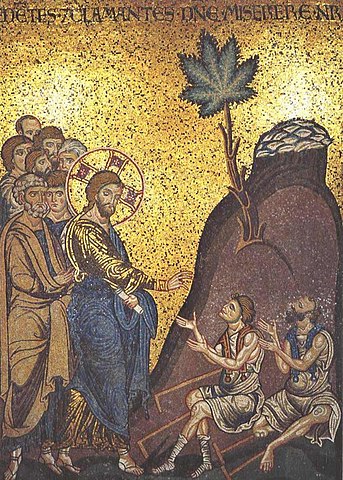
Jesus healing two blind men, 11th century mosaic, Sicily
As Jesus went on from there, two blind men followed him, calling out, “Have mercy on us, Son of David!”
When he had gone indoors, the blind men came to him, and he asked them, “Do you believe that I am able to do this?”
“Yes, Lord,” they replied.
Then he touched their eyes and said, “According to your faith let it be done to you”; and their sight was restored. Jesus warned them sternly, “See that no one knows about this.” But they went out and spread the news about him all over that region.
While they were going out, a man who was demon-possessed and could not talk was brought to Jesus. And when the demon was driven out, the man who had been mute spoke. The crowd was amazed and said, “Nothing like this has ever been seen in Israel.”
But the Pharisees said, “It is by the prince of demons that he drives out demons.” (New International Version)
Every day the news is a steady stream of disease, death, war, and outright human suffering. It’s as if the phrase, “slow news cycle,” is a thing of the past.
As we stare into the face of trouble, I find myself uttering the ancient prayer of the Church: “Lord have mercy. Christ, have mercy. Lord have mercy and grant us your peace.”
We collectively feel the weight of the world’s suffering, experience the heaviness of concern for family and friends, and perhaps wonder how much more people can take.
It’s in the topsy-turvy times that I come back again and again to the deep spiritual convictions which inform what I do each day. One of those underlying creeds and affirmations is this:
Jesus is trustworthy, no matter whether my faith or the faith of others is small or great.
In our Gospel lesson for today, two blind men were healed according to their faith in Jesus. The diverse healing accounts of Jesus in the New Testament, whether the faith was large or small in those healed, leads me to the conclusion that:
It isn’t faith itself that heals, saves, or transforms – it is Jesus.
All the healing accounts in the New Testament Gospels have something in common: They all directly point to Jesus as the object of faith.
It isn’t about the level or amount of faith, but about where the faith is placed.
For the Christian, faith itself doesn’t mean much if it isn’t in Jesus.
If I place a large and sincere faith in an inanimate object such as money; in a position of power; or, even in my own independence, my faith isn’t worth much.
If I have a huge faith in a doctor or a psychiatrist to heal my body or my mind, I will quickly discover there are limits to their abilities.
If I have a confident faith that my family will meet all my needs, my faith will eventually run into failure when they let me down. That’s because the ultimate object of faith is Jesus.
If all my faith eggs are in the church basket, my faith will eventually face a crisis because it is a misplaced faith. Furthermore, the answer I provide for others is not simply getting them to attend church or to adopt my moral code.
There should be a consistency that runs through us all. For Jesus doesn’t change—yesterday, today, tomorrow, he’s always totally himself.
Hebrews 13:8, MSG
We know with certainty that circumstances change, as everyday seems to bring new levels and permutations of unprecedented alterations to our lives – and through it all, Jesus remains as the ever-present Savior, seated at the right hand of God ceaselessly interceding on behalf of those who offer even the slightest mustard seed of faith.
“For truly I tell you, if you have faith the size of a mustard seed, you will say to this mountain, ‘Move from here to there,’ and it will move, and nothing will be impossible for you.”
Jesus (Matthew 17:20-21, NRSV)
It says something about our modern Western society that whenever we hear the words of Jesus on faith that we interpret the mountain moving as an immediate event that happens almost instantaneous, like a snap of the finger. Yet, there is nothing in those words that says that. There is also nothing that says an individual necessarily does it.
The fact of the matter is this: Jesus heals, transforms, and delivers people from sickness, sin, trouble, and overwhelming circumstances in his own good time, not ours.
Just because we pray without ceasing for days, weeks, months, and even years for something doesn’t mean we lack faith if the prayer isn’t answered immediately. It could be that God wants others involved, maybe even across generations, for the impossible mountain to be moved.
It is misplaced faith which expects microwave results. Faith placed appropriately in Jesus as the object of belief discerns that faithful prayer is consistently prayed until there is an answer.
Healing and restoration will happen – just maybe not always how or when we think it will.
Almighty God, you know that we have no power in ourselves to help ourselves: Keep me both outwardly in my body and inwardly in my soul, that I may be defended from all adversities which may happen to the body, and from all evil thoughts which may assault and hurt the soul; through Jesus Christ our Lord, who lives and reigns with you and the Holy Spirit, one God, forever and ever. Amen.
Welcome, friends! Luke 10:25-37 contains the familiar story of the Good Samaritan. It’s a parable of mercy, relationship, trust, and meeting a pressing need. It’s a story of God’s love for humanity. Click the videos below and let’s explore what it means to stop and help….
Pastor Tim Ehrhardt, Luke 10:25-37
The Maranatha Singers
God the Father, Creator of heaven and earth, Have mercy upon us.
God the Son, Redeemer of the world, Have mercy upon us.
God the Holy Spirit, Sanctifier of the faithful, Have mercy upon us.
Blessed Holy Trinity, the God whom we serve, Have mercy upon us, and grant us your peace. Amen.
On one occasion an expert in the law stood up to test Jesus. “Teacher,” he asked, “what must I do to inherit eternal life?”
“What is written in the Law?” he replied. “How do you read it?”
He answered, “‘Love the Lord your God with all your heart and with all your soul and with all your strength and with all your mind’; and ‘Love your neighbor as yourself.”
“You have answered correctly,” Jesus replied. “Do this and you will live.”
But he wanted to justify himself, so he asked Jesus, “And who is my neighbor?”
In reply Jesus said: “A man was going down from Jerusalem to Jericho, when he was attacked by robbers. They stripped him of his clothes, beat him and went away, leaving him half dead. A priest happened to be going down the same road, and when he saw the man, he passed by on the other side. So too, a Levite, when he came to the place and saw him, passed by on the other side. But a Samaritan, as he traveled, came where the man was; and when he saw him, he took pity on him. He went to him and bandaged his wounds, pouring on oil and wine. Then he put the man on his own donkey, brought him to an inn and took care of him. The next day he took out two denarii and gave them to the innkeeper. ‘Look after him,’ he said, ‘and when I return, I will reimburse you for any extra expense you may have.’
“Which of these three do you think was a neighbor to the man who fell into the hands of robbers?”
The expert in the law replied, “The one who had mercy on him.”
Jesus told him, “Go and do likewise.” (New International Version)
Mosaic of the Good Samaritan in the Cathedral of St. Mary, Madrid, Spain
Start with Love and Mercy
The short answer to the question of how to begin any ministry is love, by providing relief through showing mercy. Compassion, mercy, and love are always behind every true Christian ministry.
Being available and approachable, crossing paths with people in need, noticing and caring about others is a merciful response. Following the example of Jesus, the Christian community ought not to pass by on the other side of the road. Instead, we are to stop and get involved smack in the middle of human need.
That isn’t what always happens, though. It can be far too easy to respond to the vast sea of human need by being judgmental and critical. We might observe people’s predicaments and write those persons off as being lazy, foolish, or of bad character. Just as bad, our prejudice or bias might see a person’s clothes, habits, race, ethnicity, or gender and immediately make sweeping negative assumptions about them – without having even engaged them.
Frankly, from a Christian perspective, it just doesn’t matter. Whether we believe someone deserves our help or not, all Christian ministry is to be driven by a spirit of love, compassion, and mercy – rather than a spirit of condemnation. We need to see all people, without exception, as image bearers of God who possess inherent worth and dignity as human beings.
The Good Samaritan by Vincent Van Gogh, 1890
Start with Relationships
It is good to give money, food, and resources to those in need. It’s even better to develop relationships and get to know the people for whom we are helping. Both handouts and hugs are good and necessary. In this COVID-19 world we are currently living in, I am using “hug” as both a metaphor and an acronym….
Hold eye contact. One of the things we all have discovered about masking is that the eyes communicate a lot. Looking someone in the eye is important. Far too many people in our world don’t feel seen by others. They wonder, if they fell off the face of the earth, whether anyone would even notice. Seeing people is a necessary ministry, in and of itself.
Understand another’s life and point of view. Be curious about their lives, their history, their faith background, and their experiences. Put yourself in their shoes. See things from their perspective. Empathy (communicating to someone that they are not alone) goes a long way. What’s more, we don’t have to agree with another to extend mercy.
Go to others, rather than waiting for others to come to you. Go where they are. Get close enough to show empathy and compassion, even if it’s an air hug. Half of any relationship, before any talking or doing happens, is simply showing up. The good Samaritan showed up and stopped. He was willing to go wherever the mercy of God sent him.
Start with Building Trust
Most needy people have been, at the least, ignored or dismissed by others; and, at worst, like the man attacked by robbers, beat down and berated by others and left for dead. Anyone who has endured past abuse or trauma is understandably guarded in trusting others. The last thing they want to do is be open and vulnerable to a stranger who might take advantage of them and hurt them.
It takes time to build trust. A person’s issues, a neighborhood’s concerns, and a city’s anxiety won’t be solved overnight. Those problems took a great deal of time in their development, and so, it will take just as much, or more, time to address and resolve all that is wrong.
As we lovingly and mercifully tackle those problems, we must always keep in mind that we fix problems and heal people – and never the other way around. Trying to fix people is a fool’s errand because people are not their problems. Nobody is a cancer, a disease, a schizophrenic, or a lunatic. People have physical, mental, emotional, and spiritual illnesses but they are not inherently those problems. Anything we won’t possess in heaven is something we are not, as people.
Human organizations, systems, institutions, and culture can be a problem – but not people themselves. Whenever someone begins labeling people as “problem” people, or as “those” people, or even worse, as “monsters” or some other label, the judgment of God is not far behind. (Matthew 5:22)
Trust cannot be developed with putting adjectives in front of people’s names or replace those names with pejorative terms. Christian ministry can only thrive in an atmosphere of love, mercy, and compassion.
Trust is developed when we give people the dignity of choices and ask whether they would like help, or not. We don’t save anyone. God does. We are all responsible for our own choices and our own openness to accepting and owning our own problems.
The Good Samaritan by Paulus Hoffman
Start with Meeting a Need
The man alongside the road had a clear need for immediate assistance. The Samaritan stepped in and met that pressing need. The man would have died without it. Yet, some people’s needs aren’t quite so obvious. If we have worked at building trust, some of those needs become known. And there are always existing organizations who are diligently addressing many of those needs with whom we can partner.
Another way of meeting needs is to connect people with one another. Through consulting and collaborating with others, we can foster relational connections in which someone’s or a group’s needs can be met. Since no one person or community can meet everyone’s needs, many times the best approach is to help people meet one another.
When we get neighbors working together to care for one another and improve their neighborhood, they are empowered to make a difference. This is especially viable when a church commits itself to the place or parish in which it exists. By being involved, partnering with community organizations or neighborhood associations, the church joins others as a community connector and a place where the community comfortably gathers.
Conclusion
All Christian ministry begins with a loving attitude, a compassionate heart, and a merciful spirit. Then, it looks for opportunities to be available and show up with a compassionate presence. From there, we are able to discover and discern the real needs of people so that we are providing what is truly needed instead of what we believe someone else needs.
In one of the communities I once pastored, I noticed the town had a significant number of single parents trying to raise their kids. So, I did a bit of demographic work and presented it to the elders, pointing out the opportunity we have to make a difference in many of these family’s lives. The elders became excited about the chance for outreach, that is, until I proposed that we recruit two or three of those single parents to come, sit around the table, and help us understand their needs and how we might help…. The elders became eerily silent…. Finally, one of them spoke up and said, “We can’t do that. They got themselves into this single parent situation. They don’t know what’s best. We do….”
That response is just the opposite of what God is looking for in us. If we believe we know better to the point of not even asking others how we might help, then our arrogance and prejudice has blinded us to true Christian ministry in the way of Jesus. Now for a better story….
The Good Samaritan by Corinne Vonaesch
A woman and her husband were not from the area they were living, and so, every Thanksgiving they spent it only with each other, since both their families lived far away. So, when one Thanksgiving came around, they wondered if there were others like them, spending the holiday apart from family.
They found a few and spent that Thanksgiving together. Those folks had such a good time together that, next year, the woman and her husband asked if they could use the church fellowship hall where I was pastoring at Thanksgiving because they found more people who had no family to celebrate with.
To make a long story short, these two people now serve about two-hundred people in the community every Thanksgiving who gather together, and another two hundred shut-ins are delivered a Thanksgiving meal, along with some needed human connection. Many positive friendships and relationships are formed.
“It’s not how much we give but how much love we put into giving.”
Mother Teresa
Small acts of kindness done with big love result in the kind of Christian ministry which pleases God.
Lord, help us believe we are all ordinary people made extraordinary through your vision and power. Take our insecurities and feelings of inadequacy and give us the courage to see ourselves and others as you see us, with gifts and potential to transform your world and build your Kingdom, through Jesus Christ our Lord. Amen.
Welcome, friends! Micah 6:1-8 lets us know exactly what God desires for us as God’s people: to act justly, to love mercy, and to walk humbly with our God. Click on the videos below, and we will consider the Word of the Lord together.
Blessed God and Father of our Lord Jesus Christ, fill the hearts of your people with the fire of your love and mercy, and with the desire to ensure justice is done for the common good of all persons. Amen.