Matthew 10:34-42 – The Trouble with Jesus

Jesus teaching the disciples, from the Catacombs of Domitilla, Rome

Jesus said, “Do not suppose that I have come to bring peace to the earth. I did not come to bring peace, but a sword. For I have come to turn

‘a man against his father,
    a daughter against her mother,
a daughter-in-law against her mother-in-law—
    a man’s enemies will be the members of his own household.’

Anyone who loves their father or mother more than me is not worthy of me; anyone who loves their son or daughter more than me is not worthy of me. Whoever does not take up their cross and follow me is not worthy of me. Whoever finds their life will lose it, and whoever loses their life for my sake will find it.

Anyone who welcomes you welcomes me, and anyone who welcomes me welcomes the one who sent me. Whoever welcomes a prophet as a prophet will receive a prophet’s reward, and whoever welcomes a righteous person as a righteous person will receive a righteous person’s reward. And if anyone gives even a cup of cold water to one of these little ones who is my disciple, truly I tell you, that person will certainly not lose their reward.” (New International Version)

Jesus is the sort of guy that gets up in our grill and confronts us with this: All of life centers in him. That may sound incredibly narcissistic. For Christians, it isn’t, because we discern and confess along with the Apostle Paul:

“The Son is the image of the invisible God, the firstborn over all creation. For in him all things were created: things in heaven and on earth, visible and invisible, whether thrones or powers or rulers or authorities; all things have been created through him and for him. He is before all things, and in him all things hold together. And he is the head of the body, the church; he is the beginning and the firstborn from among the dead, so that in everything he might have the supremacy. For God was pleased to have all his fullness dwell in him, and through him to reconcile to himself all things, whether things on earth or things in heaven, by making peace through his blood, shed on the cross.” (Colossians 1:15-20, NIV)

The Christian’s confession of centrality in Christ means that we believe Jesus is the most important person there is. That confession often makes us troublemakers, as we follow in the footsteps of the Lord who was himself a troublemaker.

That may also sound like something that happens when a narcissist is in control. Again, for Christians, it isn’t, because we realize that trouble is central to Christian mission; the way of the resurrection comes through the cross; the way to succeed is to fail; and whoever loses their life will find it.

We Should Expect Opposition

We should not be obstinate, pigheaded, short-sighted, legalistic, or use the Bible as a brick to throw at people who disagree with us. That will certainly bring opposition and trouble. But this is not the kind of opposition we’re talking about. Being a jerk is antithetical to the gospel. Don’t be a jerk.

The opposition Jesus experienced came through being humble, meek, just, merciful, pure, and peace-loving. According to Christ’s Beatitudes, embracing these values will smack against their opposites. Pride, criticism, judgmentalism, and selfishness are ensconced everywhere throughout this fallen world.

The virtues of Jesus are counter-cultural; they’re different than how the world typically operates. 

As people who must live in this world, we need to avoid the extremes of simple assimilation into the culture, or an outright rejection of the culture. Blending into culture, and separating from it, are both ways of avoiding opposition and trouble. 

Instead, there is a third way that encompasses both shrewdness and innocence. And it is faithful to the way of Jesus. We need to interact with and engage the culture as salt and light. 

Assimilation means that we lose our saltiness. Isolation means that we hide our light.

But interaction means that we are discerning and seek to apply understanding and truth in the concrete situations of life in the world.

It means that we learn critical thinking skills. It involves listening to others and discovering their values. It requires speaking into another’s life with grace and truth. It is a matter of following the words and ways of Jesus, the center of all things.

Any fool can stand against something and complain about it – shouting from afar about what they don’t like. It’s also foolish to accept everything without question. As followers of Jesus, opposition and trouble is going to come when you rub shoulders with the world. If we never experience opposition, it’s probably because we have either succumbed to the culture or have removed ourselves from it.

We Will Inevitably Upset Our Family

Trouble will likely come from family. In many countries of this world, a family member who becomes a Christian has brought shame upon the entire family and, so, is in jeopardy of being shunned, rejected, or worse. That sort of trouble may be foreign to many, but family separations certainly occur in our own culture because of faith commitments to Jesus. 

Jesus stated that anyone who takes the easy way of loving family more than him is not worthy of him. Anyone who does not take up their cross and follow Jesus, even if it means trouble, is not worthy of following him. 

Each one must die to self. Let… it… go….

Die to the old life; take up a new life – a life dedicated wholeheartedly to Christ.

The old life involves holding onto a spirit of unforgiveness and bitterness; avoiding certain people; refusing to make things right with others. The new life entails keeping steadfast love, caring for others, embracing humility, being self-less, thinking the best of others, forgiving others, taking pleasure in truth, remaining patient, and always trusting God, no matter what.

We Are Going to Feel Afraid

Fear has to do with the unknown. If we expect opposition and trouble, then we won’t live in dread of what might happen. The early Christians even rejoiced in their suffering because they considered it a privilege to be walking in the way of Jesus. (Acts 5:41)

God has generously granted you the privilege, not only of believing in Christ but also of suffering for Christ’s sake. (Philippians 1:29, CEB)

We will receive special help in times of trouble and fear. We have the Holy Spirit, given to us to be our Helper for such a time as this. God is with us.

When you go through deep waters,
    I will be with you.
When you go through rivers of difficulty,
    you will not drown.
When you walk through the fire of oppression,
    you will not be burned up;
    the flames will not consume you. (Isaiah 43:2, NLT)

God sees everything and isn’t taken by surprise by your hardship; the Lord will eventually deal with all that is wrong in this world.

Jesus said, “In this world you will have trouble. But take heart! I have overcome the world.” (John 16:33, NIV)

It is a privilege to follow Jesus into trouble. This is “upside-down” theology. In giving my life away to Jesus, I find it. In getting into trouble, I find peace. In taking up my cross, I find purpose and joy. 

The flooding of thousands of square kilometers of rain forest in Brazil has given birth to an unusual industry – the extraction of underwater wood. Millions of tree trunks, below the waters of a lake formed by the 1980 construction of a hydro-electric dam, captured the entrepreneurial vision of Juarez Cristiano Gomes.

He invented an electric saw that works underwater and set up a company to extract this wood. Lumberjacks equipped with air tanks go down as far as 164 feet but are never in danger of being smashed by trees they cut since they “fall” upward to the surface.

The kingdom of God is upside-down. Facing trouble and opposition doesn’t make us fall; it actually lifts us up.

So, count the cost. Give your life away. In doing so, you will certainly not lose your reward from God.

Luke 9:18-27 – Jesus Makes All the Difference

Christ the Redeemer, Rio De Janeiro, Brazil

Once when Jesus was praying in private and his disciples were with him, he asked them, “Who do the crowds say I am?”

They replied, “Some say John the Baptist; others say Elijah; and still others, that one of the prophets of long ago has come back to life.”

“But what about you?” he asked. “Who do you say I am?”

Peter answered, “God’s Messiah.”

Jesus strictly warned them not to tell this to anyone. And he said, “The Son of Man must suffer many things and be rejected by the elders, the chief priests and the teachers of the law, and he must be killed and on the third day be raised to life.”

Then he said to them all: “Whoever wants to be my disciple must deny themselves and take up their cross daily and follow me. For whoever wants to save their life will lose it, but whoever loses their life for me will save it. What good is it for someone to gain the whole world, and yet lose or forfeit their very self? Whoever is ashamed of me and my words, the Son of Man will be ashamed of them when he comes in his glory and in the glory of the Father and of the holy angels.

“Truly I tell you, some who are standing here will not taste death before they see the kingdom of God.” (New International Version)

In my work as both a church pastor and hospital chaplain, not to mention just being a regular guy, I rarely encounter people who characterize Christians as setting self-interest aside to follow Jesus completely with humble ministry which is willing to suffer on behalf of others.

Instead, I daily interact with folks who have long left the Church with stories of Christians squelching genuine questions about God and faith; being judgmental toward others who are not like them; having a hypocritical double-standard approach to most issues; and verbally abusing individuals who don’t conform to their cultural ideas and biblical interpretations.

We need Christians who make a difference in this world. We need Jesus.   

A right and real confession of Jesus by his Church speaks a relevant word into the culture; proclaims the gospel of grace (not judgment); and consistently and lives what it believes.

Confessing Jesus as Lord makes all the difference.

After interacting with a lot of people on their ministry journeys, Jesus asked two questions of his disciples: “Who do people say I am?” and “Who do you say I am?” Out of all the questions we can ask people, these are two good ones: “Who do others say Jesus is?” and “Who do you say Jesus is?”  

The disciples gave a variety of answers, which is to be expected. Today, you will also get variegated answers, such as, Jesus is a good teacher, a model humanitarian, a myth or a legend. A few times I’ve been told that Jesus was an alien from another planet. My all-time personal favorite response is that Jesus was a nudist and that if we all just took off our clothes, there would be peace in the world.

Although the disciples are sometimes clueless, Peter as the spokesperson, gave an insightful answer: “You are God’s Messiah.” 

Messiah or Christ literally means, “The Answer.”  Peter confessed Jesus as being The Answer, the person for whom it all comes down to. Peter may not have fully understood what he was saying, but he said it, nevertheless.

Being called by God makes all the difference.

“The Answer” was revealed to Peter by the heavenly Father. Faith in Jesus Christ is a gift given to us by God.

“My Father has entrusted everything to me. No one truly knows the Son except the Father, and no one truly knows the Father except the Son and those to whom the Son chooses to reveal him.” (Matthew 11:27, NLT)

Peter was blessed – not because he did anything to deserve it – but because of sheer grace. It was revealed to Peter who Jesus really is, The Answer. We know who God is and who Jesus is by revelation, by God’s gracious self-revealing to people. Scripture is God’s revelation, a self-disclosure. It is through Scripture that we know. 

Revelation isn’t just a matter of waiting for some spiritual zap to occur, in which God bonks me in the brain and deposits the knowledge and understanding of who Jesus is. 

Peter put himself in a position to know by obeying the voice of Jesus to follow him. Then, Peter got to know Jesus over time.

Since it took years of being with Jesus for Peter and the other disciples to make a right confession of faith, then we need to have a great deal of patience for others, as well as ourselves. Others need time to get to know us, they need some time in the Scriptures, and they need some time with Jesus, too.

People do not typically come to a right confession of Jesus without having spent a good deal of time around us and within Holy Scripture.

Denying self, taking up our cross, and following Jesus makes all the difference.

God chooses to use you and me. The Lord only knows why. We are most certainly an imperfect people. Yet, it seems that our imperfections are the very thing God keeps using to reveal Jesus to others. Another way to put the matter is this: Genuine openness and vulnerability is needed, and not perfection or keeping up a tidy appearance.

Most people aren’t crazy about the word “vulnerable.”  We might expect openness in others yet have no intention of being vulnerable ourselves. If you have ever poured out your heart to someone or a group of people and only got blank stares in return; sincerely loved someone and they did not love you back; shared your genuine thoughts on something important to you and received only criticism; well then, we may believe vulnerability is a bad thing and not worth the emotional effort.

However, Jesus became vulnerable – descending from heaven, submitting to the machinations of evil persons, and exposed on a cruel cross. (Philippians 2:5-11)

In the Gospel of John, Mary displayed vulnerability in pouring expensive perfume on Jesus’ feet and wiping them with her hair, all the while exposing her true feelings for her Lord. In return, Mary got pushback and criticism from Judas. But Jesus upheld Mary’s actions and told Judas to leave her alone. (John 12:1-8).

In the Psalms, even a cursory reading reveals a boatload of vulnerability on the part of the psalmists. They were unafraid to explore the depth of human emotion, misery, joy, and praise of God.

Maybe we need the person who will stand up and say they are finally learning patience by being among a group of really annoying co-workers. Perhaps instead of laboring so hard to keep our thoughts and emotions in check, we need a church environment that lends itself to a person bawling their eyes out, while others just sit and cry with them.

That kind of vulnerability won’t happen unless we ourselves are real with God, who is never fooled by our deceitful hearts. Our evil-radar might be carefully attuned to others’ sin, but we are woefully inept at identifying the blackness within ourselves.

Jesus became completely exposed, naked, abandoned, alone and vulnerable on a cruel cross. Yet, instead of being shamed by the whole thing, Jesus scorned the shaming power of his crucifixion and embraced the suffering as the means of victory for our salvation. 

Vulnerability might seem ugly, but it turns whatever it touches into beauty. God can change our weakest, worst, and most shameful places into incredible strength and newfound love.

The broken and despised, the struggling and the lost, are the ones worthy of God’s kingdom. 

Whenever we are too afraid to walk into the mud of people’s lives, including our own, and are enamored instead with every spiritual shiny thing that comes along, we may have lost sight of our Lord, whom we are to imitate in his vulnerability. 

Christians don’t  have all the answers. But we do know the One who knows all things.

Methinks people will be drawn to Jesus when they observe Christians forsaking the path of the self-righteous prick, in favor of the humble servant who loses their life, only to find it.

Acts 1:1-11 – Ascension of the Lord

In my first book I told you, Theophilus, about everything Jesus began to do and teach until the day he was taken up to heaven after giving his chosen apostles further instructions through the Holy Spirit. During the forty days after he suffered and died, he appeared to the apostles from time to time, and he proved to them in many ways that he was actually alive. And he talked to them about the Kingdom of God.

Once when he was eating with them, he commanded them, “Do not leave Jerusalem until the Father sends you the gift he promised, as I told you before. John baptized with water, but in just a few days you will be baptized with the Holy Spirit.”

So, when the apostles were with Jesus, they kept asking him, “Lord, has the time come for you to free Israel and restore our kingdom?”

He replied, “The Father alone has the authority to set those dates and times, and they are not for you to know. But you will receive power when the Holy Spirit comes upon you. And you will be my witnesses, telling people about me everywhere—in Jerusalem, throughout Judea, in Samaria, and to the ends of the earth.”

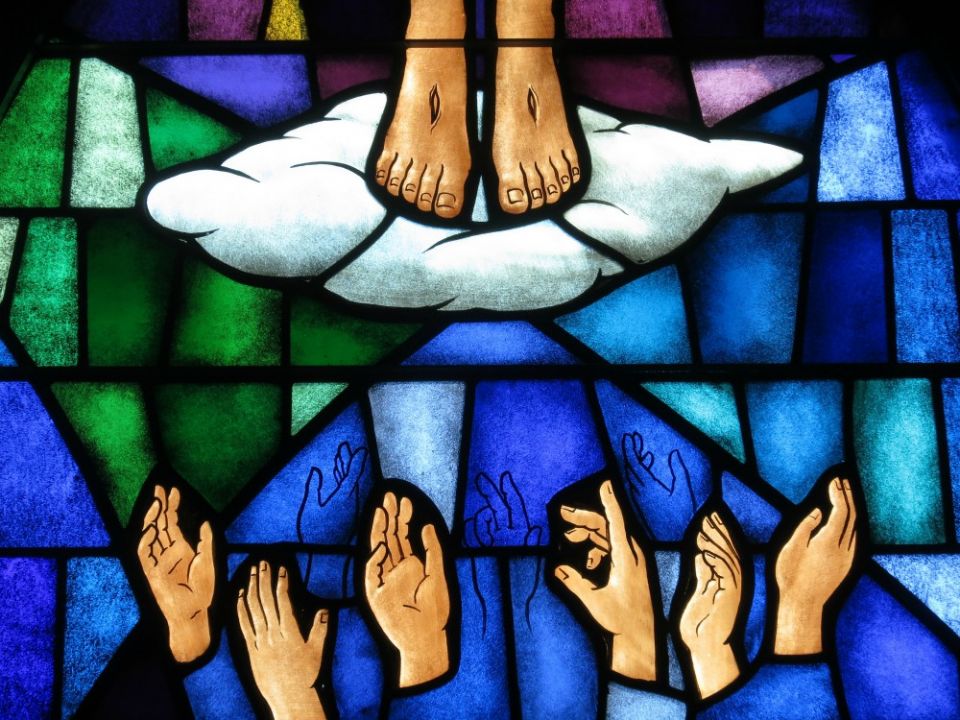
After saying this, he was taken up into a cloud while they were watching, and they could no longer see him. As they strained to see him rising into heaven, two white-robed men suddenly stood among them. “Men of Galilee,” they said, “why are you standing here staring into heaven? Jesus has been taken from you into heaven, but someday he will return from heaven in the same way you saw him go!” (New Living Translation)

“At his Ascension, our Lord entered Heaven, and he keeps the door open for humanity to enter.”

Oswald Chambers

Jesus was taken up to heaven in what Christians celebrate as the “Ascension of the Lord.” This is a hugely important event for followers of Jesus.

The Ascension means that Christ is now presently sitting at God’s right hand, offering continual prayers on our behalf to the Father. We have an advocate, a champion, who has gone before us and secured deliverance from sin, death, and hell.

On top of it all, Christ’s ascension means that Jesus is the universal ruler; he commands a kingdom that will never end. Yes, the Ascension of the Lord is a big deal.

So, why does a day set aside on the Christian Calendar celebrating the Lord’s mighty and redemptive ascension over all creation garner such scant attention from many churches?

Maybe the church has A.D.D. (Ascension Deficit Disorder).

Our clue to the inability to focus on such a grand redemptive event is the disciples’ response when Jesus ascended.

The picture St. Luke paints for us in the account of our Lord’s ascension, is a group of guys looking up into the sky slack-jawed and shoulders hunched.

It took a couple of angels to come along and ask them what in the world they were doing just standing there. Now is not the time to stand and gawk at the clouds, the angels insisted. Jesus will come back when he comes back. You aren’t going to know when. So, now is the time to get busy with what Jesus just told you to do two minutes ago: Tell everyone about me.

Christ’s ascension to heaven is a deeply theological event. It’s freighted with major implications for our prayer lives. And it means Christ is the King to whom we must obey.

Jesus is coming again. In the meantime, there’s to be no cloud-gawking. Instead, there is to be a well-developed and well-cultivated connection with Jesus which proclaims the good news that Christ died, rose from death, and ascended to heaven for mine and your forgiveness of sins and a new clean slate on life.

Trying to peer into the future about how the end of history will shake-out is, frankly, not the job we are called to do. Believers in Jesus aren’t supposed to stand and gawk at the clouds waiting for the Lord’s return, as if we are in some earthly holding tank until heaven. 

Rather, we are to bear witness about the person and work of Jesus. The Ascension of the Lord means we are God’s people blessed with deliverance from the realm of sin, and the hope of Christ’s coming again. The Church everywhere recognizes together the rule and reign of the Lord Jesus.

The world, as we know it, shall eventually come to an end. Until that time, Christians since the time of the ascension have been proclaiming Christ crucified, died, risen, ascended, and coming again.

This is a day of joy and celebration for us. Jesus is our ascended and glorified king! The fate of the earth is with the benevolent and mighty Ruler of all. Jesus is Lord, and no other human leader is. Thank you, Jesus.

The great Reformed Confession, the Heidelberg Catechism, question and answer 49, states:

Q: How does Christ’s ascension to heaven benefit us?

A: First, he is our advocate

            in heaven

            in the presence of his Father.

Second, we have our own flesh in heaven

            as a sure pledge that Christ our head

            will also take us, his members,

            up to himself.

Third, he sends his Spirit to us on earth

            as a corresponding pledge.

            By the Spirit’s power

                        we seek not earthly things

                        but the things above, where Christ is,

                                    sitting at God’s right hand.

Amen.

Revelation 11:16-19 – Be Encouraged

The Episcopal Church of the Heavenly Rest in Abilene, Texas

Then the twenty-four elders who sit on their thrones before God fell on their faces and worshiped God, singing,

“We give you thanks, Lord God Almighty,
    who are and who were,
for you have taken your great power
    and begun to reign.
The nations raged,
    but your wrath has come,
    and the time for judging the dead,
for rewarding your servants, the prophets
    and saints and all who fear your name,
    both small and great,
and for destroying those who destroy the earth.”

Then God’s temple in heaven was opened, and the ark of his covenant was seen within his temple; and there were flashes of lightning, rumblings, peals of thunder, an earthquake, and heavy hail. (New Revised Standard Version)

Late in his life, as the old Apostle John lived in exile, he experienced a grand vision. It is what we today refer to as The Book of Revelation, or The Apocalypse of John. 

At the turn of the first century, Christ’s Church was facing a great deal of difficulty and hardship. Christians were the minority. Believers in Jesus were looked at with suspicion. Followers of Christ were often misunderstood and persecuted because of false information. 

In short, all of the myriad sufferings and persecutions that Jewish people currently face and have faced for millennia were true of the early believers in Jesus.

Therefore, the purpose of John’s vision was not to give slick preachers a reason to craft elaborate prophecy charts about what’s going to happen in the future. Instead, God was concerned for the current welfare of his people. The vision was meant to bring encouragement.

The message to John, passed onto the suffering church, was that this present hard situation will not always be this way. Danger, adversity, and hardship will not last forever. There is a day coming when God’s judgment and benevolent reign will truly rule in all of its glorious fullness.

Our prayers will be answered, the ones we have lifted to God for centuries: “Your kingdom come, your will be done, on earth as it is in heaven.”

Gergeti Trinity Church, Georgia

The Lord did not want his beloved children to succumb to discouragement and lose heart. So, the vision from John assured them that all will be made right. Jesus is Lord, and his good rule will have the day. 

Yes, we currently live in a world profoundly touched by the presence and power of sin. And because of that sad reality, we feel all kinds of various pain. We have no choice but to endure the hardships of national wars, bodily diseases, lack of resources, economic woes, mental disorders, emotional distress, and spiritual warfare.

It is possible to observe, as well as experience, all the crud of this sinful world and fall into despair. If or when that happens, we give-in to unhealthy ways of coping with the adverse circumstances around us.

Graciously, we have been given a glimpse into how all of history will shake-out in the end. That brief pulling back of the curtain is meant to bring us needed encouragement, steadfast hope, and patient endurance. 

There is coming a day when expressions of grief and lament will give way to praise and gratitude to God. And that incredible praise will explode with all believers, past and present, along with all creation, proclaiming together that the Lord God is all-powerful. 

The kingdom of this world belongs to our Lord and to his Chosen One. And he will rule forever and ever.

Some might protest that Christians have been harping on this return of Jesus for two millennia and he still isn’t here. We must not misinterpret God’s inaction as uncaring or that God is non-existent. Because it is really patient grace.

But do not forget this one thing, dear friends: With the Lord a day is like a thousand years, and a thousand years are like a day. The Lord is not slow in keeping his promise, as some understand slowness. Instead, he is patient with you, not wanting anyone to perish, but everyone to come to repentance. (2 Peter 3:8-9, NIV)

Our present sufferings must also not be misinterpreted, as if God hates us or is just plain mean. For the Christian, suffering is transformed into solidarity with Jesus Christ.

My dear friends, do not be surprised at the painful test you are suffering, as though something unusual were happening to you. Rather be glad that you are sharing Christ’s sufferings, so that you may be full of joy when his glory is revealed. (1 Peter 4:12-13, GNT)

All of our collective experiences are meant not for harm, but for good so that we might realize spiritual growth and maturity.

Grow in the grace and knowledge of our Lord and Savior Jesus Christ. To him be glory both now and forever! Amen. (2 Peter 3:18, NIV)

Lord Jesus Christ, by your patience in suffering you caused our earthly pain to be sacred and have meaning. Through your example of humble obedience, you opened the way for us to walk through our own hard circumstances with grace and submission.

Be near me in my time of weakness and pain. Sustain me by your grace, so that my strength and courage may not fail. Heal me according to you will. Help me always to believe that what happens to me in this present life is of little account if you hold me in eternal life, my Lord and my God.

As Jesus cried out on the cross, I cry out to you in pain, O God my Creator. Do not forsake me. Grant me relief from this suffering and preserve me in peace; through Jesus Christ my Savior, in the power of the Holy Spirit. Amen.