Preparing the Way (John 1:19-28)

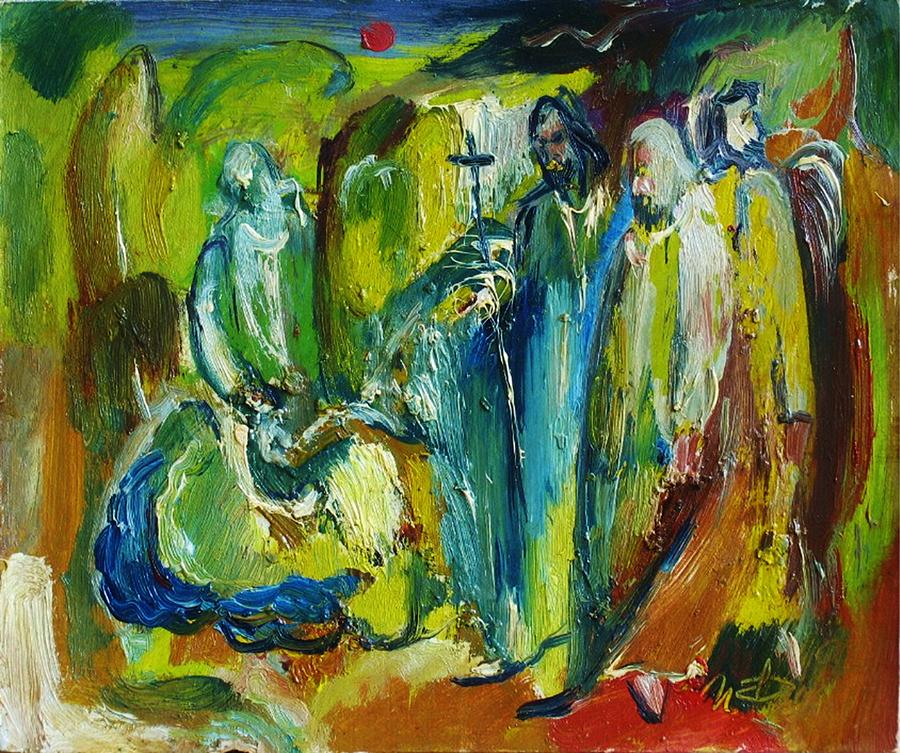
John the Baptist by Ivan Filichev, 1992

Now this was John’s testimony when the Jewish leaders in Jerusalem sent priests and Levites to ask him who he was. He did not fail to confess, but confessed freely, “I am not the Messiah.”

They asked him, “Then who are you? Are you Elijah?”

He said, “I am not.”

“Are you the Prophet?”

He answered, “No.”

Finally they said, “Who are you? Give us an answer to take back to those who sent us. What do you say about yourself?”

John replied in the words of Isaiah the prophet, “I am the voice of one calling in the wilderness, ‘Make straight the way for the Lord.’”

Now the Pharisees who had been sent questioned him, “Why then do you baptize if you are not the Messiah, nor Elijah, nor the Prophet?”

“I baptize with water,” John replied, “but among you stands one you do not know. He is the one who comes after me, the straps of whose sandals I am not worthy to untie.”

This all happened at Bethany on the other side of the Jordan, where John was baptizing. (New International Version)

John was not the Messiah. Jesus is the Messiah. John’s life was devoted to preparing people and pointing them to Jesus. You and I are not the Messiah; Jesus is. You and I are to devote are lives to preparing people and pointing them to Jesus.

John the Baptist had a way of communicating that didn’t exactly win friends; but he sure influenced a lot of people. (Matthew 3:1-12) 

Considering that John lived in seclusion, dressed weird, and ate different food, it’s not a stretch to see how people might dismiss him as a kook and move on. Yet, there’s no evidence that people viewed John that way. 

Instead, John the Baptist had an effective ministry. I suggest that’s because John didn’t seek his own gain, wasn’t trying to build a big following, but understood that he was to point to the coming Christ. 

John believed judgment was imminent, so he put all his efforts into getting people to realize the wrath of God was real and coming soon.

The kingdom of God cannot be entered by forcefully pushing the door in; we enter God’s kingdom through the humility of confession and repentance. The way to the Nativity goes through John the Baptist and his message of “Repent, for the kingdom of God is near.” (Matthew 3:2; Mark 1:4; Luke 3:3)

We are, like John, to make a straight and level way for folks to come to Jesus. That’s going to require some change on our part. But if we’re stuck in our ways, that makes it really hard to make a level path to Jesus.

There’s all sorts of ways we get stuck. We might be mired in a destructive habit because we think we need it to keep going; we may get cemented into rehearsing all the past dumb decisions we made, and so, cannot move forward; or we might become fastened in an unhealthy relationship and see no way to move. 

If we are stuck long enough, we blandly accept this as a new normal, then go about our daily lives with a “meh” kind of attitude; not too low, not too high, but just “meh.”

All this sticky stuff – the patterns, behaviors, activities and habits which trap us – keep us in an immovable bondage. And we might become so used to “meh” that we are cut off from the source that would get us un-stuck.

The reason people didn’t dismiss John as some creepy clown is that he offered them something better than their sticky situations. 

Awareness of our real selves and our true condition brings hope – because God will not leave us stuck. The Lord will turn us into free people, delivered from the stickiness, to live fully for the coming King. God doesn’t give up on us, so we do not need to settle for a “meh” existence.

It can be scary, looking squarely at our sins, habits, memories, and emotions because they might keep us on the flypaper of death. We may feel overwhelmed and think there is hope for other people, but not me. Or, conversely, we might think that everyone else has a problem except me. 

Jesus will baptize with the Holy Spirit and with fire. Christ will shake things up. He’ll unstick people and free them from narrow thinking and a lack of self-awareness.

The season of Advent means that the time of the Lord’s coming is near. Therefore, preparation for the Nativity of the Lord, Christmas, is of primary importance. And the best way of preparing for Christmas Day is to repent and believe that the kingdom of God is near (as opposed to far away). 

God has come near to us in the person of Jesus; and that makes all the difference. 

It’s hard to admit we’re stuck. Yet, if many are honest, their relationship with God and/or the Church is nothing more than a shoulder shrugging “meh.”

There are two ways to deal with being stuck in guilt and shame: either justify it or confess it. 

Denying, minimizing, or excusing sin leads to separation from God – whereas confession leads to connecting with God. 

John the Baptist’s message is this: Get ready because Jesus is coming! Through the grace of repentance and faith there is hope – the hope of stopping all the petty games we play to hide our sin and hide the fact we are really super-glued to our idols. Our hope is in being cleansed from our impurities and ready for God to be with us in the person of Jesus.

God unsticks us so we can bear good fruit that is in keeping with repentance. Our lives need to be congruent between what we profess and how we live. Outward religious observance, although important, is not the way into the kingdom. And confession without genuine change is not repentance – it’s just confession. 

The God who came to his people in Jesus will one day unveil his kingdom in all its glory. We need to get ready for that day. There are roads that need straightening; fires that need to be lit in order to burn away the rubbish and brush in the path; dead trees that need to be cut down; there are people who need to repent because the kingdom of God is near.

We must clear the road so that Jesus has a way into our hearts. 

Just as law enforcement and the secret service are serious about making presidential motorcades free of obstacles and having a clear road to the destination, so we need to ensure that we are doing all we can to pave the way for Christ’s coming. 

This is no time for a spiritually milquetoast deadpan “meh” kind of life; this is the day to clear the way for Jesus. Now is the time to prepare for Christ’s coming. 

And the proper preparation for the Lord’s return is with admitting our stickiness and asking God to unstick us from the sin that so easily entraps us on the devil’s flypaper. 

The kingdom of God belongs to those who prepare the way and produce good fruit in keeping with repentance. 

Maranatha. Even so, come, Lord Jesus.

The Kingdom of God Is Here (Matthew 10:5-15)

Jesus sent his twelve harvest hands out with this charge:

“Don’t begin by traveling to some far-off place to convert unbelievers. And don’t try to be dramatic by tackling some public enemy. Go to the lost, confused people right here in the neighborhood. Tell them that the kingdom is here. Bring health to the sick. Raise the dead. Touch the untouchables. Kick out the demons. You have been treated generously, so live generously.

“Don’t think you have to put on a fund-raising campaign before you start. You don’t need a lot of equipment. You are the equipment, and all you need to keep that going is three meals a day. Travel light.

“When you enter a town or village, don’t insist on staying in a luxury inn. Get a modest place with some modest people and be content there until you leave.

“When you knock on a door, be courteous in your greeting. If they welcome you, be gentle in your conversation. If they don’t welcome you, quietly withdraw. Don’t make a scene. Shrug your shoulders and be on your way. You can be sure that on Judgment Day they’ll be mighty sorry—but it’s no concern of yours now. (The Message)

“People can’t observe the coming of God’s kingdom. They can’t say, ‘Here it is!’ or ‘There it is!’ You see, God’s kingdom is within  you.” Jesus, from Luke 17:20-21, GW

When Jesus told his followers that the kingdom of God is here, he didn’t simply mean that it all of a sudden showed up. No, it’s already here. It always has been. We just haven’t paid attention. And we haven’t noticed because we keep looking for a location, somewhere outside of ourselves. But, as it turns out, we already have what we’ve been searching for.

Christianity, at its core, is about following Christ. And that journey with Jesus is first and foremost a journey into oneself. This is why the Lord tells the disciples not to go first to outsiders. There’ll be a time for that. But now, the journey to their fellow Jews was to be an internal walk into the very depths of their own souls and the soul of a nation.

The singular message of this particular mission was to proclaim that the kingdom of God is near. It is here. In fact, it is so near and here that it is actually within you. But the disciples needed to discover this for themselves by going out and removing all obstacles to awareness of God’s light.

Jesus sent the disciples out and told them not to take anything with them because they already had what they needed. The kingdom of God is already within them.

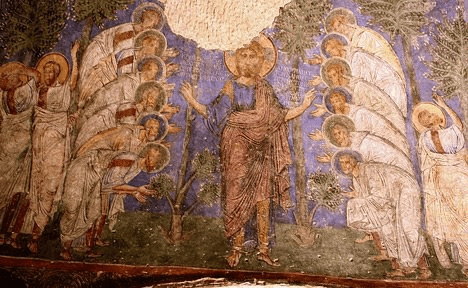
A Byzantine fresco of Jesus sending the disciples, 12th century

So, they were to leave all their baggage and their stuff behind. The disciples were to be stripped of all their trusted outer resources so that they had the ability to see themselves, to others, and human need – and then to be moved in their hearts with compassion, just as Jesus is. 

Whenever we take all our pre-packaged stuff with us into relationships and the doing of Christ’s mission, we already assume we know what other people need. If we have nothing with us, then we are able to see people for who they actually are; we can genuinely listen to what they are saying. 

You have freely received compassion from God, so freely give it away. Not everyone will respond, but that’s not your business; they will have to deal with God on that later.

Compassion is to be our response to human need. Yet, we don’t always respond with compassion because of the obstacles within our own hearts and lives prevent us from seeing others and their needs.

The following are a few of obstructions which hinder us from compassion and perceiving the kingdom of God within us, and how to deal with them:

  1. Contempt. Contempt breeds contempt. Unacknowledged and unresolved anger produces bitterness. Hatred feeds more hatred. Our environment makes a difference. For example, if you find you have to check your heart at the workplace in order to do your job, then you need to either you quit your, or bring forth the kingdom of God by tirelessly advocating for compassionate treatment of people.
  2. Busyness. I’m referring to an unhealthy pace of life. Many of us work too much and do too many things. We cannot have compassionate hearts by moving so fast that we fail to see other people’s needs. Slow down. No one is going to come to the end of their life and wished they had been workaholics. Make a thoughtful plan to slow down enough so you can tune into the needs of others and have emotional energy for them.
  3. Resentment. It’s possible to become coldhearted by excessive and unrelenting caregiving. This is the same sort of problem as an unhealthy pace of life; you give so much that you actually begin to resent the people you care for. Caregiving has to be meticulously balanced with self-care. There’s a time for everything, including rest and recuperation.
  4. Inaction. Only receiving and not giving is what I call “spiritual constipation.” It’s when a person listens to hundreds and thousands of sermons and podcasts but doesn’t listen to their neighbor. They have no intention of putting anything they hear into practice.

However, with nothing restricting or obstructing God’s kingdom within us, we can see the divine image within each person and within ourselves. We can begin to radiate that divine presence and be transformed by it’s inner light.

Like Jesus, transfigured before the disciples on Mount Tabor, we too, become transfigured by God’s energy of love touching our hidden divine energy as image-bearers. That energy now comes forth because we have left everything behind to follow Christ and experience the generosity which, ironically, only comes from having nothing.

This is a spiritual walk we cannot take alone. The road we travel is the way of community. Just as God is community – Father, Son, and Spirit – always in a unity of love, so we, as God’s image-bearers with the divine light within us, must strip ourselves of everything that hinders and the sin that so easily entangles and run with perseverance the race marked out for us.

We are to fix our eyes on Jesus and see him, the pioneer of our faith, the Light of the World, the Living Water, and Bread for the world, who endured all things for the redemption of humanity and all creation.

Almighty God, you sent your Son Jesus Christ to reconcile the world to yourself: We praise and bless you for those whom you have sent in the power of the Spirit to proclaim that the kingdom of God is near. We thank you that in all parts of the earth a community of love has been gathered together by their prayers and labors, and that in every place your servants call upon your Name; for the kingdom and the power and the glory are yours forever. Amen.

Luke 18:18-30 – A Rich Man’s Question

A certain ruler asked him, “Good teacher, what must I do to inherit eternal life?”

“Why do you call me good?” Jesus answered. “No one is good—except God alone. You know the commandments: ‘You shall not commit adultery, you shall not murder, you shall not steal, you shall not give false testimony, honor your father and mother.’”

“All these I have kept since I was a boy,” he said.

When Jesus heard this, he said to him, “You still lack one thing. Sell everything you have and give to the poor, and you will have treasure in heaven. Then come, follow me.”

When he heard this, he became very sad, because he was very wealthy. Jesus looked at him and said, “How hard it is for the rich to enter the kingdom of God! Indeed, it is easier for a camel to go through the eye of a needle than for someone who is rich to enter the kingdom of God.”

Those who heard this asked, “Who then can be saved?”

Jesus replied, “What is impossible with man is possible with God.”

Peter said to him, “We have left all we had to follow you!”

“Truly I tell you,” Jesus said to them, “no one who has left home or wife or brothers or sisters or parents or children for the sake of the kingdom of God will fail to receive many times as much in this age, and in the age to come eternal life.” (New International Version)

The sorts of questions we ask say a lot about us. We might classify all questions into genuine curiosity and self-justification. This includes the tone of voice and affect in which the question is asked.

The wealthy man in today’s Gospel lesson asked a question. Rather than his tone being one of truly seeking to know, and his affect reflecting an authentic desire to know, instead he had his nose held high with a sanctimonious sounding expression. The man was mostly after a divine sanction of his lifestyle and his spirituality.

It doesn’t take the Son of God to know that this guy was pompously trying to angle for some kudos from Jesus about his superior life. But Christ, rather than blowing off the rich man or just blasting him for being a peacock, answered his question and led the man to what is most important.

One way of looking at the interaction between the rich man and Jesus is that it was an intervention. The rich man was addicted to wealth and money, but he didn’t see it. And he wanted validation that his way of life was sanctioned by the Almighty. 

The rich man believed himself to be quite godly and spiritual – an upstanding citizen, a religious man, attentive to God’s law. It’s a sad story because he walked away un-transformed by his encounter with Jesus and refused to follow him. He didn’t see himself as hopeless and desperately needing to change. He held to his denial.

We are all addicted to sin.  If you want to push back on that statement and are thinking, “Well, I don’t have as much money as _____” or, “So-and-so really has a problem with this…” then you are practicing what we call, in terms of addiction, denial. 

Truth be told, all of us are in some sort of denial about how much we really trust in paychecks, bank accounts, investments, and a wealth of stuff. Even people who are truly in poverty can also be addicted to wealth by always thinking about money and wishing for it as the answer to their problems, as if wealth is the highest good to attain in life.

Jesus put the problem out there for us all to see by communicating to us that sin cannot be managed – rather, sin needs to die. 

The good news is that by honestly facing up to our own addiction to things we can find grace. Grace always has the last word. Grace trumps addiction to money, stuff, and anything else. 

God’s love and acceptance is not conditional. Both the wretched sinner and the pompous peacock will find Christ’s forgiveness through the cross. Jesus put sin to death. We are simply invited to bring it out in the open, confess it, and follow Jesus.

One question that delights the heart of God, and reflects a humble and penitent spirit from us is this: “Will you forgive me, Lord?”

Most merciful God, we confess that we have sinned against you in thought, word, and deed, by what we have done, and by what we have left undone. We have not loved you with our whole heart; we have not loved our neighbors as ourselves. We are truly sorry and we humbly repent. For the sake of your Son Jesus Christ, have mercy on us and forgive us; that we may delight in your will, and walk in your ways, to the glory of your Name. Amen.

Luke 14:25-33 – The Cost of Being a Disciple

Large crowds were traveling with Jesus. And turning to them he said: “If anyone comes to me and does not hate father and mother, wife and children, brothers and sisters—yes, even their own life—such a person cannot be my disciple. And whoever does not carry their cross and follow me cannot be my disciple.

“Suppose one of you wants to build a tower. Won’t you first sit down and estimate the cost to see if you have enough money to complete it? For if you lay the foundation and are not able to finish it, everyone who sees it will ridicule you, saying, ‘This person began to build and wasn’t able to finish.’

“Or suppose a king is about to go to war against another king. Won’t he first sit down and consider whether he is able with ten thousand men to oppose the one coming against him with twenty thousand? If he is not able, he will send a delegation while the other is still a long way off and will ask for terms of peace. In the same way, those of you who do not give up everything you have cannot be my disciples. (New International Version)

The goal of the Christian life is to be a disciple, and to do the work of discipleship. “Disciple” is another word for “follower.” We are to be faithful followers of Jesus; and the Church is to engage in the task of inviting others to join us along the way of following Jesus.

Jesus made it clear to the large crowds of people following him that the disciple’s life and work of discipleship (following Jesus) is to be of highest importance to us – it is why we exist as the Church. We are to discover what this kind of life entails, and we are to decide volitionally and intentionally to follow Jesus in every area of our lives with everything we have. 

Therefore, it is necessary to carefully consider the implications of Christ’s words to us and weigh the cost of following Jesus. 

Discipleship (following Jesus) requires obedience. Love of family must not stand in the way. Jesus said we are to “hate” family and even self. In our culture, we typically use the words “hate” and “love” as descriptions of our emotions or feelings. However, in Scripture, love and hate are primarily terms of allegiance or priority. 

In other words, Jesus is saying that our primary loyalty must clearly lie with following him over every earthly relationship. To follow Jesus means that we will not use family responsibilities to avoid obeying Christ, nor use other commitments to work or school as a reason to put our cross down.

The bottom line is this: In this life, with all its competing loyalties, the call of Jesus to discipleship not only takes precedence, but it also redefines all the other loyalties we have. 

The call of discipleship involves some detachment from other things in order to pursue following Jesus. All of life is to be infused with being a disciple and doing the work of discipleship. If we insist on making other commitments and loyalties as high a priority as following Jesus, we will find ourselves in a pickle. 

Several years ago, I took a trip with some other church leaders into the Canadian wilderness. We were so far out in the boonies that we needed special first aid training because if someone got hurt it would be hours before help could come. We canoed the lakes, carrying our backpacks and canoes between the lakes for an entire week.

Whatever we took with us, we had to carry. Some people thought they needed all kinds of clothes and other accessories. Not far into the week, they quickly began to leave things along the trail and learned, over time, to see that what they thought was important in their life wasn’t really important to what they were doing.

We must get back to basics and do what is essential; and what is of most importance is following Jesus. An un-salty disciple is worthless. Making a commitment to Christ without counting the cost is foolish.  Discipleship was never designed to be easy; it was intended to be a public display that Jesus is Savior and Lord in every area of my life. 

That means we will struggle with questions such as: 

  • How do I be a faithful follower of Jesus in my family? 
  • How do I be a disciple, and do the work of discipleship at work? 
  • How do I practice following Jesus in my neighborhood, and everywhere I go?

If we do not plan to follow Jesus at home and in the world, we won’t, because all kinds of competing loyalties will take over if we are not intentional about being disciples and making disciples. 

Everything and everyone is to take a back seat to Jesus, who is to be our primary loyalty.  Jesus used two examples to illustrate that we need to count the cost of discipleship. In the first, a builder plans and should ensure that he has enough money and materials to complete the entire structure. 

We must take stock to finish what we have started; if we started well with Christ, we need to do whatever it takes to finish well as a disciple of Jesus. What will we do when the going is difficult?

“Jesus has many who love his kingdom in heaven, but few who bear his cross. He has many who desire comfort, but few who desire suffering. He finds many to share his feast, but few his fasting. All desire to rejoice with him, but few are willing to suffer for his sake. Many follow Jesus to the breaking of bread, but few to the drinking of the cup of his passion. Many admire his miracles, but few follow him in the humiliation of the cross.”

Thomas à Kempis, The Imitation of Christ

We only know real joy whenever we give up pursuing happiness. In God’s upside-down kingdom, to live is to die, and to die is to live. Until we grasp this, we will be endlessly frustrated with our circumstances and other people.  

The second illustration from Jesus is of a king and war. The king makes a battle plan, and if he thinks he cannot defeat the opposing army, he wisely seeks a peace treaty. My friends, no one is going to oppose God and win, so it is best to make peace. 

Rather than trying to fit Jesus into our calendar, we are to let our calendar fill out around the center of following Jesus. If we insist we are too busy for prayer; do not have time for daily reading of the Scriptures; for loving one another; for making disciples (which requires much time and effort) then we have lost our way and must listen to this call of Jesus to be his disciple.

What then, shall we do?  

Imagine that in our heart is a big conference room: a big table, leather chairs, coffee, bottled water, and a whiteboard. A committee sits around the table in your heart. There is the social self, the private self, the work self, the sexual self, the recreational self, the religious self, and others.

The committee is arguing and debating and voting, constantly agitated and upset. Rarely can they come to a unanimous, wholehearted decision. We may tell ourselves we are this way because of so many responsibilities or too little abilities. Yet, the truth is that we’re just divided, unfocused, hesitant, and not free. 

One way to deal with the situation is to invite Jesus onto the committee. Give him a vote, too. But then he becomes just one more complication. A better way is to say to Jesus, “My life isn’t working. Please come in and fire my committee, every last one of them. I hand myself over to you. I am your responsibility now. Please run my whole life for me.” 

Being a disciple of Jesus is not just adding Jesus. It is also subtracting the idols that are in our hearts. Saying that we belong to Jesus means that he will come in with a whip, overturn tables, and throw out a bunch of people.

If you are ready for that, pray with me…

Almighty and everlasting God, from our recliners and comfortable chairs, we solve all the world’s problems. We take people to task for what they say and do, without lifting a finger to be a part of the solution. We are too often de-sensitized to your mercy and compassion because we are not involved in your dream for all people to be your disciples. 

Remove the scales from our eyes and lift the indifference from our hearts, so that we may see your vision – a vision of people following Jesus in the mission of being disciples and of making disciples. 

Transform our lives, so that we may accomplish your purpose. 

Anoint us with your Spirit that we might bring good news to the oppressed, bind up the brokenhearted, and proclaim release to the captive. 

Give us a new urgency to reach out to those whom no one else will touch, to accept the unacceptable, to embrace the enemy, to do justice and love mercy. 

Surround us with your love, fill us with your grace, and strengthen us for your service. Empower us to respond to the call of Jesus – to deny ourselves, take up our crosses, and follow Christ our Lord, in whose name we pray. Amen.