Acts 1:1-11 – Ascension of the Lord

In my first book I told you, Theophilus, about everything Jesus began to do and teach until the day he was taken up to heaven after giving his chosen apostles further instructions through the Holy Spirit. During the forty days after he suffered and died, he appeared to the apostles from time to time, and he proved to them in many ways that he was actually alive. And he talked to them about the Kingdom of God.

Once when he was eating with them, he commanded them, “Do not leave Jerusalem until the Father sends you the gift he promised, as I told you before. John baptized with water, but in just a few days you will be baptized with the Holy Spirit.”

So, when the apostles were with Jesus, they kept asking him, “Lord, has the time come for you to free Israel and restore our kingdom?”

He replied, “The Father alone has the authority to set those dates and times, and they are not for you to know. But you will receive power when the Holy Spirit comes upon you. And you will be my witnesses, telling people about me everywhere—in Jerusalem, throughout Judea, in Samaria, and to the ends of the earth.”

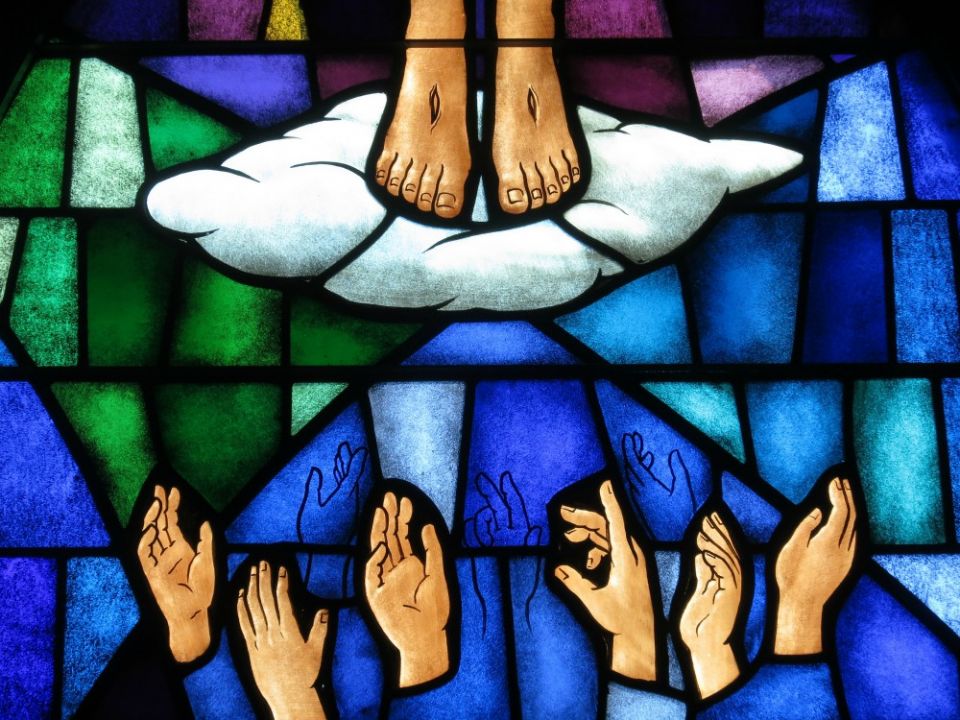
After saying this, he was taken up into a cloud while they were watching, and they could no longer see him. As they strained to see him rising into heaven, two white-robed men suddenly stood among them. “Men of Galilee,” they said, “why are you standing here staring into heaven? Jesus has been taken from you into heaven, but someday he will return from heaven in the same way you saw him go!” (New Living Translation)

“At his Ascension, our Lord entered Heaven, and he keeps the door open for humanity to enter.”

Oswald Chambers

Jesus was taken up to heaven in what Christians celebrate as the “Ascension of the Lord.” This is a hugely important event for followers of Jesus.

The Ascension means that Christ is now presently sitting at God’s right hand, offering continual prayers on our behalf to the Father. We have an advocate, a champion, who has gone before us and secured deliverance from sin, death, and hell.

On top of it all, Christ’s ascension means that Jesus is the universal ruler; he commands a kingdom that will never end. Yes, the Ascension of the Lord is a big deal.

So, why does a day set aside on the Christian Calendar celebrating the Lord’s mighty and redemptive ascension over all creation garner such scant attention from many churches?

Maybe the church has A.D.D. (Ascension Deficit Disorder).

Our clue to the inability to focus on such a grand redemptive event is the disciples’ response when Jesus ascended.

The picture St. Luke paints for us in the account of our Lord’s ascension, is a group of guys looking up into the sky slack-jawed and shoulders hunched.

It took a couple of angels to come along and ask them what in the world they were doing just standing there. Now is not the time to stand and gawk at the clouds, the angels insisted. Jesus will come back when he comes back. You aren’t going to know when. So, now is the time to get busy with what Jesus just told you to do two minutes ago: Tell everyone about me.

Christ’s ascension to heaven is a deeply theological event. It’s freighted with major implications for our prayer lives. And it means Christ is the King to whom we must obey.

Jesus is coming again. In the meantime, there’s to be no cloud-gawking. Instead, there is to be a well-developed and well-cultivated connection with Jesus which proclaims the good news that Christ died, rose from death, and ascended to heaven for mine and your forgiveness of sins and a new clean slate on life.

Trying to peer into the future about how the end of history will shake-out is, frankly, not the job we are called to do. Believers in Jesus aren’t supposed to stand and gawk at the clouds waiting for the Lord’s return, as if we are in some earthly holding tank until heaven. 

Rather, we are to bear witness about the person and work of Jesus. The Ascension of the Lord means we are God’s people blessed with deliverance from the realm of sin, and the hope of Christ’s coming again. The Church everywhere recognizes together the rule and reign of the Lord Jesus.

The world, as we know it, shall eventually come to an end. Until that time, Christians since the time of the ascension have been proclaiming Christ crucified, died, risen, ascended, and coming again.

This is a day of joy and celebration for us. Jesus is our ascended and glorified king! The fate of the earth is with the benevolent and mighty Ruler of all. Jesus is Lord, and no other human leader is. Thank you, Jesus.

The great Reformed Confession, the Heidelberg Catechism, question and answer 49, states:

Q: How does Christ’s ascension to heaven benefit us?

A: First, he is our advocate

            in heaven

            in the presence of his Father.

Second, we have our own flesh in heaven

            as a sure pledge that Christ our head

            will also take us, his members,

            up to himself.

Third, he sends his Spirit to us on earth

            as a corresponding pledge.

            By the Spirit’s power

                        we seek not earthly things

                        but the things above, where Christ is,

                                    sitting at God’s right hand.

Amen.

Revelation 11:16-19 – Be Encouraged

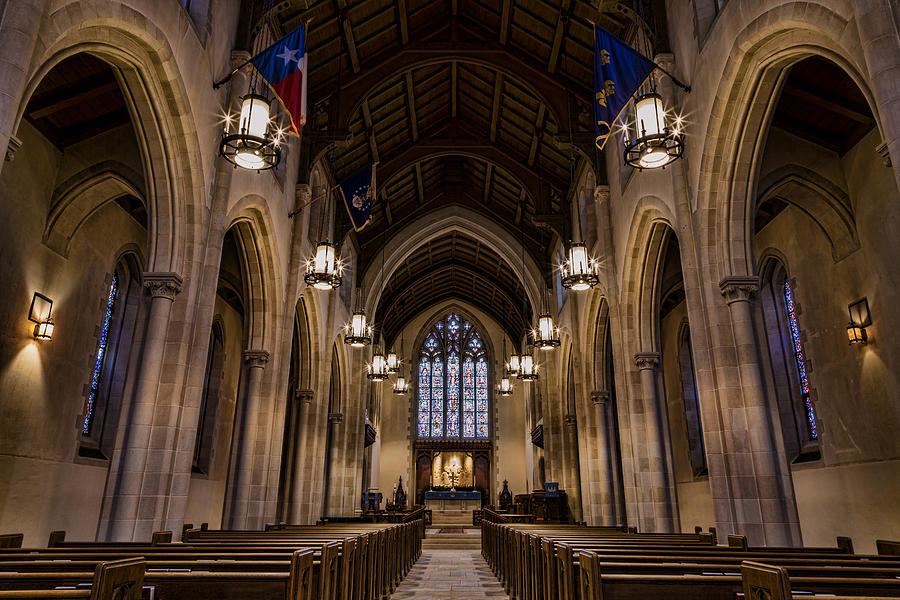
The Episcopal Church of the Heavenly Rest in Abilene, Texas

Then the twenty-four elders who sit on their thrones before God fell on their faces and worshiped God, singing,

“We give you thanks, Lord God Almighty,
    who are and who were,
for you have taken your great power
    and begun to reign.
The nations raged,
    but your wrath has come,
    and the time for judging the dead,
for rewarding your servants, the prophets
    and saints and all who fear your name,
    both small and great,
and for destroying those who destroy the earth.”

Then God’s temple in heaven was opened, and the ark of his covenant was seen within his temple; and there were flashes of lightning, rumblings, peals of thunder, an earthquake, and heavy hail. (New Revised Standard Version)

Late in his life, as the old Apostle John lived in exile, he experienced a grand vision. It is what we today refer to as The Book of Revelation, or The Apocalypse of John. 

At the turn of the first century, Christ’s Church was facing a great deal of difficulty and hardship. Christians were the minority. Believers in Jesus were looked at with suspicion. Followers of Christ were often misunderstood and persecuted because of false information. 

In short, all of the myriad sufferings and persecutions that Jewish people currently face and have faced for millennia were true of the early believers in Jesus.

Therefore, the purpose of John’s vision was not to give slick preachers a reason to craft elaborate prophecy charts about what’s going to happen in the future. Instead, God was concerned for the current welfare of his people. The vision was meant to bring encouragement.

The message to John, passed onto the suffering church, was that this present hard situation will not always be this way. Danger, adversity, and hardship will not last forever. There is a day coming when God’s judgment and benevolent reign will truly rule in all of its glorious fullness.

Our prayers will be answered, the ones we have lifted to God for centuries: “Your kingdom come, your will be done, on earth as it is in heaven.”

Gergeti Trinity Church, Georgia

The Lord did not want his beloved children to succumb to discouragement and lose heart. So, the vision from John assured them that all will be made right. Jesus is Lord, and his good rule will have the day. 

Yes, we currently live in a world profoundly touched by the presence and power of sin. And because of that sad reality, we feel all kinds of various pain. We have no choice but to endure the hardships of national wars, bodily diseases, lack of resources, economic woes, mental disorders, emotional distress, and spiritual warfare.

It is possible to observe, as well as experience, all the crud of this sinful world and fall into despair. If or when that happens, we give-in to unhealthy ways of coping with the adverse circumstances around us.

Graciously, we have been given a glimpse into how all of history will shake-out in the end. That brief pulling back of the curtain is meant to bring us needed encouragement, steadfast hope, and patient endurance. 

There is coming a day when expressions of grief and lament will give way to praise and gratitude to God. And that incredible praise will explode with all believers, past and present, along with all creation, proclaiming together that the Lord God is all-powerful. 

The kingdom of this world belongs to our Lord and to his Chosen One. And he will rule forever and ever.

Some might protest that Christians have been harping on this return of Jesus for two millennia and he still isn’t here. We must not misinterpret God’s inaction as uncaring or that God is non-existent. Because it is really patient grace.

But do not forget this one thing, dear friends: With the Lord a day is like a thousand years, and a thousand years are like a day. The Lord is not slow in keeping his promise, as some understand slowness. Instead, he is patient with you, not wanting anyone to perish, but everyone to come to repentance. (2 Peter 3:8-9, NIV)

Our present sufferings must also not be misinterpreted, as if God hates us or is just plain mean. For the Christian, suffering is transformed into solidarity with Jesus Christ.

My dear friends, do not be surprised at the painful test you are suffering, as though something unusual were happening to you. Rather be glad that you are sharing Christ’s sufferings, so that you may be full of joy when his glory is revealed. (1 Peter 4:12-13, GNT)

All of our collective experiences are meant not for harm, but for good so that we might realize spiritual growth and maturity.

Grow in the grace and knowledge of our Lord and Savior Jesus Christ. To him be glory both now and forever! Amen. (2 Peter 3:18, NIV)

Lord Jesus Christ, by your patience in suffering you caused our earthly pain to be sacred and have meaning. Through your example of humble obedience, you opened the way for us to walk through our own hard circumstances with grace and submission.

Be near me in my time of weakness and pain. Sustain me by your grace, so that my strength and courage may not fail. Heal me according to you will. Help me always to believe that what happens to me in this present life is of little account if you hold me in eternal life, my Lord and my God.

As Jesus cried out on the cross, I cry out to you in pain, O God my Creator. Do not forsake me. Grant me relief from this suffering and preserve me in peace; through Jesus Christ my Savior, in the power of the Holy Spirit. Amen.

Revelation 11:15 – He Will Reign Forever

The seventh angel sounded his trumpet, and there were loud voices in heaven, which said:

“The kingdom of the world has become
    the kingdom of our Lord and of his Messiah,
    and he will reign for ever and ever.” (New International Version)

I am so looking forward to that day!

As an ordained Minister, I have done my share of weddings over the years. Working with engaged couples anticipating marriage is both exciting and awkward. It is, in some ways, a difficult time for the betrothed because they are committed to one another in a manner different from just dating. But they are not yet in a marriage relationship. 

The same is true for the Church. She is betrothed to the Lord Jesus. They are both quite committed to each other. But the marriage hasn’t yet happened. There is still this engagement period. We’re ready for permanent unending marital bliss.

The kingdom of God has been inaugurated, but not yet consummated. That’s a fancy way of saying that God’s rule and reign has come to this earth, but its fulfillment has not yet occurred. 

This present time we are now experiencing between the two advents of Christ – his incarnation and his coming again – is a weird and awkward time of engagement. We’re trying to figure out how to live in the world but not of it. 

Yet, there is a time coming at the consummation of the ages, at the end of time, when Christ will return to take his bride. Then, the Church will celebrate in a great wedding feast, the marriage supper of the Lamb. From then on, the kingdom of the world becomes the kingdom of our Lord, and he will reign forever and ever.

Just as marriage is designed for permanence, so our union with Jesus will last forever. His gracious and benevolent reign shall never end. Christ’s rule will be complete and extend over all the earth. 

Until then, however, believers must patiently persevere with fidelity to our Lord Jesus, who loved us and gave himself up for us.

Slow and steady is better than nothing at all.

We keep going, despite all obstacles, adversity, difficulty, and discouragement – without comparing ourselves to others or making everything a competition.

Let us throw off everything that hinders and the sin that so easily entangles. And let us run with perseverance the race marked out for us, fixing our eyes on Jesus, the pioneer and perfecter of faith. For the joy set before him he endured the cross, scorning its shame, and sat down at the right hand of the throne of God. Consider him who endured such opposition from sinners, so that you will not grow weary and lose heart. (Hebrews 12:1-3, NIV)

Persevering to the end is the goal, not being perfect all the time. Perfection is the sure road to depression and feeling defeated. Endurance, however, is able to focus on the small efforts of each day to get where it wants to go.

Even though we anticipate our eternal life, that very life has already begun, right now. So, we can live with confidence, knowing the Lord is with us.

Be strong and courageous; do not be frightened or dismayed, for the Lord your God is with you wherever you go. (Joshua 1:9, NRSV)

Perseverance can only happen with physical, mental, emotional, as well as spiritual health. We compromise our ability to keep going and remain encouraged with a lack of self-care.

We need to pay attention to our bodies because they are the vehicles by which we do the will of God.

We must attend to our minds because that is where we do battle with the enemy.

We have got to become comfortable with talking about feelings because we are emotional creatures, created by a God with deep feeling and emotion.

And we are to be disciplined with spiritual practices, just as we are with anything which requires our attention.

Exercise daily in God—no spiritual flabbiness, please! Workouts in the gymnasium are useful, but a disciplined life in God is far more so, making you fit both today and forever. You can count on this. Take it to heart. This is why we’ve thrown ourselves into this venture so totally. We’re banking on the living God, Savior of all men and women, especially believers. (1 Timothy 4:8-10, MSG)

In those times we are confused or just don’t know what the heck to do, we turn to the Lord.

With all your heart
you must trust the Lord
    and not your own judgment.
Always let him lead you,
and he will clear the road
    for you to follow. (Proverbs 3:5-6, CEV)

Keep moving. The Lord will direct you. The kingdom is coming in all its fullness.

Gracious heavenly Father, may we never lose the way through our self-will, and so end up in the far countries of the soul. May we never abandon the struggle, but endure to the end, and so be saved. May we never drop out of the race, but continually press forward to the goal of our high calling.

May we never choose the cheap and temporary things and let go the precious things that last forever. May we never take the easy way, and so leave the right way. May we never forget that sweat is the price of all things, and that without the cross, there cannot be the crown.

So, almighty and everlasting God, keep us and strengthen us by your grace so that no disobedience and no weakness and no failure may stop us from entering into the blessedness which awaits those who are faithful in all the changes and chances of life, through Jesus Christ our Lord. Amen.

Luke 14:12-14 – Abundance and Inclusion For All

The Great Banquet by Hyatt Moore

Then Jesus said to his host, “When you give a luncheon or dinner, do not invite your friends, your brothers or sisters, your relatives, or your rich neighbors; if you do, they may invite you back and so you will be repaid. But when you give a banquet, invite the poor, the crippled, the lame, the blind, and you will be blessed. Although they cannot repay you, you will be repaid at the resurrection of the righteous.” (New International Version)

A lot of people live by the old adage, “You scratch my back and I’ll scratch yours.” It’s a phrase referring to reciprocity. In other words, if you give me something I want, I will then respond by giving you something you want.

That old adage works fine, that is, unless you have no ability to give or give back to another. If we only operate by the principle of reciprocity, a large chunk of people automatically get left out. And this situation is untenable and unacceptable to Jesus.

Christ observed that the religious insiders of his day were keeping entire groups of people on the outside through their practice of scratching one another’s backs.

We need to get ahold of the reality that God loves us, as well as everyone else – even the people we may not give the time of day to. God so loved the world that he sent his Son. Jesus has come to feed us. 

The kingdom of God is about food. The food given by Jesus is to feed the hungry by staging a banquet. It is a feast of God’s abundance. Yet, many seem to hoard the resources they have, only thinking about their friends, family, and people just like them. They act as if there is no need to invite outsiders, consumed as they are with their own daily lives.

We have an incredible abundant feast contained in Scripture – in fact, Jesus said that his food and drink was to do the Father’s will, that Scripture was his bread. (Matthew 4:4; John 4:34) 

It’s much too easy to take our blessings of food for granted. After all, when we are well-fed, it’s easy to assume that everyone else is, too. Feeling healthy, it’s easy to forget that others are hurting. Making money, it’s easy to think there are not many poor people around. Living in a community with plenty of churches and more bibles than people, it’s natural to assume that everyone knows the gospel of Jesus – but they don’t!

Then, whenever we get around to acknowledging there are people who need Jesus, we keep devising ways to reach them without having to change or accommodate our own lives to do it.

Christ’s call to faithful discipleship requires people to change from having a narrow focus on our small circle of friends, to including those who have no means to pay us back.

The gospel of Jesus Christ is open to outcasts and failures, to problem people and to unimpressive persons. People with needs and flaws are especially dear to Jesus. It’s the people who outwardly have it all together who are being replaced wholesale with those who admit their need. 

We must not be picky about who we invite to participate in the largess of abundance we possess. We are to avoid the spiritual snobbery of looking down our noses at the needy and less fortunate, who have nothing to offer us in return.

St. John Chrysostom (348-407, C.E.) was a Bishop of Constantinople and arguably one of the greatest preachers in the history of Christianity. John always thought of both the recipient and the giver in his sermons, insisting that both need God’s mercy.

With a concern for the giver’s soul, John insisted that givers provide for all – even the lazy, the fool, and the sinner. By opening our hearts in almsgiving, we open ourselves to Christ, who is present in the least of those among us. Refusing mercy to people deemed as unworthy, givers then actually shut themselves off from the very mercy God desires for them.

There is no reward from God when there is only reward from others.

“If we are going to examine lives, we will never have mercy upon any human being; rather, hindered by this inopportune meddlesomeness, we will remain fruitless and destitute of all help ourselves.”

St. John Chrysostom, On Repentance and Almsgiving

It’s not only the poor who suffer when the rich fail to give. In judging whether or not a particular person is worthy of love and aid, the wealthy person rejects the spiritual fruit that he would have received by giving with humility.

Giving to the poor, simply to relieve our own conscience, is not real charity; it doesn’t consider the other. We attend fully to the other by observing their spiritual and holistic needs for community, purpose, respect, and dignity. Dispassionate giving from a distance, without relationship, refuses to acknowledge the whole person. It exploits the poor for the mental comfort of the rich.

We need to be involved in people’s lives, and that takes a lot of blood, sweat, and tears. There are too many lost people who need Jesus, and too many Christians who are the walking wounded and need the healing touch of Jesus, for us to pay scant attention to the call of Jesus to invite the needy into our lives. 

Seeing people come into God’s great banquet, and into a joyous and vital relationship with Christ, probably takes about ten times more work than what you are thinking it does right now. Yet, this is the pathway of true blessing – to having God’s stamp of approval on our lives.

Merciful God, thank you for the abundance of life, relationships, health, comfort, and wealth you have provided to so many. Thank you that, even in times of need, despair, and brokenness, you are there. Please, put your arms around children and families in  poverty and disability so that they feel your comfort and hope. Meet their needs both physically and spiritually. And guide me so I can be your hands and feet pursuing justice for the poor and upholding the cause of the needy, in the way of Jesus Christ our Lord. Amen.