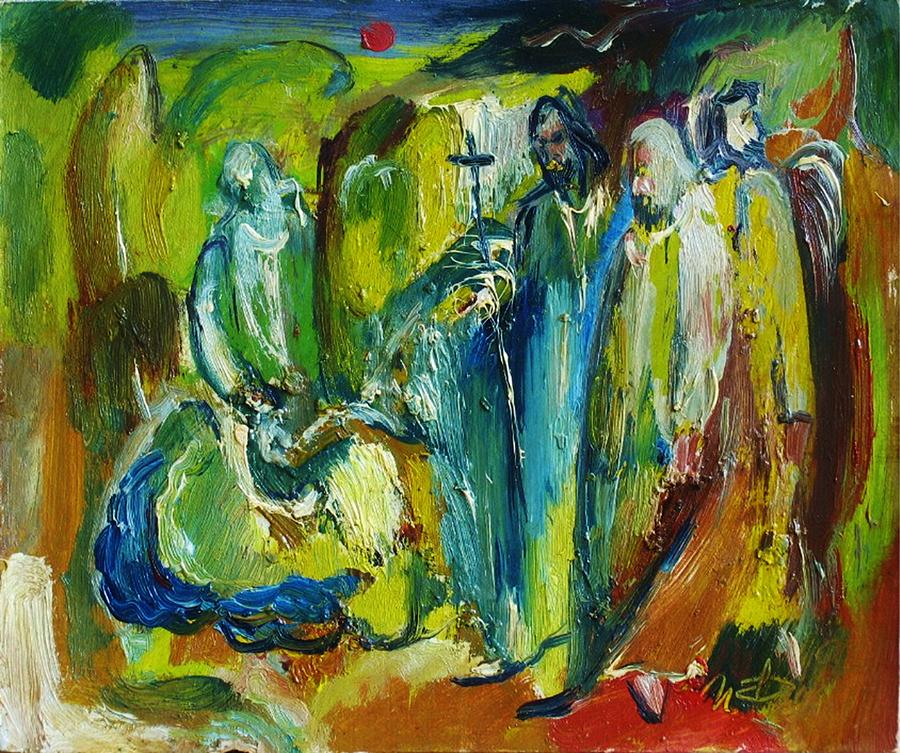
The Vision of Jesus (Luke 10:21-24)

Cristo de la Concordia (Christ of Peace) in Cochabamba, Bolivia

At that time Jesus was filled with joy by the Holy Spirit and said, “Father, Lord of heaven and earth! I thank you because you have shown to the unlearned what you have hidden from the wise and learned. Yes, Father, this was how you were pleased to have it happen.

“My Father has given me all things. No one knows who the Son is except the Father, and no one knows who the Father is except the Son and those to whom the Son chooses to reveal him.”

Then Jesus turned to the disciples and said to them privately, “How fortunate you are to see the things you see! I tell you that many prophets and kings wanted to see what you see, but they could not, and to hear what you hear, but they did not.” (Good News Translation)

A healthy view of Holy Scripture is to see it as an unfolding drama of redemption. Ever since the fall of humanity, God has been on a rescue mission to reclaim, redeem, and restore people. This human project has obviously taken several millennia; and, it still has not reached its fulfillment.

The Christian tradition understands that the climax of victory and final restoration to our true state as humans will occur when Christ returns. By warning us that divine mysteries are hidden to some, and revealed to others, is Christ’s way of cautioning us toward triumphalism and self-congratulation.

Redemption is a reality; and, it’s also not a reality. It is both. Redemption is here; and it’s also coming. We are delivered from sin, death, and hell – and we still labor against the evil machinations of systemic world problems, our own sinful nature, and a demonic realm which is looking for every opportunity to exploit sin’s residue upon the earth.

This all means, on a practical level, that the good old days for some were the bad old days for others. History is always written by the winners and those in power. The hidden voices are typically squelched.

The vision of Jesus is that all kinds of people, not just a certain segment of winners, should enjoy God’s favor.

There were ancient people who longed for spiritual and physical freedom. They looked forward into history and had the hope of Messiah and God’s promises being fulfilled. History is still unfolding. There are people who yet remain locked in personal bondage; large swaths of humanity still experience oppression and a longing to enjoy the blessings which others possess and take for granted.

It is vital that we hold together both the blessings of realized freedom, along with the limits of others’ freedom. This realization helps us continue to actively work for all people, and keep praying that God’s kingdom come, and God’s will be done, here on earth, as it is always done in heaven.

I lift a voice from history which exemplifies the struggle of the black experience in the United States. The following is a small portion from a speech by the ex-slave Frederick Douglass, orated on July 4, 1852, nine years before civil war, with President Millard Fillmore and many congressional politicians in attendance:

“The feeling of the nation must be quickened; the conscience of the nation must be roused; the propriety of the nation must be startled; the hypocrisy of the nation must be exposed; and its crimes against God and man must be proclaimed and denounced. What, to the American slave, is your 4th of July? I answer: a day that reveals to him, more than all other days in the year, the gross injustice and cruelty to which he is the constant victim. To him, your celebration is a sham; your boasted liberty, an unholy license; your national greatness, swelling vanity; your sounds of rejoicing are empty and heartless; your denunciations of tyrants, brass fronted impudence; your shouts of liberty and equality, hollow mockery; your prayers and hymns, your sermons and thanksgivings, with all your religious parade, and solemnity, are, to him, mere bombast, fraud, deception, impiety, and hypocrisy — a thin veil to cover up crimes which would disgrace a nation of savages. There is not a nation on the earth guilty of practices more shocking and bloodier than are the people of these United States, at this very hour.”

Frederick Douglass

Because history is forever unfolding, freedom and blessing develop over time and come more powerfully to some than others. True spiritual discernment, with the awareness to labor on behalf of the common good, does not ultimately come through astute observation and superior intellect; it comes by divine revelation.

God both conceals and reveals according to divine purposes and not human agendas.

Christian spirituality cannot be reduced to praying a sinner’s prayer, and then maintaining a holding pattern on earth until heaven. Rather, Jesus remains present in this world through the person of the Holy Spirit, and is continually interceding on behalf of those who need freedom and blessing.

As Christ’s Body, Christians are to be the hands and feet of Jesus, animated by the Spirit to bring God’s ethical and benevolent regime to those who need it most. If we are blessed, we are to pass blessing onto others without prejudice. For the kingdom of God belongs to the poor in spirit.

Dear God, Creator of the universe and all that inhabit it, we come as your Church, and as individuals, in humble submission to your word and your way.

God, you are the Alpha and Omega, The Almighty Judge and The Forgiver of All Sins, so we come with humility and contrition on behalf of generations past, present and those yet unborn. We ask that you forgive us and create in us a new spirit.

Bind our hearts and send forth the healing power that you and you alone can give to us and this sin-sick world. Bring us into reconciliation with one another and restore us to your righteous and holy path. Amen.

The Ministry of Jesus (Matthew 4:12-23)

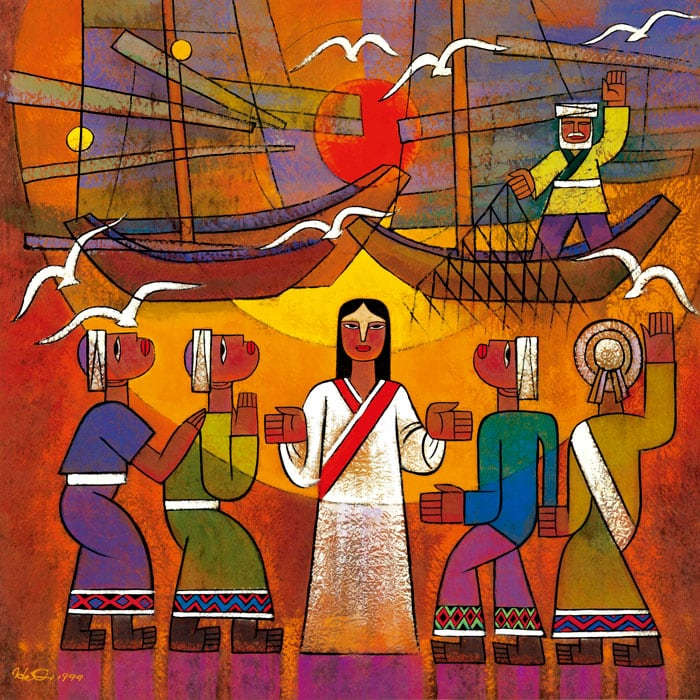
Jesus Calls His Disciples by He Qi

When Jesus heard that John had been put in prison, he withdrew to Galilee. Leaving Nazareth, he went and lived in Capernaum, which was by the lake in the area of Zebulun and Naphtali—to fulfill what was said through the prophet Isaiah:

“Land of Zebulun and land of Naphtali,
    the Way of the Sea, beyond the Jordan,
    Galilee of the Gentiles—
the people living in darkness
    have seen a great light;
on those living in the land of the shadow of death
    a light has dawned.”

From that time on Jesus began to preach, “Repent, for the kingdom of heaven has come near.”

As Jesus was walking beside the Sea of Galilee, he saw two brothers, Simon called Peter and his brother Andrew. They were casting a net into the lake, for they were fishermen. “Come, follow me,” Jesus said, “and I will send you out to fish for people.” At once they left their nets and followed him.

Going on from there, he saw two other brothers, James son of Zebedee and his brother John. They were in a boat with their father Zebedee, preparing their nets. Jesus called them, and immediately they left the boat and their father and followed him.

Jesus went throughout Galilee, teaching in their synagogues, proclaiming the good news of the kingdom, and healing every disease and sickness among the people. (New International Version)

What is “ministry”? 

For some, ministry is only about the souls of people; it is seeing as many people respond to the message of salvation in Christ as possible. 

For others, ministry is meeting the tangible needs of people because there is such a breadth and depth of human social and physical problems. 

And, for others, ministry is defined in terms of what takes place within the four walls of a church building, led by pastors and church leaders.

“Ministry takes place when divine resources meet human needs through loving channels to the glory of God.”

Warren Wiersbe

Problems, however, arise whenever we:

  • Focus on one dimension of ministry. Because, in reality, ministry is multidimensional.
  • Fulfill the outward, administrative demands of ministry – without going after the relational heart of what ministry entails. 
  • Forget about whole groups of people who are different than us. Ministry is for everyone, not some.

We need to look at the ministry of Jesus – what he did and why he did it. Christ’s purpose is to be our purpose: Minister to the total life of all people.

Jesus Preaching

Before there were newspapers, CNN, and 24 hour news cycles, ancient people heard what was happening from heralds or preachers who loudly announced in the streets the important news of the day.

Jesus had a ministry to both Jew and Gentile. Although his ministry was chiefly directed toward his fellow Jews, Christ went out of his way to engage Gentiles, as well, with a message of repentance.

Repentance is turning the whole person – body, soul, mind, will, and emotions – from sin and disobedience to God in obedience to the message of Christ. It involves humility, sorrow for sin, and a commitment to following Jesus.

To repent doesn’t mean to manage sin or clean up parts of my life; it’s a radical conversion from an old way of life to a new way of life. Repentance is not simply adding Jesus to our schedule but is a complete change of how we live.

Christianity is a life, not just an event. Following Jesus is a journey, a life-long process of inner transformation; a complete forsaking of anything that does not please God; and a desire to reorient my life around what’s important to God. 

To illustrate this in a contemporary context, I ask, “What does it mean to follow the Green Bay Packers football team?” A fan not only watches all the games from start to finish, but cheers loudly for the Packers; talks about the Packers with everyone, even strangers; and doesn’t cheer for the Chicago Bears! Fans are committed to their team.

The difference, however, between football and Christianity, is that followers of a team are fans, whereas followers of Jesus are not fans in the stands or watching the television. Instead, Christ followers are on the field of play as teammates with Jesus.

So, when it comes to repentance, we turn from being fans of Jesus to followers of Jesus, doing what he did and saying what he said. We are active participants in the kingdom of God – embracing and embodying a message of repentance to new life in Christ.

Jesus Calling

Jesus calling the first disciples illustrates the kingdom message: a radical break with the old life. Each disciple walked away from a good life and embraced of a new life following Jesus.

Some understanding of Jewish culture in the time of Jesus is helpful here. Central to the life of any Jew was the Torah, the Law. Around age 6, Jewish boys would begin to go to the synagogue for schooling in the Torah by the local rabbi. 

This first level of education was called Beth Sefer (“House of the Book”) and would last until about age 10. In those four years, the first five books of the Old Testament, the Pentateuch, were thoroughly memorized.

By age 10, some of the boys would distinguish themselves as good students and able to handle Torah. So, they would continue on in the second level of schooling called Beth Talmud (“House of Learning”). Those that did not continue with school would then learn the family trade and become an apprentice. Those that went on with school would then memorize the rest of the Old Testament.

At about age 14, only the best of the best were studying Torah. At the completion of their studies, they would apply to a well-known rabbi in order to become his disciple. The goal of this third level was to become just like the rabbi. This was called Beth Midrash (“House of Study”). The rabbi essentially interviews the teenager to find out if he has the stuff to become like the rabbi. 

If the rabbi believes the kid doesn’t have it in him, he tells him to go back to the family business. If, however, the rabbi grills the kid and finds he has what it takes, then he will say to him, “Come, follow me.” It was considered a great privilege and opportunity, and the teenager would leave everything to literally follow the rabbi everywhere he went.

Now, let’s return to Christ’s disciples. Jesus calls Andrew, Peter, James, and John. At the time, they were fishing because they were fishermen. That meant somewhere along the line they didn’t have what it took to further their education, or to follow a rabbi. 

Let’s, then, not miss the import and impact of Jesus saying to them, “Come, follow me!”  Jesus is expressing a belief that these men can become just like him. Well, of course you drop your nets and follow him! Jesus believes I can be like him! Jesus took a group of young men who couldn’t make the grade and used them to change human history. 

Jesus also says the same thing to you and me: I choose you. Come, follow me. 

Christ believed in us before we believed in him. Yes, Jesus believes you can do all the work of embodying the very words of God and becoming like him.

The attitude here is not, “Oh, geez, I have to go do ministry,” as if I were a teenager who was just asked to do the dishes. Rather, the attitude is of privilege and opportunity. If we fail to view ministry in this way, then we must come back to the message of repentance and have an attitude adjustment. People who follow Jesus do so because they get to, not because they have to.

Jesus Healing

            Envision yourself walking with Jesus and following him. You observe several things about his ministry of healing:

  • Jesus heals every problem. Christ has the power and authority to do so.
  • Jesus heals the whole person – not just the physical, or just the spiritual.
  • Jesus heals people whether they repent or not. Christ never made repentance a prerequisite for healing. He heals simply because he wants to.
  • Jesus heals to defeat the devil. Christ continually looks to reverse the hold that sin has on people.
  • Jesus chose to focus on healing the destitute, the poor, and the disadvantaged – rather than directing ministry to the higher classes and royalty to mediate his wishes to the people.

Who are the people – the least, the lonely, the lost – in need of healing in your family, neighborhood, and community?

  1. Those who are ill with various diseases
  2. Those suffering severe pain – of body, mind, emotion, and spirit
  3. The demon possessed or demonically influenced
  4. Prisoners and ex-convicts
  5. The working poor, and the elderly poor
  6. Those in the hospital with no one to visit them
  7. Those who grieve alone
  8. Those with addictions and behavioral issues
  9. Victims of verbal or physical abuse
  10. And many, many more….

Jesus had a ministry of both word and deed. To follow Christ is to become like him and pass on what we have learned to reliable people who will do the same.

Preparing the Way (John 1:19-28)

John the Baptist by Ivan Filichev, 1992

Now this was John’s testimony when the Jewish leaders in Jerusalem sent priests and Levites to ask him who he was. He did not fail to confess, but confessed freely, “I am not the Messiah.”

They asked him, “Then who are you? Are you Elijah?”

He said, “I am not.”

“Are you the Prophet?”

He answered, “No.”

Finally they said, “Who are you? Give us an answer to take back to those who sent us. What do you say about yourself?”

John replied in the words of Isaiah the prophet, “I am the voice of one calling in the wilderness, ‘Make straight the way for the Lord.’”

Now the Pharisees who had been sent questioned him, “Why then do you baptize if you are not the Messiah, nor Elijah, nor the Prophet?”

“I baptize with water,” John replied, “but among you stands one you do not know. He is the one who comes after me, the straps of whose sandals I am not worthy to untie.”

This all happened at Bethany on the other side of the Jordan, where John was baptizing. (New International Version)

John was not the Messiah. Jesus is the Messiah. John’s life was devoted to preparing people and pointing them to Jesus. You and I are not the Messiah; Jesus is. You and I are to devote are lives to preparing people and pointing them to Jesus.

John the Baptist had a way of communicating that didn’t exactly win friends; but he sure influenced a lot of people. (Matthew 3:1-12) 

Considering that John lived in seclusion, dressed weird, and ate different food, it’s not a stretch to see how people might dismiss him as a kook and move on. Yet, there’s no evidence that people viewed John that way. 

Instead, John the Baptist had an effective ministry. I suggest that’s because John didn’t seek his own gain, wasn’t trying to build a big following, but understood that he was to point to the coming Christ. 

John believed judgment was imminent, so he put all his efforts into getting people to realize the wrath of God was real and coming soon.

The kingdom of God cannot be entered by forcefully pushing the door in; we enter God’s kingdom through the humility of confession and repentance. The way to the Nativity goes through John the Baptist and his message of “Repent, for the kingdom of God is near.” (Matthew 3:2; Mark 1:4; Luke 3:3)

We are, like John, to make a straight and level way for folks to come to Jesus. That’s going to require some change on our part. But if we’re stuck in our ways, that makes it really hard to make a level path to Jesus.

There’s all sorts of ways we get stuck. We might be mired in a destructive habit because we think we need it to keep going; we may get cemented into rehearsing all the past dumb decisions we made, and so, cannot move forward; or we might become fastened in an unhealthy relationship and see no way to move. 

If we are stuck long enough, we blandly accept this as a new normal, then go about our daily lives with a “meh” kind of attitude; not too low, not too high, but just “meh.”

All this sticky stuff – the patterns, behaviors, activities and habits which trap us – keep us in an immovable bondage. And we might become so used to “meh” that we are cut off from the source that would get us un-stuck.

The reason people didn’t dismiss John as some creepy clown is that he offered them something better than their sticky situations. 

Awareness of our real selves and our true condition brings hope – because God will not leave us stuck. The Lord will turn us into free people, delivered from the stickiness, to live fully for the coming King. God doesn’t give up on us, so we do not need to settle for a “meh” existence.

It can be scary, looking squarely at our sins, habits, memories, and emotions because they might keep us on the flypaper of death. We may feel overwhelmed and think there is hope for other people, but not me. Or, conversely, we might think that everyone else has a problem except me. 

Jesus will baptize with the Holy Spirit and with fire. Christ will shake things up. He’ll unstick people and free them from narrow thinking and a lack of self-awareness.

The season of Advent means that the time of the Lord’s coming is near. Therefore, preparation for the Nativity of the Lord, Christmas, is of primary importance. And the best way of preparing for Christmas Day is to repent and believe that the kingdom of God is near (as opposed to far away). 

God has come near to us in the person of Jesus; and that makes all the difference. 

It’s hard to admit we’re stuck. Yet, if many are honest, their relationship with God and/or the Church is nothing more than a shoulder shrugging “meh.”

There are two ways to deal with being stuck in guilt and shame: either justify it or confess it. 

Denying, minimizing, or excusing sin leads to separation from God – whereas confession leads to connecting with God. 

John the Baptist’s message is this: Get ready because Jesus is coming! Through the grace of repentance and faith there is hope – the hope of stopping all the petty games we play to hide our sin and hide the fact we are really super-glued to our idols. Our hope is in being cleansed from our impurities and ready for God to be with us in the person of Jesus.

God unsticks us so we can bear good fruit that is in keeping with repentance. Our lives need to be congruent between what we profess and how we live. Outward religious observance, although important, is not the way into the kingdom. And confession without genuine change is not repentance – it’s just confession. 

The God who came to his people in Jesus will one day unveil his kingdom in all its glory. We need to get ready for that day. There are roads that need straightening; fires that need to be lit in order to burn away the rubbish and brush in the path; dead trees that need to be cut down; there are people who need to repent because the kingdom of God is near.

We must clear the road so that Jesus has a way into our hearts. 

Just as law enforcement and the secret service are serious about making presidential motorcades free of obstacles and having a clear road to the destination, so we need to ensure that we are doing all we can to pave the way for Christ’s coming. 

This is no time for a spiritually milquetoast deadpan “meh” kind of life; this is the day to clear the way for Jesus. Now is the time to prepare for Christ’s coming. 

And the proper preparation for the Lord’s return is with admitting our stickiness and asking God to unstick us from the sin that so easily entraps us on the devil’s flypaper. 

The kingdom of God belongs to those who prepare the way and produce good fruit in keeping with repentance. 

Maranatha. Even so, come, Lord Jesus.

The Kingdom of God Is Here (Matthew 10:5-15)

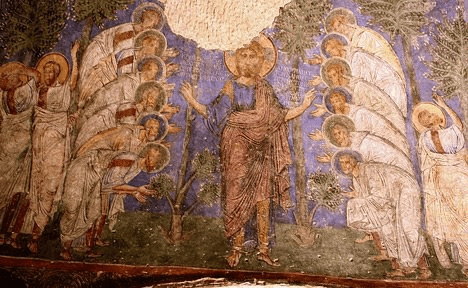
Jesus sent his twelve harvest hands out with this charge:

“Don’t begin by traveling to some far-off place to convert unbelievers. And don’t try to be dramatic by tackling some public enemy. Go to the lost, confused people right here in the neighborhood. Tell them that the kingdom is here. Bring health to the sick. Raise the dead. Touch the untouchables. Kick out the demons. You have been treated generously, so live generously.

“Don’t think you have to put on a fund-raising campaign before you start. You don’t need a lot of equipment. You are the equipment, and all you need to keep that going is three meals a day. Travel light.

“When you enter a town or village, don’t insist on staying in a luxury inn. Get a modest place with some modest people and be content there until you leave.

“When you knock on a door, be courteous in your greeting. If they welcome you, be gentle in your conversation. If they don’t welcome you, quietly withdraw. Don’t make a scene. Shrug your shoulders and be on your way. You can be sure that on Judgment Day they’ll be mighty sorry—but it’s no concern of yours now. (The Message)

“People can’t observe the coming of God’s kingdom. They can’t say, ‘Here it is!’ or ‘There it is!’ You see, God’s kingdom is within  you.” Jesus, from Luke 17:20-21, GW

When Jesus told his followers that the kingdom of God is here, he didn’t simply mean that it all of a sudden showed up. No, it’s already here. It always has been. We just haven’t paid attention. And we haven’t noticed because we keep looking for a location, somewhere outside of ourselves. But, as it turns out, we already have what we’ve been searching for.

Christianity, at its core, is about following Christ. And that journey with Jesus is first and foremost a journey into oneself. This is why the Lord tells the disciples not to go first to outsiders. There’ll be a time for that. But now, the journey to their fellow Jews was to be an internal walk into the very depths of their own souls and the soul of a nation.

The singular message of this particular mission was to proclaim that the kingdom of God is near. It is here. In fact, it is so near and here that it is actually within you. But the disciples needed to discover this for themselves by going out and removing all obstacles to awareness of God’s light.

Jesus sent the disciples out and told them not to take anything with them because they already had what they needed. The kingdom of God is already within them.

A Byzantine fresco of Jesus sending the disciples, 12th century

So, they were to leave all their baggage and their stuff behind. The disciples were to be stripped of all their trusted outer resources so that they had the ability to see themselves, to others, and human need – and then to be moved in their hearts with compassion, just as Jesus is. 

Whenever we take all our pre-packaged stuff with us into relationships and the doing of Christ’s mission, we already assume we know what other people need. If we have nothing with us, then we are able to see people for who they actually are; we can genuinely listen to what they are saying. 

You have freely received compassion from God, so freely give it away. Not everyone will respond, but that’s not your business; they will have to deal with God on that later.

Compassion is to be our response to human need. Yet, we don’t always respond with compassion because of the obstacles within our own hearts and lives prevent us from seeing others and their needs.

The following are a few of obstructions which hinder us from compassion and perceiving the kingdom of God within us, and how to deal with them:

  1. Contempt. Contempt breeds contempt. Unacknowledged and unresolved anger produces bitterness. Hatred feeds more hatred. Our environment makes a difference. For example, if you find you have to check your heart at the workplace in order to do your job, then you need to either you quit your, or bring forth the kingdom of God by tirelessly advocating for compassionate treatment of people.
  2. Busyness. I’m referring to an unhealthy pace of life. Many of us work too much and do too many things. We cannot have compassionate hearts by moving so fast that we fail to see other people’s needs. Slow down. No one is going to come to the end of their life and wished they had been workaholics. Make a thoughtful plan to slow down enough so you can tune into the needs of others and have emotional energy for them.
  3. Resentment. It’s possible to become coldhearted by excessive and unrelenting caregiving. This is the same sort of problem as an unhealthy pace of life; you give so much that you actually begin to resent the people you care for. Caregiving has to be meticulously balanced with self-care. There’s a time for everything, including rest and recuperation.
  4. Inaction. Only receiving and not giving is what I call “spiritual constipation.” It’s when a person listens to hundreds and thousands of sermons and podcasts but doesn’t listen to their neighbor. They have no intention of putting anything they hear into practice.

However, with nothing restricting or obstructing God’s kingdom within us, we can see the divine image within each person and within ourselves. We can begin to radiate that divine presence and be transformed by it’s inner light.

Like Jesus, transfigured before the disciples on Mount Tabor, we too, become transfigured by God’s energy of love touching our hidden divine energy as image-bearers. That energy now comes forth because we have left everything behind to follow Christ and experience the generosity which, ironically, only comes from having nothing.

This is a spiritual walk we cannot take alone. The road we travel is the way of community. Just as God is community – Father, Son, and Spirit – always in a unity of love, so we, as God’s image-bearers with the divine light within us, must strip ourselves of everything that hinders and the sin that so easily entangles and run with perseverance the race marked out for us.

We are to fix our eyes on Jesus and see him, the pioneer of our faith, the Light of the World, the Living Water, and Bread for the world, who endured all things for the redemption of humanity and all creation.

Almighty God, you sent your Son Jesus Christ to reconcile the world to yourself: We praise and bless you for those whom you have sent in the power of the Spirit to proclaim that the kingdom of God is near. We thank you that in all parts of the earth a community of love has been gathered together by their prayers and labors, and that in every place your servants call upon your Name; for the kingdom and the power and the glory are yours forever. Amen.