James 2:8-13 – On Mercy and Against Favoritism

“Benevolent Mercy” by Iowa artist William Butler

If you really keep the royal law found in Scripture, “Love your neighbor as yourself,” you are doing right. But if you show favoritism, you sin and are convicted by the law as lawbreakers. For whoever keeps the whole law and yet stumbles at just one point is guilty of breaking all of it. For he who said, “You shall not commit adultery,” also said, “You shall not murder.” If you do not commit adultery but do commit murder, you have become a lawbreaker.

Speak and act as those who are going to be judged by the law that gives freedom, because judgment without mercy will be shown to anyone who has not been merciful. Mercy triumphs over judgment. (NIV)

One of my bedrock foundational unshakable beliefs is that God’s big world spins on the axis of grace. Without grace we would all be living in some nightmarish dystopian novel just trying to survive. Grace is the force which overwhelms and overcomes everything. 

When I was growing up, we had a dog named Sam. Sam loved being on the farm. More than once he tussled with a skunk. In those times, I could barely get close enough to clean him up because he stunk so badly.  Favoritism stinks, and God has a hard time getting close to us when we show partiality to others. God is going to clean us up when smelling the stench of discrimination on us.

Showing favoritism to some over others is evidence the dog is running away from the bath of grace. To develop relationships and interact with people the way God wants us to, we must be free from prejudice. Favoring the rich over the poor stinks because God cares about those trapped in poverty. When Jesus began his ministry, he lifted-up the importance of poor folk by placing himself in the position of extending grace to them:

The Spirit of the Sovereign Lord is on me, because the Lord has anointed me to proclaim good news to the poor. (Isaiah 61:1; Luke 4:18, NIV)

In the Old Testament, there are seven different words for the “poor” because poverty was a pervasive reality (and still is!). The various reasons for poverty range from being born into poverty, being lazy, or being oppressed and/or in slavery. The types of poor persons run the gamut from simple beggars to the pious and humble poor.  These spiritual poor persons were called in biblical times the anawim” (Hebrew עֲנָוִ֣ים). The anawim are humble and gentle folk caught in grinding poverty with no other option but to put their trust in God.

The mistreatment, exploitation, and inattention to the needs of the poor are a chief reason why Holy Scripture is filled with references about how to treat them. The anawim are dear and near to the heart of God:

“Poor persons will never disappear from the earth. That’s why I’m giving you this command: you must open your hand generously to your fellow Israelites, to the needy among you, and to the poor who live with you in your land.” (Deuteronomy 15:11, CEB)

“If you hire poor people to work for you, don’t hold back their pay whether they are Israelites or foreigners who live in your town. Pay them their wages at the end of each day because they live in poverty and need the money to survive. If you do not pay them on time, they will complain about you to the Lord, and he will punish you.” (Deuteronomy 24:14-15, CEV)

Listen to this, you who rob the poor
    and trample down the needy!
You can’t wait for the Sabbath day to be over
    and the religious festivals to end
    so you can get back to cheating the helpless.
You measure out grain with dishonest measures
    and cheat the buyer with dishonest scales.
And you mix the grain you sell
    with chaff swept from the floor.
Then you enslave poor people
    for one piece of silver or a pair of sandals.

Now the Lord has sworn this oath
    by his own name, the Pride of Israel:
“I will never forget
    the wicked things you have done!” (Amos 8:4-7, NLT)
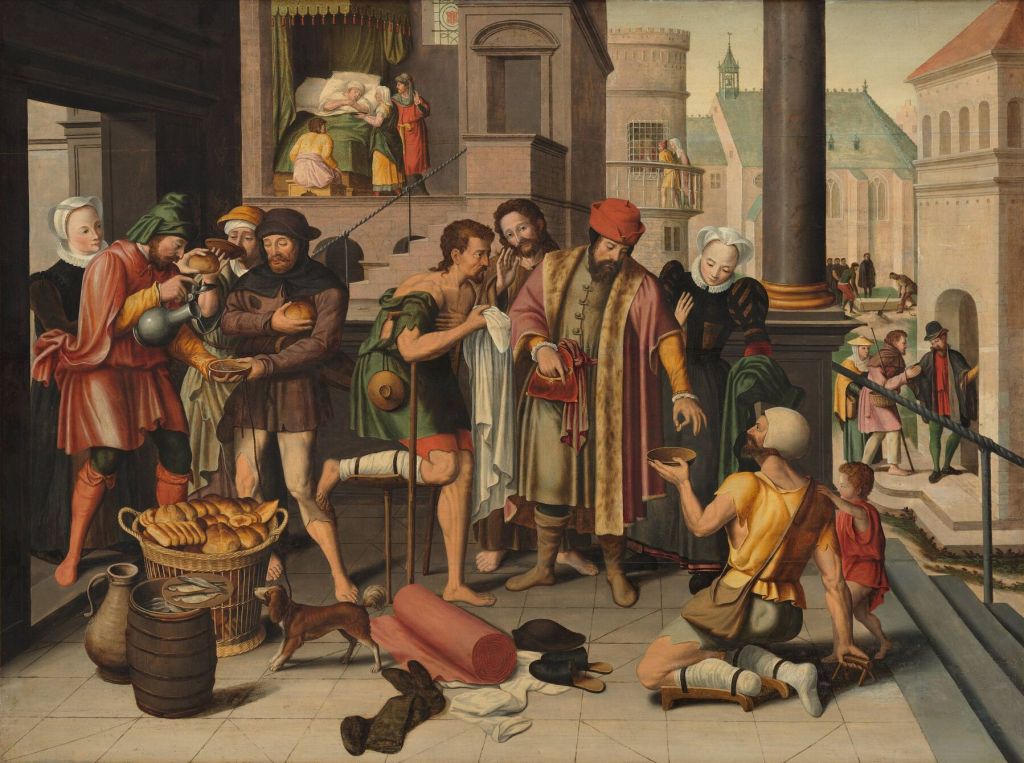
The Seven Corporal Works of Mercy by Unknown Dutch artist, 1580.

Nothing gets God’s hackles up more than unjust and unfair favoritism which is devoid of mercy and grace toward the poor. It all stinks to high heaven, and when God smells it, divine egalitarian power is not far behind.

It is the poor in spirit with no trust in stuff and ingenuity who will enter the kingdom of heaven. The humble person gives grace to another even though the person cannot offer something in return. It is easy to be merciful to people who have a deal with you about scratching each other’s backs. However, it is altogether a different thing to be gracious simply because it is the right thing to do and pleases the heart of God. 

God cares about the condition of our souls and not the balance of our bank accounts. Inattention to the poor and needy only betrays a heart of unjust favoritism – a materialistic heart full of greed. A 2012 Boston Globe article asked the following question: Does money change you?

The Globe article stated, “most people are convinced that gaining a lot of money … wouldn’t change who they are as people. Yet, a mounting body of research is showing, wealth can actually change how we think and behave—and not for the better. Rich people have a harder time connecting with others, showing less empathy to the extent of dehumanizing those who are different from them. They are less charitable and generous. They are less likely to help someone in trouble. And they are more likely to defend an unfair status quo. If you think you would behave differently in their place, meanwhile, you are probably wrong: These are not just inherited traits but developed ones. Money, in other words, changes who you are.”

The University of Minnesota’s Carlson School of Management found in their research that even the mere suggestion of getting more money makes people less friendly, less sensitive to others, and more likely to view some groups of people as inferior to others.  Another series of studies from the University of California at Berkley concluded that wealthier people tend to be less compassionate toward others in a bad situation than people from lower-class backgrounds. Their research concluded, “If you win the lottery and you want to avoid becoming an insensitive jerk, there is a simple solution: Give at least half the money away.” 

Some poor people, as in the days of the Apostle James, are willing to put up with being treated unfairly so they might get a piece of the rich person’s pie. Favoritism ignores the sin in others to gain something from them. God says that is stinking thinking.

Favoritism is flat out a violation of God’s law. The entire law is summed up in two commands: Love God and love neighbor. Favoritism violates our neighbor, and therefore, is sinful disobedience of God. Any needy human we encounter is our neighbor – no matter their social or economic status, their ethnicity, race, gender, or anything that identifies them as different. They are to be helped when we can do so.

We are to speak and act with mercy because we will eventually have to face the Judge. God is always watching us – every word and every action. Judge Jesus will respond to how we have treated each person we encountered and how we talked about other people when they were not around. We will all appear before Christ at the end of the age and must give an account of ourselves. (2 Corinthians 5:10)

Words are important, so they ought to be full of grace, seasoned with salt. Showing mercy instead of favoritism is the way love expresses itself.  Mercy is best given when we have first received it ourselves from God. A heart touched by the grace of the Lord Jesus is one which will stand in the judgment.

We rid ourselves of favoritism’s stench through the cleansing bath of God’s mercy in Jesus Christ.  There is grace available if we will receive it. God is the expert in transforming lives, renewing minds, and putting to death the pride of favoritism. The work is done with needed grace and compassionate mercy.

So, we are to make it our goal to be a grace-givers, to have willing hearts which seek to emulate the mercy of Christ. The bath of mercy and grace takes away the stank of prideful favoritism and leaves us with the sweet aroma of love, justice, peace, and joy in the Holy Spirit.

May it be so to the glory of God.

Matthew 23:29-36 – “Woe Is Me!”

Ethiopian Jesus
Jesus, from an Ethiopian Orthodox Church, c.1750 C.E.

“Woe to you, teachers of the law and Pharisees, you hypocrites! You build tombs for the prophets and decorate the graves of the righteous. And you say, ‘If we had lived in the days of our ancestors, we would not have taken part with them in shedding the blood of the prophets.’ So, you testify against yourselves that you are the descendants of those who murdered the prophets. Go ahead, then, and complete what your ancestors started! 

“You snakes! You brood of vipers! How will you escape being condemned to hell? Therefore, I am sending you prophets and sages and teachers. Some of them you will kill and crucify; others you will flog in your synagogues and pursue from town to town. And so upon you will come all the righteous blood that has been shed on earth, from the blood of righteous Abel to the blood of Zechariah son of Berekiah, whom you murdered between the temple and the altar. Truly I tell you; all this will come on this generation. (NIV) 

I almost feel the need to place a warning label on this blog post: “The writer has determined that a careful reading of this Scripture is dangerous to those who think their current state of Christianity is just fine.”  Jesus stands in a long line of Old Testament prophets as the ultimate prophesier calling the people to see things as they really are and come back to the God of all, not the God of their own making. 

I feel yet another warning is warranted, knowing from years of experience that there is an Enemy of our souls: The dark forces of this world will try every which way to get us to believe these words of Jesus are for other people, not me or you – that you and I are okay and that this is for “those” people [probably ones we don’t like] who are clearly deluded. We, however, are simply fine.   

We all need these words from Jesus and to let them speak to us. Christ’s scathing and damning critique was leveled against a distorted spirituality, a false Christianity, a controlling leadership that stifled and snuffed-out the true worship of God. Jesus pronounced seven woes on the religiously pious spiritual brokers of his day. Today’s Gospel lectionary contains only the seventh woe. This woe, along with the rest, are not directed toward the irreligious or the spiritually lackadaisical folks among us – the woes are aimed squarely at the religiously committed. 

Ethiopian Orthodox Jesus
Ethiopian Orthodox Church depiction of Jesus

The word “woe” literally means “disaster” “calamity” and “misery.” Jesus pronounced a woe against ultra-religious persons who were obsessed with respecting the tombs and the graves of the ancient prophets. It was considered a terrible travesty to walk on such a grave, even accidentally. The concern about it would be something like today’s respect given to the American flag by many people. 

Here is what Jesus is getting at with his woe on those being so concerned with the tombs of the prophets: Honoring dead people and inanimate objects like graves while ignoring live people is not good. Respecting dead people of the past means nothing if we simultaneously ignore the live people right in front of us. For Jesus, one of the surest ways to hell is to give credence to Christian leaders long dead while flippantly disregarding the prophet or pastor presently in our lives who is taking pains to communicate God’s will and care for God’s people right now. 

Jesus knew quite well the telltale signs of hypocrisy: 1) hypocrites don’t practice what they preach; 2) hypocrites keep other people out of God’s kingdom; 3) hypocrites focus on externals; and, 4) hypocrites major on the minors. Hypocrisy, however, never has the last word – grace does. The final word to everything is God’s grace.  

For all of Christ’s severe words, his heart was filled with a love and a longing for his wayward people. Jesus died for the ungodly with deep concern, intention, and hope that everyone would come to know the true worship of God – filled with an abundance of mercy for the penitent sinner. 

When the prophet Isaiah experienced a vision of God his response was “woe is me!” (Isaiah 6:1-5). The appropriate response to today’s Gospel lesson is repentance – to see and turn from our own propensity toward spiritual and/or religious pride and the tendency to view the “other” as needing to repent, but not me.  

Let us, then, come to the cross of Jesus Christ and there find the grace which absolves us from such sin. Let us approach the empty tomb and find Christ’s resurrecting power of transformation. Let us approach the ascended Christ on the throne with both humility and confidence. Let us intercede for a world which desperately needs the peace of Christ. 

Lord Jesus Christ, you prayed that we would be one as you and your Father are one. We confess our resistance to your prayer. We have failed to maintain the unity of the Spirit. We have broken the bond of peace. For the times we have not listened to each other, when we have spoken in anger, haste, or fear, we are sorry. For the times we have not loved each other, when we have competed, or insulted or judged each other, we are sorry. For the harm that our disunity has done to our witness to the Gospel, we are sorry. Have mercy on us, we pray. Restore us to friendship with you and with one another, through the power of your Spirit. Lord, grant your grace for repentance to spiritual charlatans and victimizers; and, give your power to those distressed and victimized for forgiveness of their abusers, so that all of us together may strive to break the chains of oppression and show the peace of Christ in the world. Amen. 

Revelation 14:12-20 – Enduring to the End

Judgment Day by William de Kooning 1946
Judgment Day by William de Kooning, 1946

Here is a call for the endurance of the saints, those who keep the commandments of God and hold fast to the faith of Jesus.

And I heard a voice from heaven saying, “Write this: Blessed are the dead who from now on die in the Lord.” “Yes,” says the Spirit, “they will rest from their labors, for their deeds follow them.”

Then I looked, and there was a white cloud, and seated on the cloud was one like the Son of Man, with a golden crown on his head, and a sharp sickle in his hand! Another angel came out of the temple, calling with a loud voice to the one who sat on the cloud, “Use your sickle and reap, for the hour to reap has come, because the harvest of the earth is fully ripe.” So, the one who sat on the cloud swung his sickle over the earth, and the earth was reaped.

Then another angel came out of the temple in heaven, and he too had a sharp sickle. Then another angel came out from the altar, the angel who has authority over fire, and he called with a loud voice to him who had the sharp sickle, “Use your sharp sickle and gather the clusters of the vine of the earth, for its grapes are ripe.” So, the angel swung his sickle over the earth and gathered the vintage of the earth, and he threw it into the great wine press of the wrath of God. And the wine press was trodden outside the city, and blood flowed from the wine press, as high as a horse’s bridle, for about two hundred miles. (NRSV)

The Scripture meditations I offer each day are based in the daily readings of the Revised Common Lectionary. The readings are designed to move us through the whole of the Bible in a three year cycle; and, they are arranged so that Thursday, Friday, and Saturday readings anticipate the Sunday scriptures, and the Monday, Tuesday, and Wednesday readings reflect on Sunday’s texts. Today’s New Testament lesson is such a reflection on Sunday’s Gospel reading of Christ’s Parable of the Weeds (Parable of the Wheat and Tares).

Jesus made it clear in the parable that it is not our job to weed out evil. This will be done by the angels at the end of the age. Well, here we are in Revelation with a grim look into the future as to how it all shakes-out. And, as you can readily see, it is not a pretty picture. Those among us who are visual learners and picture the words in their minds, their stomachs might just be turning about now.

The entire book of Revelation was originally meant to encourage believers in Jesus to persevere, endure, and keep going in their commitment to Christ. As they were undergoing difficulty and even persecution for their faith, this apocalyptic vision of the Apostle John was to instill hope that it will not always be this way. There is a time coming soon in which the problem of evil will be taken care of, once for all.  Until that final day of judgment comes, we are to hold fast to our faith and continue to keep the commandments of Christ.

Judgment Day by Aaron Douglas 1939
Judgment Day by Aaron Douglas, 1939

The wrath of God has always been an issue with various people throughout the ages. In contemporary theology, it is common to have groups of folks polarized between either making God out to be constantly angry and looking to zap people, or dismissing God’s wraith altogether as some outdated and antiquated idea. Neither of these approaches will do.

God’s anger and wrath exists, yet it is never divorced from God’s love. Rather than viewing wrath and love as two sides of the same coin, I believe a healthier and more biblical understanding is to discern God’s wrath as an expression of God’s love. I will explain….

When God bends to observe us in the world and sees injustice, war, poverty, oppression, trauma, and abuse from narcissistic people who exalt themselves above others and use them for selfish purposes, I am here to say to that God is not okay with this! Whenever God looks at the world and sees governments, institutions, corporations, and even churches which maintain structures that keep others from becoming all that God intends for them to become, Divine compassion is stirred along with a determination to bring about justice and righteousness.

Only God has the combination of willingness, power, and ability to handle the evil of this world in a way which is both just and loving. I fully realize there are many times when we wonder if God is really watching, or not, and are curious if he is aloof and uncaring to our plight. There is a day when the dramatic will happen, but that day is not today. For now, God is patiently and carefully working his love into the fabric of this world in a way that will not destroy the innocent and compromise the integrity of the righteous.

So, until the time is ripe for God to act in a more decisive manner by equipping angels with scythes and bringing in the final harvest, we experience pain and hurt. We sometimes are misjudged and misunderstood by others. We often get shafted by systems which are supposed to be helping us. We can, however, be assured that God is working behind the scenes, planting seeds of love and grace, and tending to the growth till the time is right to gather the abundant crop. Acting too soon and going off half-cocked without enough information is what we humans tend to do. Not so with God.

So, the fact of the matter is that justice and injustice will co-exist side-by-side for a while. Righteousness and evil will be found together everywhere we go, including our own hearts – holding both our altruistic motives and our evil inclinations.

Sisters and brothers, let us endure, persevere, and be patient. God is good and will not forget your deeds done in faith, your actions inspired by hope, and your work animated by love.

Lord Christ, you came into the world as one of us, and suffered as we do. As I go through the trials of life, help me to realize that you are with me at all times and in all things; that I have no secrets from you; and that your loving grace enfolds me for eternity. In the security of your embrace I pray. Amen.

John 12:44-50 – Christ’s Philosophy of Ministry

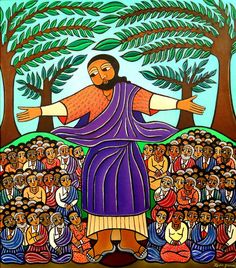
Jesus teaching
“Sermon on the Mount” by Laura James

In a loud voice Jesus said:

Everyone who has faith in me also has faith in the one who sent me. And everyone who has seen me has seen the one who sent me. I am the light that has come into the world. No one who has faith in me will stay in the dark.

I am not the one who will judge those who refuse to obey my teachings. I came to save the people of this world, not to be their judge. But everyone who rejects me, and my teachings will be judged on the last day by what I have said. I do not speak on my own. I say only what the Father who sent me has told me to say. I know that his commands will bring eternal life. That is why I tell you exactly what the Father has told me. (CEV)

Everybody has a philosophy of ministry of how to proceed with the actual doing of Christian works and service to others. We might think of philosophy as a theory about how to gain knowledge and what we are supposed to do with the knowledge we possess. We all have philosophies, even if they are not written down for others to see.

Ponder the thought that Jesus had a philosophy of ministry… which he did.  If Christ’s words carry a lot of weight for us, then perhaps he articulated what he believes about the nature of knowledge; what to do with that knowledge; and, how to handle humanity. Contained within today’s Gospel lesson is the heart of Christ’s philosophical (and thus practical) approach.

Here are several observations about Christ’s philosophy of ministry:

  1. True faith is Trinitarian faith.
  2. Jesus came to dispel darkness by deposing its ruler.
  3. Jesus did not come to nit-pick, harangue, or reject people.
  4. Jesus came to save the world.
  5. Jesus has the authority to save the world.
  6. Belief in Jesus brings deliverance from sin, death, and hell.

Yes, there is a Day of Judgment coming – but that day is not today. Today is the day of salvation, of availing oneself of the opportunity to discover the life, teaching, claims, death, resurrection, and ascension of Christ. Jesus has declared (in a loud voice so we can hear him) that he is the light of the world, the path to God, the Savior of humanity. Those are some very audacious assertions! So, before tomorrow comes, we need to consider the claims of Christ today.

Those whose philosophies include generous portions of people-pleasing and posturing for people-praise will not be judged or rejected by Jesus today (and, so, ought not to be rejected by us, as well!) but will be judged by the words and message of Jesus on the Last Day. According to this philosophy of ministry, there is neither a precedent nor a need to step in and (attempt) to do the Spirit’s work. Rather, we place our faith in Jesus and allow that belief to shape our conversations and interactions with others.  A Christian philosophy of ministry does not need to be complex; it just needs to be Christ-centered.

Great God of deliverance, thank you that you sent your Son, Jesus, to save people from their sins.  I believe in you and what you did and what you stand for.  Each time I open my mouth, may you form my words so that they are not judgmental, but helpful in bringing others to realize life-giving faith through the power of your Holy Spirit.  Amen.