John 12:44-50 – Christ’s Philosophy of Ministry

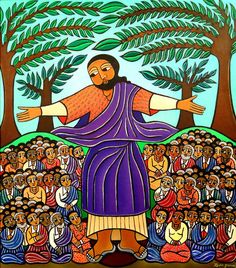
Jesus teaching
“Sermon on the Mount” by Laura James

In a loud voice Jesus said:

Everyone who has faith in me also has faith in the one who sent me. And everyone who has seen me has seen the one who sent me. I am the light that has come into the world. No one who has faith in me will stay in the dark.

I am not the one who will judge those who refuse to obey my teachings. I came to save the people of this world, not to be their judge. But everyone who rejects me, and my teachings will be judged on the last day by what I have said. I do not speak on my own. I say only what the Father who sent me has told me to say. I know that his commands will bring eternal life. That is why I tell you exactly what the Father has told me. (CEV)

Everybody has a philosophy of ministry of how to proceed with the actual doing of Christian works and service to others. We might think of philosophy as a theory about how to gain knowledge and what we are supposed to do with the knowledge we possess. We all have philosophies, even if they are not written down for others to see.

Ponder the thought that Jesus had a philosophy of ministry… which he did.  If Christ’s words carry a lot of weight for us, then perhaps he articulated what he believes about the nature of knowledge; what to do with that knowledge; and, how to handle humanity. Contained within today’s Gospel lesson is the heart of Christ’s philosophical (and thus practical) approach.

Here are several observations about Christ’s philosophy of ministry:

  1. True faith is Trinitarian faith.
  2. Jesus came to dispel darkness by deposing its ruler.
  3. Jesus did not come to nit-pick, harangue, or reject people.
  4. Jesus came to save the world.
  5. Jesus has the authority to save the world.
  6. Belief in Jesus brings deliverance from sin, death, and hell.

Yes, there is a Day of Judgment coming – but that day is not today. Today is the day of salvation, of availing oneself of the opportunity to discover the life, teaching, claims, death, resurrection, and ascension of Christ. Jesus has declared (in a loud voice so we can hear him) that he is the light of the world, the path to God, the Savior of humanity. Those are some very audacious assertions! So, before tomorrow comes, we need to consider the claims of Christ today.

Those whose philosophies include generous portions of people-pleasing and posturing for people-praise will not be judged or rejected by Jesus today (and, so, ought not to be rejected by us, as well!) but will be judged by the words and message of Jesus on the Last Day. According to this philosophy of ministry, there is neither a precedent nor a need to step in and (attempt) to do the Spirit’s work. Rather, we place our faith in Jesus and allow that belief to shape our conversations and interactions with others.  A Christian philosophy of ministry does not need to be complex; it just needs to be Christ-centered.

Great God of deliverance, thank you that you sent your Son, Jesus, to save people from their sins.  I believe in you and what you did and what you stand for.  Each time I open my mouth, may you form my words so that they are not judgmental, but helpful in bringing others to realize life-giving faith through the power of your Holy Spirit.  Amen.

Galatians 3:1-9

            “You stupid Galatians!  I told you exactly how Jesus Christ was nailed to a cross.  Has someone now put an evil spell on you?” (CEV).  So, Paul, what do you really think of the Galatians’ attitude?  The apostle was totally exasperated with this church.  Having embraced the gospel of grace the Galatian churches turned around and started practicing a gospel of works.  This did not just raise the ire of Paul; he went spiritually Rambo on them.  The Christian life, Paul argued, was thoroughly imbibed with grace – so much so that there is no room whatsoever for Christianity to practically exist outside of grace.  If we were saved by grace, we continue to live by grace.
 
            The Galatian heresy, or stupidity, or whatever you want to call it, still exists.  Having been redeemed by the grace of God in Christ, there are “believers” who persist in declaring a gospel of judgment for any and all who are different.  Whereas they were saved by grace, stupid believers set up a system of works for folks like the LGBTQ community.  Somehow they cannot be saved and sustained by grace because they are in a special class of sinner.  In this system, somehow Muslims can only be saved and sustained by proving how bad they are, and not by grace, because they are terrible people who want everyone else dead.  Somehow they need a gospel of judgment….  I see stupid believers everywhere (said in a hushed whisper).
 
            If I seem perturbed, I guess I am.  I would like to think I’m living along the lines of the Apostle Paul, but I know the human heart’s propensity toward thinking better of itself than it really is.  It seems that, without fail, someone inevitably feels the need to remind me that God cares about truth whenever I talk about grace, as if grace isn’t the highest truth that one could hold.  If it isn’t the gospel of grace it is not biblical – it is a perverted gospel – and the evidence of it is folks who downgrade the crucifixion of Christ and living by the Spirit in favor of group-speak and fighting the culture wars.  Lord, have mercy, Christ have mercy.


            Gracious God, you are merciful and save all who come to you by faith in the name of Jesus.  Help me to see grace for what it is – scandalously free and exorbitantly wonderful – bought with the price of Christ’s blood.  Amen.

Amos 9:8-15


             Doom and hope, judgment and grace, suffering and glory are the movements and rhythm of the Old Testament prophets.  The sins of Israel were not only that they trampled on the poor and needy, but that they saw nothing wrong with their way of life.  Thus, the time was imminent when God would deal with the situation by destroying that way of life and sending the people away to a place where they would have no chance to oppress others.  Death would come to many:  “All the sinners of my people shall die by the sword, who say, ‘Disaster shall not overtake or meet us.’”
             But God would not completely destroy forever.  Restoration, renewal, and fruitful times will come as a result of God’s free grace toward his people.  “I will restore the fortunes of my people Israel, and they shall rebuild the ruined cities and inhabit them.”  God acts and demonstrates grace because that is what God does.  We often get the notion in our heads that God executes judgment to teach people a lesson or to make a point.  But God acts out of his holiness and his grace.  He maintains his righteous decrees while showing mercy to the undeserving out of his storehouse of grace.  
             Israel deserved only judgment, not grace.  God would have been completely justified to destroy them and never restore or renew them.  Yet, God’s grace overwhelms human sin.  Try and understand grace and you will be befuddled because grace is wildly illogical, nonsensical, and unconditionally free.  Grace shows radical acceptance where there ought to be only hell.  
             The height of grace, the pinnacle of restoring the fortunes of Israel, came through a baby and a humble birth in the small village of Bethlehem.  Jesus came to save the people from their sins.  God acted by entering humanity of his own free love so that there could be new life and fresh hope.  Let grace wash you clean.  Allow mercy to renew your life.  Let worship of the newborn king shape your season and the New Year.
             Gracious God, although you are careful to uphold your great holiness, your mercy extends from everlasting to everlasting.  May the gospel of grace form all of my words and actions so that true righteousness reigns in my life through Jesus, my Lord.  Amen.

Amos 8:4-12


             Four hundred years of silence….  That is the time known as the inter-testament period, that is, the time between the Old and New Testaments.  No word from God.  No prophets.  There was complete silence… until the fullness of time when the incarnation of Jesus changed everything.  Why so long to hear from God?
             The prophet Amos delivered a scathing message to the Israelites about their total disregard for the poor and needy in the land.  The people in positions of authority and power in Israel only looked on the less fortunate as commodities – as pawns to be taken advantage of for the rich merchants.  Because the wealthy never took the time to listen to the poor, God would not listen to them:  “I will send a famine on the land – not a famine of bread, nor a thirst for water, but of hearing the words of the LORD.  They shall wander from sea to sea, and from north to east; they shall run to and fro, to seek the word of the LORD, but they shall not find it.”
             We live in a day when the poor are often disregarded.  Either they are ignored altogether, or they are given hand-outs and services without ever having any significant human contact.  In other words, very few people take the time to listen and get to know the real face of poverty.  After all, we are busy making money and checking our stocks, and….  Oh, my, perhaps we have the answer as to why there is such a lack of revival in the land.  God shows such solidarity with the poor that to ignore them is to ignore him.  No matter our financial picture and outlook, every one of us can grace the poor with the gift of time and listening to them.  For in doing so we might just be listening to the voice of God himself.
             Gracious God, you are found everywhere – both the halls of power, and the back alleys of slums.  As I seek you more and more, may I see the face of Jesus in everyone I encounter, whether rich or poor so that I can share the gift of life with them all in this season of anticipation.  Amen.