Matthew 24:15-27 – Everything Will Change

“The prophet Daniel said that the disgusting thing that will cause destruction will stand in the holy place. When you see this (let the reader take note), those of you in Judea should flee to the mountains. Those who are on the roof should not come down to get anything out of their houses. Those who are in the field should not turn back to get their coats.

“How horrible it will be for the women who are pregnant or who are nursing babies in those days. Pray that it will not be winter or a day of rest, a holy day, when you flee. There will be a lot of misery at that time, a kind of misery that has not happened from the beginning of the world until now and will certainly never happen again. If God does not reduce the number of those days, no one will be saved. But those days will be reduced because of those whom God has chosen.

“At that time don’t believe anyone who tells you, ‘Here is the Messiah!’ or ‘There he is!’ False messiahs and false prophets will appear. They will work spectacular, miraculous signs and do wonderful things to deceive, if possible, even those whom God has chosen.Listen! I’ve told you this before it happens. So, if someone tells you, ‘He’s in the desert!’ don’t go out looking for him. And don’t believe anyone who says, ‘He’s in a secret place!’ The Son of Man will come again just as lightning flashes from east to west.” (God’s Word Translation)

Midwest American summers can be brutally hot and humid. And the winters can be terribly frigid and full of snow. 

Having lived in various university towns and worked with many college students, every Fall there are always new international students, and students from the American Deep South, that have never experienced a Midwest winter and snow. 

I might tell them, repeatedly, of the need for a sturdy winter coat before the snow flies. Yet, having never known sub-freezing, let alone sub-zero temperatures, it’s difficult to imagine such cold when the weather is warm. 

There is little belief that everything around them will change in a few short months to the point that it will be felt down to the bone.

At the coming of winter, I, or someone else, helped ensure they had a suitable coat. Even then, those students often bodily shake all winter and never take their scarves off.

Since none of us have yet experienced it, it might be difficult to imagine that someday Christ will return to judge the living and the dead. 

So, in order to help the disciples to grasp the coming future, Jesus told them to use discernment. Although it may seem improbable now, a time is coming which will be loaded with cosmic and cataclysmic changes. 

Sometimes, even for myself who has lived through many hard winters, it’s incredible to know that the landscape, as it is right now, will be completely different in another six months.

Seasons come and go. Eventually, the sky and the earth as we know it now will pass away. However, the words and ways of Jesus Christ will endure for all time. 

If we are attentive and alert, we will be ready. We will have a warm winter parka on hand.

For now, it means taking off the old clothes of fear, insecurity, hopelessness, and hate; and putting on the new clothes of righteousness, peace, and love in the Holy Spirit. 

You may not think winter is coming. But it is. It may even be here sooner than you believe.

Do you feel that chill in the air?

Almighty and everlasting Father, we long for the coming of your kingdom in Jesus Christ our Lord. We lament before you the signs that your kingdom has not yet come in its fullness. The signs of brokenness and divisions, oppression and abuse, poverty and loneliness, are everywhere present in this present world.

So, we cry out from the depths of our being for you to come and bring us humility, wisdom, discernment, comfort, and hope. Dispel the shadows of the night and turn our darkness into light, through Jesus Christ, your Son, our Lord who with you and the Holy Spirit reign as one God, now and forevermore. Amen.

Luke 12:32-40 – Don’t Be Afraid to Give

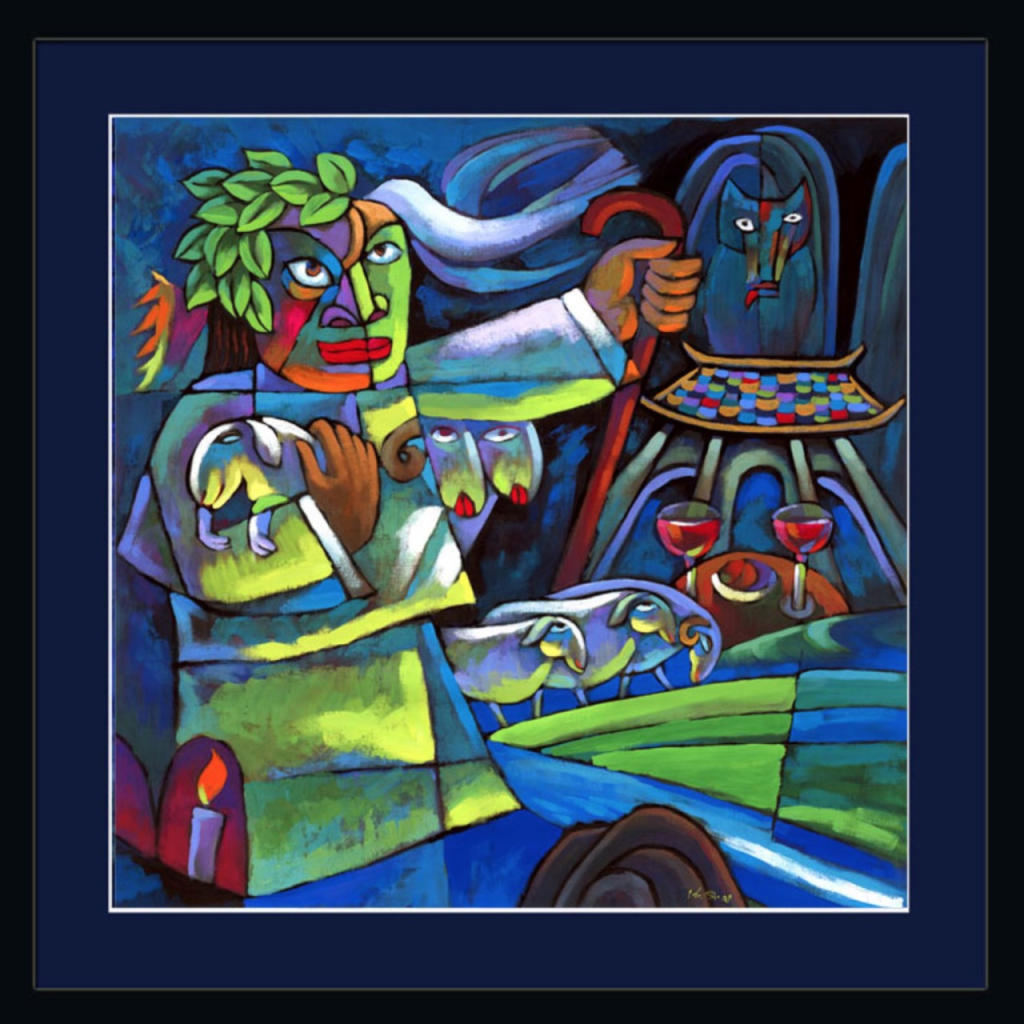
The Good Shepherd by He Qi

“Do not be afraid, little flock, for your Father has been pleased to give you the kingdom. Sell your possessions and give to the poor. Provide purses for yourselves that will not wear out, a treasure in heaven that will never fail, where no thief comes near, and no moth destroys. For where your treasure is, there your heart will be also.

“Be dressed ready for service and keep your lamps burning, like servants waiting for their master to return from a wedding banquet, so that when he comes and knocks they can immediately open the door for him. It will be good for those servants whose master finds them watching when he comes. Truly I tell you, he will dress himself to serve, will have them recline at the table and will come and wait on them. It will be good for those servants whose master finds them ready, even if he comes in the middle of the night or toward daybreak. But understand this: If the owner of the house had known at what hour the thief was coming, he would not have let his house be broken into. You also must be ready, because the Son of Man will come at an hour when you do not expect him.” (New International Version)

The most oft repeated command in all of Holy Scripture is, “Do not be afraid.” The Lord says it 365 times. It seems like we are meant to be reminded of this every day of the year.

The particular stating of the phrase by Jesus is in the context of money and possessions. Christ is telling his disciples to not fear about personal resources. Since we have a kingdom inheritance, we ought to freely give what we have to the poor without fear of being in need ourselves.

And it isn’t something we ought to procrastinate about – because the Lord could return at any time; and he doesn’t want to have to go looking for us underneath a pile of money and possessions in order to find us.

“Inaction breeds doubt and fear. Action breeds confidence and courage. If you want to conquer fear, do not sit home and think about it. Go out and get busy.”

Dale Carnegie

Fear is a real thing. Fear, at its core, is being afraid of losing what we have and getting hurt. Fear can be a helpful emotion, meant to protect us and keep us safe from harm. The problem, however, is that our fears can lead us to some unhealthy behaviors such as:

  • Vilifying another, afraid that others I don’t know or who are different from me might harm me, my family, or my community.
  • Hiding my emotions, afraid my weaknesses or failures will be exposed or exploited.
  • Serving others compulsively, afraid that I won’t have worth, meaning, or purpose without helping.
  • Achieving or winning, afraid that I will be irrelevant or unwanted, if I lose.
  • Smiling and being upbeat, afraid of facing and feeling the deep sadness within me.
  • Procrastinating projects, tasks, or conversations, afraid of being disliked or rejected.

“Fear is the path to the Dark Side. Fear leads to anger, anger leads to hate, hate leads to suffering.”

Yoda

All of those unhealthy practices keeps us at arm’s distance from the poor and needy. Getting close to poor folk creates fear with some people, that is, being afraid they might hurt me, or afraid that they will get my money.

“Fear keeps us focused on the past or worried about the future. If we can acknowledge our fear, we can realize that right now we are okay.”

Thich Nhat Hanh

Faith is the opposite of fear. Faith tethers itself to the promises of God and frees us to be generous. And faith allows us to confidently minister and build relationships with all kinds of people, especially the poor and needy.

One of the great preachers in church history, St. John Chrysostom (the fourth century Bishop of Constantinople) lived in a large city full of both rich and poor. He lamented the large class difference between them. He said this about poverty and wealth:   

“To deprive is to take what belongs to another; for it is called deprivation when we take and keep what belongs to others.  By this we are taught then when we do not show mercy, we will be punished just like those who steal.  For our money is the Lord’s, however we may have gathered it.  If we provide for those in need, we shall obtain great plenty. 

This is why God has allowed you to have more, not for you to waste on… indulgence, but for you to distribute to those in need….  If you are affluent, but spend more than you need, you will give account of the funds which were entrusted to you… for you obtained more than others have, and you have received it, not to spend it for yourself, but to become a good steward for others as well.”

“Whenever you see anyone longing for many things, esteem him of all persons the poorest, even though he possess all manner of wealth; again, when you see one who does not wish for many things, judge him to be of all persons most affluent, even if he possess nothing. For by the condition of our mind and spirit, not by the quantity of our material wealth, should it be our custom to distinguish between poverty and affluence.”

The point that Jesus makes of selling possessions and giving to the poor is not to elevate poverty over wealth – or the poor over the rich – but rather to lift generosity as a significant mark of the Christian life.

In the same way, the watchfulness Jesus commands is not an anxious hand-wringing anticipation of the apocalypse. Instead, it is an eager expectation of God’s final act of doing away with all injustice forever.

In other words, Jesus is extoling a faith that frees us to be generous; enables us to leave fear, worry, and anxiety behind; and that creates in us confidence about how the future is all going to shake-out in the end.

The Lord’s Table is meant to remind us that God is hospitable and generous.

Communion together is meant to show us that we are not alone in faith.

And the Eucharist allows us to celebrate a future we know is coming, that as often as we eat and drink the elements of bread and cup, we proclaim the Lord’s death until he returns to judge the living and the dead.

Like the feeding of the 5,000, there is plenty of bread for all – and the cup will never run dry. That’s because the Lord we serve is a God of abundance. And when we are near to such a generous God, we feel safe and secure, and are able to freely share what we have with others – without fear and without panicking that there isn’t enough. There’s always enough because God is enough.

Generous and gracious God, You came to honor the least, the forgotten, the overlooked and the misjudged. You came to give first place to the last, those left behind, and those who are misunderstood and undervalued. You came to give a warm welcome to the lost, the abandoned, and the destitute.

Help us to be your ears to listen to their cries. Help us to be your voice speaking out love and acceptance. Help us to be your feet walking beside those in need. Help us to be your hands to clothe, feed and shelter them. You came for the least, the lost and last of this world. Lord, hear our prayer. Amen.

Matthew 6:19-24 – Where Is Your Loyalty Placed?

Jesus said, “Do not store up for yourselves treasures on earth, where moths and vermin destroy, and where thieves break in and steal. But store up for yourselves treasures in heaven, where moths and vermin do not destroy, and where thieves do not break in and steal. For where your treasure is, there your heart will be also.

“The eye is the lamp of the body. If your eyes are healthy, your whole body will be full of light. But if your eyes are unhealthy, your whole body will be full of darkness. If then the light within you is darkness, how great is that darkness!

“No one can serve two masters. Either you will hate the one and love the other, or you will be devoted to the one and despise the other. You cannot serve both God and money. (New International Version)

Nobody can pursue two diametrically opposed commitments. 

Trying to live in both worlds of pursuing earthly treasure and heavenly treasure is not possible. 

Jesus has no place for any of his followers to ride the fence between those two worlds.

We cannot practice God’s will, and at the same time have a moonlighting job with the world.

As followers of God, we must have a single-minded loyalty to kingdom values. 

We are to do the will of God, from a right and sincere heart, and follow Christ’s teaching alone. 

We may give of ourselves, and give of our money, with sincerity, but if we walk away from that and believe the rest of my money, time, talents, and resources are mine to use as I want (since I fulfilled my duty) then we have a divided loyalty between the kingdom of God and the domain of darkness.

Jesus, as he typically does in the Gospels, used metaphors to communicate that we must have an unswerving loyalty to God’s kingdom values.

The Treasure Metaphor

Do not store up for yourselves treasures on earth. So, what are earthly treasures? 

Stuff, money, possessions, control, power, position, and recognition from others. 

You may rightly ask in response, “Is any of that really, in and of itself, wrong?” 

No. However, that’s not the real issue. The real question is this:

Do we use our earthly treasure to build heavenly treasure, or do we hoard earthly treasure for our own purposes apart from Christ’s kingdom values?

A man in a crowd said to Jesus, “Teacher, tell my brother to give me my share of what our father left us when he died.”

Jesus answered, “Who gave me the right to settle arguments between you and your brother?”

Then he said to the crowd, “Don’t be greedy! Owning a lot of things won’t make your life safe.”

So, Jesus told them this story:

A rich man’s farm produced a big crop, and he said to himself, “What can I do? I don’t have a place large enough to store everything.”

Later, he said, “Now I know what I’ll do. I’ll tear down my barns and build bigger ones, where I can store all my grain and other goods. Then I’ll say to myself, ‘You have stored up enough good things to last for years to come. Live it up! Eat, drink, and enjoy yourself.’ ”

But God said to him, “You fool! Tonight, you will die. Then who will get what you have stored up?”

“This is what happens to people who store up everything for themselves but are poor in the sight of God.” (Luke 12:13-21, CEV)

Earthly possessions are tools to be used. Jesus warns that we must not accumulate personal wealth, esteem, and success for the sake of placing ultimate security in money, but for advancing God’s kingdom values. 

Why do that? 

Because earthly treasure is temporary, and heavenly treasure is permanent. 

Heavenly treasure is righteousness; it’s right and just relationships. Humility, peace, grace, mercy, purity, and forgiveness are all relational values. The only thing that we will take with us when we die is relationships; it’s the only thing that’s permanent.

If I am genuinely committed to God’s kingdom, my most cherished values will be established by God. 

Whatever it is that we value, those values consume our thoughts and our efforts. In other words, what’s truly in our hearts directs our work.

And what we value derives from how we perceive our identity. For many Americans, we are defined primarily not as citizens or workers, but consumers. Jesus is neither advocating that we take vows of poverty, nor that we ought not to enjoy the good things in life. Rather, Jesus wants us to define where our loyalties truly lie.

The Light Metaphor

In the ancient world, the eye represented what you fixed your gaze on, or what your focus was. In our culture, we could replace the word “eye” with the word “goal.” The word “body” represents the entirety of one’s life.  So, we may interpret Christ’s words in this way: 

A goal is the focus of a life. If your goals are good, your whole life will be full of proper focus. But if your goals are bad, your whole life will be full of blindness. If then, the focus within you is only really blindness, how great is that darkness!

If the goals and dreams of life are toward earthly treasure, you will blindly move in that direction and your life will end up in disordered love and misplaced values. At death, you will have nothing to take with you because all the eggs have been put in the temporal basket.

The Slavery Metaphor

Jesus flatly stated that we cannot simultaneously serve God and money. Pick and choose. You must go one way or the other; there is no middle ground. 

The question Jesus is posing is: “Who’s your Master?” 

  • When deciding between two jobs, or two homes, or how to spend your time or your money, what set of values comes into play?… values that define me as a follower of Jesus?… or values that define me as an American consumer? 
  • Will I be a bondservant of Jesus, or a slave to credit card debt? 
  • Will I serve God, or serve the lifestyle that I believe I deserve?

Conclusion

None of us are immune from the temptations of all the world’s shiny things, of ambling into misdirected goals.  If you find that you are slave to the wrong god, then there is good news: There is an infinite storehouse of grace that flows from the very heart of God through Jesus Christ. 

If we confess our sins, he is faithful and just to forgive us our sins and cleanse us from everything we’ve done wrong. (1 John 1:9, CEB)

Choose this day whom you will serve.

Our Father in heaven,
may your name always be kept holy.
May your kingdom come
and what you want, be done,
    here on earth as it is in heaven.
Give us the food we need for each day.
Forgive us for our sins,
    just as we have forgiven those who sinned against us.
And do not cause us to be tempted,
but save us from the Evil One.

The kingdom, the power, and the glory are yours forever. Amen. (Matthew 6:9-13, NCV)

Luke 12:22-31 – Do Not Worry

Then Jesus said to his disciples: “Therefore I tell you, do not worry about your life, what you will eat; or about your body, what you will wear. For life is more than food, and the body more than clothes. Consider the ravens: They do not sow or reap; they have no storeroom or barn; yet God feeds them. And how much more valuable you are than birds! Who of you by worrying can add a single hour to your life? Since you cannot do this very little thing, why do you worry about the rest?

“Consider how the wild flowers grow. They do not labor or spin. Yet I tell you, not even Solomon in all his splendor was dressed like one of these. If that is how God clothes the grass of the field, which is here today, and tomorrow is thrown into the fire, how much more will he clothe you—you of little faith! And do not set your heart on what you will eat or drink; do not worry about it. For the pagan world runs after all such things, and your Father knows that you need them. But seek his kingdom, and these things will be given to you as well. (New International Version)

Worry is debilitating. It sucks the life out of us. And Jesus doesn’t want us to live that way. So, he makes it clear that we don’t have to.

Jesus cares about your whole life, not just the spiritual part. Your physical, mental, and emotional needs are also important to God. The Lord wants you and I to thrive and flourish in this life – free from worry.

In our anxiety about the future, Jesus guides us to embodying a non-anxious presence as we move from day to day.

Do Not Worry About Your Life

Worry is that sinking feeling you get whenever you face surgery; or your friend is depressed and suicidal; or someone close to you is diagnosed with major mental illness; or you lose a job, a spouse, a reputation, or a million other things that happen to us in this world. 

Jesus is not saying that we should never be concerned about the significant situations we face; what he is saying is that when we worry, we are displaying an inability to see beyond my own little world. We are exhibiting feelings about the future of which we know nothing about. And we are letting those feelings hinder us in our ability to serve God, express faith, love others, and function in well-being on a daily basis. 

We are to acknowledge those sinking feelings and face them, rather than ignoring them, wishing they would go away, or stuffing them down. Why acknowledge them?

Because Life Is More Than Food and Clothes

Whenever we experience worry about how the necessities of life are going to be met, let’s back up the truck and take a big picture view of what’s going on. 

We must remind ourselves that God cares for life itself, all of it. The Lord knows what it takes to live in this world and make it on this earth. If God cares about life, which is so valuable, he will sustain us with what we need to live that life.

Because God Cares for the Birds In Creation 

People are the apex of God’s creation. Since God cares for every other creature on this earth, and sustains their lives, the Lord will certainly care for us, as well. 

Worry begins to melt away, and replaced by faith, not when we try and work up feelings of trust, but when we take the time to observe creation – watching the birds and seeing how God takes care of them. 

Birds don’t worry; they just enjoy God’s providence. 

They work hard, but they aren’t farmers who do the work of planting and harvesting crops. Yet, God sustains them for what they need. So then, if God provides for small creatures that don’t even make plans to avoid starvation, how much more will the Lord sustain you!?

Because Worry Accomplishes Nothing 

Worry is like a rocking chair; it gives you something to do; but doesn’t get you anywhere – it’s not helpful.

Because God Cares for the Flowers and Grass In Creation 

God can dress the flowers better than we ever could dress ourselves (which is what your wife has been telling you for years). 

Jesus chooses flowers and grass because they clearly illustrate something that is not here for very long, as well as something that is fragile. 

The logic is from the lesser to the greater: If God cares for something as fragile and temporary as flowers and grass, how much more will he care for you, Jesus says, “you of little faith.”

Jesus links our worry with a small faith. 

Here’s how it happens: We have expectations in life about how things ought to go. If we have expectations based on God’s promises, then, when adverse circumstances come, we will tend toward responding in peace and with trust.

However, if we expect the future to turn out a certain way in order to be happy, then the worry sets in. As the worry seeps into the soul, we begin to take matters into our own hands. 

If the situation ends up not turning out how we want, then we start questioning if God is good, or not. We wonder if God really has our best interests at mind – or is even there, at all.

Tethering ourselves to specific outcomes, instead of specific promises, will come around to bite us in the backside every time. We must bank on God taking care of us, no matter the situation, with outcomes of divine design, and not our shortsighted half-baked human plans.

Do Not Worry About It 

Why?

Because Your Heavenly Father Knows What You Need 

Unlike other deities, who are aloof and do not pay attention to people, God always watches us and knows our every need. Fickle deities may or may not come through for people – which keeps their worshipers forever worrying about whether they’ll get their needs met, or not. 

To know God is to be a stranger to worry. Just as my girls used to jump from our stairway steps in a leap of faith – because they knew for sure that Dad was going to catch them – so also your heavenly Father is a trustworthy God.

Because the Necessities of Life Will Be Given To You

God’s business is to provide for our necessities; our business is to seek first God’s kingdom and righteousness.  The verb form of “seek” communicates a continuous action, that is, we are to keep on seeking. 

We are to continually seek God’s kingdom by:

  • Submitting to Christ’s lordship
  • Being obedient to kingdom values 
  • Praying, “your kingdom come”
  • Bringing all of life under the gracious authority of Christ
  • Dethroning wealth and possessions as our first pursuits, and instead, seeking heavenly treasure as defined by Jesus
  • Pursuing social reform, political reform, church reform, private and public institutional reform

We are to continually seek God’s righteousness by: 

  • Being peacemakers
  • Forgiving others
  • Showing mercy, instead of judgment 
  • Pursuing right relations with family members, co-workers, neighbors, and fellow parishioners 
  • Providing for the needs of others
  • Agitating for justice in every sphere of society
  • Proclaiming the gospel to all nations

For the believer, there is to be no room for worry because we are busy with kingdom business. Whenever we are diverted from seeking God’s kingdom and righteousness, worry is sure to set in.

May God’s richest blessings rest upon you, as you seek to value what God values, and as you seek the Lord with all your heart, mind, soul, and strength.