
Luke 6:1-5 – Lord of the Sabbath

One Sabbath Jesus was going through the grainfields, and his disciples began to pick some heads of grain, rub them in their hands and eat the kernels. Some of the Pharisees asked, “Why are you doing what is unlawful on the Sabbath?”

Jesus answered them, “Have you never read what David did when he and his companions were hungry? He entered the house of God, and taking the consecrated bread, he ate what is lawful only for priests to eat. And he also gave some to his companions.” Then Jesus said to them, “The Son of Man is Lord of the Sabbath.” (New International Version)

We Christians tend to be rather hard on the Pharisees. Yet, most of them, much like us, were just trying to uphold their understanding of God’s commands. They wanted to do God’s will. And so did Jesus.

The problem in the New Testament Gospels is that Jesus and some of the Pharisees (not all of them, e.g., Nicodemus) were at loggerheads about how to view and interpret the Law. Jesus wanted them to see the purpose of the law, the heart and spirit of the law, and who was the lord of the law. For Jesus, many of the Pharisees were spiritually blind. They either would not or could not discern who Jesus was and what he was all about.

So, when we refer to spiritual blindness, let’s have a bit of humility about it. Although for the Apostle Paul, a dramatic event happened in which the scales of blindness (both physically and spiritually) fell from his eyes, most folks have a gradual ability to see, an awakening which requires a process of time and growing awareness. This was true of Christ’s original disciples. They believed, yet their faith was an extended process over three years. It wasn’t until after Christ’s resurrection and Pentecost that their faith became complete.
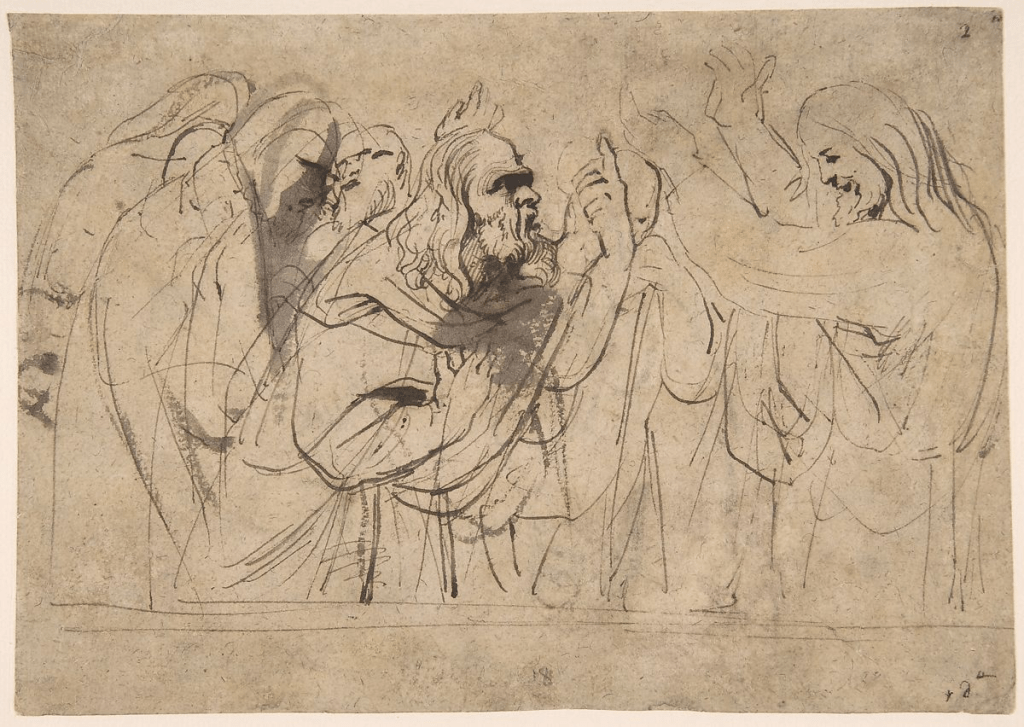
Christ and the Pharisees by Belgian artist Anthony van Dyck (1599-1641)

Jesus didn’t like it that those who should know better, those persons for whom the light of God’s truth ought to be clear and present, were in darkness. When leaders are blind, then we have the blind leading the blind, and nobody finds the door of God’s kingdom.

Many of the Pharisees in the New Testament, most of the heretics in the early church, and some of the spiritual phonies of today are actually not charlatans, that is, they are not deliberately trying to deceive or lead others astray; they are not trying to keep people out of God’s kingdom – they think they are doing the right thing when they are actually leading others astray. 

One of the eye-opening realities I discovered, when I first began studying church history, is that the early heresies condemned at the church councils were doctrines promoted and put forth by men who were not evil bad people – they were just sincerely misguided. They thought they were helping the church better understand the nature of God and Christ, when in fact they were promoting unhealthy doctrine – unintentionally closing the door of God’s kingdom to some people. 

And later when I worked on my master’s thesis in nineteenth century American religious history, I read hundreds of sermons from southern preachers before the American Civil War. I learned that they had a biblical defense for the institution of black chattel slavery. Many of them were pastors of large churches and led many people to Christ, that is, white people. They were slamming the door of God’s kingdom in the faces of African-Americans, and teaching others to do the same.

We can unwittingly slam the door of God’s kingdom in the faces of people when we say God’s grace is for all and then turn around and avoid particular people; or whenever we have explicit written statements or rules that exclude people from serving or being served; or when we bind people to human traditions and practices instead of Holy Scripture. 

The seven deadly words of the Church, believing it is doing the Lord’s will, is, “We’ve-never-done-it-that-way-before… We cannot have somebody out in the field picking heads of grain and rubbing them in their hands. That’s reaping; it’s work; and you can’t do that on the Sabbath.”

Never mind that there are people trying to eat or attempting to enter the kingdom of God. So, we lose sight that the Law was meant to benefit people, to help them thrive and flourish, to lead them into the grace and knowledge of God. The Law gets turned on its head by becoming a heavy burden to carry instead of an easy yolk which brings freedom.

No matter the issue, the last word to everything is grace, God’s grace in Jesus Christ.  

Just as the priest in David’s day was gracious in giving him and his men the consecrated bread meant only for the priests, so Jesus was gracious in giving himself, the Bread of Life, for the benefit of the whole world.

For the Christian, the Law points to Christ, who is the Law’s fulfillment. Now, we carry one another’s burdens, and in doing so, we fulfill the Law of Christ.

O God the Holy Spirit, Sanctifier of the faithful: Make us holy through your abiding divine presence. Enlighten the minds of your people more and more with the light of the everlasting Gospel. Bring erring souls to the knowledge of our Savior Jesus Christ; and those who are walking in the way of life, keep them steadfast in faith to the end.

Give patience to the sick and afflicted and renew them in body and soul. Guard those who are strong and prosperous from forgetting you. Increase in us your many gifts of grace and make us all fruitful in good works. This we ask, O blessed Spirit, whom with the Father and the Son we worship and glorify, one God, world without end. Amen.

Hebrews 12:3-17 – Don’t Let Bitterness Take Over

Think about Jesus, who endured opposition from sinners, so that you don’t become tired and give up.

You struggle against sin, but your struggles haven’t killed you. You have forgotten the encouraging words that God speaks to you as his children:

“My child, pay attention when the Lord disciplines you.
Don’t give up when he corrects you.
The Lord disciplines everyone he loves.
He severely disciplines everyone he accepts as his child.”

Endure your discipline. God corrects you as a father corrects his children. All children are disciplined by their fathers. If you aren’t disciplined like the other children, you aren’t part of the family. On earth we have fathers who disciplined us, and we respect them. Shouldn’t we place ourselves under the authority of God, the father of spirits, so that we will live? For a short time, our fathers disciplined us as they thought best.

Yet, God disciplines us for our own good so that we can become holy like him. We don’t enjoy being disciplined. It always seems to cause more pain than joy. But later on, those who learn from that discipline have peace that comes from doing what is right.

Strengthen your tired arms and weak knees. Keep walking along straight paths so that your injured leg won’t get worse. Instead, let it heal.

Try to live peacefully with everyone, and try to live holy lives, because if you don’t, you will not see the Lord. Make sure that everyone has kindness  from God so that bitterness doesn’t take root and grow up to cause trouble that corrupts many of you. 

Make sure that no one commits sexual sin or is as concerned about earthly things as Esau was. He sold his rights as the firstborn son for a single meal. You know that afterwards, when he wanted to receive the blessing that the firstborn son was to receive, he was rejected. Even though he begged and cried for the blessing, he couldn’t do anything to change what had happened. (God’s Word Translation)

Bitterness begins with a seed of resentful anger…

it steadily grows within the soil of antagonism…

then, buds of hostility pop out…

and a devastating crop of corruption, injustice, chaos, and trouble feeds the community with death.

A bitter spirit doesn’t appear overnight.

Something happens, an event for which a person neither wanted nor expected.

And life becomes more difficult and sad.

A change or a loss occurred. It could be anything: a spouse walks out and asks for divorce; a job transfer or termination happens without any warning or discussion; estrangement occurs between friends; the house burns down; a bankruptcy looms in the near future; it’s hard to make ends meet; items are stolen; assault, abuse, and ridicule violate a person, family, or community.

These and a thousand other events happen in this old fallen world. It makes us angry, and rightly so. And yet, if that anger stews within us for too long, and grudges are nursed and coddled, it turns eventually into the bitterness which gives us gangrene of the soul. Then, like a nasty weed, the bitterness spreads and takes over the garden.

Don’t let bitterness take over your garden.

The ancient Hebrew Christians were in danger of losing their resolve and reneging on their commitment to Christ. Their circumstances had been so adverse, for so long, that they just did not have any more fight in them to keep going. 

The believers were losing their faith. They began holding onto grudges and letting go of their spiritual commitment; instead of holding fast to perseverance and discarding their resentments toward others, and even God.

Yes, life was a challenge. But, no, it wasn’t because God didn’t love them or was in some way just mean or capricious. The struggling believers were invited to see their adversity as education by correction in the school of hard knocks. It was a class in faith formation, and many of them were failing it.

God loves us enough to not always make everything a bowl of Cap’n Crunch or a plate full of bacon. The Lord is going to dish up some broccoli and brussels sprouts and expects us to eat it – even if we don’t like it or don’t want to. We aren’t going to have a healthy faith apart from it, and God is just being a good Father.

It isn’t what happens to us that matters; it’s how we interpret what happened to us that makes all the difference.

Hard unwanted circumstances will either make us bitter, or better. They will never leave us the same.

The path to perseverance, healthy interpretations, and keeping the seed of bitterness away is through keeping our minds on Jesus and being kind to one another. Antagonism cannot grow in the soil of grace and mercy.

Sometimes we might forget that Jesus didn’t have it so easy on this earth. He faced ridicule, insults, hardship, and was not born with a silver spoon in his mouth. Eventually, he was tortured and killed, having done nothing wrong and everything right. And there was absolutely no bitterness in his heart about any of it.

If that was the path for our Lord, then it is silly to think that, as Christ’s followers, we should avoid suffering and hardship. 

So, think about Jesus.

Consider him who endured suffering without resentment.

Don’t give up.

Keep your head and your heart in the game.

Feelings of resentful anger, giving up, and getting back at others only brings self-harm and makes life unnecessarily difficult for everyone. Whenever such feelings arise, it is our inner person’s warning that it is time to retreat with God and get a divine perspective on your situation.

Jesus, you are the Suffering Servant who has gone before us and secured deliverance from sin, death, and hell. In the scope of eternity, it is a small thing for me to live for you and face any kind of ridicule and hardship it might bring to me. I only ask to be in solidarity with you in all things. Amen.

Luke 19:45-48 – Jesus Cleans House

A bronze panel of Jesus chasing the merchants from the Temple by Lorenzo Ghiberti (1378-1455)

When Jesus entered the temple courts, he began to drive out those who were selling. “It is written,” he said to them, “‘My house will be a house of prayer’; but you have made it ‘a den of robbers.’”

Every day he was teaching at the temple. But the chief priests, the teachers of the law and the leaders among the people were trying to kill him. Yet they could not find any way to do it, because all the people hung on his words. (New International Version)

Jesus seems a bit like an actor in an old western movie. He’s the sheriff who drifts into town, sizes up the situation, shoots up the bad guys, defends the women and children, and cleans up the town. 

It’s a side to Jesus that might surprise some.

Jesus is no simple one-dimensional person, as if he’s always calm and picking dandelions. Christ is fully human and fully God – a complex person full of both human and divine anger. Today’s Gospel lesson reminds us that Jesus defies stereotyping, and that we need to see a fuller profile of who he is, and what he is up to.

Jesus is not only the merciful servant who graciously heals at the temple; but he is also a mighty judge who is intolerant of unjust systems and cleans house. 

Because Jesus is superior to everything, he is not some Being that we can domesticate for our own personal use. He did not come to this earth as some sort of spiritual vitamin supplement, or to be on call 24/7 in order to bail us out when we need it, or help us get ahead in life.

Instead, zeal for his Father’s house consumes Jesus. (John 2:13-17)

Jesus driving the merchants out of the Temple by Raymond Balze (1818-1909)

Christ sought to please the Father. Jesus oversees what the church and Christians are supposed to be. 

It’s our task to conform to Christ, and not the other way around. 

That happens whenever we let Jesus be the sheriff who drives out our sin, and, at the same time, the town doctor who brings the needed healing to our lives. 

Jesus cleaned house by attacking the system he saw operating.

It was Passover, the time when all pious Israelites made the pilgrimage to Jerusalem. Cattle, sheep, and doves were used for sacrifices. And the only place where those sacrifices were made was at the Temple in Jerusalem.  This meant that anyone wanting to worship God from outside of Jerusalem would have to do some traveling. 

Over time, a system was set up: Vendors established kiosks which lined the Temple courts; and they sold animals for the required sacrifices, as a matter of convenience. 

Since there were thousands of folks who came from a long way, often from outside of Israel, they brought their foreign currency with them, and it could be exchanged at the tables set up by money-changers.

Perhaps that all sounds practical. A little capitalism which provides a service for the people doesn’t seem all bad. So, what’s the problem? 

Jesus didn’t have a problem with capitalism per se; his problem with the whole system is that it should not even exist – these guys should not be in the Temple, at all! 

Jesus attacked the system and made a western movie scene out of it because the vendors and money-changers, even if using sound business practices (which they weren’t) should not even be there. For Jesus, it trivialized the Temple and took away from its intended purpose as a house of prayer for all nations.

Here’s how the system was supposed to work:

Coming to the Temple from outside of Jerusalem was never intended to be easy or convenient.

Making the pilgrimage to Jerusalem was supposed to be difficult. For the past year, since the last Passover, a family raised a newborn lamb in their house. Parents and children all took part in caring for it.

Then, when it was time, they all journeyed to Jerusalem together, taking turns carrying the year old lamb over their shoulders. Everyone knew what was coming. Their precious lamb, now a cherished part of the family, would be given in sacrifice at the Temple.

It was all a very powerful reminder of sin’s cost and how terrible it truly is.

Entering Jerusalem with no animal, and only money to buy one, is a cheap facsimile of real worship.

It misses the entire point of the system. It hinders people from genuinely connecting with God through prayer.  And Jesus will not put up with it – to the point of violently driving the whole system out of the Temple.

Jesus didn’t mess around with the sinful system. He didn’t politely ask the money-changers to move their tables somewhere else; he didn’t strike a deal with those selling animals to market them at cost. No. Instead, he went all town sheriff on them because the whole system was a blasphemous act against the right and true worship of God.

It has been the sin of the Church, through the centuries, to find ways of doing ministry and worship by not actually doing it (e.g., selling indulgences). 

We might feel good by simply attending a worship service, or offering some obligatory prayers, and giving money without having done anything to meaningfully connect with God. Our devotion may not be toward bringing something of ourselves to sacrifice by using our spiritual gifts and laying our lives down for others. 

It’s really a heart issue. For example, we might rightly give to missionaries or mission projects. Yet, if we give without any thought to doing missions ourselves and being missional people, then we are in grave need of having a clean house by overturning the tables in our hearts. 

17th century Ethiopian depiction of Christ cleansing the Temple

Jesus cleaning house was not an end in itself; he did it so that the Temple could be used for its intended purpose: A house of prayer. A place of healing. A gathering of collective praise to God.

Whenever an existing system is challenged, there will be those who push back because they benefit from the way things are.

The religious leaders were incensed by Christ’s systemic change. The behavior of Jesus challenged their authority, and they were angry about losing some of their power – not to mention jealous and envious that the people hung on his every word.

Jealousy rots the bones. Envy and selfish ambition accompany every evil practice and are behind every evil system. (Proverbs 14:30; James 3:14-16)

The real culprit behind the Temple system, as well as our own conflicts and disagreements is our selfish anger, our abject jealousy that someone else is receiving something which should be mine, and our insidious envy of wanting what another has.

Jesus knew he would upset and anger the religious leaders. But he cared enough about the proper place of worship that he attacked the contrived Temple system that fed on obscuring what real sacrifice was. Christ was willing to take on the establishment and reestablish a house of prayer for all people.

The way for us has been made clear through the death of Christ. Jesus has removed the old system and replaced it with the new. (Hebrews 8:13)

Therefore, we ought to be a beacon of hope for all who are coming to God and desire to offer their sacrifice of service or praise. We must eliminate any system, rule, or practice that eviscerates true worship.

May we follow the Lord Jesus by being active and proactive in making the way clear for others to come to God. And the first step to doing so is by having God clean house on our own hearts.

It’s what a good deputy sheriff would do.

Create in me a clean heart, O God,
    and put a new and right spirit within me.

The sacrifice acceptable to God is a broken spirit;
    a broken and contrite heart, O God, you will not despise. Amen.

Matthew 24:15-27 – Everything Will Change

“The prophet Daniel said that the disgusting thing that will cause destruction will stand in the holy place. When you see this (let the reader take note), those of you in Judea should flee to the mountains. Those who are on the roof should not come down to get anything out of their houses. Those who are in the field should not turn back to get their coats.

“How horrible it will be for the women who are pregnant or who are nursing babies in those days. Pray that it will not be winter or a day of rest, a holy day, when you flee. There will be a lot of misery at that time, a kind of misery that has not happened from the beginning of the world until now and will certainly never happen again. If God does not reduce the number of those days, no one will be saved. But those days will be reduced because of those whom God has chosen.

“At that time don’t believe anyone who tells you, ‘Here is the Messiah!’ or ‘There he is!’ False messiahs and false prophets will appear. They will work spectacular, miraculous signs and do wonderful things to deceive, if possible, even those whom God has chosen.Listen! I’ve told you this before it happens. So, if someone tells you, ‘He’s in the desert!’ don’t go out looking for him. And don’t believe anyone who says, ‘He’s in a secret place!’ The Son of Man will come again just as lightning flashes from east to west.” (God’s Word Translation)

Midwest American summers can be brutally hot and humid. And the winters can be terribly frigid and full of snow. 

Having lived in various university towns and worked with many college students, every Fall there are always new international students, and students from the American Deep South, that have never experienced a Midwest winter and snow. 

I might tell them, repeatedly, of the need for a sturdy winter coat before the snow flies. Yet, having never known sub-freezing, let alone sub-zero temperatures, it’s difficult to imagine such cold when the weather is warm. 

There is little belief that everything around them will change in a few short months to the point that it will be felt down to the bone.

At the coming of winter, I, or someone else, helped ensure they had a suitable coat. Even then, those students often bodily shake all winter and never take their scarves off.

Since none of us have yet experienced it, it might be difficult to imagine that someday Christ will return to judge the living and the dead. 

So, in order to help the disciples to grasp the coming future, Jesus told them to use discernment. Although it may seem improbable now, a time is coming which will be loaded with cosmic and cataclysmic changes. 

Sometimes, even for myself who has lived through many hard winters, it’s incredible to know that the landscape, as it is right now, will be completely different in another six months.

Seasons come and go. Eventually, the sky and the earth as we know it now will pass away. However, the words and ways of Jesus Christ will endure for all time. 

If we are attentive and alert, we will be ready. We will have a warm winter parka on hand.

For now, it means taking off the old clothes of fear, insecurity, hopelessness, and hate; and putting on the new clothes of righteousness, peace, and love in the Holy Spirit. 

You may not think winter is coming. But it is. It may even be here sooner than you believe.

Do you feel that chill in the air?

Almighty and everlasting Father, we long for the coming of your kingdom in Jesus Christ our Lord. We lament before you the signs that your kingdom has not yet come in its fullness. The signs of brokenness and divisions, oppression and abuse, poverty and loneliness, are everywhere present in this present world.

So, we cry out from the depths of our being for you to come and bring us humility, wisdom, discernment, comfort, and hope. Dispel the shadows of the night and turn our darkness into light, through Jesus Christ, your Son, our Lord who with you and the Holy Spirit reign as one God, now and forevermore. Amen.