Revelation 3:1-6 – Remember

Sardis
Ruins from the ancient city of Sardis, the capital of the kingdom of Lydia, in present day western Turkey.

“To the angel of the church in Sardis write:

These are the words of him who holds the seven spirits of God and the seven stars. I know your deeds; you have a reputation of being alive, but you are dead. Wake up! Strengthen what remains and is about to die, for I have found your deeds unfinished in the sight of my God. Remember, therefore, what you have received and heard; hold it fast, and repent. But if you do not wake up, I will come like a thief, and you will not know at what time I will come to you.

Yet you have a few people in Sardis who have not soiled their clothes. They will walk with me, dressed in white, for they are worthy. The one who is victorious will, like them, be dressed in white. I will never blot out the name of that person from the book of life but will acknowledge that name before my Father and his angels. Whoever has ears, let them hear what the Spirit says to the churches. (NIV)

When Christians think of biblical epistles (letters) to churches, the Apostle Paul might immediately come to mind. Yet, contained within the first three chapters of Revelation are seven succinct letters to seven different churches.  What makes these short bursts of exhortation so powerful is that they come from Jesus himself.  Yes, that Jesus – the Lord Jesus Christ, the head of the church.  So, it seems to me that Christ’s observations about the church carry more weight than anybody else’s thoughts.

And the thoughts of Christ were about how far the church was from completing the work of God. So, Jesus gave a pointed admonition, almost like a parent trying to awaken a teenager in the morning. “Wake up!” said Jesus because he found the church’s obedience incomplete and lacking strength. If this were the Apostle Paul talking, he would likely have framed it this way: “You have sinned and fallen short of the glory of God.”

Our Lord went directly to the heart of the church’s life… that is, death.  The stark reality is that these statements from Jesus remain penetrating and relevant for today’s church. So, what is to be done about the situation of spiritual death and dryness in the church?  Jesus did not leave the church hanging but in a few compact words let them know exactly what they are to do to remedy their spiritual malady: Remember. Obey. Repent.

The Seven Churches of Asia - York Minster
The Seven Churches of Asia, stained glass window in York Minster, England.

Sometimes, if not many times, we may tend to forget the things we need to remember and remember the things we are to forget. We are to follow God in his pattern of remembering and forgetting. God has said:

I wipe away your sins because of who I am. And so, I will forget the wrongs you have done. (Isaiah 43:25, CEV)

I will forgive their wrongdoing and never again remember their sins. (Jeremiah 31:34, CEB)

I will forget their sins and never again remember the evil they have done. (Hebrews 10:17, ERV)

When it comes to those who have wronged us, we are to emulate God’s grace, mercy, and kindness through forgiveness. To “forget” does not mean performing a personal lobotomy but simply not to hold an offense against another by continually bringing it to mind. On the other hand, God remembers his promises to his people. Likewise, we are to constantly bear in mind what God has put before us to remember:

For I received from the Lord what I also handed on to you, that the Lord Jesus on the night when he was betrayed took a loaf of bread, and when he had given thanks, he broke it and said, “This is my body that is for you. Do this in remembrance of me.” In the same way he took the cup also, after supper, saying, “This cup is the new covenant in my blood. Do this, as often as you drink it, in remembrance of me.” For as often as you eat this bread and drink the cup, you proclaim the Lord’s death until he comes. (1 Corinthians 11:23-26, NRSV)

We are to have an abiding remembrance of the Lord Jesus, the very person who spoke to the church hundreds of years ago. It is in those times when we become distressed that we must center our memory on Christ:

We must focus on Jesus, the source and goal of our faith. He saw the joy ahead of him, so he endured death on the cross and ignored the disgrace it brought him. (Hebrews 12:2, GW)

Remembering Jesus Christ sets us on the path to fulfilling the work of God and completing that which has been given us to do. This is precisely why I choose to follow the Church Year and remember time by having it centered around the life and ministry of Jesus.

Always think about Jesus Christ. He was brought back to life and is a descendant of David. This is the Good News that I tell others. (2 Timothy 2:8, GW)

I have been a constant example of how you can help those in need by working hard. You should remember the words of the Lord Jesus: “It is more blessed to give than to receive.” (Acts 20:35, NLT)

Let us remember together in prayer:

Awesome Lord Jesus, your words penetrate to the core my being.  Strengthen me by the continuing presence of yourself through the Holy Spirit so that my every thought, word, and deed is done in your holy Name. Kindle in my heart a vision of your love and shine the light of your victory over sin, death, and hell over this dark world. Continually take me to yourself; keep me in your wounds and mindful of your presence so that I shall fulfill all the will of God for my life through your divine enabling. Amen.

Matthew 16:21-28 – The Need for Sacrifice

Welcome, friends. Simply click the video below and let us consider together the words of Jesus.

You may also view this video at TimEhrhardtYouTube

For a response in song, click Take My Life and Let It Be arranged by Hymn Charts.

And, also click Jesus, I My Cross Have Taken sung by RYM Worship.

May the Lord bless you
    and keep you.
May the Lord smile down on you
    and show you his kindness.
May the Lord answer your prayers
    and give you peace. Amen.

The Need for Sacrifice

Man of Suffering by Georges Rouault, 1942
Ecce Homo by French artist Georges Rouault, 1942

Christ’s Church is not so much made up of saints or sinners as it is made up of saintly sinners and sinning saints.  The Church is at the same time both beautiful and ugly, holy, and wicked, full of faith and full of fear.  The Body of Christ is the place of spiritual sensitivity as well as a den of depravity.  So, anyone searching for a squeaky-clean church on a nice upward path of success with everything done to perfection and where no one ever gets hurt or unhappy… it does not exist; and, it never did.

Jesus stands alongside his imperfect people, despite their faults and egotism.  Jesus intimately knows our damaged emotions and our open putrid spiritual abscesses.  Yet, he treats us with mercy because he never tires of rehabilitating and reforming his Church.

Christ’s disciple, Peter, is the poster child for all the mixed motives and imperfect following of God we experience. For example, Peter stepped out of the boat in great faith and walked on the water, only to begin sinking because of his great fear. It was Peter who made a bold and right confession of faith, and then turned around here in our story for today and bought into Satan’s agenda. And Jesus was right there next to Peter all the way. Christ both rebukes and loves, all the while never abandoning us, but always working in and through us to accomplish his kingdom purposes.

Here is what we need to know or be reminded of today: Following Jesus involves pain and sacrifice because we live in a broken mixed-up world, and, on top of it, Christ’s Church is still imperfect and in the process of becoming holy.  If we will admit it, we are all like Peter – a little devil who needs to get in line behind Jesus. (Matthew 16:21-28)

Peter Admonishes Jesus
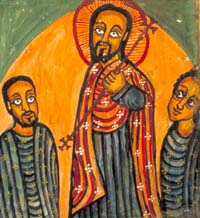
Peter Admonishes Jesus by Unknown artist

We all, at times, get frustrated and/or disgusted with the whole church thing.  We can whine and complain and even avoid it.  Or, we can commit to taking up our cross, and give our lives for Jesus Christ.  We can choose to put love into the church where love is not, even when we do not feel loved. Priest and professor, Ron Rollheiser, once gave the following analogy about staying together around Jesus:

Imagine that the family is home for Christmas, but your spouse is sulking, you are fighting being tired and angry, your seventeen year old son is restless and doesn’t want to be there, your aging mother isn’t well and you are anxious about her, your uncle Charlie is batty as an owl… and everyone is too lazy or selfish to help you prepare the dinner.  You are ready to celebrate but your family is anything but a Hallmark card.  All their hurts and hang-ups are not far from the surface, but you are celebrating Christmas and, underneath it all, there is joy present.  A human version of the messianic banquet is taking place and a human family is meeting around Christ’s birth….

In the same way, here we are, the community of the redeemed. We gather in our imperfect way, a crazy mix of sinner and saint.  But we gather in and around Jesus – and that makes all the difference.  There is a reason we are here on this earth, a reason much bigger than all our dysfunctional ways and dyspeptic attitudes. Jesus Christ is building-up the people of God and he will keep doing it until the end of the age. In other words, Jesus is not quite finished with us yet; we still have some things to learn about the need for sacrifice.

The need for sacrifice by Jesus. (Matthew 16:21-23)

Jesus stated openly and in detail what must happen.  It was necessary for Christ to suffer deeply and die a cruel death; it was God’s will and plan. Yet, good ol’ Peter was not down for this plan, at all.  He took Jesus aside and rebuked him, believing him to be off his rocker for even suggesting such a terrible scenario.  Jesus, however, turned the tables on Peter and rebuked him right back.  Essentially, what Jesus said is that being Christ-centered without being cross-centered is satanic.

The error of Peter was that he presumed to know what was best for Jesus. He believed the suffering of the cross would “never” happen. Peter’s perceptions were dim and limited; he did not clearly see how broken the world really is and how much it would take to heal it. Jesus needed to offer himself as a sacrifice for the sins of the entire planet.

Crucifixion of Christ by Georges Rouault, 1936

Sometimes, like Peter, we might think that the way I see and the way I perceive is the way things really are, or, at least, how they should be. Peter had been walking with Jesus for a few years, watching and enjoying his ministry of teaching, healing, and extending compassion.  It was all good for Peter, and, therefore in his mind, it should not change. Peter wanted to hold this moment forever. After all, why try and fix something that is not broken? Oh, but broken the world is – so much so that it required the ultimate sacrifice.

Just because it was good for Peter did not mean it was good for everybody or should always be this way.  If Peter were to have his way, we would all be in hell right now; it would not have been good for us.  We, like Peter, are finite humans with limited understanding and perceptions.  We can easily slip into a satanic mode of believing that because something is going fine for me that everyone else is doing okay, too.  I like it, I want it, so what is the problem?

The problem is that we too easily look at life through narrowly selfish lenses, and then cannot see other people’s needs; cannot perceive the lost world around us with any sense of reality; cannot see that Jesus has an agenda very different from our own.  Our limited perceptions come out in saying things like, “Oh, she is just depressed because she is avoiding responsibility.”  “People on government welfare are lazy.”  “He’s addicted because he doesn’t want to help himself.”  “They’re demonstrating on the streets because they are a bunch of malcontents.” These, and a legion of statements like it, betray a satanic worldview devoid of grace and a compulsive need to find blame, believing that if there is personal suffering there must be personal sin.

In truth, we are all part of one human family, and we are all in this together; one person’s joys are our joys; one person’s struggles are our struggles. We really are our brother’s keeper. The detachment we can have toward other human beings is completely foreign to the words of Jesus.  The Christian life involves suffering, and Jesus invites us to follow him in his way of sacrifice.

The need for sacrifice by the followers of Jesus. (Matthew 16:24-28)

There is a way to reverse demonic thinking.  Jesus issues an invitation to practice self-denial, to fall in line behind him, and walk with him in his suffering.  Self-denial is not so much doing something like giving up sweets for Lent as it is giving up on ourselves as our own masters.  It is the decision to make the words and ways of Jesus the guiding direction for our lives.  It is the choice to quit holding onto the way I think things ought to be, and to take the time to listen to Jesus.

The logic of Jesus is relentless.  Life comes through death, so, we must give up our lives to find them.  It does us no good to adulterate our lives by serving the gods of success and perfectionism.  Jesus invites us to quit our moonlighting job with the world and go all in with him.  Only in this way will we truly find life.

Jesus was saying more than just submitting to suffering – we are to embrace it. In doing so, we will find reward and joy.  For those familiar with this path, they can tell you that suffering is a blessing because they have found the true purpose and meaning of life.

Crucifixion with Lamp by Colin McCahon 1947
Crucifixion with Lamp by New Zealand artist Colin McCahon, 1947

Few people have suffered as much as the nineteenth-century missionary medical doctor to Africa, David Livingstone.  He was a pioneer explorer who opened the interior of Africa to the outside world.  He had two reasons for doing so: To be able to take the good news of Christ’s suffering to the African people; and, to open Africa to legitimate trade so that the illicit slave trade would end.

Dr. Livingstone’s hand was once bitten and maimed by a lion; his wife died while on the mission field; he was most often alone on his travels; the one house he built was destroyed in a fire; he was typically wracked with dysentery and fever, or some other illness in the jungle.  Someone once commented to him that he had sacrificed a lot for going in the way of Jesus. Livingstone’s response was, “Sacrifice? The only sacrifice is to live outside the will of God.”  When asked what helped him get through so much hardship, he said that the words of Jesus to take up his cross were always ringing in his ears.

We may believe we must watch out for ourselves; that we need to push for our personal preferences; that if I accept this invitation to follow Jesus in the way of self-denial I will be miserable and people will walk all over me. Such thoughts are demonic whispers in our ears.

There are two ways of thinking and approaching the Christian life: There is the way which believes success, perfection, and a pain-free life is the evidence of God’s working; while the other way believes that suffering is right and necessary to connect with God and to be in solidarity with those who suffer.

Suffering, rejection, and execution did not fit into Peter’s church growth plan or factor into his view of Messiah. So, I will say it plainly: We do not exist only for ourselves. We do not exist to be a spiritual country club.  We do exist to follow Jesus in his path of sacrifice and suffering for a world of people who desperately need to know the grace of forgiveness and the mercy of Christ. Jesus died.  We are to die to ourselves. Christ lives; so, we are to live a new life.  In God’s upside-down kingdom, joy comes through suffering. We are to follow Jesus as the mix of sinners and saints that we are.

Peter eventually learned his lesson from Jesus. After Christ’s resurrection and ascension, Peter caught fire with courage and boldness – which landed him in hot water with the Jewish ruling council. As a result, he was severely whipped and flogged and told to keep in line. Peter’s response demonstrates how far he had come. He left the experience rejoicing that he had been counted worthy of suffering disgrace for the Name of Jesus Christ. (Acts 5:41)

May dear old Peter’s spiritual tribe increase.

Matthew 8:14-17 – A Changed Life

Jesus Heals Peters Mother In Law
A mosaic of Jesus healing Peter’s mother-in-law, from a Byzantine Church, c.1100 C.E.

When Jesus came into Peter’s house, he saw Peter’s mother-in-law lying in bed with a fever. He touched her hand and the fever left her, and she got up and began to wait on him.

When evening came, many who were demon-possessed were brought to him, and he drove out the spirits with a word and healed all the sick. This was to fulfill what was spoken through the prophet Isaiah:

“He took up our infirmities
    and bore our diseases.” (NIV)

One of the great realities we run headlong into with the New Testament Gospels is that Jesus has the authority to heal and transform the world… and me. Forty-one years ago, today, I experienced the reviving and revolutionizing work of Jesus Christ. I realize not everyone has a specific time they can point to when God does something miraculous, and I also do not expect that everyone’s experience of the divine must conform or be like my own. No, my encounter with God was just that, mine alone. Yet, I hope you find some encouragement and solace in my brief story.

I was probably the least likely person to become a follower of Jesus, let alone to have shown any promise toward the pastoral and religious life. I had serious reservations about the veracity of faith, the relevance of church, and the importance of religion. Although, outwardly, my family made attending our local church mandatory, inwardly, I felt the entire Christianity thing to be boring, irrelevant, and contrived. I was much more likely to behave passive-aggressively than piously.

But I began to rethink and revisit my doubts and epistemic assumptions about all things God and Christianity. The love of Christians around me stirred the internal upheaval. I had come to view the world as a cruel place and saw other people through jaded lenses. Relationships were for me a necessary evil. So, when love and grace entered my orbit, it threw me into sort of an existential angst. Having come to settled-thinking in my understanding of a dark world and having learned to navigate it with the tools of sarcasm and skepticism, genuineness and authenticity were a complete monkey wrench in my cosmology.

To put the whole matter succinctly, Jesus touched me. My small sin-sick heart was healed and enlarged. I walked away completely changed. I cannot accurately say what happened any more than I could tell you how a transplant doctor puts a new heart into the chest of a person. I can only speak to the results: newfound joy instead of nihilism; new desires to bless others and the world instead of looking for ways to disengage from people; new speech and wanting to edify and encourage people instead of sly words of putting others down; and, perhaps most surprising of all (to me) a thoroughly new desire to glorify God and enjoy him forever.

Pastor Tim

The love of God in Christ made all the difference for me – and still does, all these years later. I stand in a long Christian tradition of outsiders and misfits entering the kingdom of God through spiritual metamorphosis – going all the way back to today’s story of Jesus healing and transforming.

In the first century, Jewish women were not allowed as far inside the temple as Jewish men.  Lepers could not go in, at all.  Centurions and Gentiles could only get into the outer court, emphasizing that they were outsiders.  In the synagogue service, women sat in the back, under the balcony. There were pious men who would pray, not in a spirit of humility, but thanking God they were not women.  In this healing account of a woman, no one asks Jesus for healing; he just walks into a house and heals Peter’s mother-in-law just because he wants to!

Christ’s authority, concern, and healing power even extended to the demonic realm. It perhaps goes without saying that most people would not want to hang-out with demonized people who carry a load of problems and sickness with them; they are yet another example of the classic outsiders.  If we take seriously that Jesus is our model for ministry, then we need to take passages like this seriously and connect with outsiders and bring them to Jesus.

The Old Testament quote comes from Isaiah 53:4. Sickness relates to sin – not always personal sin, but from living in a fallen and fundamentally broken world.  In other words, when the biblical text says that Jesus took up our infirmities and carried our diseases, it is saying that Christ takes our sin upon himself. His healing acts are tied to the cross.  There is new life and spiritual health in the cross of Jesus Christ.  We come to the foot of the cross as spiritual beggars, looking for grace and mercy in our time of need because Jesus has the authority to extend healing and deliverance from every sin and every sickness and every problem known to people.

Through Jesus Christ there is and can be healing for damaged emotions, broken hearts, pain-ridden bodies, and sin-sick souls. There shall be joy through mourning. There is life through death. A new day will dawn, carrying fresh grace and unique mercies for the journey ahead. Behind it all is the God who is still in the business of renewing minds and hearts, and reforming attitudes and actions through extravagant and inexhaustible love.

God of all creation forgive my foolish thoughts and errant ways; clothe me in my right mind; and, calm my troubled heart. My soul is off, and I cannot seem to find my balance, so I stumble and worry constantly. Give me the strength and clarity of mind to find my purpose and walk the path you have laid out for me. I trust your love, God, and know that you will heal this stress, and mend my spirit. Just as the sun rises each day against the dark of night, bring me clarity with the light of God, through Jesus Christ, Savior and Lord, in the power of your Holy Spirit. Amen.